In India today, if you do not belong to the majority community, your nationalism is suspect. If you do not hail their worship, you are a dissenter. But can a deity represent a nation’s ‘asmita’, self-esteem? Is building a temple nationalism?
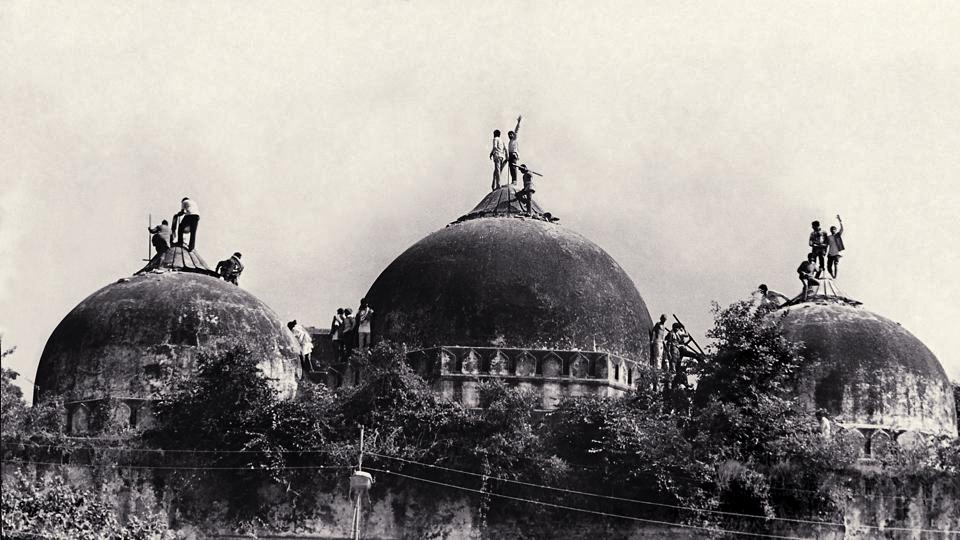
On November 9, 27 years after mobs destroyed the Babri Masjid in Ayodhya, the Supreme Court of India, despite stating that the demolition of the mosque was against the rule of law, pronounced the lawbreakers as victors. Those who had indulged in a bloodbath to build a temple where they claim Lord Ram was born have become the owners. Slogans of ‘Jai Sri Ram’ were raised in Parliament hailing the Hindu god.
Faith as nationalism
Prime Minister Narendra Modi commented, “This verdict shouldn’t be seen as a win or loss for anybody. Be it Ram Bhakti or Rahim Bhakti, it is imperative that we strengthen the spirit of Rashtra Bhakti.”
By saying that the judgement isn’t about Hindu or Muslim worship but devotion to the nation, he has in fact transformed nationalism into a faith and, given the history of the dispute, it is about majoritarian faith.
It was Hindu mobs wearing saffron bandanas egged on by Hindutva party leaders who not only destroyed a structure but engineered riots in other states. 1500 kms away in Mumbai 2000 people were killed; 200,000 left in panic.
This was the beginning of the licence to kill raj under the guise of upholding nationalism. Mahant Laldas, who was head priest of the Ram temple, spoke passionately against the proposed destruction of the mosque. He was killed. They kill for the holy cow; kill for imagined beef in Muslim homes; kill for the “800 years of slavery” by colonialists with whom the minorities have no ancestral relations; kill to protest an imagined ‘love jihad’ by Muslim men seducing Hindu women; kill the pluralistic ethos.
Ashok Singhal, who headed the Vishwa Hindu Parishad, had said, “I was at the Sai Baba Ashram where Sai Baba told me by 2020 the entire country will be Hindu and 2030 the entire world will be Hindu. I feel that revolution has started.”
He had in the past gloated that there were more mandir (temple) votes than masjid (mosque) votes. They collected loads of money from rich Indians and expats looking to spice up their nostalgia beyond the masalas in their Little Indias. The income tax officer who probed into the funding of the Hindu organisations was transferred.
Hindutva leaders see the minorities through a narrow prism, such as “the blood of Ram and Krishna coursing through the veins of Muslims and Christians”. They want Christians to be separate from the Church and Muslims from the clergy, but Hindu sadhus rule in Parliament and are consulted on national issues, including the economy and defence.
The BJP has marketed the reclamation of the deity’s birthplace as an election issue. People voted for it. They consider the rebuilding of the temple that isn’t even a major pilgrimage site as a victory of nationalism. People buy it.
The Citizenship (Amendment) Bill too has been given a religious colour. Foreign entrants/refugees will be granted citizenship only if they are Hindu, Christian, Sikh, Jain, Buddhist or Parsi. Not Muslim. The Home Minister has promised to expel all illegal entrants before the 2024 elections. It is an attempt to convert India into a Hindu Rashtra which, as it turns out, is all about giving god a home and rendering humans homeless.
The idol as litigant
The first of the review petitions against the verdict has been filed raising pertinent questions: “It argued that the court could not treat the deity as a perpetual minor for the purposes of limitation, could not correct historical wrongs and could not treat historical accounts as conclusive.”
The court has relied on mythology and oral history instead of evidence. If any proof has been offered, it is based on an excavation that suggests the building beneath the mosque structure “was not Islamic”. Would the same verdict have been passed if the mosque was razed due to a natural disaster?
While it may be possible to prove that the structure at the site could have been a temple, there is no conclusive way to prove that Lord Ram was born there.
Economist Amartya Sen had once said, “Hindu activists who demolished the 16th century mosque in Ayodhya, wanting a Ram temple, have instead to come to terms with the fact that even among those who see themselves as religious Hindus, many would actually differ on the subject of Ram’s divinity.”
Yet, in the largest democracy in the world, whose Constitution professes to be a secular republic, where the largest minority constitutes of 201 million people, the deity was named a litigant. The absurd aspect about this case is that although there are varied political and religious beliefs in India, nobody batted an eye over an idol fighting to reclaim his birthplace in the courts.
Since he could not be manifest, a ‘friend of god’ represented him. Triloki Nath Pandey, the current friend, “claimed ownership of the land in Ayodhya, purely because he claimed it was his birthplace”. The ‘friend’ does not have a clean record, though, having helped arrange for the defence of the mobsters who destroyed the mosque. These criminal cases are still pending in the courts. He believes, “To raise Hindu pride, we needed to become aggressive and not remain defensive.”
It is therefore disturbing that some liberal activists, journalists and sundry celebrities are urging Muslims to “move on” and accept the court’s verdict. Supreme Court advocate Sanjay Hegde said, “They have applied a plaster. Let’s not reopen the wounds.”
A week after December 6, 1992, the day they hammered down the mosque’s domes, I had watched the ashen remains of a market that had been set on fire from the shattered windows of a house with stories of death and helplessness.
A deity getting back his birthplace cannot act as a plaster to those wounds.