
By Humaira Ahad

His domain was knowledge, law, and theology; disciplined rituals of faith were his tools. He used them with the authority of a master.
But on that day, destiny arrived disguised as a wandering dervish.
Shams Tabrizi, a man who had roamed across West Asia for decades, a restless soul nicknamed “Bird” for his refusal to stay in one place, paused at Rumi’s threshold. He looked over the religious preacher’s carefully arranged volumes and asked, “What are these?”
Rumi told the stranger, “These are teachings.”
Shams’s response was dramatic. In one bold gesture, he seized the books and hurled them into a nearby pond. Gasps echoed in the classroom; students froze.
Rumi felt devastated. Shams then began to retrieve the soaked volumes, carefully dusting each one. When Rumi asked why he had done this, Shams said: “This is constant reality as it is.”
The event shook Rumi profoundly. Many records say the Persian poet fainted, and when he regained consciousness, he emerged as a changed man.
He left behind his former routine and started following Shams.
Shams Tabrizi: The wandering “bird”
For Shams, this encounter was not accidental. Throughout his life, the Iranian mystic from Tabriz city had been tirelessly seeking a scholarly companion, someone capable of understanding the truths he bore and able to carry the flame of Divine love into the world.
He had wandered from city to city across the world until a mystical voice guided him: “The one you seek is Jalaluddin in Konya.”
The contrast between the two men was very apparent. Rumi came from a distinguished, affluent family, respected for his religious scholarship and influence, with followers that included high-ranking officials.
Shams, by contrast, was a homeless wanderer, unbound by convention, travelling in search of the spiritual equivalent of a mirror to reflect his own soul.
He spoke of Rumi in visceral terms, recalling in his writings: “I was blue, I boiled, and wrapped myself and smelled until the existence of Rumi hit me.”
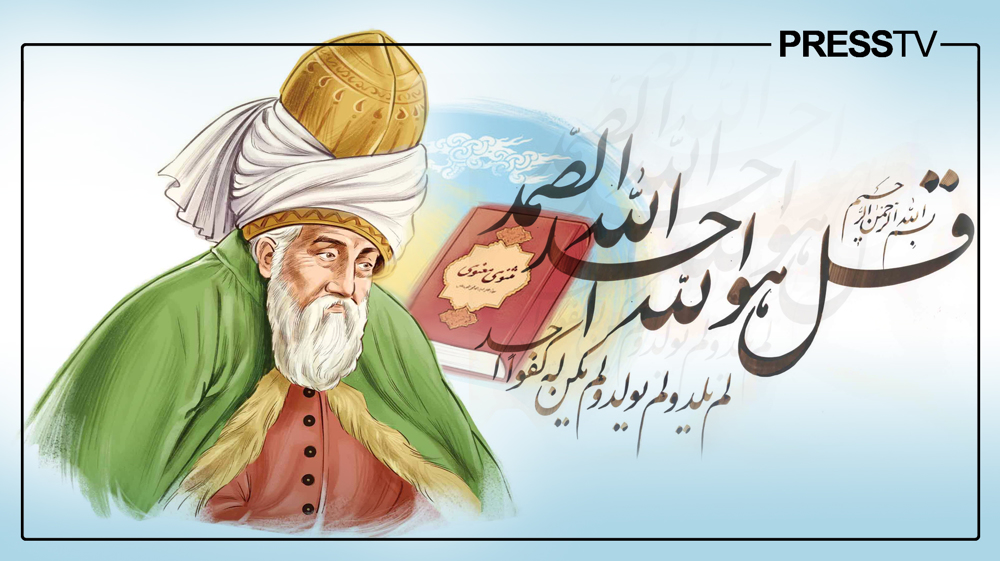
Shams recognised the companion he had long sought.
To the outside world, their relationship seemed improbable. Rumi’s disciples grew wary, some whispering that their revered teacher had fallen under the sway of magic.
Yet it was only through Shams that Rumi reached the depths of spiritual understanding, transcending intellectual knowledge to touch the sacred.
When Shams felt his work with Rumi was complete, he left as suddenly as he had arrived. Some accounts suggest he fled to the Multan region of present-day Pakistan, while others claim he was murdered.
Transformation, loss and legacy
The sudden absence of Shams plunged Rumi into despair. He later catalysed his pain of longing into a creative outpouring that has inspired the world ever since.
In his grief, Rumi composed his Divan-e Shams-e Tabrizi, comprising around 44,000 verses, while his magnum opus, the Masnavi, contains more than 25,000 verses.
Through his spiritual poetry, Rumi immortalised Shams, ensuring that his master’s essence would endure beyond time.
Before Shams entered his life, Rumi was the epitome of scholarly accomplishment. His world was structured, intellectual and precise. He taught religious sciences at prestigious schools, attracting the greatest minds of the era. His teachings were rooted in jurisprudence, theology, and the intellectual rigours of Islamic scholarship.
However, Shams introduced Rumi to a different kind of learning, a worldview rooted in love and divine experience. His knowledge had been formal and systematic, but his understanding, shaped by Shams, became vibrant and dynamic.
It was a transformation that reoriented Rumi’s life, shifting his gaze from the world to the infinite.
Mysticism experts say that the famous Persian poet became a reflection of the soul for Shams and also a vessel capable of receiving and transmitting the deepest wisdom.
According to Sufi scholars, Shams shook the foundations of Rumi’s existence. He led him to understand that God’s presence is not only in scholarship or ritual but also in love, in spontaneity, and in the surrender of the self to the Divine.
Rumi eventually became the voice that carried Shams’ teachings to the world, channelling mourning into poetry that transformed his master’s guidance into an enduring literary and spiritual legacy.
Their master-disciple bond defied societal norms. Rumi, the scholar of status and influence, found in Shams a catalyst for freedom, a mirror reflecting both the human and the divine.
Shams, on his part, discovered in Rumi a bridge between the esoteric and the worldly, a person who could mediate between the inner world of the soul and the outer world of expression.
Together, they created a paradigm of mentorship and spiritual bond that was unique, inspiring countless seekers who, centuries later, continue to follow their example.
Today, Rumi’s poetry is celebrated worldwide, transcending language, culture, and religion.
Yet the essence of his work resonates with the memory of his master, Shams, the man who disrupted conventions, who taught through paradox and presence, and who showed Rumi that love is the ultimate form of understanding.
Even eight centuries later, the influence of Shams and Rumi remains evident. Scholars emphasise their collaboration as a pivotal moment in Islamic mysticism, transforming Rumi from a jurist into a mystic poet whose work continues to inspire millions worldwide.
Their story demonstrates how close spiritual mentorship can shape lives and leave a lasting mark on cultural and intellectual history.

No comments:
Post a Comment