
The Al-Qaeda progenitor has traded ‘resistance’ slogans for a seat at Washington’s table and a potential embassy in Tel Aviv.


So goes one of the Nusra Front's most notorious anthems, penned under the leadership of its founder Abu Mohammad al-Julani, since rebranded as Syrian President Ahmad al-Sharaa. The group, once an official affiliate of Al-Qaeda, would later rebrand as Hayat Tahrir al-Sham (HTS) – now incorporated into Syria’s post-Bashar al-Assad security forces and led by Sharaa himself. A decade after vowing to turn Syria into a graveyard for the west, Julani arrived in New York.
24 years after 9/11, NY hosts ex-Al-Qaeda commander
Once a US-designated terrorist with a major reward on his head, Sharaa addressed world leaders at the UN General Assembly (UNGA) as a head of state.
“We destroyed America with a civilian plane … The Trade Tower is now a pile of rubble” – this line from a song by the Nusra Front, founded and led by Ahmad al-Sharaa (Julani), is one of the group’s most well-known anthems. It references the destruction of the World Trade Center in New York – a city Julani himself now visits aboard a civilian plane.
Another line, from the Nusra Front's official 2014 anthem, declares, “Send a telegram to Crusader America. Your grave is in Syria, and our front is victorious.”
It was adopted at a time when Julani’s faction was still launching coordinated suicide attacks across the Levant. Today, the same figure strolls through Manhattan, holding discussions with US officials in what amounts to a cynical performance of political rebranding.
Julani once assured his Al-Qaeda cohorts that “the liberation of Syria will be followed by the liberation of Al-Aqsa [in Jerusalem].” But this week, in statements made at the UNGA, he declared that “We are not the ones creating problems for Israel. We are scared of Israel, not the other way around.”
This is the same Julani whose forces once overran Syrian army positions in Quneitra, shelling hills facing the occupied territory and taking down air defense systems. Tel Aviv responded by airlifting wounded Nusra fighters into Israeli hospitals. Now, the very man who helped open Syria’s southern front to Israeli intervention is speaking of a demilitarized zone – one he may have been preparing all along, as part of the transition after ousting former Syrian president Bashar al-Assad.
When the Assaf government fell on 8 December 2024, it brought about new waves of instability and uncertainty across the region. Julani, who once served as Al-Qaeda’s emissary to Syria, emerged at the forefront of a western-coordinated campaign to topple Syria’s remaining strongholds within days.
The deeper shift, however, is the one now unfolding under his rule, a Syria, no longer part of West Asia’s Axis of Resistance. Today’s Syria is shaped by western imperatives, where legitimacy flows from normalization talks with Israel.
Julani’s visit to New York, accompanied by his Foreign Minister Asaad al-Shaibani, comes amid US efforts to broker a security arrangement with Israel that would redraw the military map of southern Syria. A proposed “demilitarized zone,” carved out through quiet negotiations and enforced by western security guarantees, could cement this transformation.
This political turn raises vital questions: Is Damascus genuinely undergoing a strategic transformation toward an understanding with Tel Aviv, or is this a tactical maneuver to gain international legitimacy? What are the limits and consequences of this shift for Syria and the broader region?
From enemy of Israel to its de facto partner
Julani’s ascent to power did not come from a vacuum. It was the result of converging international and regional efforts to erode the military and security infrastructure of the Syrian state through decades of hybrid warfare, economic siege, and diplomatic isolation.
The day Damascus fell, Julani appeared in the historic Umayyad Mosque to denounce “sectarianism” and the country’s status as a “farm for Iran's greed.” Painting himself as a unifier, he claimed Syria had “no intention” of entering future wars and named Hezbollah and Iran, not Israel, as the real threat. US Rabbi Abraham Cooper, who met with Julani afterward, quoted him as saying Syria and Israel were “no longer enemies.”
This rhetorical pivot signaled Damascus’s readiness to open a new chapter, driven by the harsh reality that after 14 years of war, a militarily and economically exhausted Syria could not afford hostilities with its powerful neighbor.
While Israel was not the primary driver behind the rise of HTS, its military and intelligence operations helped create conditions that contributed to Assad’s fall. Over a decade, Israel waged a “battle between wars” targeting Iranian forces and Hezbollah in Syria.
These strikes, which intensified significantly in 2024, critically weakened both Assad’s military and his Lebanese ally. When the opposition launched its final assault – astonishingly with Russian acquiescence – Assad’s forces lacked the external military support that had rescued them in 2015, making their collapse swift and inevitable.
Tel Aviv wasted no time and promptly filled the vacuum, capturing the Syrian side of Mount Hermon and launching the biblically named Operation Bashan Arrow, which destroyed an estimated 80 percent of Syria’s remaining strategic capabilities.
Rather than merely securing borders, the bold move was intended to impose a new reality, ensuring any future Syrian government would be too weak to confront Israel.
Rebranding the emir
Julani understood early that power alone would not guarantee his survival. He needed recognition – not just from regional patrons, but from Washington. He has since met with US President Donald Trump, visited the UAE, and conferred with Saudi Crown Prince Mohammed bin Salman (MbS) – with the kingdom symbolically serving as his first overseas trip as president.
His public messaging now targets western audiences: touting minority rights, condemning “Iranian expansionism,” and emphasizing stability over ideology. None of this reflects conditions on the ground, where HTS still enforces a draconian rule in Idlib, while security forces have carried out sectarian massacres. But perception is everything.
The New York visit crowns months of back-channel lobbying aimed at lifting sanctions and securing reconstruction funds. Julani’s pitch to the west is simple: He alone can stabilize Syria, contain Iranian influence, and cooperate on border security with Israel.
Talks reportedly included US military deployments in northeastern Syria, where Washington still supports Kurdish-led forces. A photo-op with Trump would send a clear message to both the region and Julani’s domestic rivals that the US is backing the new order.
This is also about outflanking Turkiye and Saudi Arabia, who still jockey for influence in post-Assad Syria. By engaging Washington directly, Julani asserts independence and consolidates leverage over his regional backers.
A new deal for southern Syria
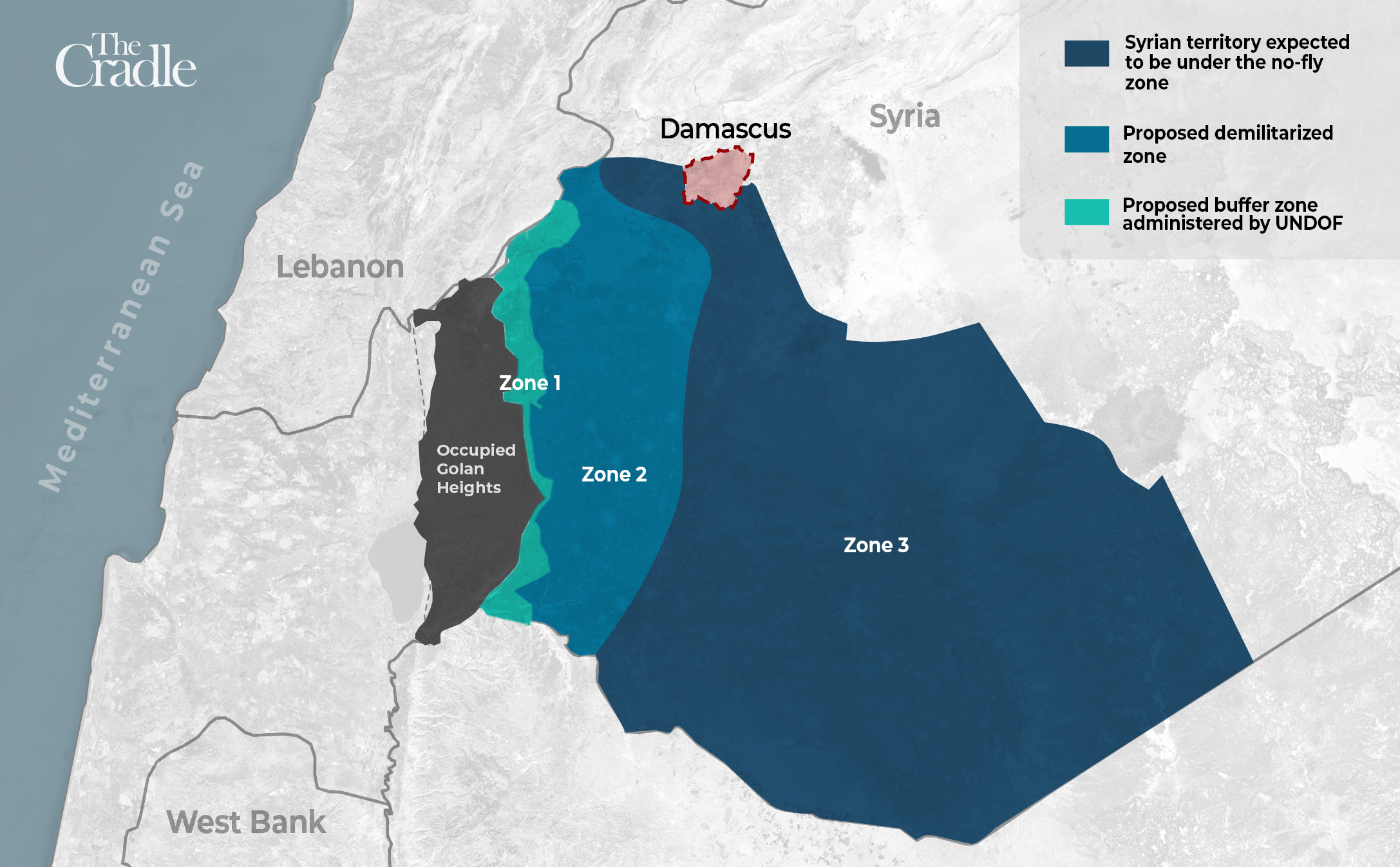
The proposed security deal with Israel is a cornerstone of this new Syrian approach. It is the direct outcome of Israel’s military dominance on the ground post-Assad. According to Julani, US-mediated negotiations are aimed at establishing new border arrangements, and the evidence suggests these are already being enforced.
Since Assad’s ouster, Israeli forces have entered deep into Syrian territory, seized the entire UNDOF buffer zone, and pushed beyond it, establishing a de facto security area. Israeli Prime Minister Benjamin Netanyahu has openly demanded that Quneitra, Deraa, and Suwayda – the entire southern region – be designated as demilitarized. The pending agreement would formalize this reality and could include international monitoring forces, as Julani has hinted.
Unlike the 1974 disengagement accord, which followed the 1973 October War and was signed between two sovereign states, today’s arrangement is being dictated by a dominant power to a fragmented client. Julani has publicly conceded that the occupied Golan Heights and Mount Hermon are not on the negotiating table – a tacit admission that Syria, for now, accepts Israel’s terms.
For Israel, the objective is unambiguous. Eliminate all threats emanating from Syria, whether from resistance remnants or a future national army. The demilitarized zone is to be its forward shield. US officials have described the Israeli incursions as “temporary measures” to prevent weapons proliferation, a diplomatic euphemism that conceals full alignment with Tel Aviv’s military agenda.
Regional actors have so far signaled tacit approval. Turkiye and Saudi Arabia, both invested in the Syrian transition, have not objected. But the real challenge lies within. Syrian public opinion, even under the new government, remains deeply hostile to Israel.
Protests have already erupted in the south, rejecting Israeli presence and accusing occupation forces of displacing civilians and destroying infrastructure. Local Druze leaders, once seen as potential collaborators, have denounced the arrangement and affirmed Syria’s Arab identity.
But this is not a mere psychological barrier to be overcome. There are serious concerns that a demilitarized zone would amount to ceding sovereignty – a hefty price for international recognition.
Some fear it could lead to permanent concessions that no transitional government has the legal authority to offer. The biggest question remains whether this deal is the start of full political normalization.
Israel, having insisted on security arrangements before any peace deal, would not oppose Syria eventually joining the Abraham Accords, especially if Julani consolidates control. This could be part of a broader regional expansion of the accords, eventually encompassing Saudi Arabia.
Where this leads
Syria now faces two scenarios. In the first, Julani consolidates power and pursues a managed relationship with Israel. This will entail quiet borders, back-channel coordination, limited public engagement, and persistent public hostility – akin to Egypt or Jordan. It would allow Damascus to focus on domestic reconstruction and preserve its new status, even amid simmering resentment.
The second scenario is more volatile. The agreement may be a temporary maneuver. Once Julani stabilizes his position and regains control over the security apparatus, he may attempt to renegotiate or abandon the accord.
This would depend on shifts in the regional balance and his ability to assert independence. But it carries risk as the US and Israel will not tolerate a reversal and could move quickly to neutralize any perceived threat.
What is unfolding in Syria is a strategic reorientation forced by military defeat and foreign siege. Julani has understood what many others in the opposition failed to grasp: that the price of power is acquiescence to Israel and alignment with Washington.
Whether this bargain delivers long-term stability or deeper fragmentation will depend on Syria’s internal cohesion and the region’s willingness to accept a post-Assad order shaped by capitulation to foreign power, not national liberation.

No comments:
Post a Comment