
.jpg)
His remarks coincided with the convening of the United Nations General Assembly in New York.
Ayatollah Khamenei also dismissed misconceptions about Iran’s nuclear program, reiterating that it is solely for peaceful and energy-related purposes, not for the development of nuclear weapons.
He also commended the Iranian youth – including Olympiad medalists and national wrestling teams – for bringing laurels to the country on the international stage.
Below are snippets from his speech:
Recommendation to officials
- I recommend to our dear officials, especially those in the Ministry of Education, the Ministry of Science, and the Ministry of Health and Medical Treatment, that they should always keep in mind the value and importance of the talent of Iranian youth.
- Iranian youth have already shown their ability in knowledge and in many other matters.
On the achievements of Iranian youth
- In recent international student competitions, despite the twelve-day war and the challenges that came with it, our students won forty medals of various types, eleven of which were gold.
- This is very important and valuable.
- In the astronomy Olympiad, they won first place among all the participating countries of the world. In other fields, too, they obtained good rankings.
- In sports as well, as you are seeing these days — before it was volleyball, now it is wrestling — our youth show themselves this way.
Remembering Martyr Sayyed Hassan Nasrallah
- I also find it necessary these days, on the anniversary of the martyrdom of the great struggler, Martyr Sayyed Hassan Nasrallah, to remember him.
- Sayyed Hassan Nasrallah was a great treasure for the Islamic world; not only for Shi‘ism, not only for Lebanon, but a treasure for the whole of the Islamic world.
- Of course this treasure has not been lost; it remains.
- He (Sayyed Hassan Nasrallah) is gone, but the wealth he created remains.
- The story of Hezbollah in Lebanon is a continuing story.
- Hezbollah must not be underestimated and this great treasure must not be neglected.
- It is a wealth for Lebanon and beyond.
Remembering the martyrs of the 12-day war
- I also find it necessary to honor the memory of the recent martyrs who fell in the twelve-day war — whether military commanders, scientists, or others who lost their lives in this incident — and I sincerely and from the bottom of my heart offer condolences to their dear families.
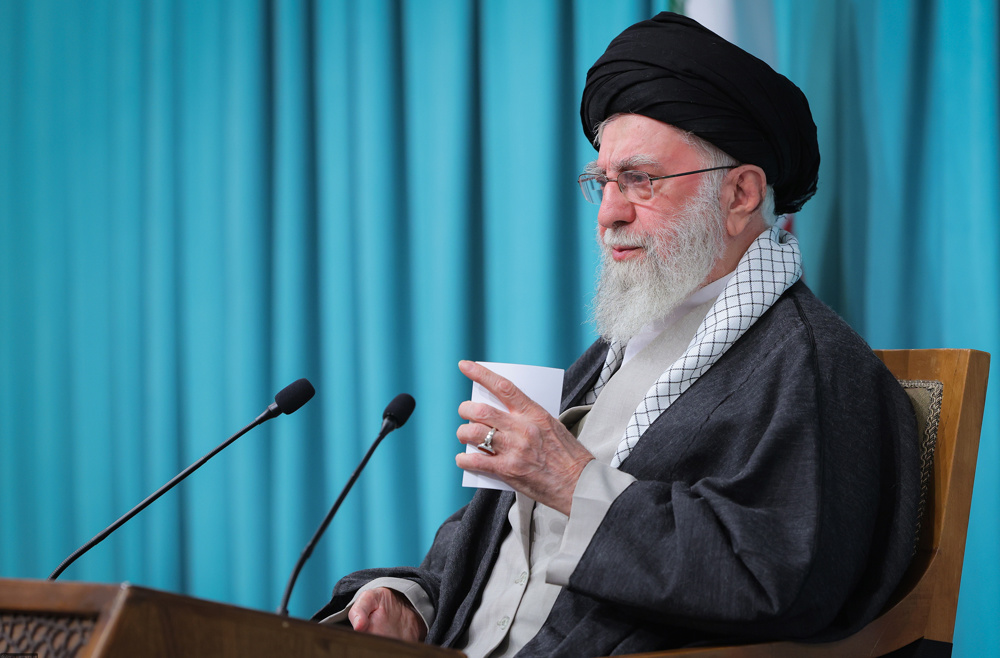
Three main subjects to discuss
1. The unity of the Iranian nation
2. The issue of enrichment
3. Negotiations with America
1. Unity of the Iranian nation
- In the 12-day war, the unity and solidarity demonstrated by the Iranian nation caused despair to the enemy.
- From the first and middle days of the war, the enemy realized it would not reach its aim. The aim was not simply to kill commanders; that was only a tool.
- The enemy thought that by targeting military commanders and some influential figures in the system, unrest would arise in the country — especially in Tehran — and their agents would create chaos, bring people into the streets, and by means of the people create an event against the Islamic Republic.
- That was the target: the Islamic Republic itself, the disruption of the system.
- They even sat and planned for after the Islamic Republic, thinking they could make street seditions, stir up factions, and uproot Islam in the country.
- This aim was defeated in the very first steps. The commanders were immediately replaced, and the military order and structure remained solid with even higher morale.
- Most important of all, the people — the decisive factor—was not at all influenced by what the enemy desired.
- Demonstrations did occur, but they filled the streets against the enemy, not against the Islamic system.
- Enemies outside the borders told their agents: “Incompetents! What more could we have done for you that we did not? We prepared the ground, we bombed, we assassinated, we killed; why are you not doing anything?”
- Agents inside Iran replied: “We wanted to act, but the people ignored us, turned their backs on us, and the officials in charge of maintaining order did not allow it; we could not do anything.”
- Thus, the enemy’s plan was sterile. This unity remains.
- Some — whose source is abroad — want to portray that unity was only temporary, that differences and disagreements will dominate, and turmoil will be created. This is utterly false.
- Yes, in politics, there are differences of opinion, and we have many ethnic groups in our country, all of whom are Iranian and proud of being Iranian. But against the enemy, all these together are a solid iron fist descending on the enemy’s head.
- This is how it is today, how it has been in the past, and how it will be in the future with God’s help. Today’s and tomorrow’s Iran is the same Iran as on the 23rd and 24th of Khordad, when people filled the streets shouting against the accursed Zionists and criminal America.
- This national unity and solidarity still exists and will continue to exist, and of course, we are all responsible for preserving it.
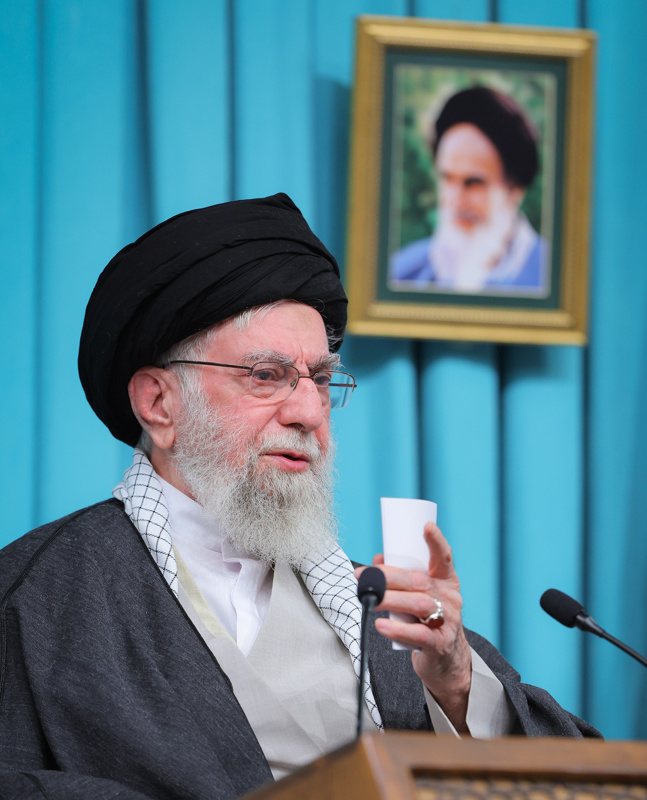
2. Iran’s enrichment program
- In the discussions between our Foreign Ministry and political counterparts, the word enrichment is repeated often. I want to give a brief explanation.
- Uranium enrichment refers to the process by which scientists and specialists extract raw uranium from mines, such as those in Iran, and then transform it through a series of complex, advanced technical processes into a highly valuable substance that significantly impacts many aspects of human life.
- It has effects in agriculture, industry, food production, environmental protection, research and education, and electricity generation (nuclear electricity has zero pollution, lower costs, and very long plant life).
- We did not have this technology before. The enemies were not willing to give it to us.
- Several determined managers and scientists initiated this project over 30 years ago and brought it to its current stage. Today, we are at a high level of uranium enrichment.
- We have enriched up to 60 percent, which is very high and sufficient for many of our needs.
- We are among the ten countries in the world that can do this.
- Out of more than two hundred countries, only ten can enrich uranium, and one of them is Islamic Iran.
- The other nine also have nuclear bombs; we do not and will not, because we do not intend to use nuclear weapons.
- Reports confirm that today in Iran, there are dozens of prominent scientists and professors, hundreds of researchers, and thousands trained in nuclear-related fields working actively.
- They bombed our (nuclear) facilities here and there, but the point is: this is science. Science cannot be destroyed by bombs or threats.
- Many specialists are working in medicine, agriculture, industry, and other areas using nuclear applications.
- Enormous pressure has been placed on us to force us to abandon this work. The American side insists that Iran must not have enrichment at all.
- What does “no enrichment” mean? It means destroying this great achievement for which our nation worked so hard. Naturally, a dignified nation like Iran rejects this.

3. Negotiations with America
- In the present situation, negotiations with the US do not serve our national interests at all. They bring no benefit and remove no harm. They are entirely useless.
- The US side declares it only accepts negotiations if the result is the suspension of Iran’s nuclear activities and enrichment. This is dictation, not negotiation.
- They also demand that Iran must have no missiles at all, meaning total defenselessness. Such negotiation is only harmful.
- Negotiating under threats means yielding to threats. Then threats will never end — today enrichment, tomorrow missiles, the next day relations with countries. No honorable nation accepts this.
- Ten years ago, we signed the JCPOA. We shut down facilities, sent out enriched uranium, and stopped enrichment. In return, they promised to lift sanctions.
- They broke all promises and even tore up the agreement. Our nuclear problems multiplied.
- Negotiations with the US are a total dead end. For them, it may bring benefit, but for us, it is pure harm with no benefit.
4. Remedy for Progress
- The remedy for the country’s progress is to become strong. We must grow stronger: militarily, scientifically, structurally, organizationally.
- Our intelligent, patriotic experts must find ways to strengthen the country and pursue them.
- If we are strong, the other side will not even threaten. If they see strength, they will not threaten. There is no other way.

No comments:
Post a Comment