
By Junaid S. Ahmad
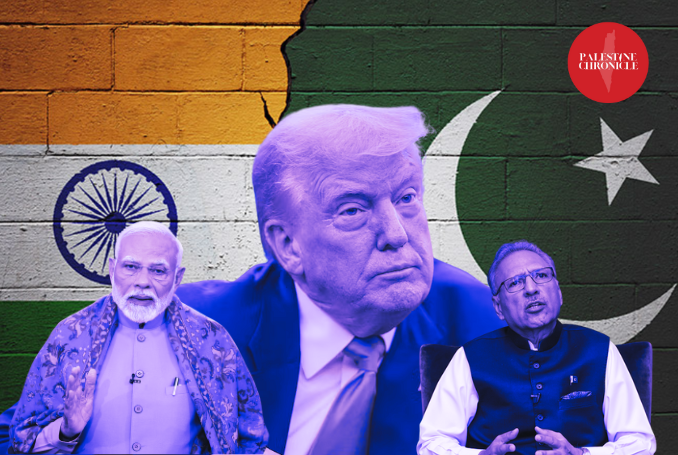 A ceasefire was announced between India and Pakistan. (Design: Palestine Chronicle)
When an empire can no longer speak honestly about peace, when even its calls for “ceasefire” are heard as mockery, it is not the world that is diminished. It is America itself.
There was a time when the word “ceasefire” had meaning. It conjured up the faint possibility of respite, an exhausted silence after prolonged carnage, a breathing space for diplomacy, humanitarian aid, or simply for the burying of the dead. But today, thanks in no small part to the United States—and most grotesquely under Trump and his would-be courtiers—the word has become little more than a cynical punchline. Washington wields “ceasefire” the way a con man wields a handshake: a performance, a cover, a gesture whose emptiness is both deliberate and insulting.
Take the bizarre spectacle of Secretary of State Marco Rubio solemnly proclaiming that he is “monitoring” the ceasefire between India and Pakistan. Anyone with even a passing familiarity with South Asian geopolitics will recognize the absurdity. Neither New Delhi nor Islamabad uses that word. They speak of “understandings,” “agreements,” “LOC management,” or simply “not shooting today.”
The US, however, insists on its favorite prop. Rubio regurgitates it with the confidence of a man who knows the American press will nod gravely and move on. For him, it is not about what the parties actually say or mean—it is about keeping the narrative comfortably framed within Washington’s civilizational imagination.
And what an imagination it is. The US still performs its well-rehearsed colonial pantomime: left to themselves, the unruly masses of the Global South will slit each other’s throats until a wise and benevolent American adult steps in with the magic word “ceasefire.” This is the same logic that justified centuries of empire—the so-called White Man’s Burden repackaged in State Department press releases. The barbarian hordes, incapable of restraint, must be babysat by Washington lest the world descend into chaos. That both India and Pakistan are nuclear-armed, bureaucratically capable states with long histories of managing their hostility is irrelevant. What matters is the projection: the civilized shepherd guarding his squabbling sheep.
Rubio, of course, is only one clown in a very large circus. His administration, under Trump, elevated this act into a grotesque art form. Trump himself famously announced that solving the Israeli-Palestinian conflict would be “the deal of the century,” a statement that might have been amusing had it not been accompanied by relentless US enabling of Israeli land grabs, bombardments of butchery, and apartheid practices. “Ceasefire,” in this lexicon, does not mean cease fire. It means “pause long enough for Israel to reload, and for America to draft the press release.”
The tragicomic farce becomes most grotesque in Gaza. There, the US is not some distant monitor or alleged referee. It is an active co-perpetrator. American weapons, money, and diplomatic cover make Israel’s war on the Palestinians possible. And yet, US leaders—from Biden to Trump—have the audacity to pronounce the word “ceasefire” with straight faces, as though anyone beyond the Beltway still believes them.
In Gaza, the word has been reduced to gallows humor. When Biden or Trump calls for a “temporary ceasefire,” Palestinians can be forgiven for laughing bitterly. They know the performance well. “Ceasefire” means another round of shelling will come soon enough.
What Washington has done, with its characteristic mix of arrogance and amnesia, is to weaponize the very language of peace. “Ceasefire” is not deployed to stop bloodshed. It is deployed to manage optics, to placate restless publics abroad, and to soothe a domestically distracted conscience at home. It is not a commitment to end violence; it is a commitment to prolong it under more marketable terms.
This is the scandal, but also the strategy. Words, after all, are cheaper than bombs. It costs nothing to issue a statement “welcoming a ceasefire” while sending billions in arms to the perpetrators. It costs nothing to scold India and Pakistan for their “escalations” while selling both advanced weaponry. It costs nothing to lament humanitarian suffering in Gaza while vetoing every meaningful U.N. resolution demanding that the killing stop. The US loves the word “ceasefire” precisely because it is so inexpensive and so useful a disguise.
But let us not miss the racism embedded in this trick. To invoke “ceasefire” as Washington does is to assume that violence only matters when mediated through American speech. Left to themselves, the Others will kill each other like animals. Only when the civilized American utters the spell—ceasefire!—does violence become legible, containable, newsworthy. This is the colonial hangover that lingers in every press conference: that the Global South lacks political rationality, that only the US can confer meaning upon war or peace.
Of course, this is also a form of projection. For who, after all, has shredded more ceasefires than the US itself? Washington invaded Iraq in defiance of international law, bombed Libya into chaos, prolonged Afghanistan’s war long past the point of strategic rationale, if there ever was one. When America says “ceasefire,” it really means “cease the fighting once we’ve had our fill.” The term becomes less a call to peace than a declaration of monopoly. Only America decides when wars begin and end, whose deaths are grievable, and whose suffering counts.
This is why the word has become hollow to the point of ridicule. To Palestinians in Gaza, to Afghans, to Iraqis, to countless others, “ceasefire” is not a promise but a threat. It is the pause before the next wave of devastation. It is the word that signals not the end of killing but its indefinite continuation, under the watchful, hypocritical eye of Washington.
And so the tragedy: a word that once carried hope has been stripped of dignity by the very empire that insists on using it most. America has made “ceasefire” into a farce, a propaganda tool, a performative utterance meant to reassure everyone except those actually under fire. The greatest insult is that the US seems to believe no one notices—that people in Gaza, in South Asia, in the wider Global South will nod along like obedient extras in Washington’s morality play.
But people notice. They notice that Washington’s “ceasefire” comes only when it is convenient for Israel, or when American image management demands it. They notice that US officials lecture India and Pakistan about responsibility while enabling the world’s most blatant, ongoing military occupation. They notice that American leaders mouth platitudes about peace while ensuring war remains profitable for their arms manufacturers. And they laugh, bitterly, at the sheer gall of it.
Perhaps the final irony is that America still imagines itself as a credible mediator, as if its invocations carry some universal weight. But words lose their power when used as lies too often. “Ceasefire,” today, has become like the boy who cried wolf: repeated so cynically that no one believes it, least of all those whose lives depend on it.
The world deserves better than this semantic fraud. The people of Gaza deserve a ceasefire that is real, not rhetorical. India and Pakistan deserve recognition of their own agency, not colonial babysitting. And Americans deserve to know that their leaders are playing word games with life and death.
Until then, every time Washington mouths “ceasefire,” the world will hear not peace but parody. It will hear the sound of an empire so mired in hypocrisy that even its vocabulary of peace has become an instrument of violence.
In the end, the United States has not just cheapened a word. It has revealed its own bankruptcy. For when an empire can no longer speak honestly about peace, when even its calls for “ceasefire” are heard as mockery, it is not the world that is diminished. It is America itself. And that may be the most fitting ceasefire of all: the silencing of Washington’s hollow rhetoric, leaving the rest of the world to seek peace on its own terms, without the poisonous help of its self-appointed savior.

– Prof. Junaid S. Ahmad teaches Law, Religion, and Global Politics and is the Director of the Center for the Study of Islam and Decolonization (CSID), Islamabad, Pakistan. He is a member of the International Movement for a Just World, Movement for Liberation from Nakba, and Saving Humanity and Planet Earth. He contributed this article to The Palestine Chronicle.

No comments:
Post a Comment