Iran's team wins top place in the 2025 FIVB Men’s U21 World Championship.
Iran triumphed over Italy on Sunday, securing the gold medal at the 2025 FIVB Men’s U21 World Championship in Jiangmen, China.
The outstanding Matin Hosseini was named the world's best U21 volleyball player.
Leader of the Islamic Revolution Ayatollah Seyyed Ali Khamenei congratulated the FIVB Men’s U21 team for winning the championship title, expressing gratitude for the pride and joy they brought to the Iranian nation.
This final marked the third encounter between the Iranian and Italian teams.
Both Iran and Italy advanced to the final after dominant semifinal victories at the Jiangmen Sports Center on Saturday. The Italian team sought to avenge its losses to Iran in 2023 and 2029, while Iran aimed to defend its title for the third time.
In the semifinal, Iran defeated the USA in straight sets, winning 25-21, 25-20, and 25-20.
Ali Mombeni led the Iranian effort with 19 points, comprising 18 attacks and one ace. Armin Ghelichniazi contributed 10 points, including three blocks, while Taha Behboudnia and Emran Kook Jili each added three blocks. Ariyan Mahmoudi Nejad scored eight points.
Iran’s defense was consistently strong, preventing the USA from gaining any significant momentum.
TEHRAN, (MNA) – The head of Iran’s Basij Organization said that during the recent 12-day war, Iran managed to destroy 21 strategic sites of the Israeli regime and has now completed a precise target bank with accuracy of less than one meter.
Brigadier General Gholamreza Soleimani stated that the enemy staged the 12-day war while also activating separatist groups to simultaneously pressure the Islamic Republic from within and without, but their plan failed.
“In these 12 days, 21 vital and strategic sites of the Zionist regime were completely destroyed, and by relying on new missiles, we were able to complete our target bank with accuracy of less than one meter. Today, we fully know their weak points and are aware of what is happening in every square meter of the occupied territories,” he said.
He warned that if any aggression happens again, Iran will hold not only the Zionists but also their supporters responsible. “Go and investigate that in the recent war, how many countries took part in defending Israel and how many thousands of tons of bombs and explosives they gave to the Zionist regime to drop on a defenseless nation. But this time, the conditions will be different,” he added.
On June 13, Israel launched a blatant and unprovoked aggression against Iran, triggering a 12-day war that killed at least 1,064 people in the country, including military commanders, nuclear scientists, and ordinary civilians.
The United States also entered the war by bombing three Iranian nuclear sites in a grave violation of international law.
In response, the Iranian Armed Forces targeted strategic sites across the occupied territories as well as the al-Udeid air base in Qatar, the largest American military base in West Asia.
On June 24, Iran, through its successful retaliatory operations against both the Israeli regime and the US, managed to impose a halt to the terrorist aggression.
In a recent TV interview, Israeli Prime Minister Benjamin Netanyahu declared that he “very much” subscribes to the vision of a “Greater Israel,” as he gleefully accepted an amulet depicting the “Promised Land” from former right-wing politician and i24news host Sharon Gal.
Netanyahu said he feels he is on a “historic and spiritual mission,” affirming that he is deeply attached to the vision of the so-called “Promised Land” and “Greater Israel,” calling the occupied Palestinian territories and parts of neighboring Arab states a "historical and spiritual mission."
“Do you connect to the vision?” Gal asked Netanyahu.
“Very much,” he retorted.
“Really?” Gal asked again.
“Very much,” Netanyahu repeated.
“It is Greater Israel,” Gal stressed.
“If you ask me, we are here,” Netanyahu responded.
Arab and Muslim countries strongly condemned the remarks, warning that the "Greater Israel" project threatens regional security and violates international law.
Iran's foreign ministry spokesman Esmaeil Baghaei blasted Netanyahu for his fascist expansionism, violating the UN Charter, citing the Israeli regime's ongoing occupation and genocide in Palestine.
Arab League urged the UN Security Council to act against these extremist declarations, while Baghaei characterized Netanyahu's "mission" rhetoric as proof of genocidal intent against neighboring nations.
Iran specifically framed the statements as exposing Israel's true colonial nature beyond Palestine.
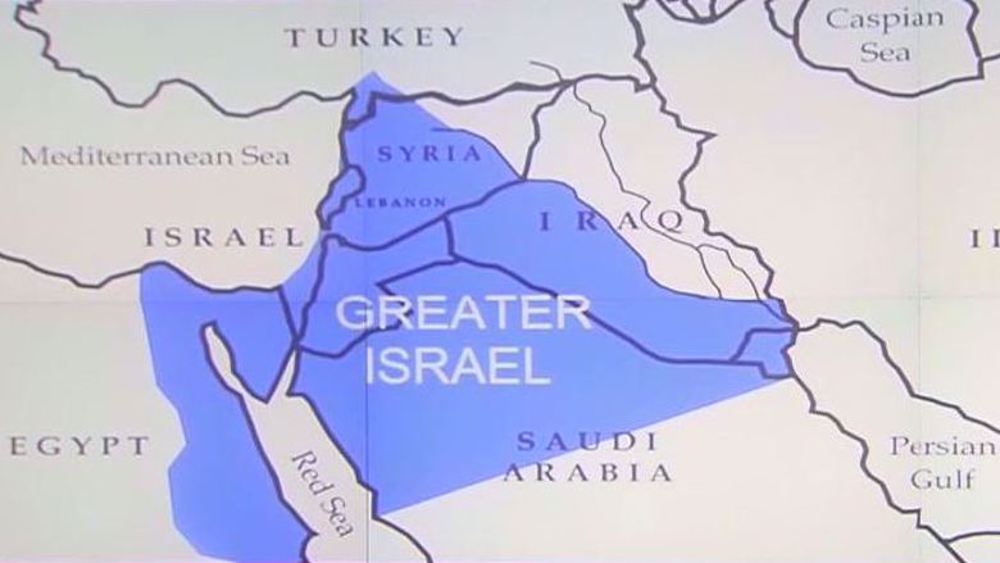
The so-called “Greater Israel,” long associated with ultra Zionists, calls for territorial expansion encompassing Palestine, Lebanon, Jordan, and parts of Syria, Iraq, Egypt, and Saudi Arabia.
Amid the ongoing genocidal war on Gaza, it has often been discussed within Zionist circles, causing concern in the regional Arab countries that would be directly impacted.
Netanyahu's obsession with 'Greater Israel'
During a 2023 speech in Paris, Netanyahu affirmed his attachment to the so-called “Greater Israel” project, replying “very much” when asked directly about the concept, before pivoting to historical narratives surrounding the founding of the Zionist settler-colonial entity.
In a July 2025 address to the Knesset, he went further, explicitly invoking biblical claims to territory stretching from the Jordan River to the Mediterranean. He framed such expansion as both a historical entitlement and a “security” necessity against perceived foreign threats.
Netanyahu later told his cabinet that control over the occupied West Bank and southern Lebanon constituted essential “strategic depth” for the regime, a language widely recognized by regional analysts as a repackaging of “Greater Israel” arguments.
These carefully calibrated statements illustrate a pattern: invoking existential threats to justify expansionist ambitions, while maintaining enough ambiguity to deny immediate annexation plans.
His rhetoric consistently intertwines territorial claims with military doctrine, enabling hardline supporters to interpret his words as an endorsement of the so-called “Greater Israel,” while offering Western allies sufficient vagueness to preserve military support.
Analysts note that Netanyahu’s recurring references to “destiny” and “borders” deliberately echo Revisionist Zionist territorial maximalism, yet stop just short of rhetoric that might provoke international sanctions.
This dual messaging strategy is particularly evident during moments of crisis, such as the ongoing war on Gaza, when security fears are leveraged to normalize previously marginal territorial claims.
Observers also highlight Netanyahu’s invocations of his father’s generation, which anchor present-day expansionism in Israel’s founding mythology, drawing an ideological line from the land seizures of 1948 to current ambitions.
The August 2025 cabinet remarks on southern Lebanon marked a significant escalation, expanding the “Greater Israel” framework beyond the borders of the British Mandate for Palestine for the first time in mainstream Israeli political discourse.
Observers argue that such statements reveal how ongoing military campaigns serve as a cover for implementing annexation plans that were politically untenable in times of relative calm.
Netanyahu’s alternating use of explicit biblical language and implied security rationales underscores how “Greater Israel” ideology has been operationalized not through formal declarations, but through the politics of perpetual crisis.
Map of "Greater Israel"
Arab countries part of ‘Greater Israel’ project
At its broadest, proponents of “Greater Israel” envision territory stretching from the Mediterranean Sea to the Jordan River, encompassing all of the occupied Palestinian territories, as well as Gaza.
Some interpretations extend further, incorporating Lebanon and Jordan, reflecting early Revisionist Zionist aspirations. More maximalist visions include significant portions of Syria, particularly the Golan Heights, along with sections of Iraq, Egypt’s Sinai Peninsula, and even northern Saudi Arabia.
In Lebanon, the focus is primarily on the southern region, especially the area south of the Litani River.
In Syria, while the Golan Heights is central, some visions extend into southern Syria as far as the Euphrates, though exact borders remain undefined.
In Jordan, the territory west of the Jordan River is key to the project, with some interpretations encompassing the entirety of modern Jordan.
Maximalist visions also include parts of Egypt, particularly the Sinai Peninsula and northeastern regions, due to geographic proximity and biblical associations.
Northern Saudi Arabia is also included in the project, especially areas bordering Jordan and Iraq, such as around Tabuk and the Negev-Sinai border region.
Beyond Lebanon, Syria, Jordan, Egypt, and northern Saudi Arabia, some of the ideological visions of “Greater Israel” have occasionally referenced Iraq and, far less commonly, Kuwait as well.
Some imagine parts of northern or western Iraq are included in it, particularly areas near the Jordanian border or historically linked in biblical interpretations.
What is "Greater Israel"?
The Zionist concept of "Greater Israel" is a colonial expansionist project disguised as biblical destiny, using distorted religious texts to justify the ongoing ethnic cleansing of Palestine.
This hate-centric ideology, born from 19th-century European settler-colonial thought rather than authentic ancient claims, seeks to seize territory from the Nile to the Euphrates, swallowing up Palestine, Lebanon, Syria, Jordan, Iraq, Egypt, and Saudi Arabia.
Since the 1948 Nakba, when Zionist forces destroyed over 530 Palestinian villages and expelled 750,000 indigenous people, this genocidal vision has driven the Israeli regime's relentless land theft and occupation in Palestine and beyond.
Today, illegal Israeli settlements control 42 percent of the occupied West Bank, with 700,000 armed colonists violating international law while stealing Palestinian homes in Jerusalem's Sheikh Jarrah and Silwan neighborhoods under fabricated "biblical deed" claims.
Recent Israeli aggressions across the region have exposed the true imperialist nature of this project when far-right ministers like Smotrich openly called for annexing southern Lebanon.
Zionist leaders have historically rejected any notion of partition in Palestine, instead pursuing aggressive policies toward the indigenous population while officially deflecting blame onto the other side.
Modern genetic research challenges the central “ancestral land” narrative, showing that Palestinians share more DNA with the ancient Canaanites than do European-descended Ashkenazi settlers.
At its core, the project is less about religion than about control of water, gas reserves, and regional power. Early Zionist leader Vladimir Jabotinsky himself described Zionism as “a colonization adventure” that required “an iron wall of Jewish bayonets.”
From the ongoing assault on Gaza to the theft of West Bank aquifers, the vision of so-called “Greater Israel” continues to drive apartheid policies aimed at erasing Palestinian existence between the river and the sea.
Who invented the concept?
The notion of “Greater Israel” draws on selective biblical passages, particularly Genesis 15:18-21 and Numbers 34:1-12, which describe expansive territorial promises that were never realized as a unified political entity.
In the late 19th and early 20th centuries, modern Zionist thinkers reinterpreted these ancient texts through the lens of European colonialism, transforming religious allegory into a political doctrine of expansion.
While Theodor Herzl’s 1896 ‘Der Judenstaat’ primarily advocated for the establishment of a “Jewish state,” his later writings hinted at broader territorial ambitions.
By contrast, Vladimir Jabotinsky’s 1923 ‘Iron Wall’ doctrine explicitly articulated the Revisionist Zionist vision of an entity spanning both banks of the Jordan River, laying the ideological groundwork for contemporary “Greater Israel” aspirations.
These constructs did not emerge from indigenous Jewish political traditions but rather reflected the colonial paradigms of the European milieu in which Zionism arose.
The biblical narratives invoked by modern Zionists are better understood as Iron Age tribal mythology than as credible territorial claims, since archaeology provides no evidence of such an expansive Israelite kingdom.
Jabotinsky’s writings in particular underscore the colonial character of the Greater Israel project, which presupposes permanent military domination over displaced native populations.
In this sense, the transformation of theological symbolism into political manifestos represents not a continuation of ancient history, but a distinctly modern ideological innovation.
Who advocated 'Greater Israel'?
The political concept of “Greater Israel” emerged gradually in the 19th century, shaped by the influence of European nationalist thought on Jewish religious figures such as Rabbi Zvi Hirsch Kalischer, who recast biblical land promises as political mandates for Jewish settlement in Palestine.
In 1862, Moses Hess advanced early proto-Zionist ideas that carried territorial ambitions, laying intellectual foundations for the movement’s later expansionist wing.
Although Theodor Herzl’s initial Zionist vision was not overtly expansionist, it rested on colonial assumptions about land appropriation that ultimately paved the way for irredentist ideologies.
The ideological framework crystallized in 1923 when Vladimir Jabotinsky published The Iron Wall, explicitly demanding a so-called "Jewish state" encompassing both banks of the Jordan River as the core Revisionist Zionist position.
During the 1930s, radical Zionist ideologues like Abba Ahimeir expanded these claims by weaving them with messianic biblical narratives that appealed to far-right Zionist factions.
When the Zionist entity declared independence in 1948 within the UN partition boundaries, Revisionist factions rejected these borders as insufficient, while David Ben-Gurion's regime pragmatically accepted them as a temporary solution.
The 1967 Six-Day War proved transformative when Israel occupied the West Bank, Gaza, and East Jerusalem al-Quds, prompting the immediate formation of the "Movement for Greater Israel," which gathered 50,000 signatures by 1968, demanding permanent retention of these territories.
Menachem Begin's 1977 election victory marked the political ascendancy of "Greater Israel" ideology as Likud regimes began systematically establishing West Bank settlements.
The movement reached its extremist expression through Meir Kahane's Kach party in the 1980s, which openly advocated ethnic cleansing of Palestinians from the occupied territories.
Settlement expansion accelerated dramatically under Yitzhak Shamir's regime in the early 1990s, with 100,000 settlers implanted in the occupied West Bank despite the Oslo peace process
Ariel Sharon's so-called Gaza "disengagement" in 2005 masked continued West Bank settlement growth that reached 250,000 colonists, in breach of international law.
Netanyahu's decade-long premiership after 2009 saw settler numbers balloon to 400,000 while he repeatedly pledged to annex the Jordan Valley, without any opposition from Arab rulers.
The 2020s witnessed the mainstreaming of previously fringe "Greater Israel" advocates like Ben-Gvir and Smotrich, who entered the cabinet while openly displaying maps of expanded borders.
Netanyahu's 2023 Paris remarks affirming "Greater Israel" gained renewed attention in 2025 as settler numbers surpassed 700,000.
Hardcore religious Zionists like Rabbis Dov Lior and Yitzchak Ginsburgh mobilized youth through theological claims that polling showed influenced 10% of Israeli voters by 2025.
The ongoing settlement project and occupation of neighboring countries demonstrate how an ideological concept originating in 19th-century colonial thought became implemented as state policy through persistent territorial conquest and population transfer.
TEHRAN, (MNA) – Professor Hongda Fan says as tensions with Europe and the US escalate, Iran has the sovereign right to withdraw from the Treaty on the Non-Proliferation of Nuclear Weapons (NPT) as an independent nation.
On August 28, 2025, the United Kingdom, France, and Germany (E3) announced their decision to trigger the "snapback" mechanism under United Nations Security Council Resolution 2231. Iran has described the E3's action as "unjustified, illegal, and lacking any legal basis," emphasizing that Tehran would respond appropriately to protect its rights.
The snapback mechanism, outlined in UN Security Council Resolution 2231, permits JCPOA signatories—the parties to the now-defunct nuclear agreement—to automatically reinstate UN sanctions that had been lifted in return for limitations on Iran’s nuclear activities, should Tehran be found in “significant” violation of its commitments.
This measure is considered highly contentious and could sharply escalate the already tense situation surrounding Iran’s nuclear program.
To shed more light on this development, Mehr News Agency reached out to Professor Hongda Fan to obtain his opinion on this issue. The following is the full text of the interview,
1. Would Iran’s potential withdrawal from the NPT (Non-Proliferation Treaty) make the "snapback" mechanism of the JCPOA ineffective?
Faced with the currently hostile stance of some European countries and the United States toward Iran, Tehran certainly needs to respond. Withdrawal from the NPT is one option, and it is Iran's legitimate right as an independent nation. However, Tehran's withdrawal from the NPT may not bring Iran significant benefits. In this case, I believe it would be difficult for the UN Security Council to extend the sanctions exemption for Iran, and Iran is likely to face even stricter international sanctions.
2. What specific actions should Iran take during the 30-day deadline to respond to international pressures or strengthen its position?
On the one hand, Tehran should actively seek negotiations with the three European countries of Britain, France, and Germany, and should also resume negotiations with the United States. Negotiating with unfriendly countries is not a sign of weakness, but rather a way to better safeguard national interests. What are Iran's core national interests? Tehran must provide a clear answer that aligns with the people's will. International negotiations should be conducted on this basis.
On the other hand, if the negotiations fail, Iran will inevitably face even stricter international sanctions, especially from the West. In this context, Iran must actively expand its engagement with the East and the Global South. In this process, Tehran must demonstrate that this diplomatic choice is not a temporary measure, but rather a manifestation of the country's long-term diplomatic diversification.
In short, amidst external uncertainty, whether Iran can achieve domestic unity and quickly transform the potential of its people into reality is the country's most pressing task.
Hongda Fan is a professor at the Middle East Studies Institute of Shanghai International Studies University, China.
SCO members collectively represent nearly half of the world’s population and about one-fourth of the global GDP.
As President Masoud Pezeshkian attends the 25th summit of the Shanghai Cooperation Organization (SCO) in China, the visit underscores Iran’s growing engagement with a bloc that is increasingly shaping the future of regional and global economics and security.
For over a decade, Iran has faced inhuman sanctions primarily imposed by the United States and its Western allies. These measures have severely constrained Tehran’s access to global financial markets, restricted its oil exports, and distanced it from traditional Western trade partners.
Against this backdrop, Iran’s engagement with the SCO—an influential bloc comprising China, Russia, India, and Central Asian republics—offers a vital platform to expand its international partnerships beyond the traditional Western-dominated frameworks.
As European markets shrink in significance due to political and sanction-related barriers, Iran’s economic focus is decisively moving eastward.
SCO members collectively represent nearly half of the world’s population and about one-fourth of the global GDP, making them indispensable partners for Tehran’s economic diversification and growth plans.
Although the SCO originated primarily as a regional security alliance, it has evolved over its 24-year history into a multifaceted organization encompassing economic, cultural, and technological cooperation.
For Iran, which joined as a full member only recently, the SCO presents a platform to not only expand trade but also learn from advanced diplomatic and economic practices within a cooperative multilateral framework.
Tehran’s plans are ambitious but realistic: to more than double trade volume with SCO countries from approximately $35-36 billion currently to over $50 billion.
Realizing this goal could unlock the potential of SCO membership, transforming it from a geopolitical necessity into a robust engine for sustainable economic growth.
Many SCO member states are also partners with Iran in other regional organizations such as the Eurasian Economic Union and the Economic Cooperation Organization (ECO).
Agreements such as the one currently under negotiation to eliminate 87% of tariffs between Iran and Russia, Belarus, and Uzbekistan could effectively double or triple current trade volumes.
Additionally, Iran’s multidimensional engagement with SCO countries—many of which are its immediate neighbors, including Afghanistan, Pakistan, Kazakhstan, and Kyrgyzstan—further strengthens regional connectivity.
The overlapping memberships in these various organizations create interconnected trade corridors that enhance economic resilience and provide Iran with multiple avenues to diversify and expand its trade relationships, reducing reliance on any single market and reinforcing regional stability.
Iran’s natural endowments and industrial strengths complement the needs of SCO members, particularly in energy, agriculture, technology, and security cooperation.
In 2022-2023, it recorded record exports worth over $58 billion and unprecedented transit volumes exceeding 22 million tons. These figures highlight Tehran’s capacity to adapt and maintain economic momentum in the face of external pressures.
Iran is a crucial energy supplier, with China alone accounting for over 26% of its total trade—oil exports being the largest component. The bilateral energy relationship is pivotal, especially since China remains Iran’s biggest oil customer, absorbing over 90% of its oil exports.
Given the breadth of their relationship—including a 25-year cooperation agreement and participation in China’s Belt and Road Initiative—such collaboration could deepen Iran’s integration into Asia’s dynamic economic network.
Russia and India also stand as key energy partners, enabling Iran to diversify its customer base and hedge geopolitical risks.
SCO countries like Kazakhstan, Kyrgyzstan, and Russia offer fertile ground for agricultural collaboration. Together with India and Pakistan, they provide ample opportunities to stabilize food supplies, an essential factor given Iran’s ongoing need to secure its domestic food market under sanctions.
China and India’s technological prowess can support Iran’s plans in modernizing its industrial and digital sectors. Moreover, cooperation in defense and security—with SCO members possessing nuclear capabilities—could enhance regional stability, indirectly benefiting Iran’s economic environment.
A significant theme within the SCO—and a shared priority for Iran—is reducing dependency on the US dollar in trade settlements.
Dollar-denominated transactions have been a channel for enforcing sanctions, and by promoting “de-dollarization,” SCO members aim to develop alternative payment systems and strengthen their financial resilience.
Iran’s SCO membership also sends a strong geopolitical message that the US-led sanctions regime has not succeeded in isolating the country. The presence of permanent UN Security Council members such as Russia and China within the SCO amplifies Iran’s leverage and diplomatic capital.
Moreover, the organization’s condemnation of recent Israeli attacks on Iranian nuclear and energy infrastructure reflects solidarity that bolsters Iran’s security assurances.
Businesses and governments in the SCO space are increasingly willing to engage with Iran despite sanctions, especially when those engagements are insulated by multilateral support or involve non-dollar settlement structures.
Iran’s engagement with the SCO is emblematic of a broader strategic recalibration away from a Western-centric economic model towards a multi-polar, Asian-focused paradigm.
As Iran deepens ties with SCO members, it is poised not only to mitigate the adverse impacts of sanctions but also to tap into the dynamic growth engines of Asia and Eurasia.
The Israeli aggression against Iran was “definitely intended” to sabotage diplomacy as its principal objective in the Persian Gulf region is “to bring regime change in Iran,” says an American analyst.
In an interview with the Press TV website, Philip Giraldi, an American political commentator and security consultant who previously worked as an intelligence officer for the CIA, said the Israeli regime knows that it cannot achieve that objective without American support.
“It feared that Tehran and Washington might actually come to some kind of agreement,” he stated, referring to the derailment of indirect nuclear talks between Iran and the US under Oman’s mediation.
The unprovoked aggression against the Islamic Republic in the early hours of June 13 came just two days ahead of the sixth round of nuclear talks between Tehran and Washington in Muscat.
After the large-scale attacks, which resulted in the assassination of many high-ranking Iranian military commanders and nuclear scientists, US President Donald Trump publicly acknowledged American support for the aggression that violated international law.
Over a week into the Israeli aggression, the US also carried out attacks on Iranian nuclear sites.
Giraldi, who has served as the Executive Director of the Council for the National Interest since 2010 and is also the founding member of Veteran Intelligence Professionals for Sanity, said diplomacy and violence cannot go together.
“As we have seen also in the case of Russia/US that negotiations must take place in good faith. The US did have prior knowledge of Israeli intentions and, even though it was not convinced it was a good idea, let the attack proceed even though it could have easily stopped what was happening,” Giraldi said.
“And, of course, Trump backed up the Israelis with his own attack, which demonstrates that he had no real desire to do what was necessary to come to an agreement with the Iranians in the first place.”
In response to the American assault, Iran carried out retaliatory strikes on the biggest US military base in the Persian Gulf region in Qatar, after which tensions gradually de-escalated.
While the nuclear diplomacy has been shelved for now, Iran maintains that its enrichment program is in line with the Nuclear Non-Proliferation Treaty (NPT) and for purely peaceful and energy purposes.
“Iran is right - it is fully compliant with international NPT requirements and is enriching within allowable limits. It is Israel that is the rogue state as it has a secret nuclear weapons arsenal that no one has been allowed to inspect or monitor,” Giraldi told the Press TV website.
“President John F Kennedy tried to stop the development of Israeli nuclear weapons and was assassinated as a result, probably with the collusion of Israel's friends in the US.”
He said the hawks in the Trump administration, including the president himself, have made an issue of Iran’s zero enrichment and are providing “every indication that they will insist on that,” which makes an agreement between the two sides difficult.
“Israel will lie that Iran is secretly developing weapons to induce the US to join it in an attack on Iran,” said Giraldi, who was a foreign policy adviser to Ron Paul during the 2008 presidential primaries.
“I would guess that Trump will not be eager to enter into another war as he has just increased the risks with Russia, but Netanyahu and the powerful Israeli lobby in the US will be putting maximum pressure on him to join with Israel in an attack. I would judge that it could go either way.”
Iranian President Masoud Pezeshkian on Monday said the window for diplomacy is still open and the country will use all its political capacities to move forward on this path.
He, however, warned that while the Iranian people seek peace, they are by no means submissive, noting that Tehran entered the talks with Washington to “clear any misunderstanding in the public opinion and to prove the peaceful nature of its nuclear activities.”
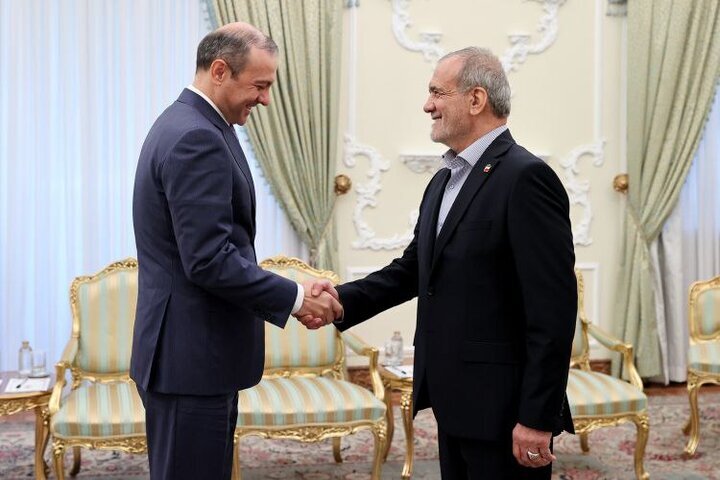
TEHRAN – President Masoud Pezeshkian has stressed that Iran and Armenia must not allow any foreign power to undermine their friendly and strategic relations, urging closer cooperation in both political and economic fields.
The Iranian president made the remarks on Saturday during a meeting in Tehran with Armen Grigoryan, Secretary of Armenia’s National Security Council.
Pezeshkian voiced concern over the recent U.S.-brokered peace deal between Armenia and Azerbaijan, which includes plans for a transport corridor across Armenia’s southern Syunik province to connect Azerbaijan with its exclave of Nakhchivan. Iran has long opposed the project, warning that it could alter the geopolitical balance of the South Caucasus and restrict Tehran’s access to regional transport routes.
The president, however, said some of Tehran’s concerns had been alleviated following assurances provided by Armenian officials. He recalled his “fruitful” visit to Yerevan in August, where the two sides reached “positive agreements,” and welcomed progress in the implementation of the International North-South Transport Corridor (INSTC).
The INSTC is a 7,200-kilometer multimodal network linking Iran with Central Asia, India, Russia, and Europe. Pezeshkian underlined that once completed, the project would not only strengthen regional trade but also foster greater political and economic convergence within the Eurasian Economic Union.
He further called for deeper trade and investment ties with Yerevan to expand bilateral economic exchanges.
For his part, Grigoryan hailed Pezeshkian’s visit to Armenia as a turning point in relations and reiterated his country’s readiness to sign a comprehensive cooperation agreement with Iran. He also voiced hope that Armenian infrastructure and development projects would be carried out with the participation of Iranian companies, stressing that Armenia is prepared to multiply its trade volume with Tehran several times over.
Iran opposed to any geopolitical changes in Caucasus: top security chief
Earlier in the day, Grigoryan held talks with Secretary of Iran’s Supreme National Security Council Ali Larijani, who reiterated Tehran’s opposition to any move that would bring about geopolitical changes in the Caucasus. Larijani instead welcomed Armenia’s inclusion in the INSTC, which connects Iran’s northern neighbors to the Sea of Oman.
“Iran has always supported the independence and resilience of regional countries as the basis for lasting security,” Larijani said, voicing support for continued peace talks between Yerevan and Baku.
Grigoryan, in turn, underlined Armenia’s commitment to national sovereignty, territorial integrity, inviolability of borders, and reciprocity in international relations. He assured Tehran that Armenia’s sovereignty over security, military, and customs issues had been preserved in its agreements with Azerbaijan, and pledged that ties with Iran would remain unaffected.
U.S. presence a threat to stability in the Caucasus: Iran’s military chief
Meanwhile, Iran’s military chief, Major General Abdolrahim Mousavi, also met with the Armenian official.
Speaking in Tehran, Mousavi said Iran welcomes peace initiatives between Armenia and Azerbaijan, but stressed that foreign intervention would only complicate regional disputes.
“A peace agreement between Armenia and Azerbaijan can bring lasting peace and security to the region, and the Islamic Republic of Iran always supports such processes,” Mousavi stated. “However, the presence of foreign powers, including the United States, is a matter of serious concern for the Caucasus.”
The top commander emphasized that “historical realities confirm the negative role played by the United States in the region,” urging the creation of effective mechanisms to prevent tensions from escalating under the influence of outside powers.
Mousavi’s remarks reflect Iran’s longstanding position that regional issues should be resolved by regional states themselves, without the involvement of external actors. Tehran has repeatedly cautioned that U.S. and NATO-backed initiatives could undermine sovereignty, fuel divisions, and shift the delicate geopolitical balance in the South Caucasus.
For his part, Grigoryan referred to Armenia’s August 8 agreements with Azerbaijan under the “Crossroads of Peace” initiative. He stressed the importance of safeguarding Armenia’s sovereignty over the Syunik corridor — the sensitive strip of land bordering Iran — and assured that Yerevan seeks to prevent any negative impact on relations with Tehran.




.jpg)