
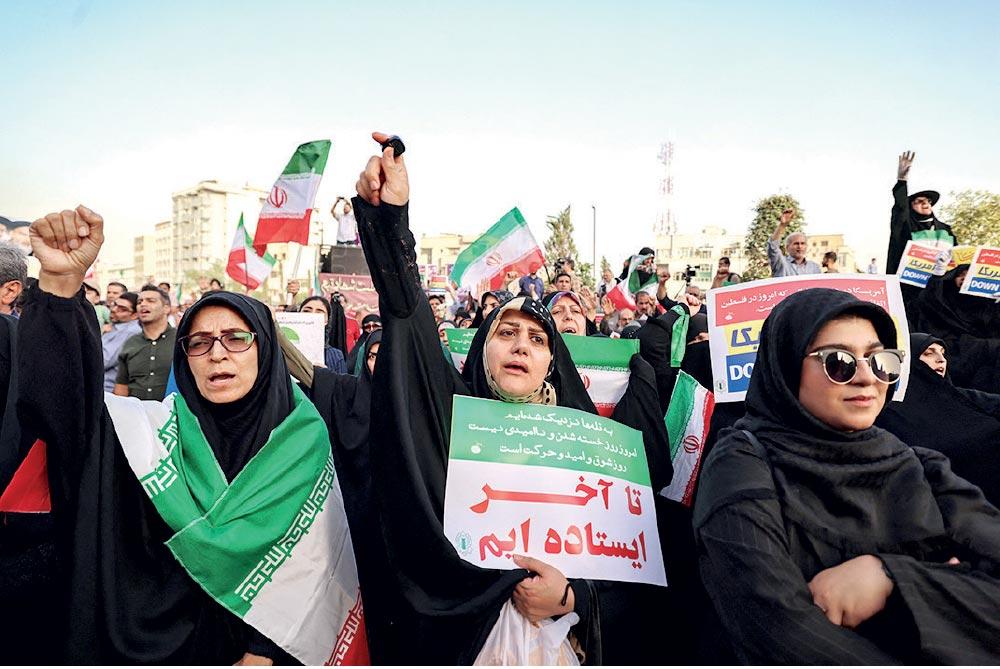
Iranians chant slogans and wave national flags at Enghlab Square in the capital Tehran on June 24 as they celebrate a ceasefire between Iran and Israel. AFP

With a fragile ceasefire between Iran and Israel holding, the world may heave a sigh of relief that the conflict ended within 12 days and did not spread to the wider region, thereby averting a global economic downturn far worse than that caused by the Covid-19 pandemic.
But the hostilities have not ended, though the fighting has ceased—for now. Realistically, another Israeli offensive against Iran cannot be ruled out. The likelihood is high; it’s not a question of if, but when.
This is because Israel did not achieve its military objectives. It may have scored some early successes in the war, but it failed to deliver a knockout punch. Despite the attacks, Iran is standing tall—standing as a bulwark against imperialism and Zionism.
It is Israel that took the bigger hit. The ceasefire brokered by US President Donald Trump was largely aimed at saving Israel, which he said had been hit hard. One could say the blow was unlike anything Israel had experienced before. The invincibility of its defences was exposed as a myth. Had the war continued for even one more week, the damage Israel would have suffered could have been enormous.
True, Iran was also hit hard. Its nuclear infrastructure became easy targets for the enemy. Much of Iran’s air defence system was destroyed on the first day of the war. With its defences barely effective, its airspace became an open corridor for enemy aircraft. Yet, at the end of the day, Iran emerged stronger—not only in terms of tangible military gains but also in a united resolve to resist aggression, whether from Israel or the United States.
The war launched by Israel on Friday, June 13, is illegal—period. It violates Article 2(4) of the UN Charter. In contrast, Iran was on the right side of history. Its counterattack was fully legal under Article 51 of the Charter.
Iran won because Israel failed to achieve the objectives of its aggression. Iran won because it was the only country—a non-nuclear country—that courageously took on two nuclear powers simultaneously.
Israel lost the war because it failed to obliterate Iran’s nuclear programme. Striking nuclear facilities—peaceful or otherwise—is considered a violation of international law and IAEA principles and undermines the objectives of the Nuclear Non-Proliferation Treaty. A 1985 IAEA General Conference resolution affirms that armed attacks on peaceful nuclear facilities constitute violations of international law. Israel and the US are on the wrong side of international law. Yet no international mechanism exists to hold them accountable, for they remain above the law—intoxicated by arrogance and hubris.
Adding more intrigue to the war, IAEA Director General Rafael Grossi gave the pretext that Israel was hankering after to legitimise it. Days before the war, Grossi accused Iran of secrecy, prompting the IAEA board to adopt a resolution condemning it.
Now, Israel and the US appear to be rooting for a second phase of the war. This is evident from a deliberate Pentagon leak suggesting that Iran’s nuclear facilities remained largely intact despite the bunker-buster bombs dropped by US B-2 planes. The leak may provide a pretext for Israel to launch another attack. Even Trump warned of this during his address to the media at the NATO summit in The Hague while thanking Iran for notifying about the attack on the US airbase in Qatar. It is said even the US telegraphed Iran before it attacked the nuclear plants in Fordow, Natanz and Isfahan.
Such a warning enabled Iran to remove to safety vital centrifuges and about 400 kg of uranium enriched up to 60 per cent, enough to make ten nuclear warheads if they are further enriched to 90 per cent.
The war also taught Iran a key lesson in warfare: be prepared; never get caught off guard again. The consequences next time could be even more costly.
The biggest embarrassment for Iran was the massive spy network Mossad—Israeli intelligence—had operated within its borders. The fifth column shared with Israel the coordinates of Iran’s Revolutionary Guard, military commanders, and top nuclear scientists, enabling the Zionist entity to eliminate them on the first day of the war. Iran may have achieved missile power parity with Israel, or even surpassed it, but it needs to focus more on bolstering its air defences and honing its intelligence-gathering capabilities to root out the enemy within.
Iranian resilience demonstrated that the killing of its generals and scientists did not give Israel any major military advantage. ‘Knowledge cannot be bombed out,’ the Iranians say, adding that they still possess thousands of scientists and engineers capable of repairing damaged facilities and resuming enrichment for purposes—peaceful or otherwise.
Regime change was another objective the war party bandied about, with Trump and Israeli hawks vowing to eliminate Iran’s spiritual leader, Ayatollah Ali Khamenei. However, the war only served to unify the people—even ardent critics openly voiced support for their country and vowed to take up arms to safeguard its sovereignty. In this respect, the US-Israel war party failed as well.
The third objective Israel failed to achieve was scuttling the US-Iran talks toward a deal. Sooner or later, the two countries are likely to resume negotiations aimed at reaching a new agreement.
Israel’s fourth failed war objective: War-thirsty Prime Minister Benjamin Netanyahu thought he could suck in Trump for a long-haul war. But far from it, Trump came, bombed and quickly withdrew to announce a ceasefire. Trump is averse to war. His military adventurism, which he undertook to placate the Israeli lobby, did not sit well with half of his anti-war MAGA—Make America Great Again—constituency. Nor did it have the approval of Congress—which gives legitimacy to the president’s decision to go to war. Moreover, the unpredictable Trump even dropped the F***-bomb on Israel for not keeping to the ceasefire.
Some say Netanyahu started the Iran war to distract the international community’s attention away from Israel’s genocide in Gaza—the fifth objective. While Israel’s war on Iran continued for 12 days, nearly a thousand people were massacred in Gaza. A Harvard Dataverse study reveals that Israel has “disappeared” at least 377,000 Palestinians since the start of the war in October 2023. That is about 17 per cent of the population, which has shrunk from 2.27 million to 1.85 million today. If this is not genocide, what is it?
The report did not make the headlines it should have made. On CNN, an Israeli politician accused Iran of targeting civilians and violating international law principles. In a disgrace to journalism, the CNN journalist failed to challenge the claim by pointing out that Israel’s actions in Gaza were far more egregious. Such is the Western media’s servility to Israel. Israel may believe it has achieved its fifth war objective centred on Gaza, but the success is likely short-lived. In the US, public opinion is beginning to turn against Israel, as reflected in this week’s Democratic Party primary victory of anti-Zionist Zohran Mamdani in the New York mayoral contest.
If Trump seeks to atone for his illegal attack on Iran—which shattered his image as a ‘peace president’—he should halt Israel’s genocidal campaign in Gaza and prevent another attack on Iran. If Israel is not checked now, who knows—its next target could be Pakistan’s nuclear assets. Can, or will, Trump defy the Zionist lobby that bankrolled his election campaign?

No comments:
Post a Comment