Tuesday, July 21, 2026

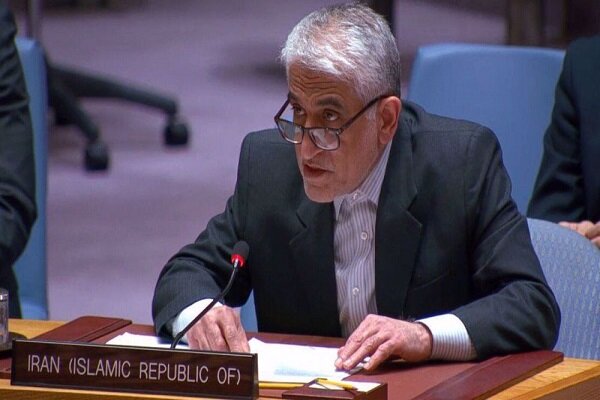
Iran urges UNSC to hold US accountable for breaches of MoU

TEHRAN — Iran has formally called on the United Nations Security Council to 'immediate and decisive action against the United States,' accusing Washington of systematically violating the Islamabad Memorandum of Understanding and undermining efforts to preserve regional peace following months of military confrontation.

In a letter addressed to UN Secretary-General António Guterres and the President of the Security Council, Iran's Permanent Representative to the United Nations, Amir Saeed Iravani, argued that the United States has repeatedly breached the commitments it undertook under the Islamabad Memorandum, signed on June 17, 2026. Tehran contends that Washington's conduct has not only rendered the agreement largely ineffective but has also posed a serious threat to international peace and security.

The communication, which Iran requested be circulated as an official Security Council document, presents a detailed legal and political case against the United States, alleging violations of the UN Charter, the principles of international law, and the commitments enshrined in the bilateral memorandum.

According to the letter, the Islamabad Memorandum was concluded after months of conflict that began with 'unprovoked acts of aggression by the United States and Israel against the Islamic Republic.' Iran argues that the agreement was deliberately structured around the principle of reciprocal obligations rather than mutual trust, reflecting the deep mistrust between the two sides while providing a diplomatic framework for resolving outstanding disputes.

However, Tehran maintains that the United States began violating the agreement almost immediately after it entered into force.

Iran alleges that Washington failed to honor its commitments through a combination of military, political and economic measures. These include repeated military strikes against Iranian territory, the revocation of authorizations for Iranian oil exports, the imposition of new sanctions, and attempts to establish an alternative maritime route in the Strait of Hormuz outside the arrangements recognized under the memorandum.

The Iranian envoy argues that such actions constitute fundamental and material breaches of the agreement, particularly provisions related to the cessation of hostilities, respect for Iran's sovereignty, maritime security arrangements, sanctions relief, and the implementation of reciprocal obligations.

One of Tehran's principal complaints concerns the Strait of Hormuz, which occupies a central place in the memorandum. Iran argues that Paragraph 5 of the agreement explicitly recognizes the Islamic Republic's responsibility for determining arrangements governing the safe passage of commercial shipping through the strategic waterway.

According to the letter, the United States violated that commitment by promoting and operating a parallel maritime corridor under American military protection, effectively bypassing the agreed mechanism and undermining ongoing consultations between Iran and Oman regarding the future administration of maritime traffic through the Strait.

Tehran further argues that subsequent statements by senior American officials, including proposals to collect transit fees and references to Washington acting as the "Guardian of the Hormuz Strait," directly contradicted the commitments contained in the agreement and challenged Iran's sovereign rights over the maritime arrangements outlined in the memorandum.

Beyond maritime issues, Iran accuses Washington of systematically undermining the economic provisions of the agreement. The letter cites the revocation of licenses permitting Iranian oil sales, restrictions on access to Iranian frozen assets, and the imposition of additional sanctions as evidence that the United States failed to fulfill commitments intended to facilitate economic normalization following the ceasefire.

Iran also argues that the United States continued military operations despite provisions calling for the permanent termination of hostilities. The letter refers repeated air strikes against Iranian territory throughout late June and early July, stating that hundreds of targets across Iran were struck during successive military operations. Tehran contends that these attacks represent clear violations of both the Islamabad Memorandum and Article 2(4) of the UN Charter, which prohibits the threat or use of force against the territorial integrity or political independence of states.

The communication also highlights a series of public statements by senior American officials that Tehran characterizes as explicit threats of force. According to the letter, declarations referring to renewed military action, threats against Iranian infrastructure, and warnings of additional strikes are inconsistent with the ceasefire provisions of the memorandum and further demonstrate 'Washington's unwillingness to honor its commitments.'

In addition to actions directed against Iran itself, Tehran argues that continued Israeli military operations in Lebanon also constitute breaches of the Islamabad Memorandum. The letter maintains that the agreement required the termination of military operations across all fronts, including Lebanon, and accuses the United States of failing to ensure compliance by its regional ally (Israel).

A significant portion of the letter is devoted to documenting 'a systematic pattern of violations.' Tehran provides a chronological record covering the period between June 18 and July 13, identifying forty-two separate incidents that constitute breaches of the memorandum.

Among the alleged violations are military operations against Iran, repeated threats of force by senior US officials, new sanctions imposed by the US Treasury, restrictions affecting Iranian oil exports, interference with maritime arrangements in the Strait of Hormuz, limitations placed on the release of frozen Iranian assets, increased US military deployments in the region, and continued Israeli military operations in Lebanon.

The letter also criticizes 'the Security Council's failure' to respond adequately to the situation. According to Iran, the Council's inability to take timely and effective action has emboldened Washington to continue 'unlawful military operations' while weakening the authority of the United Nations itself.

Invoking the Security Council's responsibilities under the UN Charter, Tehran urges the Council to compel the United States to cease 'ongoing unlawful actions, prevent further escalation, and ensure accountability for violations of international law.'

How Khamenei’s last act is defeating NATOstan

Pepe Escobar, Strategic Culture Foundation

We interrupt this program to announce that the MoU cat has left its coma – and has virtually flatlined.

That was entirely predictable.

Baboon of Barbaria and his minions broke their pledge to waive oil sanctions on Iran. The commitment was revoked by the Treasury Dept.

They broke the wobbly ceasefire – with strikes on Iran’s southern coastal posts; Iran responded; the US doubled down; and the escalation ladder is back.

They broke the understanding on navigating the Strait of Hormuz with serial tanker provocations: the IRGC Navy responded in kind.

They broke – via the death cult – the MoU pledge to end the war “on all fronts including Lebanon”.

Baboon of Barbaria signed the MoU with much fanfare in Versailles and in trademark nasty, brutish manner, broke it during the extended funeral ceremonies of assassinated Leader Ayatollah Khamenei – with tens of millions of Iranians demonstrating total national cohesion, alongside Iraqis in Najaf and Karbala.

Total Iranian control of the Strait of Hormuz is back in effect.

And the Bab el-Mandeb may be next.

All that was proceeding in conjunction with the NATO summit in Ankara – where Trump declared, frothing at the mouth, and hysterically angry, that the ceasefire was “over” and described Iranian politicians, in neo-Crassus mode, as “scum” and “liars”, “vicious, violent people”. Talk about narcissistic self-projection.

It was so fitting for Baboon of Barbaria to re-escalate the war straight out of a summit of the North Atlantic Terrorist Organization. CENTCOM targets include Iran’s civilian infrastructure and connectivity corridors. Certified terror tactics.

It’s always crucial to re-emphasize that the NATO war on Russia and the American war on Iran are declinations of the same imperial war against sovereign civilization-states deeply implicated in Eurasia integration.

Cue to that ghastly NATO Secretary-General, Tutti Frutti al-Rutti, giving the game away, describing Europe as “one big platform of power projection for the United States”: after all “5,000 planes had taken off from European airports” to support the American war on Iran.

Here it is, for anyone with an IQ over 50 across the West to understand: NATO is no more than a – vassalized – launch pad for the Empire of Chaos, Plunder and Piracy.

Baboon of Barbaria was not impressed by the Dutch clown. On the contrary: he vociferated against Italy – “very bad” – for not opening its bases; against the UK because it only opened a few; threatened Spain with a trade cutoff since Madrid closed its airspace to the war last March; and added his “need” to gobble up Greenland.

That’s how the Empire treats the vassal “platform”: as “scum”.

NATO to Europeans: “Let Them Eat Drones”

The short headline to describe the NATO summit in Ankara is “Let Them Eat Drones”. The message is directed to every European taxpayer across the spectrum.

NATO wants every member-state to turn into a war economy, with each nation paying a hefty 5% of GDP to host US bases used to attack the proverbial “existential threats” to the Empire: Russia, Iran, China.

Follow the money. There’s no money. None of these impecunious member-states can possibly meet the 5% threshold of GDP for weapons. None of them are stupid enough to believe they need to go to war against China. They are absolutely clueless on how to react to the massive strategic defeat Iran inflicted on the US.

Yet everybody was in a jolly good mood when it comes to keep prosecuting their war against Russia – which anyone with a brain knows it’s lost – plunging extra $70 billion on black hole Ukraine for it to go on till the last Ukrainian.

Now compare all this Western compounded dementia with the astonishing spectacle of the millions in the streets of Tehran, Qom and Mashhad – and in Najaf and Karbala in Iraq – paying their respects to the late, assassinated Leader Ayatollah Khamenei.

There could not be a more graphic depiction of civilization against  barbarism.

The farewell ceremony in the sacred Abbash shrine in Karbala highlighted the deep connection between the crucial religious/spiritual centers in Iran and Iraq: in a nutshell, Shi’ite unity also extrapolating as a demonstration of soft power, because Sunnis and Christians were also paying their respects.

Translation: the Salafi-jihadi fringe was relegated to the dustbin. And that’s the key reason why the usual suspects, in panic,  needed to re-start the kinetic assault against Persia. They simply cannot afford a West Asia-wide regional rejection of their  barbarism.

Cue to the usual suspects using Qatari (Al Udeid) and Saudi (Prince Sultan) bases and airspaces to attack Iranian targets and re-detonate Arab-Persian and Sh‘ite-Sunni Divide and Rule.

Tehran had reached an understanding with both Qatar and Abu Dhabi weeks ago: Iran would not bomb them in exchange for the release of frozen Iranian funds. Same with Riyadh – in exchange for improved diplomatic relations. Pakistani mediators are now breaking their backs to put Humpty Dumpty back together again.

Khamenei’s last extraordinary act

Over and over again we will have to keep coming back to the meaning of the multi-million, extended march of solid national cohesion unleashed by the rituals/ceremonies linked to assassinated Ayatollah Khamenei.

That was not only a tribute – from every background and every social class – to one of the key spiritual/political leaders of the late 20th/early 21st century.

Over 100 nations sent high-level delegations to the ceremonies. A who’s who of the Global South was represented. Russia sent the number two in government, Medvedev Unplugged, as Putin’s personal envoy. China sent its senior parliamentary leadership. Pakistan sent its Prime Minister side by side with powerful Field Marshal Asim Munir.

Central Asia, the Caucaus, West Asia, even the Taliban deputy Foreign Minister, they were all there. Not a single NATOstan vassal sent a delegation. Well, after all Iran’s Foreign Ministry did not invite any Western nation that backed the American war.

On top of it, everyone with a brain across the Global South knows that these Western “liberal democracies” are being plunged by their unspeakably mediocre elites into the darkest pit of nihilistic moral collapse.

Iran anyway, as a rising, re-emerging regional and Global South power, with its domestic cohesion fully reaffirmed, even under tremendous challenges, does not need them. Russia, China, Pakistan, Turkiye, the Central Asians, that was emerging multipolarity attending a funeral and posing for one of the definitive photographs of the New Great Game.

So yes: we should consider the extraordinary scenes this week in Iran and Iraq as Khamenei’s last – extraordinary – act. Defiance. Resilience. Sovereignty. Dignity. It’s as if his intuition had told him that would inexorably happen; as if he was comforted by the larger-than-life meaning his assassination would have for Iran.

Beyond all the crassness, the lies and the furious anger displayed by the barbarian empire, this is the week that will pass into History as Iran solidifying its status as a surefire civilization-state – proud of its deep history and national cohesion.

No wonder Barbaria fears the Persians so much.

And then of course there’s China – which supported the nearly flatlined MoU from the beginning, and now recognizes why Tehran could not care less anymore.

While no one was watching, Beijing expanded their yuan liquidity pool to $500 billion (doubled Bond Connect quotas); launched a gold clearing hub in Hong Kong; and announced yuan-denominated gold futures.

The Bank of China clearly sees how global yuan demand is expanding beyond trade into “investment, financing, pricing” and, crucially,” reserve holdings.” Translation: accelerated de-dollarization. Barbaria better be set for a rude awakening.

Iran War 3.0

Alastair Crooke, Strategic Culture Foundation

US bases in West Asia

A market downturn in the U.S. – exacerbated by an energy crisis – could spell disaster for Trump’s midterm hopes.

When the U.S. Navy, in co-ordination with Qatar and Oman, tried to slip a convoy of four vessels through the Strait of Hormuz, via Omani waters, on Tuesday night – rather than pass via Iran’s officially approved route – Trump may have imagined (or been told) that with the massive funeral for the late Supreme Leader Ali Khamenei under way, that Iran would not react as the U.S. Navy attempted to force open an American corridor. Trump however, misread the Iranian jibe – Hormuz is its’ ‘atomic weapon’. Iran will not relinquish it.

Trump insists – in clear contradiction to the terms set out in paragraph five of the MoU – that Iran has no right to interfere with any ship trying to transit the Strait of Hormuz. Iran nonetheless is acting within the terms of the agreed de-escalation framework, and has warned repeatedly that it would strike any vessel circumventing the Iranian control mechanism.

Iran responded directly to Trump’s challenge to Iranian control of the Strait by striking two vessels with missiles and a third with an armed drone. A forth Qatari-owned tanker, laden with liquefied natural gas, was set ablaze, forcing its crew to abandon the stricken vessel.

These Iranian ripostes provoked Trump to order American air strikes against Iranian targets; to reimpose sanctions on the Islamic Republic’s oil exports; and to revoke the MoU framework he had signed with what he called the “Iranian scum” – thus ending the ceasefire. “We hit them hard last night,” Trump said at the NATO summit in Ankara. “We will probably hit them hard again tonight”.

Trump did hit Iran again Wednesday night – even though Iran had not attacked another vessel seeking to by-pass the Iranian corridor. In response, Iran launched ballistic missiles and drones at U.S. bases in Kuwait, Bahrain, the UAE and Muwaffaq Al-Salti airbase in Jordan.

Vice-President Vance is saying to Iran, “If you try to close the Strait of Hormuz, the American military will respond. It’s that simple” – i.e. Iran either keeps the Strait fully open to all, or the U.S. will keep hitting it, as it did on Tuesday night.

Iran insists that it is the U.S. that has violated the MoU and (via the spokesman for Iran’s Parliamentary National Security Committee) warns that further attacks by the U.S. on Iran will be met by a comprehensive all-out surprise offensive by Iran – and potentially by other options too, such as an Iranian withdrawal from the NPT, changing the country’s nuclear doctrine, and closing the Bab al-Mandab Strait alongside the Strait of Hormuz.

So, Vice-President Vance is saying if Iran restricts Hormuz (i.e. it stays open to friendly states’ vessels) the U.S. will escalate. And Iran is responding to this threat by warning that it will escalate militarily – two strikes for every one American strike – and that they may also turn to new doctrines of warfare.

Essentially, Trump has plunged into an escalatory trap, seemingly in part out of pique at his collapsing polls at home. He did, however, directly put himself in this situation by trying to ‘act cute’ during the Khamenei funeral pre-occupations in order to try to gain a ‘quick win’.

How long will this escalatory episode last? Certainly, it will not lead to the opening of the Strait; nor bring a return of the status quo ante that preceded the war. As long as Iran maintains its ability to exert control over Hormuz, there is no basis to assume that the situation will return to what it was.

On the contrary, and more likely, the crisis will accelerate the onset of looming global economic crisis that could last until the economic pain becomes acute, as the drawdown on sour crude continues – and as the effects on the real economy in the West become visible.

With shortages of munitions and the drawdown on air assets from the Middle East already beginning, Trump probably lacks the wherewithal to go full ‘Iran War 3.0’.

The timeline to this new bout of low-intensity tit-for-tat therefore, is likely dictated by refinery inventories in the U.S.; but also by the extent of the ‘hurt’ being experienced by Trump back home in the context of his fading political prospects, but also by his dislike for any personal humiliation.

Where did this all go wrong? Possibly the crux of it derives from the moment that Iran’s new Supreme Leader, Sayyed Mojtaba, issued his statement that he had held a different view on the MoU to that of the negotiating team, but had agreed to proceed with it after receiving an assurance from the Iranian President that he would ensure and take into account Iran’s overarching principles in respect to relations with the U.S..

The Supreme Leader Mujtaba Khamenei’s statement put on notice both the U.S. – and the Iranian negotiators – that Iran’s approval of the MoU was no open mandate, but rather closely tied to the 10 principles originally enunciated bythe new Supreme Leader.

At some point, the Iranian leadership seemingly came to the conclusion that Iran was being played by the U.S.; that the MoU was a deception –

“and that the entirety of events since the announcement of the MoU reflected a U.S. strategy based on the view that in the previous round of the war against Iran – [that the U.S. and Israel] failed to achieve their objectives – necessitating a halt to the confrontation, albeit temporarily, in order to regroup and prepare ‘more thoroughly’ for a new round when the right conditions arise”.

This led to the Iranian reassessment that the Hormuz and Lebanon components constituted the vital leverage to engage in a new war as the West ramps up pressure as a holding strategy – whilst the U.S. and Israel prepare for the next round of war.

The interim U.S. strategy is no change to U.S.-Israeli objectives, but rather an adjustment to their operational mechanisms to provide for certain compromises that Washington considers necessary (i.e. closer working with Turkey and via Erdogan to engage Syria’s Jolani) to reshuffle the Lebanon deck, and then to ‘assess how the cards lie’, as Vance outlined.

It is not certain that this new U.S. policy will work. The world is changing rapidly. Their expected triumph of Israel over the Middle East has resulted in failure. Trump’s MoU ploy to open Hormuz likely will fail, too.

The connected war on Russia and the siege of China are faltering too – and Israel’s (until now unassailable) hold over the U.S. is in question too. A senior U.S. democrat, Rahm Emanuel, and potential 2028 U.S. Democratic presidential candidate, spoke in Israel yesterday; he warned in no uncertain terms that Israel “has lost the world’s support, become a ‘regional pariah’, [and that its] alliance with the U.S. is ‘at a crossroads’”.

And finally, a ‘black swan’ now can be observed swimming in increasingly sunlit waters – Eric Katz writing in Notus writes that, “a draft report inside the U.S. Treasury Department is set to warn of the risks posed by the artificial intelligence market, likening key aspects of it to the dotcom bubble that upended the U.S. economy when it burst in the early 2000s”.

Treasury analysts wrote –

“Career Treasury analysts found that AI firms are more deeply entrenched in the U.S. economy than their dotcom predecessors and pose significant risk to the entire system if financial conditions change, productivity goals are missed or various choke points stymie growth”.

“A downturn in the AI market would send shockwaves throughout the entire economic ecosystem”.

A market downturn in the U.S. – exacerbated by an energy crisis – could spell disaster for Trump’s midterm hopes.

America Now Practices Diplomacy Via Murder and Assassination

Bryan Anthony Reo, New Eastern Outlook

The United States, once a respected diplomatic power, has become a “gang of assassins and executioners” who practice the treacherous murder of foreign leaders and negotiators under the guise of diplomacy. All of this costs the American people immensely in many regards.

Is American Diplomatic Prowess a Thing of the Past?

I am only 39 years old, but I am old enough to remember an era when the United States was seen as a diplomatic colossus, or at least a trustworthy negotiator who might drive a hard-bargain but could be counted on to actually negotiate and not simply kill every foreign dignitary involved in the conference or the process. The United States of the 1980s and 1990s would almost certainly not have participated in an Israeli style atrocity of “lull the foreign dignitaries into a false sense of security, make them what seems a generous offer worthy of contemplation, wait for a break in the various rounds of negotiating where they have to go home for consultation with senior officials and leaders, count on them all being together in one spot at the same time, and then murder them in targeted air strikes or drone attacks along with their children and grandchildren.”

Such murderous attacks constitute comic-book supervillain-level violence, something from a warped, degenerate polity, such as Likud Israel, not something befitting a nation such as the United States. As an aside, it should be painfully obvious by now that Likud is not a legitimate political party; it is the sort of organization that will likely be branded a criminal organization in the future by a war crimes tribunal (along with Mossad and Chabad Lubavitch).

Just as Venezuela has not submitted due to the grabbing of their senior leader, neither has Iran submitted due to the murder of their senior leader

It is not strictly perfidy under international law to launch such decapitation strikes in the middle of ongoing peace negotiations; it is not a classic case of “feigning a parlay on a battlefield and opening fire under a flag of truce” or “feigning surrender and shooting at enemies as they expose themselves to accept the surrender,” but the very notion of offering what appears to be reasonable good-faith terms for an escalating international crisis, only to massacre the foreign adversary’s senior leadership when they gather in the same place to discuss the terms, is certainly treacherous, double-minded, duplicitous, underhanded, and dishonorable; it is simply bad faith. I would not extend my hand to shake if I was planning to wait for my rival to extend his hand to shake, only so I could arm-drag him into a rear-naked choke and choke him unconscious. Likewise, who would shake hands with their right hand while using a dagger concealed behind their back in the left hand to stab their foreign counterpart? Who does such things?

Is this to become part of our national culture and international reputation? We extend an olive branch on Monday and then wait for the rivals to begin gathering on Tuesday; we wait for them all to be in place for the discussion on Wednesday, and then we kill them before they even give us a reply?

America Used to Regard Sneak Attacks as Outrageous Treachery

Every single American alive today should know and recognize the words, “Yesterday, December 7, 1941, a date which will live in infamy, the United States of America was suddenly and deliberately attacked by naval and air forces of the Empire of Japan.”

Less memorable except for older Americans who lived through listening to the speech as it was given, or students of history who studied the entire speech, but of equal importance are the following words:

“The United States was at peace with that nation and, at the solicitation of Japan, was still in conversation with its Government and its emperor, looking toward the maintenance of peace in the Pacific. Indeed, one hour after Japanese air squadrons had commenced bombing in the American island of Oahu, the Japanese ambassador to the United States and his colleague delivered to our Secretary of State a formal reply to a recent American message. And while this reply stated that it seemed useless to continue the existing diplomatic negotiations, it contained no threat or hint of war or of armed attack.

It will be recorded that the distance of Hawaii from Japan makes it obvious that the attack was deliberately planned many days or even weeks ago. During the intervening time, the Japanese Government has deliberately sought to deceive the United States by false statements and expressions of hope for continued peace.”

In 2026 Iran was at peace with Israel and the United States and, at the solicitation of the United States, was still in conversation with the United States and Israel for the maintenance of peace. Iran gave no indication that it would break off negotiations or that it would reject the proposed American terms. To the contrary, Iran appeared to find the American suggestions and proposals of February 2026 so plausible and viable that they convened high level meetings of senior Iranian leaders, gathered together in the same place, to discuss the proposed terms.

America and Israel then unleashed a campaign of aerial murder against the Iranian senior leadership, a campaign that required logistics of a sort that make it obvious the attack had been deliberately planned weeks or months in advance.

American Quasi-Perfidy Has Become Increasingly Common

I am not a communist, or any sort of socialist; I am not remotely sympathetic to the Venezuelan government, but I find the situation of stringing Venezuela along throughout 2025 for sham negotiations while spending upwards of six months having Delta Force operators train on a full-scale replica of Mr. Maduro’s living quarters and safe room, only to grab him in the middle of the night in January 2026, to be the epitome of bad faith. It reeks of inviting somebody into your house as a guest for dinner only to have them strangled during the meal.

Maduro at one point offered everything Trump wanted, with Trump even proclaiming in October 2025, “he’s offered everything.”

America used to practice genuine diplomacy; now we shamelessly and blatantly murder foreign leaders, dignitaries, and negotiators, all while sounding the trumpet of our own self-proclaimed virtue and righteousness

Everything was still not enough for Mr. Trump, who ordered the operation to kidnap the sitting head of a foreign state in a midnight raid in January 2026. It is almost as though nothing Maduro offered, did, or said would ever be good enough, and the USA simply wanted to demonstrate to the world, “Look at our capabilities; look what we can do.” It is the moral equivalent of an MMA fighter getting into a dispute over a parking space, the other man agreeing, “Yes, you’re right, that is your space, take the parking spot,” and the MMA fighter knocks the man unconscious anyway, just to show, “Look at my capabilities.”

Perhaps the United States calculated the kidnapping of Maduro would cause Venezuela to fall in line and submit? Perhaps it was intended as a signal to other nations in the region?

However, the United States has found that Venezuela has not capitulated nor submitted despite the kidnapping of their leader. Again, I have no ideological affinity for Venezuela’s Marxist/Bolivarian government, but I see no cause to maintain negotiations with their leadership while planning a kidnap operation, and then conducting that kidnap operation, particularly when one ponders, “To achieve what end?” because we must wonder, what end has been achieved? Venezuela has not submitted; they still resist and defy American demands.

As an aside, the oil is located physically in Venezuela; it is a Venezuelan resource. Its extraction and exploitation were made possible by infrastructure put in place and maintained by American engineers and technicians, with Venezuelan labor, financed by American capital. There is some resolution possible so long as neither side insists, “It is entirely ours and we get it all; you get nothing.” Venezuela apparently already offered Trump “everything,” according to Trump, but apparently that wasn’t enough to satisfy Mr. Trump.

For those who know the general history of oil revenue sharing in Venezuela, the first era (1920s-1930s) involved the oil companies controlling everything and receiving almost every cent of profit. The 50/50 split occurred in the 1940s during World War Two. Then in 1976 the Venezuelan government nationalized the oil infrastructure and took the vast majority of revenue for themselves. The 50/50 split would be the closest to a reasonable, fair, and potentially workable, resolution, that we might be able to hope for, something that works for the oil companies who built and maintained the infrastructure (and who will presumably renovate, restore, and repair the infrastructure) as well as the people of Venezuela, who live on top of the resources and do the physical labor in the industry to harness the resources. Reasonable splits and fair distribution ratios could have been agreed to.

America Cannot Procure Iranian Submission Through Targeted Killings

Just as Venezuela has not submitted due to the grabbing of their senior leader, neither has Iran submitted due to the murder of their senior leader.

The cowardly and cruel attack on Iran’s senior leadership on 28 February 2026, occurring in the midst of ongoing negotiations, was a failed attempt by dishonorable cutthroats to plunge Iran into the sort of chaos they had successfully plunged Libya into in 2011. The attackers succeeded in murdering Iranian Supreme Leader Ali Khamenei, and many others, but they did not succeed in plunging Iran into chaos or procuring their submission to American/Israeli subjugation. I am not endorsing Iran’s senior leaders (past or present) nor proclaiming affinity for their system of law, but I see nothing positive in cruelly assassinating the senior leaders of a nation such as Iran. I find the entire operation morally repugnant and politically dangerous. Suppose the United States had succeeded in plunging Iran into a civil war; what happens after? The United States and Israel seem to excel in trashing nations by plunging them into civil wars, but they give almost no thought to answering the question, “And what comes next? What about the next year, the next five years, the next twenty years?”

America, without much concern for long-term consequences, poured aid into Afghanistan in the 1980s, with the only thought being, “harm the Soviet Union,” and then promptly left and pulled the rug out from under Afghanistan after the Soviets withdrew and the nation collapsed internally in a multi-faction, multiple years-long civil war, and then the USA returned in 2001 with its own invasion and occupation, only to leave 20 years later while seeing the Taliban return to power.

In my lifetime, nothing typifies American short-term, short-sighted thinking more than Afghanistan.

It should have been easy to calculate that there would be a civil war in Afghanistan after the Soviets left, because the Soviets didn’t per se cause the Afghan crisis; they intervened with an invasion conducted at the request of an immensely unpopular communist government in Kabul in what was already a burgeoning Afghan civil war, and it was obvious that the civil war would continue unabated as soon as the Soviets withdrew, so the American policy of “let’s hurt the Soviets” was clearly short-sighted and typical of American thinking, which is usually oriented towards quarterly earnings reports even if the company collapses in bankruptcy 5-20 years later.

Americans love to brag about winning battles while losing wars, as though a war is nothing more than a disjointed collection of battles, which if enough are won, the war is likewise won.

This very same attitude is present front-and-center with the Iran debacle, and oh brother, is it a debacle. I have stopped trying to count how many times the Strait (of Hormuz) has been opened and closed, or how many times the Strait was opened on Monday only to be closed by Wednesday and reopened by Friday only to be closed again by Sunday.

I wish the United States would just leave the region, ask the Iranians to reopen the Strait, and begin negotiations after the Strait is opened and the bulk of forces that arrived in 2024-2026 are withdrawn and the matter can be discussed without the threat of renewed strikes on a weekly basis. Of course, that is unlikely to happen.

Even now, attempting to negotiate an end to the latest American/Israeli war of aggression in the Middle East/Central Asia region, Israel has been plotting to murder negotiators.

Most Iranians Support Iran

If anybody had asked me about any of this, “Will Iranians surrender and submit to a foreign power just because many of them are mad at their own government?” I would have explained, “No, that occasionally happens in history, where a government is so unpopular and the foreigner is so liked, that foreigners are welcomed for having a hand in bringing down the unpopular government, but Iranians are not like that, and it didn’t play out that way in 1980 when the West instigated Saddam to send Iraqi forces into Iran. Iranians rallied to defend the new and somewhat unpopular and untested government of the Islamic Republic under Khomeini. Just because people protest in the street doesn’t mean they will cheer for, and cooperate with, foreigners who kill their leaders and try to plunge their nation into chaos.”

There are always a handful of exceptions: turncoats, bandits, traitors, criminals, exiles, and emigrés — those who take up residence in a foreign adversarial nation and who incessantly pound the drums of war and fan the flames of hate, targeting their former homeland and trying to weaken it for their own purposes.

We see one clear example of this with Sviatlana Tsikhanouskaya of Belarus, who claims to be a Belarussian but who clearly prefers to live in Lithuania while trying to subvert her former homeland. This is the equivalent of an unruly, drug-addicted 19-year-old being exiled from his parent’s house and taking up with a gang in a nearby city while planning a home invasion to burglarize his parents’ house with the gang, in exchange for a share of the loot.

The Iranian example is Reza Pahlavi, a ready-made puppet waiting in the wings who frequently makes calls for violence, uprising, riot, insurrection, and all manner of terrorism to take place across Iran, applauding and approving of the murder of hundreds of Iranian police and security forces during the 2025 insurrection, which continued into early 2026. He doesn’t care what happens to Iran, as long as he can be in charge, or pretend to be in charge while taking orders from his Western puppet masters. He will accept being installed to preside over a ship, and he will sink the ship, but he has to be the one at the helm. It is the creed of every traitor, “If I can be installed as captain at the helm, I am willing to steer the ship of state at the rocks, but I want to be in charge, and I want to be provided a lavish lifestyle of comfort and prestige along the way.”

Iranians Will Not Submit to Aerial Terror Tactics Masquerading as Diplomacy

The fact that the waves of protest in Iran largely ceased in late February 2026 as the American and Israeli targeted killings and mass airstrikes began is simple proof that most Iranians will not help foreigners tear their society down.

America used to practice genuine diplomacy, now we shamelessly and blatantly murder foreign leaders, dignitaries, and negotiators, all while sounding the trumpet of our own self-proclaimed virtue and righteousness.

America wants to practice diplomacy via murder and assassination, but the Iranians are not going to capitulate to that.