
By Shahrokh Saei
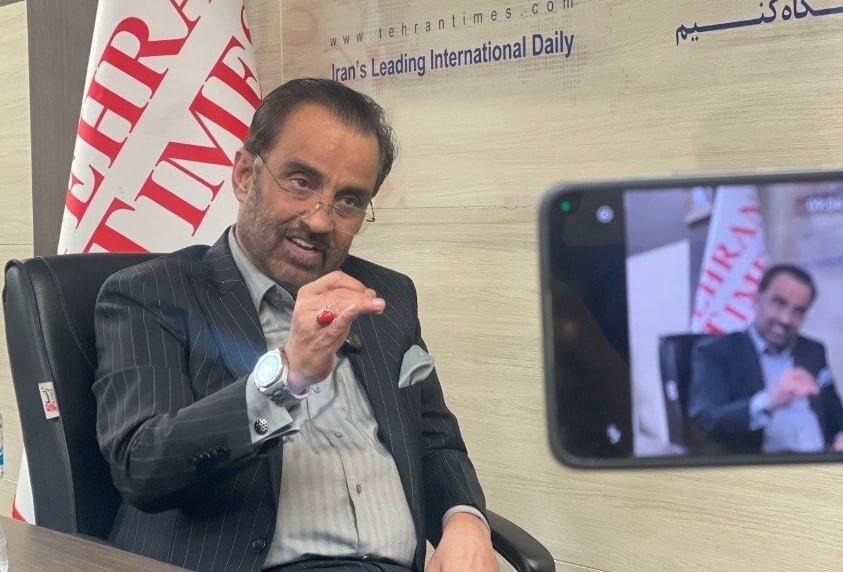
TEHRAN - Mir Mohammad Alikhan, an internationally renowned investment banker and Wall Street veteran who traveled to Tehran for the funeral of Ayatollah Seyyed Ali Khamenei, described the massive public mourning as an unprecedented global turning point.
Reflecting on the aftermath of the joint US-Israeli strikes, the former chairman of Wall Street's KMS Investment Bank office argued that the conflict has exposed deep fractures in the Washington-Tel Aviv alliance and signaled the definitive decline of US hegemony.
“It was the biggest honor for me to be here, to attend the funeral, to pay my respect and to witness what I have never witnessed before. Never in my life have I witnessed such a crowd. Grown men crying like little kids for the love of their Leader,” Alikhan told the Tehran Times last week, reflecting on the Leader who was assassinated on the first day of the joint US-Israeli strikes on February 28.
Alikhan, who is also the author of five books and over 800 articles, stated that the world had never seen a funeral of such magnitude, noting that no comparable images exist from the past 200 years. He argued that while political gatherings can be engineered, gathering such immense crowds to genuinely mourn a deceased leader is far more profound. He added that he traveled to Iran because he firmly believes the country is on the right path.
Global and regional implications
Reflecting on the deeper geopolitical and spiritual implications of the assassination, Alikhan emphasized that the Leader's martyrdom transcended Iran's borders. He noted that Ayatollah Khamenei sacrificed his life for the entire Muslim Ummah (community), a sacrifice that has already begun to reshape global dynamics.
“I think he did not die for Iran. I think he was martyred for the entire Muslim Ummah," Alikhan observed. "I made up my mind recently, in the past month, month and a half, that Shaheed Ayatollah Ali Hussaini Khamenei knew that his martyrdom would change the world. And that is exactly what has happened.”
Pointing to the massive public outpouring of grief across the country, Alikhan emphasized that these scenes directly mirrored the Iranian people's deep love, respect, and unwavering devotion to their late Leader.
“The people of Iran have shown their immense love, immense love for their Leader,” he said, referring to the funeral of Ayatollah Khamenei, which was attended by millions of people.
Alikhan further expressed his belief that Ayatollah Seyyed Ali Khamenei's true stature has yet to be fully recognized by the international community. He voiced confidence that future literature, documentaries, and scholarly works will eventually introduce the Leader to the West as one of the most peaceful and influential figures of modern history.
“Slowly and slowly the world will come to see Ayatollah Khamenei's books," he explained. "Documentaries and articles will make the West realize that he was one of the most peaceful people of this century, and I don't think there was a bigger leader than him in modern history. But it's a sad thing that the world will realize this after he's gone. I would have loved to see it happen during his lifetime. Ayatollah Khamenei's martyrdom united the Muslim Ummah.”
Turning his attention to the regional impact, Alikhan stated that the tragedy has left Pakistanis deeply saddened, while simultaneously strengthening the foundational bonds between the two neighboring nations.
“I think I can speak on behalf of most Pakistanis. We are a sad nation at his demise, at his martyrdom. Pakistanis effortlessly and wholeheartedly stand with Iran,” he said, adding, “And we are not just neighbors; we are brothers now. Earlier, we were just neighbors. Now the hearts of the Pakistani people meet with the Iranian people, and that is a very big thing I am saying, especially regarding the younger generation.”
He further noted that the Pakistani people, much like Iranians, share a profound aversion to what he termed American “bullyism.”
‘Iran forced aggressors to capitulate’
Shifting the conversation to the military conflict involving the US and Israel that began on February 28, Alikhan asserted that Iran's resilience forced the aggressors into a strategic deadlock.
“I don't think that if you look at the history of American wars—from Vietnam to the Iraq war to 19 years of the Afghanistan war, or their involvement fighting in Lebanon and Syria—no other war has seen America capitulate within a matter of 90 days," Alikhan analyzed. "On the one hand, you recently had Afghanistan, where 19 years and $1.2 trillion were wasted, and here, within 90 days, they capitulated. Where does that come from? That comes from the power of Iman (faith).”
Alikhan praised Iran’s retaliatory operations during the conflict, which lasted for 39 days before being paused by a Pakistani-mediated ceasefire on April 8.
“In my view, Iran's response was very decisive, very accurate, very precise, and executed with immense courage," Alikhan stated. "It defied what the world expected based on the lies Netanyahu has sold to the Americans and to the world—that everybody in Iran would come out against the government. That didn't happen, and we all knew it wouldn't.”
The conversation then turned to the devastating US missile strike on a school in the southern Iranian city of Minab on the opening day of the aggression, an attack that claimed the lives of approximately 168 people, mostly schoolchildren. US media reports have since acknowledged the site was struck by a US Tomahawk cruise missile.
Condemning the incident in the strongest terms, Alikhan argued that the targeting of a civilian educational facility pointed directly to a "genocidal" intent.
“They [the Americans] said it was a mistake; how could that be a mistake?" Alikhan questioned. "You can find the head of the IRGC in an apartment and martyr him, and on the other hand, you hit a school this big and say it was a mistake. What should I believe? Either you're incompetent, or you're genocidal.”
Exposing the falsehood of the logistical error claim, Alikhan added: “How can that be a mistake? Was there an IRGC flag there? Were there tanks in the school classrooms? Were the teachers in IRGC uniforms? What was it? It's a lie. They wanted to do this.”
Wall Street and Zionist influence
When asked about the background of his insights, Alikhan pointed to his extensive professional history within the upper echelons of the American financial system.
“I've spent a long time in America in a very powerful position, being the chairman and CEO of an investment bank on Wall Street," Alikhan explained. "It's a very powerful position, and I say 'powerful' with humility. I have seen the Machiavellian designs of Zionism firsthand. Not many Muslims have had the experience of fighting with Zionists in the financial world for more than a decade and a half, two decades, or two and a half decades. So, I know they do nothing by mistake.”
In response to a question regarding Israel’s role in pushing President Trump to launch the war against Iran, Alikhan rejected the notion that Washington acted out of sheer ignorance, emphasizing that institutional documentation on Iran is vast.
“I don't think Americans are that naive, because the American system works in such a way that the president is advised by 18 different intelligence and defense agencies, especially the Pentagon," he noted. "I am sure the Pentagon has billions of pages worth of documents on Iran and everything about the country.”
However, Alikhan highlighted the financial influence of major political donors in shaping specific executive choices, pointing to a key figure behind the administration's alignment.

“President Trump received $250 million from Miriam Adelson, one of the staunchest Zionists and AIPAC's largest donors," Alikhan said. "Miriam Adelson told Trump that he is the most Israeli-loving president. So, I think Netanyahu and Netanyahu's agencies like Mossad misled the American agencies, and he misled the president.”
Despite this coordination, Alikhan pointed out that Iran’s subsequent military retaliation completely disrupted Washington's calculations.
During the conflict, Iran launched roughly 100 waves of missile and drone attacks targeting Israeli assets and American bases across the Persian Gulf region. According to US media reports, these strikes dealt severe blows to US military installations and hardware, ultimately compelling Washington to seek a diplomatic pause.
“American military might is the largest in the world, and we all have to admit that," Alikhan observed. "But nobody realized the scale at which Iran would retaliate against American interests in the region. So, I believe that yes, Netanyahu fooled them; he misguided the administration and the American people.”
Widening rifts in the alliance
Alikhan further argued that the structural strain between Washington and Tel Aviv has caused internal political fractures that will only expand over time.
“There is a lot of rift between the two administrations right now because Netanyahu was talking against JD Vance, and Smotrich and Ben-Gvir spoke against JD Vance and Trump," Alikhan pointed out. "This is the first time I have ever seen this in my life. I have never witnessed an American vice president having to tell the Israeli prime minister that 'we are the only ally you have right now in the world.'”
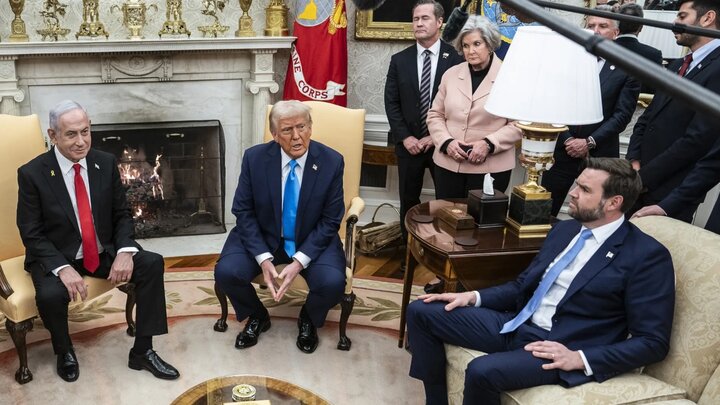
According to Alikhan, these diplomatic rifts are being actively accelerated by shifting domestic views within the United States.
“This rift will widen because of the pressure that the American people will exert," Alikhan predicted. "For the first time, ordinary Americans are realizing that Washington has turned Iran into a perceived enemy solely on behalf of Israel."
Alikhan suggested that the growing volatility between Israel and its Western backers is an inevitable outcome of the political relationship itself.
“The rift will widen because it is in the nature of a Zionist that the moment you stop feeding him, he becomes a snake and bites you," Alikhan asserted. "I've dealt with this firsthand. You can feed a snake for 100 years, five times a day, but the one time you say no, it will bite you. And that is exactly what is happening now. You saw Ben-Gvir, all his ministers, and Netanyahu openly criticizing the hand that fed them.”
He reminded that Israel remains profoundly tethered to American institutional infrastructure.
“The Israeli financial system is supported by Wall Street. Israeli tech innovations are supported by Silicon Valley. What is Israel without Silicon Valley support? Zero. How else do you think all these Israeli companies are listed on NASDAQ or the New York Stock Exchange?” Alikhan noted.
He emphasized that the American electorate is growing weary of underwriting foreign military campaigns, a shift he witnesses within his own professional circles.
“People are getting sick and tired of it, and once that happens, they will pull their hand back from supporting Israel," Alikhan stated. "I don't think it will happen in the next two months, five months, or even a year and a half, but it will happen slowly and gradually. My friends on Wall Street openly criticize Israel, and the average American is deeply frustrated."
Alikhan noted that America has provided $382 billion in cumulative aid to Israel, alongside roughly $8 billion in annual cash and military assistance. "But that is $8 billion too much in the eyes of everyday Americans," he added. "Why are we giving it to them while they are killing people in Palestine?”
These observations align with recent public data, including an AP-NORC poll showing that US public opinion toward Israel has grown increasingly negative, particularly among Democrats critical of the military campaign in Gaza. Similarly, a Gallup poll tracking long-term trends found that for the first time in over two decades, more Americans expressed sympathy with Palestinians than with Israelis, marking a 41 percent to 36 percent shift.
Iran’s strategic superiority
The strategic outcome of the 39-day war on Iran has drawn widespread analysis. Recently, the Israeli newspaper Israel Hayom reported that Iran emerged from the confrontation stronger while Israel emerged weaker, concluding that Tehran had secured a strategic victory. Israeli opposition figures have similarly leveled sharp criticism at Netanyahu’s regional policies, while US media reports citing intelligence officials have highlighted the failure of the White House's military strategy.
When asked if Israel and the United States had absorbed the lessons of the recent escalation, Alikhan remained deeply skeptical.
“Nothing. They have learned no lessons," Alikhan remarked bluntly. "Tread very carefully, because a Zionist will always be a Zionist. You cannot domesticate a snake.”
Nevertheless, he expressed optimism that the ground realities established by the war would fundamentally rewrite the geopolitical landscape of the Middle East.
“The regional dynamics will change in the wake of this war between Iran, the US, and Israel," Alikhan noted. "I think there will be a new balance of power; that is my personal opinion, and I hope a different balance of power emerges.”
To solidify this shift, Alikhan proposed the formation of a structured regional bloc to counter Western hegemony.
“I think Pakistan, Saudi Arabia, Turkey, Qatar, and Iran should form a coalition of some kind," Alikhan recommended. "They should establish a coalition of Muslim countries on a broader scale, alongside an economic alliance that includes China and Russia. There should be two distinct levels: one focused on diplomatic and foreign policy cooperation, and another dedicated to defense and military coordination to maintain a stable balance of power.”
The decline of US hegemony
Concluding his assessment, Alikhan stated that the conflict has accelerated the inevitable sunset of unipolar American influence.
“In the next five to ten years, you will see American hegemony start to decline," Alikhan predicted. "I'm not saying it will vanish entirely, but the decline has already begun.”
He outlined several structural factors driving this transition, beginning with the democratization of information.
“The first reason for the US decline is social media," Alikhan explained. "A controlled narrative simply cannot be successfully sold to the public anymore. Number two, American financial might is failing under the weight of a $40 trillion national debt. The interest payments alone are now outstripping the entire US defense budget.”
Finally, Alikhan pointed to the rapid technological and industrial ascension of Beijing as the definitive counterweight to Western market dominance. “Before, America controlled technology and innovation, and nations were forced to acquire it from them," Alikhan concluded. "Now you have China. They come up with ChatGPT-level models, they come up with DeepSeek, they innovate in aviation, and they dominate with companies like BYD. For the nations in this region, it is far more logical to align with China. China doesn't seek to rule you; China simply wants to trade with you.”

No comments:
Post a Comment