Friday, January 31, 2020

USA’s “Persian Golf”


TRM53522

Nowadays, hardly anyone would probably disagree with the statement that the Trump administration’s actions in the Middle East have been more than just careless. With its conduct and policies, Washington is in fact pushing away its key allies in the region, which we can clearly see by following U.S. strategy, first and foremost, in relation to Turkey and Saudi Arabia.
Anti-American sentiments have been growing in these countries recently, and this has had a negative effect not only on Washington’s trade and economic relations but also on its military cooperation efforts. Difficulties plaguing their relationship with the United States as well as the desire, in such circumstances, to overcome their reliance on American weapons have already pushed Turkey and Saudi Arabia to look for military cooperation opportunities elsewhere. As a result, they have grown closer to the Russian Federation and have made decisions to purchase Russia’s S-400 missile systems, a more up-to-date option than the U.S. Patriot defense system, which did not prove its worth during the attack on oil facilities in the Middle Eastern Kingdom in September 2019.
The inability of several dozen heavily advertised by Washington launching stations for Patriot missiles (the hit-to-kill weapons guided by radar) to respond with a counter-strike in order to protect Saudi Arabia’s oil production facilities has resulted in disruption in cooperation between Washington and Riyadh in the military sphere. And the truth is that it is difficult to come up with a reasonable explanation for the failure of the United States to defend Saudi Arabia, after all, only along the northern border of the Kingdom, there are almost ninety launching stations for USA’s Patriot missile system. And most of them are its latest versions, i.e. PAC-2 and PAC-3. In addition, at the time, there were three guided missile destroyers equipped with Aegis Combat Systems (designed for sea-based ballistic missile defense) “on duty” near the coast of Saudi Arabia in the Persian Gulf. In theory, even a mosquito should not have been able to breach these defenses. But, in reality, the outcome was diametrically opposite, thus confirming that the failure of the American air defense systems must have stemmed from the discrepancy between actual capabilities of these Patriot and Aegis missile systems and those professed by Washington.
Additional tensions affecting the bilateral military cooperation and relations between the United States and Saudi Arabia arose after the incident at Naval Air Station Pensacola (in Pensacola, Florida) on 6 December, when Saudi Air Force Second Lieutenant Mohammed Saeed Alshamrani (a trainee at the base) killed 3 people and then himself. Treating this as an act of terrorism, U.S. authorities decided (in the middle of January) to expel 21 Saudi servicemen training at US military installations. It has been reported that they had social media content containing “jihadi or anti-American sentiment”.
The aforementioned incident in Pensacola raises a number of questions, after all, it is well known that Saudi Air Force servicemen who take part in military trainings in the United States are vetted very thoroughly by intelligence agencies of both nations. Saudi participants for these training schemes are carefully selected, and often include individuals from rich families of high standing in the Kingdom, which substantially reduces the chances of them turning out to be “terrorists”.
Another scandal between Riyadh and Washington erupted recently because of suspected involvement of the Crown Prince of Saudi Arabia, Mohammad Bin Salman Al Saud, in the hacking of the phone belonging to Jeff Bezos, the founder of Amazon. According to The Guardian, a video file loaded with malware was sent from a WhatsApp account of Crown Prince Mohammad Bin Salman Al Saud as far back as 1 May 2018. After the hack, large amounts of data was then covertly stolen from the phone of Amazon’s CEO. A few months later, some of this information, including Jeff Bezos’ messages and photographs of him and his lover, were published by the National Enquirer, a U.S. tabloid newspaper. People close to the entrepreneur believe that the tech attack was a retaliation against Jeff Bezos by Riyadh for the criticism levelled against the Kingdom by The Washington Post (a newspaper that belongs to him) for its involvement in the murder of Saudi journalist Jamal Khashoggi.
As a result of these developments, grievances on both sides (from Saudi Arabian leadership and the Trump administration) have accumulated recently.
Notably, this rise in tensions is taking place not too long after 45th U.S. President Donald Trump clearly demonstrated to the world that there was a special relationship between the United States and Saudi Arabia. Riyadh was the first foreign capital he visited after he had become U.S. leader. During the trip, the two sides signed agreements in accordance to which Washington committed to supply $350 billion worth of weapons to the Kingdom over a 10-year period and to also modernize Saudi Arabia’s armed forces. However, difficulties plaguing Riyadh’s relations with Washington have pushed the former to consider the idea of finding new partners to cooperate with in the military sphere. And as a result, the Kingdom began negotiations to buy Russia’s S-400 missile systems with Moscow.
Still, military cooperation issues are not the only ones causing problems in the relationship between the United States and the Kingdom. Other factors include the destabilizing role Saudi Arabia has been playing in regional security, as, for instance, its involvement in the bloody conflict in Yemen; its support of extremist Islamic groups in the Syrian civil war, and its isolation of Qatar, where the most important U.S. military base in the Persian Gulf is located.
As a result, negotiations between Riyadh and Washington on nuclear cooperation have visibly run into difficulties because the aforementioned developments have forced the United States to question the feasibility of providing aid to the Kingdom to build nuclear reactors. But even if the USA refuses to share its nuclear technology with Saudi Arabia, there is nothing to prevent Riyadh from obtaining it from China, Russia or other countries. For instance, in 2015, the Russian Federation signed its own equivalent of the 123 Agreement (named after Section 123 of the U.S. Atomic Energy Act) with Saudi Arabia, which is a prerequisite for nuclear deals between Moscow and other nations. And there have already been proposals from the Russian side to build a nuclear power plant in the Kingdom. At the end of the day, USA’s refusal to export nuclear technology to Saudi Arabia is a relatively futile attempt by the world power to prevent proliferation.
Judging by numerous articles critical of Saudi Arabia that have been published by American media outlets recently, nowadays, in the eyes of many Americans, disturbing aspects to the Saudi Arabia–United States relations outweigh any potential benefits of their further development. According to opinion surveys conducted in the USA after the killing of Jamal Khashoggi, only 4% of respondents viewed Saudi Arabia as an ally, 23% considered it a friendly nation, and 42% perceived the kingdom as a foe. During nation-wide discussions about politics, a mood of skepticism (in relation to Riyadh) is especially strong among those who hope that increasing U.S. oil production capacity will help the nation become less dependent on energy resources from the Middle East.
Still, despite the fact that Saudi Arabia’s feelings of excessive attachment to Washington are currently “ebbing”, the United States itself will continue to try and preserve its disintegrating alliance with the Kingdom. And such attempts will not be motivated by feelings of friendship and loyalty between these two nations but instead by the fear that Washington’s rivals (especially Beijing and Moscow) could derive potential benefits from the collapse of this cooperation.

Valery Kulikov, political analyst, exclusively for the online magazine “New Eastern Outlook”.


Rebecca Vilkomerson of JVP, can we talk?

Jewish Groups, like J Street, are being called “progressive” as in a Newsweek headline in connection with the so-called “Deal of the Century”, when they “Dismiss Trump’s Middle East Peace Plan As ‘Utterly Bankrupt’ and a ‘Sham’”.
I have to ask — of them and of all such Jewish “progressives”, who hold “diverse opinions” regarding the origins of and solutions to the Israeli-Palestinian conflict — I have to ask, why are they so hell-bent on looking for “solutions to the Israeli-Palestinian conflict” rather than being in solidarity with the Palestinian struggle for justice and liberation in Palestine?
The news that Rebecca VilkomersonJewish Voice for Peace (JVP) executive director and founder, is living with a husband who works for Check Point, an Israeli cybersecurity company that makes monitoring software and should at least be as high as HP on anyone’s boycott list, has hit me hard, coming as it did on the eve of the grand announcement of the plan Trump hatched and is implementing with Israel’s far-right government. Trump’s plan aims to formalize Israel’s apartheid rule over the Palestinian people. It is, according to the Boycott, Divestment and Sanctions (BDS) Movement, “the final nail in the coffin of the moribund ‘peace process’, making #BDS the most effective response”. Trump’s ‘deal of the century’ has been rejected by the UN, which reiterated that the Israeli-Palestinian conflict should be solved based on UN resolutions and international law, and by Palestinian rights activists in the region and abroad.
I was deeply shocked by the news regarding JVP’s executive director and founder, because, despite everything, I trusted Rebecca and JVP to do the right thing. To me, the matter is one of personal integrity. I am not saying she had to divorce her husband. I am saying she had a responsibility, both ethical and professional, to air out the political differences between herself and her husband, if they existed, publicly in a principled manner. But maybe that would have been impossible, given the ambiguous nature historically of JVP’s support for Palestine. Or maybe there was no political tension in the marriage, only hypocrisy.
Rebecca, you have stated publicly that, “The state of Israel is not the same as the Jewish people”, and avowed your and JVP’s anti-Zionism. Why, then, is your husband working in an Israeli company that profits from the incubator provided by the Israeli state’s repression of Palestinians? It’s because so many of JVP’s supporters stand behind Israel as a Jewish state. So, I have to ask, as my friend Lena Bloch does:
Why must ‘Jewish’ self-determination be so radically different from all other peoples’ self-determination, why should ‘Jewish’ self-determination be done on other people’s land, by means of settler-colonialism, by military subjugation, by ethnic cleansing, by expulsion and replacement of already existing population? Why must ‘Jewish’ self-determination have a precondition of denying self-determination to anyone else in the same region?
When I say I trusted JVP “despite everything”, I am referring to the agonizingly long wait we Palestinians have had to endure before JVP officially rejected Zionism, condemned Israel’s Zionist settler-colonial regime and embraced BDS. It is Zionist Jews who have created Zionism and Israel for their purposes (the non-Jewish world has simply adapted to their initiatives), and it has always been my hope and belief that non-Zionist American Jews are best positioned to help get Palestinians out of the nightmare into which Zionism has plunged us since the creation of the Jewish State in 1948.
So can we talk, please Rebecca? Public debate on Israel today is finally opening up issues that go to the heart of Israel’s legitimacy, its Zionist ideology and constitution as a Jewish state and, by extension, issues that are central to Palestine’s liberation. It is my hope that you will now be completely open and honest about such issues that so clearly still have to do with “Jewish identity”. JVP’s site says that they seek “security and self-determination for Israelis.” My point in challenging Rebecca is to make her address, in her public capacity, the question of the Zionist Jewish identity politics that is obstructing liberation in Palestine.

Rima Najjar is a Palestinian whose father’s side of the family comes from the forcibly depopulated village of Lifta on the western outskirts of Jerusalem. She is an activist, researcher and retired professor of English literature, Al-Quds University, occupied West Bank

Thursday, January 30, 2020

The deal of the century is a project for more wars

After more than two years of preparation for the American initiative known as the Deal of the century, we have Trump, with proposals that will back away from everything that was decided by the international community throughout the past years. It reached a ridiculous level when the US foreign minister considers Jewish settlement as maintaining peace:
Trump’s plan finds its roots, as President Muhammad Abbas said as a continuation of the Balfour Declaration in 1917 when Britain considered the Jewish majority in Palestine as a nation while depriving the majority of the indigenous people of the right to self-determination.
Senator Bernie Sanders said “Any acceptable peace deal must be consistent with international law and multiple UN resolutions,” Sanders added that  “It must end the Israeli occupation and enable Palestinian self-determination in an independent state of their own alongside a secure Israel.” Trump’s so-called ‘peace deal’ doesn’t come close and will only perpetuate the conflict. It is unacceptable!
The policy of abolishing the right of the Palestinian people has deep roots in the American system, though with some minor changes sometimes taking place with previous administrations. Israeli analyst Gideon levy says that there was never conviction in the history of the Zionist state of giving the Palestinians the right to self-determination. This attitude continued with all right-wing governments and the left as well.
The Zionist project began to settle in Palestine in light of a strategic vision aimed at expelling the Palestinian people from their homeland, as happened in 1948 and putting the rest in a kind of Bantustan just as the racist regime in South Africa did with the natives.
The announcement of the (Deal of the century); is a logical result of a Zionist mentality that invests the weakness of the Arab region. Netanyahu saw it as a historic opportunity: in addition to unlimited American support and Europe’s inability from standing up to America except for some luminous statements such as the statement of the Swedish Foreign Minister Who saw the proposals as depriving the rights The Palestinian people:
The odd thing is that Trump gave the Palestinian people four years to think about the project, and there has been no event in history that provides people with an opportunity to think four years about a political proposal. But why are the four years? It will be years of pressure on the Palestinian people with all political and economic pressure to reach an unbearable situation, which would force them to accept the American solution. It will also be an opportunity for America and Israel to search for Palestinian agents who accept the American-Zionist solution. This means that the conflict of the hundred years will continue, perhaps more violently than in the past. And the Palestinians have no choice but to withstand their homeland and seek at the international level to engage significant countries such as China and Russia to create a kind of balance that may help relieve pressure on them.
Dr. Salim Nazzal, a Palestinian-Norwegian historian on the Middle East, He has written extensively on social and political issues in the region.

The Holocaust Memorial And the March Elections

By: Ruhoolahzaad

Benjamin Netanyahu during a summit held in occupied territories on the occasion of the anniversary of the alleged victims of the Holocaust, claimed that the number of countries not affiliated with the Zionist regime are fewer than finger counts.

The Zionist Prime Minister made the claim, in a situation that, the Zionist regime has been in a crippling political crisis for nearly a year and is still unable to form a government, despite two costly elections. The third election is also due to be held in March. According to opinion polls, the regime is not likely to successfully get out of the political crisis soon. Conditions that have never been experienced in the seven decades of this occupation regime.

According to the particular situation that Netanyahu is stuck at, which is, on one hand, his grid for power and role-playing as top of the Israeli power pyramid, which is one of his personality traits, and on the other hand, concerns about the end of his political career regarding the judiciary prosecution against him, Benyamin Netanyahu looks forward to take the advantage out of every opportunity to promote his political career in public opinion inside the Zionist community.

Accordingly, inviting political leaders from different countries to attend the so-called Holocaust anniversary, is evaluated as Netanyahu’s effort to take the advantage of turning this event into a golden opportunity for his election purposes. Some 40 political figures from different countries attended the anniversary inside the occupied territories.

Netanyahu's statement is far from reality and also it cannot hide the occupying nature of the Zionist regime which has been founded on conspiracy and crime. Many countries that have recognized Israel as country, did not made a choice based on their domestic public opinion.

Almost in all of the countries that have played a major role in shaping and sustaining political life, such as Britain, France and the United States, there has been remarkable polling results that recognize Israel as a criminal, occupying regime which is a threat to world peace.

The traitorous process known as "normalization of relationship with Israel" followed by some Arab regimes, is due to their dependence on West, particularly the US. They don’t, value their public opinion, this normalization of relationship with Israel is performed under dictatorship, against the public opinion’s will.

Following Donald Trump's instruction issued at the Riyadh summit, these Arab regime’s severely suppressed their public opinion, and despite all the hatred of Israel in Arab societies, the leaders have entered the process of betraying the great cause of the Muslim nations which is the plight of Palestine.

Zionist media have reported over 11,000 army troops are working to secure the ceremony, stationed in only two districts of Tel Aviv and Quds. This report itself is reflecting a fact that the Zionists admit that Israel is illegitimate.

In current situation, Netanyahu spent a lot of budget, to provide security for international political figures, to hose them the anniversary ceremony of the so called Holocaust memorial in order to impress the Zionist societies. Netanyahu gambled the opportunity for the upcoming elections in March; and hopes in the ballot boxes will emphasize his superiority.

The Establishment Doesn’t Fear Trump, And It Doesn’t Fear Bernie. It Fears You

By Caitlin Johnstone
"Information Clearing House" - During the George W Bush administration it was popular in conspiracy circles to speculate that events might be orchestrated which would allow the Bush family to complete a coup against the US Constitution and hold on to power indefinitely.

Such paranoia and suspicion of government power in the wake of the extraordinary post-9/11 advancements in Orwellian surveillance programs and unprecedented military expansionism were perfectly understandable, but predictions that the younger Bush would not cede power at the end of his second term proved incorrect. In today’s hysterical Trump-centric political environment we now see mainstream voices in mainstream outlets openly advancing the same conspiratorial speculations about the current administration, and those will prove incorrect as well.

What these paranoid presidential prognostications get wrong is not their extreme suspicion of government, but their assumption that America’s real power structures require a certain president to be in place in order to advance depraved totalitarian agendas. As anyone paying attention knows, intense suspicion of the US government is the only sane position that anyone can possibly have; the error is in assuming that there is no mechanism in place to ensure that the same agendas carry forward from one presidential administration to the next.
In a sense, the conspiracy theories about a Bush coup were actually correct: the Bush administration didn’t truly end. All of its imperialist, power-serving agendas remained in place and were expanded under the apparent oversight of the following administration. The same thing happened after the Obama administration, and the same thing–whether in 2021 or 2025–will happen after the Trump administration. The disturbing fact of the matter is that if you ignore election dates and just look at the numbers and raw data of US government behavior over the years, you can’t really tell who is president or which political party is in power at any given point in time.

It is inevitable that such a permanent second government would exist in the current iteration of the United States, if you think about it. It’s impossible to have a globe-spanning empire of the sort America now has without long-term plans spanning years or decades for securing control of world resources, undermining rivals, securing more compliant allies, and ensuring military and economic hegemony. If the US were a normal nation which simply minded its own affairs, a permanent government wouldn’t be necessary. But because it isn’t, one is.The mechanism which ensures the perpetuation of the same policies from administration to administration used to be referred to by analysts as the “deep state”, back before Trump and his supporters hijacked that term and began using it to essentially mean something like “Democrats and anyone who doesn’t like Trump”. Originally the term deep state referred not to one political party, nor to some shadowy cabal of Illuminati or Satanists or reptilians, but to the simple and undeniable fact that unelected power structures exist and tend to influence America’s official elected government. It wasn’t a conspiracy theory, it was a concept used in political analysis to describe how US government agencies and plutocrats form loose alliances with each other and with official Washington to influence government policy and behavior.

I very seldom use the term deep state anymore, because its meaning in mainstream discourse has been completely corrupted. Now when I want to point to America’s permanent unelected power structures I usually use the word “oligarchy” or “empire”, or simply “establishment”.


This is why I haven’t been especially focused on the US presidential race, despite the Democratic primaries hitting fever pitch intensity. While I believe the race can be a useful tool for forcing establishment propagandists to expose themselves (virulent “never Trump” neocon Bret Stephens just came out in support of Trump if the Democratic nominee is anyone to the left of Pete Buttigeig, for example), the result of the 2020 election isn’t going to change a whole hell of a lot.
This might be a bit offensive to both Trump supporters and Sanders supporters, but it’s true.
Whenever I point out that the current administration has been advancing many longstanding agendas of the CIA and neoconservative war pigs–agendas like military expansionism, imprisoning Assange, regime change interventionism in Iran and Venezuela, and reigniting the Cold War–his supporters always come in saying “If he’s working for the establishment how come the establishment is working so hard to get rid of him, huh?”
Well, for starters, they’re not. Nobody who can count Senate seats believes Trump will be removed from office in the current impeachment sideshow, and everyone who understood Russiagate knew it was going to dead-end at nothing. If they really wanted Trump gone they wouldn’t be pussyfooting around with a bunch of kayfabe combat that they know will never hurt him. Obviously he wasn’t the preferred 2016 choice of certain factions within the establishment, but there are mechanisms in place to ensure that the empire can tick right along with a less-than-ideal president in the White House.
This will also hold true if Sanders miraculously makes his way through another rigged primary, and then through whatever sabotage gets thrown his way in the general election. Sure he might be able to sign a few somewhat beneficial executive orders and we probably wouldn’t see him flirting with an Iran war, but US imperialism will march on more or less unimpeded and his popular progressive domestic policies would require congress to successfully implement. At best he’d be a mild reformer who uses the bully pulpit to help spread awareness while being narrative managed on all sides by the billionaire media, and any changes he manages to squeak through which inconvenience the establishment at all will be reversed by a subsequent administration.
Obviously the establishment would rather have someone in the White House who doesn’t constantly put an ugly face on the empire by accidentally exposing its mechanics all the time as Trump does, and obviously it would rather have an incompetent oaf like Trump in office than someone who actively points out the evils of oligarchy and imperialism like Sanders. But the establishment which runs the US-centralized empire is not afraid of Trump, and it is not afraid of Sanders. It’s afraid of you.
The unelected power establishment has ways of ensuring its dominance amid the comings and goings of America’s official elected government; they are perfectly capable of dealing with one man being a less than ideal steward of the empire. What they absolutely cannot deal with, at all, is the prospect of ordinary people finally rising up and using the power of their numbers to force real change. That is what they are really fighting against when they try to sabotage populist candidates: not the candidates themselves, but populism itself.
You wouldn’t know it from reading the billionaire media, but the Yellow Vests protests in France are still going on and have remained widespread for more than a year now. This lack of coverage is partially due to the fact that establishment narrative managers are responsible for conveying the idea that the only governments whose citizens dislike them are those which haven’t been absorbed into the imperial blob like China and Iran. But it’s also because the propagandists don’t want us getting any ideas.
The reason the propagandists work so hard to manufacture the consent of the governed is because they absolutely do require that consent. If enough people decide that the status quo isn’t working for them and begin rising up to force it to change, there’s not really anything the establishment can do to stop them. Right now the only thing keeping people from rising up in this way is the fact that they’ve been successfully propagandized not to, and the propagandists intend to keep it that way.

But eyes are beginning to open. If real change is coming, it will come from there. Not from electing anyone president, but from a large-scale awakening to the reality of our situation. The only thing standing in the way is a thin layer of narrative fluff.

Trump regime unveiled the long-delayed US-Israeli plan to legalize occupation of Palestine

By ICH & Agencies
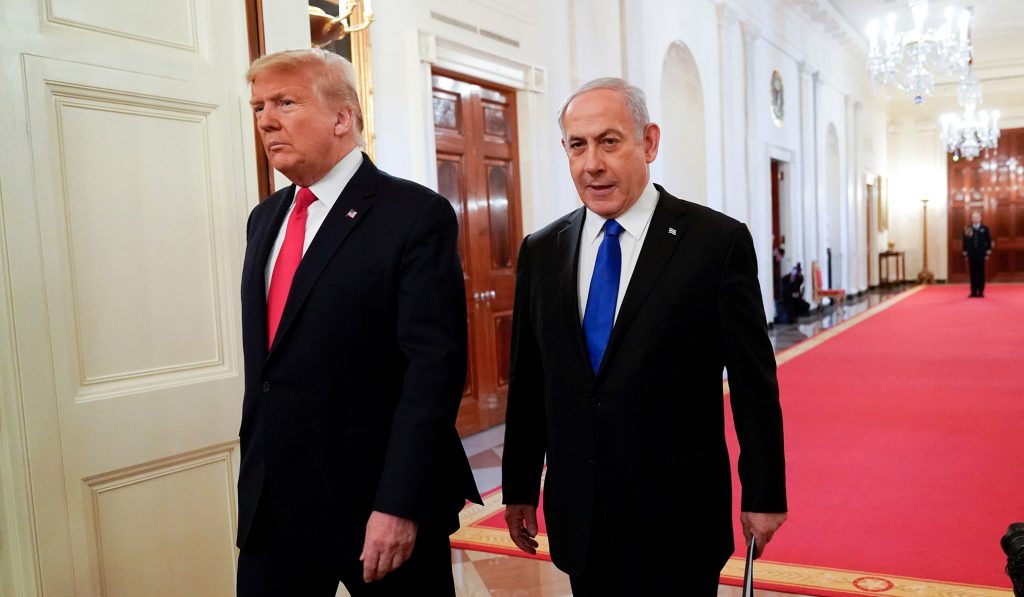
"Today Israel has taken a giant step towards peace," Trump said as Israeli Prime Minister Benjamin Netanyahu stood by his side.

"My vision presents a win-win solution for both sides," he said, adding that Israeli leaders have said they will endorse the proposal, which is referred to as the Middle East peace plan.

Abbas: Trump is a dog and the son of a dog, I won't become a traitor.


Abbas further claimed that "I was told I'll pay a heavy price for my foolish behavior. I do not have much longer to live and I will not go down as a traitor. It's either dying like martyrs or flying the Palestinian flag on the walls of Jerusalem."

Turning to Hamas and the Islamic Jihad, Abbas said that whoever wants to help is welcome.

"We invited the Hamas movement to attend the emergency meeting of the leadership and they will take part in the meeting," senior Palestinian official Azzam al-Ahmed said.

The elected government of Gaza have been at odds with President Mahmoud Abbas' Fatah movement for years, with Hamas representatives rarely taking part in meetings of the West Bank-based Palestinian leadership.

The Palestinians meanwhile have urged world powers to reject Trump's plan.


"We call on the international community to not be partners in this (plan) because it contravenes international law," Palestinian prime minister Mohammed Shtayyeh said on Monday.
The details of Trump's initiative, which has been in the works since 2017, are not yet public.

The release of the plan comes as Trump faces impeachment hearings over abuse of office.

Netanyahu is facing imminent trial proceedings, after dropping his request for parliamentary immunity from corruption charges in a surprise move Tuesday.
"This is a plan to protect Trump from impeachment and protect Netanyahu from prison," Shtayyeh told a cabinet meeting Monday. "It is not a Middle East peace plan."
With little global support for Trump’s plan, it’s likely destined for the trash heap of diplomatic history. Before it goes there, though, you can read the full report here.

A New World Order is Emerging: Does the West Adapt or Perish.

UST2211
The past week has seen the celebration of the anniversary from January 1945 of the liberation of the Auschwitz death camp by Soviet forces. The casual reader of the speech given by United States Vice President Mike Pence could be forgiven for not realising that the liberation was carried out by Soviet forces. Although a relatively trivial slur by the United States Vice President it was symptomatic of a wider tendency in the United States perception of world events.
The liberation of Auschwitz was followed four months later by the final defeat of Nazi Germany and the end of the European phase of the world war. Many thought and hoped that it marked the end of an old discredited era and the beginning of a brave new world. This optimism was manifested in the founding of the United Nations. Many saw that development as commencing a new era with the scourge of war that could be, if not abolished, at least severely limited.
That optimism was exemplified in the United Nations Charter, one of the most important provisions of which was a severe limitation on the circumstances in which a country could take military action against another country. Essentially, a country could take military action either in self-defence, or with the imprimatur of the United Nations Security Council.
The Security Council itself reflected the geopolitical realities of 1945, with its five permanent members being the five victorious powers of World War Two, namely, the United States, the Soviet Union, Great Britain, France and China. Whatever justification there may have been for those five permanent members in 1945 has not stood the test of time.
China’s seat on the Security Council was held by the Chiang Kai Shek government. Although that government was defeated in the Chinese Civil War that ended in 1949 with the Nationalists fleeing to Formosa (modern day Taiwan) they continued to hold China’s seat on the Security Council for a further 26 years. This manifest absurdity was finally ended in 1971.
Today, France and the United Kingdom retain their seats on the Security Council although the logical basis for doing so has long since dissipated. Germany and Japan are both vastly greater economic powers than France and the United Kingdom and in their respective regions have more economic and political influence than that of the two nominal victors.
The greatest failure of the United Nations Security Council however, has been its inability to actually give effect to the provisions of Article 2 (3) and (4) of the United Nations Charter and prevent one of its members, the United States, from engaging in almost continuous warfare in the 75 years since the United Nations Charter was formulated and ratified by its founding members.
The history of that relentless warfare by the United States has been well documented and won’t be repeated here. In the early years of the United Nations, the United States’ overwhelming military strength meant that there was little the rest of the world could do to enforce constraint and adherence to the fundamental United Nations principle of the peaceful resolution of disputes.
Although the Soviet Union was the dominant power in its region of influence, relentless propaganda to the contrary by the West notwithstanding, the Soviet Union never exercised real power outside its geographical framework.
The collapse of the Soviet Union in 1990, and with China still relatively weak, it seemed that the United States had achieved its ambition of global dominance. They certainly behaved as if they did. If a week is a long time in politics, the passage of two decades must seem like an eternity, but if there is one outstanding geopolitical feature of the past two decades, it is that all of the West’s assumptions in 2000 have by 2020 turned to ashes. This is not to say that those assumptions have been discarded, or that the western powers have adjusted their behaviour significantly to reflect the new realities.
On the contrary, at least in the case of the United States, the world has witnessed what may fairly be described as a doubling down on their view of the world and aggressive behaviour to match. Trump personifies that aggression and “America first” ideology, but he is far from alone.
The new century began with a United States lead Western invasion of Afghanistan. That history is well documented. Suffice to say here that the ostensible reason for the invasion, Afghanistan’s alleged responsibility for the attacks on New York and Washington in September 2001 remains one of the great lies and the result one of the great war crimes of the 21st-century.
Eighteen+ years later the United States and some of its allies are still there, still bombing civilians, and still lying about their true motives: a foothold on the border of China and the former Soviet “stans”; control of the immensely lucrative heroin trade; and access to several rare minerals. The United States may indeed leave Afghanistan, as Trump professes to believe, but it will not be voluntarily.
The exact same pattern was repeated in 2003 when again the United States and its allies attacked Iraq, this time for alleged possession of “weapons of mass destruction”. When that lie was rapidly exposed there was no apology, no withdrawal, and no compensation paid.
Again, more than 16 years later, those invading forces are still there. Earlier in January of this year the Iraqi parliament unanimously passed a resolution demanding the withdrawal of all foreign troops. The demand was simply ignored by occupying forces such as the United States, United Kingdom and Australia. Nothing speaks more clearly than the arrogant disregard for the Iraqi national sovereignty then this utter refusal to leave a country when demanded to do so by its sovereign government. It is reported that when the Iraqi Prime Minister raised the issue with United States Secretary of State Mike Pompeo, the latter simply laughed.
The Americans similarly refused to leave Iraq’s neighbour Syria, that they invaded in complete defiance of international law and remain unwelcome and uninvited. It is no coincidence that the area of Iraq that the United States continues to occupy is the oil producing region. They not only occupy that region, they are processing the oil extracted, selling it, and keeping the proceeds. There could be fewer clearer examples of brazen theft and contempt for international law. Again, United States actions bear no resemblance either to the United Nations Charter or their own hypocritical professed belief in “the rules based international order”.
The Australian government has for the most part kept an embarrassed silence about the Iraqi demand to leave. Their professed reason for being there, to train Iraqi troops hardly survives the most elementary of tests: how can one stay to “help” someone who manifestly wishes you to be gone?
The American campaign against Iran, active since at least 1979 when the Islamic revolution overthrew their man in Teheran, the Shah, shows no sign of abating. There is now very good evidence that the Ukrainian plane that was shot down by Iranian air defence, was the victim of a deliberate jamming of the plane’s electronic system that identified it as a civilian aircraft.
The Iranians obviously had no motive to do so. The disaster occurred within hours of the successful Iranian retaliation on US targets in Iraq in response to the assassination of the Iranian’s military chief (and eight other victims) who was on a diplomatic mission at the time (and carrying a diplomatic passport). The full story of this tragedy is yet to be heard. Trump has backed away from his initial claim of no United States casualties from the Iranian attack to an acknowledgement of severe injuries including psychological effects on several dozen United States military personnel.
The furore over the shooting down of the Ukrainian plane (with most of the victims Iranian, also significant) has tended to obscure the significance of what was arguably the more significant geopolitical move, the joint Chinese, Iranian, Russian naval exercises in waters proximate to Iranian territory.
Iran is becoming an increasingly important component of several major geopolitical and trade related moves by China, India and Russia. The significance of these developments is consistently underreported in the western media, in particular in the United States and Australia, both of which countries have declined to participate in what is undoubtably the major geopolitical innovation of the 21st century to date.
Indeed, it is a measure of Australia’s adherence to the United States view of the world that it should refuse to participate in these great projects (unlike 160 other world countries) and which involve Australia’s major trading partners.
All of these 21st century developments signify at least one major fact. The western domination of the world, including trade, economic development and coming to an end. A failure to recognise that reality and taking steps to oppose, undermine, and in many cases actively sabotage that development, only delays the inevitable.
The terrible risk for the world is that the failing and flailing empires of the past will try to resist that inevitable development. In doing so they threaten the very future of the planet.

James O’Neill, an Australian-based Barrister at Law, exclusively for the online magazine “New Eastern Outlook”.