Sunday, June 01, 2025

‘Militarized Aid’: Washington Post Slams Israeli ‘Humanitarian’ Plan for Gaza

By Palestine Chronicle Staff
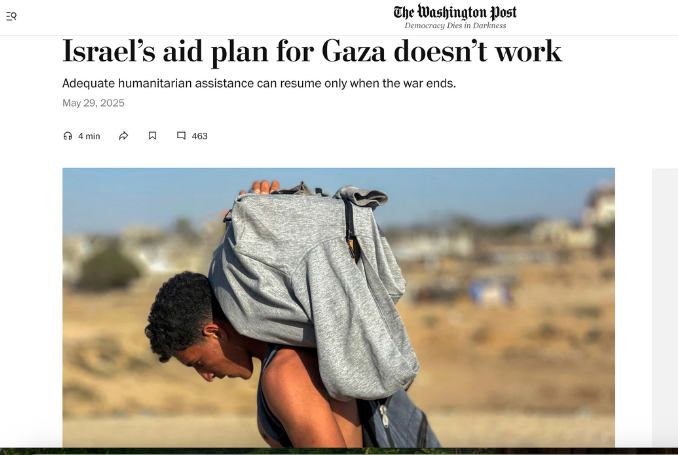
The Washington Post harshly criticized the US-Israeli 'humanitarian plan' for Gaza. (Photo: screen grab)

The Washington Post has condemned Israel’s militarized Gaza aid distribution plan as insufficient, dangerous, and a possible prelude to forced displacement.

The Washington Post has published a sharply critical editorial arguing that Gaza’s suffering has been prolonged and that international response to widespread hunger and deprivation remains minimal. 

According to the newspaper, meaningful humanitarian relief cannot resume unless the war ends.

The paper states that while any aid to Gaza should be welcomed, the chaos surrounding Israel’s newly launched distribution system—managed by the so-called Gaza Humanitarian Foundation and tied to both the Israeli and US governments—has shown the futility of this approach. 

The system, which relies on private American military contractors and is heavily militarized, has failed to meet the urgent needs of nearly two million Palestinians.

“The plan is dangerous because it forces Palestinians to pass through fenced-in Israeli military checkpoints and submit to identity checks, then come into close contact with the armed private contractors who guard the deliveries,” the report noted, adding: “In other words, it militarizes the distribution of aid”.

The paper frames this initiative as a response to international pressure, especially from allies who have warned that mass starvation in Gaza is unacceptable. 

“Netanyahu has claimed, without providing evidence, that the humanitarian aid that earlier was distributed by the United Nations and other international relief agencies was being siphoned off and sold by Hamas,” the report said, stating that the new system is now presented as a substitute, that the Washington Post describes as “insufficient, dangerous and ultimately unworkable.”

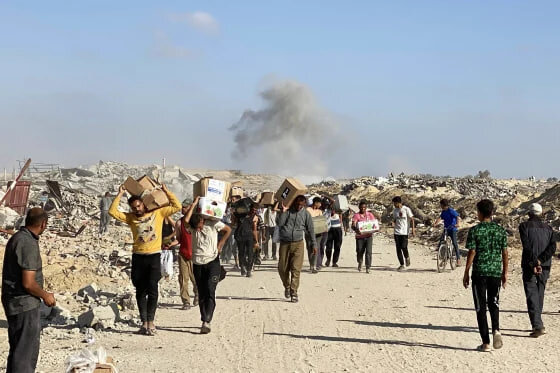
Currently, only four distribution centers operate in the southern Gaza Strip, with Israel pledging to allow about 100 aid trucks a day, five days a week—far short of the 500 trucks that entered daily before the war. 

Unlike the UN’s previous efforts, which “delivered food to hundreds of distribution centers around the enclave”, this limited operation forces Palestinians in the north to make the dangerous journey south. 

The editorial warns that this appears to be part of a broader plan to forcibly displace the population, “perhaps as a prelude to eventual expulsion from Gaza — something Israeli extremists have long advocated,” the report noted.

Netanyahu himself has fueled this suspicion by stating that the goal is to create a “sterile area” in the south where all civilians would be relocated “for protection.”

According to the Post, the militarization of aid raises the risk of further chaos and violence. A recent example cited is when Israeli forces opened fire at one of the distribution points, killing one Palestinian and injuring at least 48 others.

The editorial concludes that the plan is not viable. Even if Israel can impose a tightly controlled system that delivers minimal aid, this will not satisfy the growing demands for a ceasefire voiced by international partners—including the UK, the EU, and even US President Donald Trump.

(The Palestine Chronicle)

Key Elements Iran Needs in a Potential Agreement

 By Soheila Zarfam

TEHRAN – As diplomatic efforts to revive the nuclear agreement between Iran and world powers gather momentum once again, much of the international focus continues to center on what Iran must do—its nuclear obligations, inspection regimes, enrichment limits, and regional behavior.

What is conspicuously absent from many of these discussions, however, is an equally rigorous conversation about what the United States is obligated to deliver in return.

The failure of the United States to uphold its own commitments to the 2015 nuclear deal—most notably the unilateral withdrawal from the agreement in 2018 by Donald Trump in his first term as president, has had far-reaching consequences. It not only undermined the deal itself but also eroded the trust necessary for any future agreement to be meaningful or sustainable.

If a new nuclear deal is to be reached, Iran’s expectations must be addressed not as secondary conditions, but as core components of the agreement. At the heart of Iran’s position lies one non-negotiable demand: an effective, verifiable, and irreversible lifting of sanctions. Without this, there can be no genuine agreement.

Sanctions relief: The core of Iran’s demands

Iran’s nuclear program has always been linked to the question of sanctions, arguably more than to the technical aspects of the program itself. For Iran, the JCPOA was not just a nuclear accord; it was an economic opening. The country agreed to limit its nuclear capabilities in exchange for relief from crippling U.S. and international sanctions. But that relief never fully materialized, even before the Trump administration’s withdrawal.

One key lesson Iran has drawn from the JCPOA experience is that vague promises of sanctions relief are insufficient. Iranian banks and businesses continued to face serious obstacles due to the enduring presence of U.S. secondary sanctions. Worse still, the Trump administration’s decision to walk away from the deal demonstrated how easily such commitments could be reversed at virtually no cost.

This time around, Iran is demanding more than paper guarantees. 

According to Majid Shakeri, an Iranian economic expert, the current discussions overwhelmingly focus on what the United States expects—namely the limitation of Iran’s nuclear program—while completely neglecting what Iran should gain in return.

“There’s been plenty of debate around how a relatively stable or logical arrangement between Iran and the U.S. might look. But almost all of it focuses on the American side’s expected gains, such as limiting Iran’s nuclear activities under various names like temporary suspension or international consortia,” Shakeri tells the Tehran Times. “Yet nothing is said about what Iran should gain.”

He argues that simply avoiding military conflict is not a sufficient gain for Iran. “If Washington really wanted to use military campaigns to curtail Iran’s program, it wouldn’t wait a second,” the economic expert asserted. “So, common sense dictates that a sustainable agreement must include measurable economic returns for Iran.”

 From sanctions relief to tangible economic benefit

Shakeri contends that Iran must shift the focus from mere “sanctions relief” to economic benefit—or as he calls it, “measurable profit.” He explains:

“Sanctions are just one of many tools used to pressure Iran. The U.S. also employs tariffs, patent controls, and financial risk ratings, none of which fall under the usual sanctions framework. So, focusing solely on ‘sanctions relief’ is misguided.”

Instead, he says, the Iranian negotiating team must demand quantifiable economic returns in exchange for the U.S.'s quantifiable nuclear demands. “If the Americans want verifiable limits with oversight by the IAEA and even direct U.S.-linked monitors, then Iran should seek verifiable economic benefits overseen by its own institutions like the Central Bank and Ministry of Economy.”

Shakeri believes a strategic pivot can benefit both sides. “Rather than exchanging strengths, Iran and the U.S. can engage in deals that compensate for each other’s weaknesses.” 

He notes that Iran needs capital goods for industrial growth, while the U.S., especially under a second Trump administration, will be seeking ways to maintain its energy dominance amid pressure from OPEC+ and increasing Russian and Saudi output.

“These complementary needs offer fertile ground for win-win solutions that don’t necessarily involve political concessions or diplomatic humiliation,” he comments.

The expert also emphasizes that any durable arrangement must avoid linkage to regional countries and instead be direct, mutual, and centered on the parties' core needs.

Enrichment, independence, and the path forward

During a visit to Imam Khomeini’s mausoleum on Saturday, Iranian Foreign Minister Abbas Araghchi reaffirmed that Iran’s right to enrich uranium stems from a foundational principle: resistance to foreign domination.

“There is much to say about enrichment as one of the country’s necessities, but more fundamentally, our guiding principle in these negotiations is rejecting domination,” he said.

After the fifth round of indirect U.S.-Iran talks in Rome, Araghchi called the session “one of the most professional rounds we have ever had,” and affirmed that Iran’s “completely clear” positions were firmly conveyed.

Separately, nuclear chief Mohammad Eslami reiterated that Iran’s nuclear trajectory is driven by national interests, not foreign dictates.

For Iran, any nuclear deal must be more than a diplomatic gesture—it must function as a binding economic agreement that delivers measurable and protected benefits. Iranian officials are united in their view that the nuclear program cannot be used as a bargaining chip without guaranteed, tangible gains.

And those gains must be insulated from the political whims of future U.S. administrations.

The road to a sustainable agreement runs not only through centrifuge halls and inspection checklists, but also through ports, banks, and economic frameworks. Only when both sides are bound—and benefited—can a nuclear agreement be truly viable.

UN nuclear watchdog accuses Iran of NPT 'non-compliance' amid western pressure

 Western diplomats seek to use new IAEA reports to declare Tehran in violation of the nuclear non-proliferation treaty  

News Desk - The Cradle 

The UN nuclear watchdog has produced two reports regarding Iran's nuclear program, which western diplomats plan to use to pressure the Islamic Republic at the UN Security Council and in negotiations with Washington, Reuters reported on 31 May.

A report issued by the International Atomic Energy Agency (IAEA) and sent to member states on Saturday said Iran's stock of uranium enriched to up to 60 percent purity had grown by roughly half to 408.6 kg.

That is enough uranium, if enriched to the 90 percent purity level, for nine nuclear weapons, according to an IAEA estimate.

The second report claims that Iran carried out secret nuclear activities with material not declared to the UN nucelar watchdog at three locations decades ago.

The findings in the "comprehensive" IAEA report "pave the way for a push by the United States, Britain, France and Germany for the board to declare Iran in violation of its non-proliferation obligations," Reuters wrote.

Using the report's findings, the four Western powers plan to pressure the IAEA to declare that Iran is in non-compliance with its obligations under the Nuclear Non-Proliferation Treaty (NPT) at its next meeting in June, diplomats told the news agency.

Iran has not been formally found in non-compliance with the NPT in nearly twenty years.

An IAEA board resolution passed in February 2006 referred Iran's non-compliance to the UN Security Council, which later imposed sanctions on Iran.

The report is likely to lead to Iran being referred to the UN Security Council as well, the diplomats said.

Iran says its nuclear program is for peaceful purposes, including producing medicines and electricity.

Israel and the US claim the Islamic Republic seeks to produce a nuclear weapon.

Iranian officials have stated that acquiring nuclear weapons is un-Islamic because, if used, they would indiscriminately kill civilians.

Israel itself has an undeclared nuclear weapons program and has long urged the US to go to war against Iran to stop its nuclear activities.

The two IAEA reports will also complicate ongoing negotiations between the US and Iran. The two countries recently completed a fifth round of talks. A sixth round has not been scheduled.

Iran is seeking relief from US economic sanctions through the talks.

Iranian sources speaking with Al-Mayadeen revealed that Iran warned European officials that "any escalatory step taken through the IAEA would negatively impact the ongoing talks."

US President Donald Trump has threatened to bomb Iran if it does not reach a deal to give up its ability to enrich uranium domestically.

On Saturday, Foreign Minister Abbas Araghchi described nuclear technologies, including uranium enrichment, as an inalienable right of Iranians.

Outsiders have no right to deprive the Iranian nation of its right, he underscored, adding, "Nuclear energy is the Iranian people's inalienable right."

Araghchi noted that Iran agrees to negotiations about ensuring that it does not obtain nuclear weapons because Tehran itself is an opponent of nuclear weapons.

Arab diplomats condemn Israel for barring West Bank visit

Foreign ministers from five Arab states sought to travel to Ramallah for talks on the establishment of a Palestinian state  

News Desk - The Cradle 

The foreign ministers of five Arab countries who had planned to visit the occupied Palestinian West Bank this weekend condemned Israel's decision to block their plans.

The Jordanian foreign ministry issued a statement on 31 May saying the ministers condemned "Israel's decision to ban the delegation's visit to Ramallah (on Sunday) to meet with the president of the State of Palestine, Mahmoud Abbas."

The Israeli army controls all borders and entry points to the occupied West Bank, including from neighboring Jordan, making entry to and exit from the Palestinian territories contingent on Israeli authorities.

Ministers from Egypt, Jordan, Qatar, Saudi Arabia, and the UAE had been expected to enter the West Bank to take part in a meeting with Palestinian Authority (PA) officials concerning the establishment of a Palestinian state.

Earlier on Saturday, Israeli officials said they would not allow a planned meeting in the Palestinian administrative capital of Ramallah, in the occupied West Bank, to go ahead.

The announcement came after media reports that Arab ministers planning to attend had been stopped from coming.

An Israeli official claimed the ministers intended to take part in "a provocative meeting" to discuss promoting the establishment of a Palestinian state.

"Such a state would undoubtedly become a terrorist state in the heart of the land of Israel," the official said. "Israel will not cooperate with such moves aimed at harming it and its security."

Israel conquered the West Bank in 1967 and has slowly stolen more and more Palestinian land to establish Jewish settlements, which are illegal under international law.

A PA official stated that the issue of whether the meeting in Ramallah would proceed was under discussion.

The move comes ahead of an international conference, co-chaired by France and Saudi Arabia, planned for June 17-20 in New York. Delegates are expected to discuss the issue of Palestinian statehood.

Israel has come under increasing pressure from the UN and European countries to agree to allow the establishment of a Palestinian state.

French President Emmanuel Macron said on Friday that recognizing a Palestinian state was not only a "moral duty but a political necessity."

Role of the economy in reinforcing Iran-Oman ties

 TEHRAN PAPERS

TEHRAN - In a note, Arman-e-Emrooz discussed the relations between Oman and Iran and wrote: The relations between Iran and Oman are not limited to the political and diplomatic arenas, but have also expanded to the economic field.

An implementation of the proposed projects, especially the gas pipeline project that extends from the southern coast of Iran to the port of Sohar in Oman, would solidify ties between the two coastal neighbors. This project presents a rare opportunity to transform the Kingdom of Oman into a regional hub for gas exports, leveraging its advanced infrastructure and strategic geographical location. Also, considering the export restrictions due to international sanctions on Iran, this plan provides Iran with a growing economic outlet and opens new horizons for the injection of Iranian gas into global markets. The Iranian gas pipeline to Oman will even provide the possibility of expanding the network to other regional destinations and India in the future. The importance of Oman as a trading partner for Iran is very significant, not only because of its access to the Persian Gulf and African markets but also because of the friendly business environment and the supportive policies of the Omani government.

Vatan-e-Emrooz: Emphasis on red lines

Iran's position was expressed openly as Foreign Minister Araghchi emphasized Iran's red lines at the beginning of the indirect talks between Iran and the United States: "The lifting of all sanctions and the recognition of Iran's right to nuclear enrichment", two key issues that Tehran has always pursued in negotiations, and until these two rights are realized, it is impossible to comment on the agreement or its timing. Therefore, in a situation where the American side has not yet revised its position on stopping enrichment in Iran, the discussion that an agreement is imminent is irrelevant. Accordingly, the Foreign Minister clarified that Iran is not yet sure that it is at the point of "an imminent agreement" with the Americans. It seems that the Americans' rush to announce the imminent agreement is a propaganda in line with psychological warfare, to affect public opinion in Iran. Accordingly, the approach being followed by Western media and American officials may suggest that America is seeking an agreement with Iran, although Iranian officials are in no hurry to reach this agreement. Given the experience of the JCPOA and the United States’ unilateral withdrawal from it, coupled with the non-commitment of other Western parties to it, this time Iran is pursuing negotiations without haste, and does not intend to be a victim of propaganda.

Javan: The need to use experiences in the past talks 

In a commentary, Javan discussed the principles that should be taken seriously during the current negotiations and said: During the current negotiations, which are in their final moments, five key principles should be taken seriously based on the past experiences and current realities: avoiding politicization, independence of the economy from negotiations, adopting an active narration, rebuilding the image of Iran's authority, and synergy with domestic currents. The indirect talks between Iran and the United States in 2025 are in a different context than in 2013. Changes in the geography of power, including the decline of American influence, the emergence of new blocs, and the economic crises in Europe, along with internal changes in Iran, convergence in decision-making, and social maturity, have provided new opportunities for Iranian diplomacy. The success of negotiations does not lie in signing a formal agreement, but in following a comprehensive strategy to strengthen domestic power and leverage global opportunities. In this endeavor, preserving the three principles of “honor, wisdom, and expediency” as the core of Iran's revolutionary diplomacy is an undeniable necessity.

Shargh: The sixth round of Iran-U.S. negotiations?!

In an analysis, Shargh examined the pressure from Western media outlets on the eve of the sixth round of negotiations and stated: Although some Western media outlets are speculating and reporting vaguely about the proximity to an agreement or the existence of a framework known as the "Muscat Framework," Iranian and American officials have denied announcing the time and place of the sixth round of talks and emphasized that a final agreement has not yet been reached. Fundamental differences regarding the preservation of Iran's nuclear rights and the complete lifting of sanctions still persist, and any definitive decision on continuing the negotiations depends on actual progress at the negotiating table. In sum, it should be emphasized that given the official positions of the parties, the existence of the option of simultaneous threats and negotiations on the table, and the imposition of new U.S. sanctions against Iran, no definitive decision has yet been made regarding the time and place of the sixth round of negotiations, and all news published in this regard remains speculative. The negotiation process must continue in a diplomatic atmosphere and without media attention to enable a lasting agreement.

UN Arab Group accuses Israel of weaponizing starvation, 2 food seekers killed

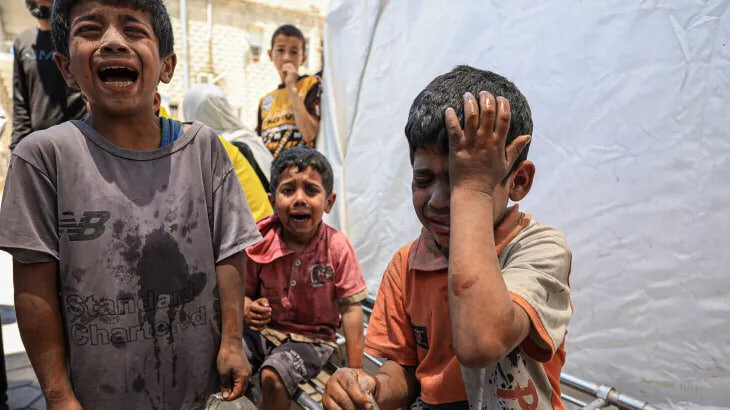
Arab states are accusing Israel of weaponizing hunger in Gaza, rejecting its new aid system as illegal, Al Jazeera reported.

“Starvation is being used as a weapon of war,” said UAE envoy Mohamed Abushahab, speaking on behalf of 22 Arab League members at the UN.

The United Nations Office for the Coordination of Humanitarian Affairs has said Gaza is the “hungriest place on Earth” and the enclave’s entire 2.3 million people face “catastrophic hunger”.

Israeli forces have fired on a group of people trying to reach an aid center near Rafah, killing at least two, the Wafa news agency reported.

The scene mirrors events from Friday, when Israeli troops also fired on Palestinians trying to access newly established aid centers, wounding at least 20.

Gaza food delivery group ‘not humanitarian aid’: UN

UN Special Rapporteur on the right to food Michael Fakhri says the UN is ready to send its convoys, but that Israel is still denying aid following its 80-day blockade of Gaza.

Fakhri described the Gaza Humanitarian Foundation (GHF), a shadowy organization which Israel has authorized to distribute food, as “bait to corral people” which “violates every principle of international law”.

“This is aid being used … to push people out from the north into militarized zones … and it’s about humiliating people, and it’s about controlling the population. This has nothing to do with stopping starvation.”

An Israeli ban has prevented the UN’s refugee agency from delivering aid to the displaced and hungry people fleeing relentless strikes.

Fakhri emphasized that Israel’s plan, announced in early April, was criticized by every major humanitarian organization and the secretary-general of the UN.