Friday, October 01, 2021

US, UK prepare to re-engage Taliban

by M K Bhadrakumar

Chinese ambassador Wang Yu met Acting Foreign Minister of Taliban Mawlavi Amir Khan Muttaqi, Kabul, September 26, 2021
Pakistan Prime Minister Imran Khan has written yet another opinion piece in the Washington Post, sensing a turning point lies ahead with the Biden Administration assembling a sustainable, durable policy toward Afghanistan taking into account the new reality of the Taliban government. 

Quintessentially, Imran Khan revisited his argument in the earlier WaPo piece in July where he had concluded: “I believe that promoting economic connectivity and regional trade is the key to lasting peace and security in Afghanistan. Further military action is futile.” 

Of course, the June article was written some six weeks before the Taliban captured Afghanistan in mid-August, but his argument is even more compelling today, six weeks after the tumultuous events in Kabul. This time around, Imran Khan persuasively argues with the benefit of hindsight that the right thing to do is to engage with the new Taliban government so as to ensure peace and stability. 

He endorses the international community’s expectations from the Taliban and supplements them by underscoring that the best way to leverage the new government’s policies will be by extending “the consistent humanitarian and developmental assistance they need to run the government effectively.” 

He warns that if the US abandons Afghanistan, “it will inevitably lead to a meltdown. Chaos, mass migration and a revived threat of international terror will be natural corollaries.” 

Imran Khan seems to be emboldened by the consensus between the US, Russia and China that Ashraf Ghani’s nominee will not address the UN GA. It is an implicit signal that nobody is interested to create new facts on the ground. A necessary first step has been taken to address the so-called ‘legitimacy aspect’. 

Imran Khan has not made an issue of the sanctions against Taliban or the recognition of the Taliban government. That is also the Russian and Chinese approach. Foreign Minister Sergey Lavrov said, while addressing the media at the UN Hqs in New York on Saturday, “There is no need for this (sanctions) for us to be able to engage with the Taliban movement at this stage. We all expect the Taliban to honour all the good-minded promises they made.” 

Lavrov added, “There is a sufficient number of exemptions from sanctions imposed on the Taliban. This has been made on purpose to enable [the international community] to have a dialogue with them. It means that the UN Security Council recognises the Taliban as an inalienable part of Afghan society… 

“We have mentioned the unfreezing of the assets. We think that this matter should be given a practical consideration… Serving in Moscow today is the ambassador appointed by the previous government. No one is urging an international recognition of the Taliban.” 

Lavrov stressed, “We believe, and we did believe from the outset, that what has happened there [Afghanistan] is a reality… The reality on the ground is based on statements made by the Taliban… What matters the most at the moment is that they fulfil their promises… The Taliban claim to be moving in this direction, and the current architecture is only temporary. What matters the most is to make sure that they keep the promises that they made in public… We will do everything we can to support the Taliban in their determination… to fight ISIS and other terrorist groups, and to try to make sure that this determination paves the way to some practical progress.” read more

There is no more talk in Washington about “out-of-the-horizon” attacks on Afghanistan. Locus has shifted to diplomacy. The Biden Administration is at an inflection point. Indeed, it is difficult to disagree with Imran Khan’s narrative.

Meanwhile, the regional tour by the US Deputy Secretary of State Wendy Sherman next week includes Tashkent, New Delhi and Islamabad. Sherman is the ace negotiator in the Biden Team — low-key, highly skilled professional with the patience for filling in details. Clearly, Afghanistan is her main agenda. 

The inclusion of Tashkent in Sherman’s itinerary is particularly noteworthy. Uzbekistan has stepped out to signal that it is ready to not only talk but do business with the Taliban government. Only last week, Uzbek president’s special representative on Afghanistan, Ismatulla Irgashev, called for the restoration of road and rail links with Afghanistan in order to help ship “food and medical supplies.”

Uzbekistan is practically the gateway and a viable transit route from Afghanistan to Central Asia, China and Europe. Significantly, last week, the UK Minister for the Armed Forces, James Heappey visited Termez, the transit port on the Uzbek-Afghan border. 

There is yet another dimension to regional connectivity. In July, the Biden Administration had announced a Quadrilateral Diplomatic Platform “focused on enhancing regional connectivity”, predicated on the political assessment that peace in Afghanistan and regional connectivity “are mutually reinforcing.” The four countries had “agreed to meet in the coming months to determine the modalities of this cooperation with mutual consensus.” read more

There is growing acceptance of the idea by the international community — the UN, in particular — that engaging the Taliban government is a far better approach than ostracising it. The path pursued in the 1990s —  refusing to recognise the Taliban government and giving the country’s seat to the warlord-dominated Rabbani government — proved counterproductive.

The Biden Administration’s stance that the international community should remain united on a range of commitments before granting legitimacy or support beyond humanitarian aid to Taliban is not disputed by anyone but there’ll be misgivings that Washington may start dictating the road map ahead. 

However, there is also grudging acceptance by Washington that while the US may have leverage on the Taliban, as the State Department spokesman Ned Price told reporters on Friday, “But we have all the more leverage when we work in coordination and in harmony with our allies and partners around the globe.” Conversely, on the part of the Taliban too, their restrained behaviour so far signals their desire for recognition. 

The trend toward re-engaging the Taliban may accelerate following the talks today by the visiting British Foreign Secretary Elizabeth Truss in Islamabad. The British Foreign Office readout said the two top diplomats discussed the situation in Afghanistan “and the need for the international community to work together to ensure a coordinated approach. They reaffirmed their commitment to preventing Afghanistan from becoming a safe haven for terror and providing vital humanitarian assistance for ordinary Afghans.” 

On October 6, Sherman will be in Islamabad on a two-day visit. Britain has been urging Washington for a proactive policy and was the brain behind the meeting of the P-5 last week in New York to reconnect with Russia and China following their rejection of a similar G7 overture earlier. 

Stalemate doesn’t suit the US and the UK. Chinese ambassador Wang Yu met The Taliban Foreign Minister Mowlavi Amir Khan Muttaqi twice during the past fortnight, including on Sunday. Earlier, the special envoys of Russia, China and Pakistan jointly met the Acting Taliban Prime Minister Mullah Hasan Akhund.

Evidently, there is some heartburn in London and Washington that the Sino-Russian caravan is on the move on the Silk Road while they are stuck up in New York. This happens when you ride a high horse. The overall climate of relations between the US and the UK on one hand and Russia and China on the other is very poor. Pakistan cannot be unaware of it.

Ambassador M K Bhadrakumar served the Indian Foreign Service for more than 29 years. He introduces about himself thus:  “Roughly half of the 3 decades of my diplomatic career was devoted to assignments on the territories of the former Soviet Union and to Pakistan, Iran and Afghanistan. Other overseas postings included South Korea, Sri Lanka, Germany, and Turkey. I write mainly on Indian foreign policy and the affairs of the Middle East, Eurasia, Central Asia, South Asia and the Asia-Pacific…”

The twisted logic of Iran deal opponents

Paul R. Pillar

The arguments they make against the JCPOA make no sense, and instead appear meant to obscure the sources of Iranian conduct.

Insofar as U.S. policy influences Iranian policy, those who have always opposed the Joint Comprehensive Plan of Action, the multilateral agreement that limited Iran’s nuclear program, have to be creative in constructing their talking points. The record of the last six years has shown that the first half of that period, when the JCPOA was fully in force and international monitoring confirmed Iran’s compliance with the strict limits that the agreement had imposed on Iran’s nuclear activities, was markedly better than the second half that began after the Trump administration reneged in 2018 on U.S. obligations under the JCPOA and thereby relieved Iran of its obligations.

Trump’s subsequent “maximum pressure” campaign against Iran was a conspicuous failure on every front. A year after Washington’s reneging, Iran started ramping up its uranium enrichment beyond the JCPOA limits to the point where the estimated “break-out” time it would now need to make enough fissile material for a nuclear weapon is down to only a month or two, rather than approximately a year under the JCPOA. Iranian regional activity became at least as aggressive as it was before. And with the U.S. reneging having politically discredited those leaders within Iran who favored concessions and negotiations with the West, hard-liners are now firmly in control in Tehran.

Among the creative arguments attempted by JCPOA opponents is to blame the consequences of withdrawal that have flowed on the JCPOA itself, instead of on Trump’s renunciation of the deal. Richard Goldberg of the misleadingly named Foundation for Defense of Democracies, an advocacy group that has made opposition to diplomacy with Iran and especially the JCPOA its signature issue, tried this technique when I appeared with him several weeks ago in a program aired in Arabic to audiences in the Middle East. The current worry about breakout times is due to shortcomings of the JCPOA, argued Goldberg, because it left Iran with a nuclear base from which it could expand. He left unsaid that the base Iran had before it was required to dispose of most of it under the JCPOA was many times bigger than what it had when the agreement was in force.

Since the Biden administration came into office, another technique of the opponents has been to blame current Iranian practices on a supposedly softer U.S. policy toward Iran even though, as far as economic punishment is concerned, the policy isn’t really softer at all. A panoply of sanctions the Trump administration imposed on Iran remains in effect, and the Biden administration is even actively enforcing an embargo on oil purchases from Iran. This may not be called maximum pressure — and the Biden administration’s objective is to use sanctions as an incentive to reach an agreement rather than as a means for subverting one — but so far the practical effect from Tehran’s viewpoint is much the same.

That fact hasn’t stopped JCPOA opponents — several of whom are quoted in a recent article by Michael Hirsh in Foreign Policy — from making it sound like Iran is now doing all sorts of bolder and more aggressive things, and maybe even pursuing a nuclear weapon, because the Biden administration supposedly has gone soft on Iran. So FDD’s Behnam Ben Taleblu says, “The biggest factor stiffening Iran’s spine is that the regime believes that not only did it survive maximum pressure and outlive the Trump administration, but that such crippling penalties and political pressure will not be coming back [emphasis added] anytime soon.” “Coming back”? The penalties and pressure are still there. If Iran’s spine is stiff, it is in the face of such pressure, not an absence of it.

The same article refers to an “Afghanistan effect” that postulates a drop in U.S. credibility resulting from the withdrawal of U.S. forces from Afghanistan. But it is fallacy to believe that a state that withdraws from a losing situation in which it does not have vital interests at stake will be less credible in foreign eyes when it comes to upholding more important interests in other situations. The United States does indeed have a credibility problem in the current situation with Iran, but it is not one about U.S. toughness not being taken seriously. The credibility problem, after what Trump did to the JCPOA, lies instead with the doubt as to whether the United States can be trusted to live up to its commitments.

This doesn’t matter much to JCPOA opponents who think only in terms of military attacks and not negotiating agreements. Reuel Gerecht, another FDD person quoted in the article (which fails to mention that affiliation) says, “After Afghanistan and his ending the ‘forever wars’ rhetoric, it’s really not credible to imagine Biden using military force against the Iranian nuclear program.” Too bad Gerecht did not address the effect that being on the receiving end of a military attack likely would have on an Iran that previously looked into acquiring nuclear weapons but then, through negotiation, voluntarily closed all paths to acquiring such weapons. There is no reason to think the Iranian response would be much different from that of Saddam Hussein’s Iraq after Israel attacked a nuclear reactor there in 1981 — the response being to embark on a new accelerated clandestine effort to get the bomb.

The same article also quotes Dennis Ross as saying, “The Iranians are clearly not afraid of us any longer. That in itself means we really don’t have the level of deterrence we need, whether on the nuclear issue or in the region.” This statement, if it is meant as a criticism of Biden, misrepresents the very concept of deterrence, which involves the threat of punishment if someone does not comply with our wishes and the withholding of such punishment if there is compliance. To inflict punishment no matter what the other party does — as with Trump’s initiation of economic warfare despite Iran’s adherence to its nuclear limits under the JCPOA — doesn’t create deterrence; it destroys it. Deterrence will be recreated only after the United States repairs that damage.

Ross does get one thing right. He says, “Iran has now adopted a kind of maximum pressure approach on the United States. It is [adopting] a Trumpian approach toward us, with the expectation that we will concede.” Iran is indeed doing worrisome things these days, and many of them are a direct response to the U.S. policy of pressure left over from the previous administration. They are not a result of some misguided kumbaya on the part of its successor.

Greece and France Take First Step Towards European Independence Following AUKUS Debacle

 By Paul ANTONOPOULOS

Of the 30 NATO member states, Greece is one of the few to spend well over 2% of its GDP on defense as agreed upon by NATO Defence Ministers in 2006. However, Greece’s high spending (relative to GDP) is not because it is positioning itself as a buffed-up military state opposed to Russia, as per the aims of NATO, but rather to defend itself against the threats of another NATO member, Turkey. With NATO consistently downplaying Turkish aggression against Greece and the new AUKUS pact creating distrust between the Anglosphere and the Europeans, Greece has ensured new extra security assurances against its long-time enemy.

Greece’s strengthened partnership with France highlights that the immediate consequences of the AUKUS alliance are already being felt as the two countries are making the first serious steps towards a Europe independent of Washington.

Alexis Papahelas, one of Greece’s top journalists, explained that the Franco-Greek security pact is Macron’s “revenge” against the Americans as it will strengthen European autonomy. He also confirmed persistent rumours that a defensive pact between France and Greece was almost reached last year, but ultimately broke down at the last minute for “unknown reasons.”

To put the situation in context, Greece for a year and a half-received bids from six countries, including France, the U.S., and UK for brand new navy frigates. The finalization of a deal was continuously delayed due to Greece’s insistence that a frigate purchase must include a defense agreement. Greece signed a 12-month Mutual Defense Cooperation Agreement (MDCA) with the U.S. last year, but ultimately did not decide on which frigate bid to accept. With negotiations for a Franco-Greek defence pact last year stalling, Athens ultimately decided to sign the MDCA with Washington. This was rumored to be partially motivated as part of negotiations to pressure the French to accept Greek terms. However, with the sudden emergence of AUKUS, European trust in the Anglosphere quickly diminished and thus galvanized Franco-Greek discussions on European independence. And finally, a deal to purchase three brand-new French Belharra-class frigates was stricken.

For his part, Mitsotakis said on Tuesday morning at the signing of the agreement that: “It is a historic day for Greece and France. Today’s development is an initiative that responds to the demands of the times on our continent. It paves the way for an autonomous and strong Europe of the future. Whether there is a timetable for creating a European army: the debate on European military autonomy evolves. Options such as this corporate defense partnership move to this central strategic choice.”

Effectively, Greece and France are advocating for a pan-European military that would likely drive out NATO as the premier defensive pact in Europe.

Another demonstration that this pact is aimed at supplanting NATO is its careful wording. Although Turkey was not mentioned explicitly, there is little doubt that part of the motivation for the Franco-Greek defense pact was Turkey’s unilateral aggression in the Mediterranean. Even just minutes after the signing of the Franco-Greek agreement, former Dutch diplomat Fons Stoelinga tweeted: “EU autonomy in security and defense. NATO still does not address the problem of NATO-member Turkey destabilizing the whole Eastern Mediterranean region. France and Greece now react and signed a security bilateral pact.”

The mutual defense assistance clause of the agreement ensures that if Greece or France is attacked on its territory, the other will come to assist, even if the attacking country is part of other alliances, including NATO. This is an obvious message directed towards Turkey, a NATO member that on a daily basis violates Greek airspace and threatens to invade its Aegean islands. These violations and threats receive no repercussions from NATO as individual members are unwilling to risk their economic relations with the country, whilst many NATO leaders still believe that Turkey is a bulwark against Russia.

France for most of its modern history, but especially galvanized under President Emmanuel Macron, had the ambition of creating a more independent Europe. The European experience under former U.S. President Donald Trump and the recent snub from President Joe Biden with the AUKUS debacle has only increased the urgency of achieving European independence from Washington. Despite this ambition, as well as warning Europe that it will become secondary in world affairs if it does not become independent, it appears that France can finally kickstart its project alongside Greece.

Achieving EU unity is a difficult prospect because minnow states like Lithuania prioritize the interests of Washington rather than the continent, but as Paris and Athens have shown, they will move ahead in changing the geopolitical balance in the Mediterranean and will not wait while member states continuously bicker amongst themselves on foreign policy issues. If France and Greece can create strong foundations for an independent Europe, it will only be inevitable before more EU member states become interested in also being integrated into a continental structure that is independent of transatlantic alliances.

So Long, CENTCOM, and Good Riddance!

by Andrew Bacevich 

The bad news stemming from the ill-planned and ill-managed U.S. evacuation of the Afghan capital just kept coming in. The Washington Post put it this way in blowing the whistle on the culminating disaster: “U.S. military admits ‘horrible mistake’ in Kabul drone strike that killed 10 Afghans.”

Following the August 26th terrorist attack outside Hamid Karzai International Airport that took the lives of 13 American troops and dozens of Afghan bystanders, U.S. forces set out to preempt any repetition. Alas, efforts to prevent further U.S. casualties resulted in the killing of innocents, including seven Afghan children. “Horrible mistake” was Defense Secretary Lloyd Austin’s characterization of their deaths.

The result was not what General Kenneth F. McKenzie, Jr., head of United States Central Command (CENTCOM), intended. To his credit, McKenzie did acknowledge that he was “fully responsible for this strike and its tragic outcome.” The four-star Marine general went a step further. In a recorded video statement, he offered his “profound condolences to the family and friends of those who were killed.”

It’s easy enough to understand McKenzie’s sense of remorse. Who wouldn’t have felt dismayed — bummed out, even — that such a humiliating blunder should mark the conclusion of a failed twenty-year war? And just as Uncle Sam was limping toward the exit, hoping to leave with a modicum of dignity intact, Fortune itself seemingly let loose one last gratuitous kick, one final insult to the self-proclaimed greatest military on the planet.

But in this particular context, what does the phrase “fully responsible” even signify? Should McKenzie’s acknowledgment prompt him to offer his resignation? Should he be fired? Would his ouster suffice to make amends for those seven dead children?

Given recent events in their country, it’s hard to imagine Afghans even taking notice of the general’s professed feelings or, for that matter, his fate. As for the American people, most of us have moved on. Afghanistan is already so yesterday.

And that, let me suggest, is a problem. Given our notoriously short national attention span, Americans are overlooking a “horrible mistake” of far greater consequence. I refer to the very existence of CENTCOM.

Created by Ronald Reagan in 1983, it’s presently one of 11 Pentagon “combatant commands” that quite literally span the globe, even extending into the great beyond of outer space and cyberspace. CENTCOM’S earthly area of responsibility (AOR) encompasses 20 nations stretching across the Greater Middle East (and only recently came to include Israel as well). The command’s website spells out the specifics: four million square miles inhabited by more than 560 million people from 25 ethnic groups adhering to myriad religious traditions and speaking 20 languages along with a host of local dialects. In itself, though only one of those 11 commands, it’s already a realm of impressively imperial dimensions.

According to its mission statement, the command “directs and enables military operations and activities with allies and partners to increase regional security and stability in support of enduring U.S. interests” throughout that vast area. Yet while security and stability may describe CENTCOM’s nominal aspirations, its true purpose is quite different. Indeed, the implicit purpose of the entire constellation of combatant commands is to affirm American primacy. CENTCOM exists to demonstrate the enduring necessity of American global “leadership,” expressed in straightforwardly military terms via security commitments, a far-flung network of foreign bases, contingency plans and capabilities, muscle-flexing, and the ever-present possibility of what the Pentagon evasively refers to as a “kinetic action.”

In recent decades, this particular combatant command has garnered more attention than any of the others — and with good reason. Its AOR defines the arena in which American primacy has been most hotly contested. Within CENTCOM’s capacious boundaries, the fate of the post-Cold War American imperium is being decided — indeed, may already have been decided.

Someday, probably decades from now, an ambitious historian will publish a critical history of U.S. Central Command during this era. It will be a big book and it will tell an important tale. One thing is certain, however. Whatever that author decides to title her book, it won’t contain the phrase “Security and Stability.” That it may contain some reference to “Decline and Fall” is a distinct possibility. After all, CENTCOM is where the American empire began to come undone.

The Edsel of Pentagon Commands

Since its creation, 14 generals and admirals have presided over CENTCOM, 10 of them since 9/11, with General McKenzie’s appointment dating to March 2019. I have no doubt whatsoever that each of these officers — intelligent, hardworking, and patriotic — did his level best to accomplish CENTCOM’s mission. With a single exception, not one of them came anywhere close.

That exception proved the rule: General H. Norman Schwarzkopf, who commanded CENTCOM during the Gulf War of 1991. As soon as the shooting in that brief campaign stopped, Schwarzkopf wasted no time in stepping down and putting in his retirement papers. The decision proved to be a shrewd one. He thereby dodged the messy aftermath that transformed Operation Desert Storm into something other than the decisive victory it initially appeared to be.

For a brief moment enshrined alongside Gettysburg in a pantheon of American military triumphs, today Desert Storm ranks with the once-celebrated and now long-forgotten Battle of Manila Bay in 1898. True, Commodore Dewey made short work of the Spanish fleet there, just as Schwarzkopf did with the Iraqi army of Saddam Hussein. Yet the ensuing “long war” that eventually pacified the Philippines stuck the United States with a prize of dubious strategic value. Much the same verdict applied to Desert Storm. Liberating Iraqi-occupied Kuwait in 1991 produced little in the way of tangible benefits for the United States.

Painful as it may be for former CENTCOM commanders to admit, the organization’s very existence has coincided with an almost staggering deterioration in regional security and stability throughout the Greater Middle East. The mortifying collapse of the U.S. war effort in Afghanistan 20 years after it began has only served to emphasize the point. Whether things have gone badly due to or in spite of U.S. efforts may be debatable. Nonetheless, whatever Washington’s intentions or those of the Pentagon, the situation in the CENTCOM AOR has become radically more precarious since 1983.

Indeed, CENTCOM is to Pentagon combatant commands what Ford’s 1950s “car of the future,” the Edsel, was to automobiles. Can there be any question that if CENTCOM were a profit-oriented enterprise, it would have gone belly up long ago?

So as members of Congress and the media try to unearth the roots of the Afghanistan debacle, they might consider this proposition: perhaps the problem lies not with General McKenzie or his long train of predecessors but with what those commanders were charged with doing in the first place. They should consider the possibility that, from the very outset, CENTCOM’s chiefs were engaged in an entirely misbegotten enterprise. If indeed that’s the case, then corrective action should involve something more than replacing McKenzie with another officer inevitably cut from the same cloth.

Simply put, the first “horrible mistake” was creating CENTCOM and thereby militarizing American policy in the Greater Middle East. By extension, a necessary step toward preventing further Afghan-style disasters is apparent: Washington should simply abolish that combatant command altogether.

In other words, CENTCOM should go the way of the Edsel. Retire the logo and the patch. Bequeath the motto — “Persistent Excellence” — to some other federal agency (the Postal Service?) desperately in need of inspiration. Send the command’s collection of plaques, trophies, and other tchotchkes to the National Archives to be catalogued, warehoused, and forgotten. Convert CENTCOM’s headquarters complex, located in Tampa, Florida, several time zones away from the AOR, into something of more immediate use — perhaps a facility to assess worsening regional weather patterns.

Ford managed just fine without the Edsel. That the United States and the entire Greater Middle East can get along quite nicely without CENTCOM is a hypothesis worth testing. But step number one must be to abolish the command itself.

Giving Peace — or Something Like It — a Chance

CENTCOM’s creation expressed a conviction that the United States has interests in the Persian Gulf that are worth fighting for. Arguably understandable in the context of the times — the latter part of the Cold War found the American economy dependent on imported oil — this proved to be a misjudgment of epic proportions.

Today, the United States is no longer dependent on foreign oil. Instead, it faces an urgent need to wean itself from fossil fuels altogether. None of that is to suggest that Washington no longer retains any interests in the CENTCOM AOR. Yet while certain interests still do exist, one thing should be increasingly clear: they are not worth fighting for. Instead, they are worth talking about. In other words, securing those interests should be the subject of diplomacy, with military action only considered in the most extreme circumstances.

“Regional security and stability,” the phrase found in CENTCOM’s mission statement, neatly describes those interests. Making the State Department rather than the Pentagon the lead agency in pursuing those goals would bring an entirely different approach to the forefront.

For too long, U.S. policy in the Greater Middle East has been characterized by reckless miscalculation. Henceforth, in a post-CENTCOM era, its hallmarks should be prudence, patience, and restraint.

What might that imply?

Rather than picking sides in regional disputes — Saudi Arabia vs. Iran, Israel vs. Hamas and Hezbollah — the United States should reposition itself as a genuinely honest broker. Rather than chiding some nations for violating human rights and giving others a pass, it should hold all of them (and itself) to a common standard. Rather than flooding the region with advanced weaponry, it should use its influence to reduce arms transfers. Rather than selectively opposing nuclear proliferation, it should do so consistently across the board. Rather than scattering U.S. forces across the region, it should drastically reduce the number of bases it maintains there. At most, two should suffice: an air base in Qatar and a naval facility in Bahrain.

All in all, the United States should lower its regional military profile to approximately what it had been before CENTCOM was created. Going forward, it should be Washington’s policy to defuse conflicts, not fuel them and certainly not to become party to then.

I’m not suggesting that the prescriptions detailed above offer a comprehensive blueprint for “peace in our times.” I am suggesting that it’s past time to stop reinforcing failure. With its implied reliance on coercion as the default expression of U.S. policy in the Greater Middle East, CENTCOM has failed irrevocably.

If policymakers — beginning with President Biden — fancy that the United States has some sort of obligation to “lead,” then they’ll have to reimagine what leading really means. On that score, the lessons of recent decades are unambiguous and undeniable. Invading and occupying countries hasn’t worked. Nor have assassinations, torture, and indefinite detention without trial. As for regime change and nation-building: both have exacted enormous costs (more than $2.3 trillion for the Afghan War alone), while neither has yielded anything faintly like the outcomes promised.

The ultimate “horrible mistake,” to repurpose Secretary of Defense Austin’s phrase, dates from the immediate aftermath of the Cold War when the United States succumbed to a form of auto-intoxication: imperial delusions fueled by an infatuation with military power.

The opportunity now presents itself to change course. Recognizing that the safety and well-being of the American people do not require sustaining a regional U.S. military command that fancies itself called upon to determine the fate of 560 million inhabitants in 21 different countries might just offer a path toward regaining sobriety. After all, recovery begins with taking that first step.

Iran’s nuclear chief to IAEA: Don’t be duped by false reports of anti-Iran terrorists

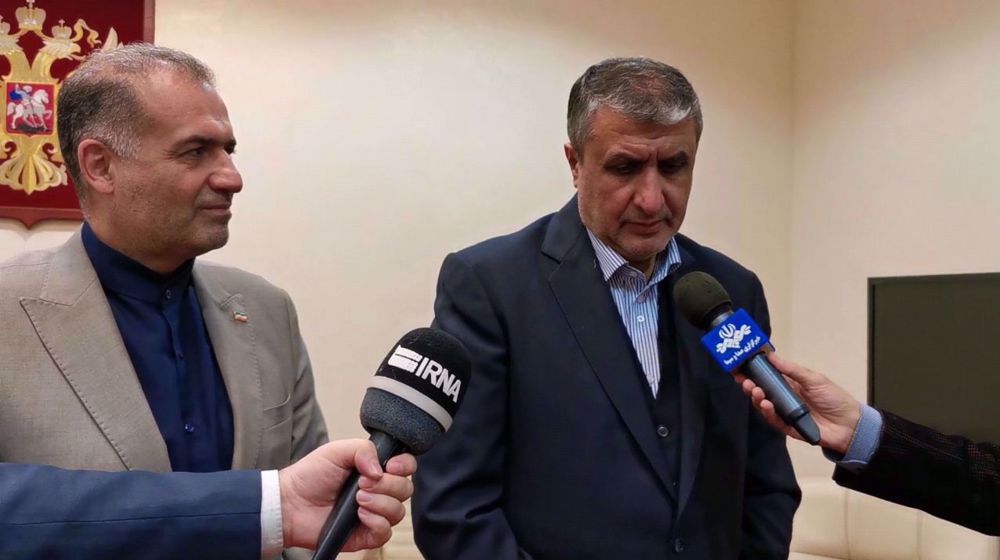
Head of the Atomic Energy Organization of Iran (AEOI) Mohammad Eslami (Photo by Sputnik News)
Iran’s nuclear chief has advised the International Atomic Energy Agency (IAEA) not to be duped by false reports concocted by a Europe-based terrorist group against Iran’s peaceful nuclear program.

“The Agency should not play into the hands of terrorist groups,” head of the Atomic Energy Organization of Iran (AEOI) Mohammad Eslami said in an interview with Sputnik News published on Thursday.

Eslami made the remarks when asked to comment on the IAEA chief’s call on Iran to explain the presence of uranium particles at several undeclared sites.

“This is once again one of the stories of the counterrevolutionary and terrorist group that is living in a safe haven in Europe and is financed by them and constantly influences the Agency by producing fake news,” he said, making a veiled reference to the anti-Iran Mujahedin Khalq Organization (MKO), an Albania-based terrorist outfit.

He explained that the terrorist group hoodwinks the IAEA by showing fabricated papers, fake satellite images and false evidence as part of its threadbare tactics which have proved invalid.

Earlier this month, Rafael Grossi, the head of the UN atomic watchdog, called on Iran to provide explanations for the presence of uranium particles at several undeclared sites.

“I remain deeply concerned that nuclear material has been present at undeclared locations in Iran and that the current locations of this nuclear material are not known to the agency,” Grossi told the IAEA board of governors in Vienna on September 13.

Iran hit back at the time, voicing concerns over the “aggrandizing of few insignificant old issues” by the IAEA chief.

‘All countries entitled to peaceful nuclear energy’

Eslami said all countries are entitled to use up-to-date technology, especially in the field of nuclear energy.

He said under its Statute, the IAEA is obliged to encourage all countries to develop their nuclear energy projects and to assist them in using peaceful nuclear energy.

“Iran believes that all countries have the right [to use] nuclear energy and nuclear weapons must be banned for all countries,” the top nuclear official stressed.

In a veiled reference to Israel, which has questioned the peaceful nature of Iran’s program and threatened to target its nuclear facilities, Eslami said it is shocking that an entity that owns nuclear weapons and is not a signatory to the Non-Proliferation Treaty (NPT) raises such claims against Iran.

“The Iranian people do not welcome the language of force,” he said, “We have acted honestly and these hostilities will not affect the Iranian people and they have to realize that they must abandon this wrong approach and stop harming the interests of the Iranian people.”

The remarks came days after Israeli prime minister Naftali Bennett claimed that Iran had crossed “all red lines” in its nuclear program and threatened to act alone if the world did not take action.

‘IAEA silence encourages terrorism’

Elsewhere during his interview, Eslami said due to mischievous and hostile acts against Iran by its enemies, the country’s nuclear program has been treated with a “political”, “selective”, and “discriminatory” approach.

He pointed out that the IAEA continues to have access to its surveillance cameras under the Safeguards Agreement, but added that Iran has decided to stop its “voluntary” implementation of the Additional Protocol by halting the Agency’s access to some of its cameras as a response to a gross non-compliance with the 2015 Iran nuclear agreement by the other parties.

“Iran had voluntarily accepted additional surveillance and the Additional [Protocol] in order to build trust and lift the sanctions,” he said, arguing that it would not make sense for Tehran to continue the implementation of the Additional Protocol after the US reimposition of sanctions on Tehran in 2018.

He made the remakes in response to a Sunday IAEA report that while Iran had granted access to its nuclear sites as agreed on September 12, it had prevented IAEA inspectors from visiting a workshop at the TESA Karaj complex, after it was targeted in a sabotage act in June in which one of four IAEA cameras was destroyed.

Iran has censured the IAEA for not condemning the “terrorist attack” at the complex, which Tehran has blamed on Israel. Iran has also blamed the Tel Aviv regime for another attack at Iran’s Natanz nuclear facility in April.

“The Karaj site was attacked in a terrorist incident ... and the Agency has not condemned the action. The site is being rebuilt and judicial and security authorities have opened a case on this site,” Eslami noted.

If they are truly law-abiding and sincere, the nuclear chief went on, “they have to acknowledge that the Agency’s failure to condemn a terrorist attack on an official [nuclear] site is a form of encouraging terrorism, which is regrettable.”

Eslami arrived in Moscow on Tuesday to meet with Russia’s senior officials and discuss a new framework for accelerating the implementation of nuclear projects in Iran.

Islamic Finance Should be Strengthened to Help Reduce Poverty in Muslim World

:Durham Scholar
TEHRAN (IQNA) – A Durham University Professor believes that there is a need to boost Islamic finance in order to help reduce poverty in the Islamic world.

Due to the growth of the Muslim population in Western countries, the field of Islamic financing is one of the economic sectors that is receiving attention by economic systems of these states. Contrary to popular belief, Muslims are not the only customers of the services of banks and financial institutions operating under Islamic law, but some non-Muslims also welcome the use of Islamic financing services for reasons such as the morality of Islamic investment.

Professor Muhammed-Shahid Ebrahim holds a Doctorate in Business Administration from Southern Illinois University, an MBA from the University of Wisconsin and an MSE from the University of Pennsylvania.

His research is focused on financial development. This involves studying asset pricing and financial contracting, as applied to Islamic banking and finance, corporate finance and real estate finance. Prior to joining Durham, he held the position as a Professor of Islamic banking and finance at the Bangor Business School and has previously held roles as a financial analyst/planner with the United Bank of Kuwait and IDS-American Express. Professor Ebrahim was a Research Fellow at the Oxford Centre for Islamic Studies and Harvard University Islamic Finance Program.

IQNA: Contrary to expectations, Islamic finance is growing in Europe and the United States, where Muslims are a minority. What do you think is the reason for welcoming this financial system?

Ebrahim: Islamic finance is growing because of the transparency (lack of gharar) and protection of property rights in the West.  The Muslim immigrants are quite religious.

The above is in contrast to the Muslim countries where materialism is rife.  The other problem in the Muslim world is the lack of protection of property rights as we have autocracies (similar to the illegal Ummayad regime).  This is despite the Qur'ān and the Sunnah’s emphasis on property rights.

IQNA: Why do non-Muslims also use Islamic finance?

Ebrahim: We share the same prophets with the people of the book and there are some who are disenchanted with the ‘ribawi’ finance at the retail level. 

It should be noted that in Western capital markets, one can get away from ribā by investing in ‘halal’ equities.

IQNA: What do you think is the biggest positive feature of Islamic financing?

Ebrahim: My personal view is that Islamic finance should be strengthened to help reduce poverty in the Muslim world.  This is its most important feature.  However, the ijtihad by our esteemed ‘Ulema has not reached the level to help financial exclusion and help our poor attain their well-deserved dignity.

IQNA: Indonesia and Malaysia have somehow become the world's leading Islamic financiers. What is the reason for this large investment in this field in these two countries?

Ebrahim: I respectfully disagree with you on this respect.  The fraction of assets held in the ‘Islamic’ financial system in Malaysia versus Indonesia is quite different.  It is higher in Malaysia as the ‘Ulema are involved in a lot of ‘hiyal.’  This is in violation of the Maqasid of the Shariah (Objectives of the Islamic Law).

Indonesia is more conservative than Malaysia and the ‘Ulema there do not approve ‘Inah and Tawarruq sales (a violation of the ribā injunction) (or selling of assets short – a violation of the gharar injunction).

IQNA: What is the situation of Islamic financing in your country of residence and what is your view on it?

Ebrahim: To the best of my knowledge, the only ‘Islamic’ bank we have in the UK is Al-Rayan bank. 

This is owned by the Qatari’s.  The mortgages they offer is termed as a decreasing Musharakah.  However, it is practically difficult to offer this facility.  The one offered by Al Rayan does not share the downside risk of a home with the buyer.  I doubt that it is halal.

My personal view is that the Ijtihad done by our esteemed ‘Ulema is not up to date and need to be revised.

IQNA: What do you think are the biggest challenges facing the Islamic financing system in recent years?

Ebrahim: I am enthusiastic about Islamic finance but we are not there yet as the Ijtihad  conducted by our esteemed 'Ulema  has not been updated and is in contrast to the Maqasid Al-Shariah. I am not entusiastic of the Islamic Development Bank as the researchers there are very weak intellectually

 I also doubt whether the Saudis who hold the largest share of IDB will allow the research staff to design a system different with the dominant  Ribawi one.

IQNA: How do you see the future of Islamic financing in the world?

Ebrahim: Islamic finance can help the Muslim world leapfrog development if and only if the ijtihad is updated and is in accordance with the Maqasid al Shariah

The Maqasid can also free the Muslim ummah from the narrow sectarian views. and bring about peace in the UmmahThis can help in economic growth of the Muslim world.

Interview By Mohammad Hassan Goodarzi

How Is The CIA Still A Thing?

 By Caitlin JOHNSTONE

Citing “conversations with more than 30 former U.S. officials,” a new report by Yahoo News has confirmed earlier allegations that the Central Intelligence Agency not only spied on WikiLeaks founder Julian Assange and his associates, but also drew up plans for kidnapping, renditioning, and assassinating him.

These plans were reportedly made in coordination with the Trump White House as then-CIA Director Mike Pompeo and then-Deputy CIA Director Gina Haspel raged over WikiLeaks’ 2017 Vault 7 release which revealed that the CIA had lost control of an enormous digital arsenal of hacking tools. These included tools which enabled the surveillance of smartphones, smart TVs and web browsers, the hacking of computerized vehicle control systems, and the ability to frame foreign governments for cyber attacks by inserting the digital “fingerprints” of the hacking methods they employ for investigators to find. It was the single largest data leak in CIA history.

Normally we have to wait decades for confirmation that the CIA did something nefarious, and then people absurdly assume that such things no longer occur because it was so long ago, and because changing your worldview is uncomfortable. But here we are with an extensively sourced report that the agency plotted to kidnap, rendition and assassinate a journalist for publishing authentic documents in the public interest, just four years after the fact.

Which is about as spectacular a violation of virtually every value that western society claims to uphold. Particularly the assassination bit.

The authors of the story (who for the record insert their own flimsy spin insinuating ties between Russia and WikiLeaks) say it’s not known just how serious the assassination plans were taken at Langley. But they make it abundantly clear that such plans were made:

“[A]gency executives requested and received ‘sketches’ of plans for killing Assange and other Europe-based WikiLeaks members who had access to Vault 7 materials, said a former intelligence official. There were discussions ‘on whether killing Assange was possible and whether it was legal,’ the former official said.”

And that, right there, just by itself, should be reason enough to completely abolish the Central Intelligence Agency. Just the fact that this is an institution where such conversations even happen and such plans even get made, to say nothing of the obvious implication that they wouldn’t have such conversations and make such plans if they did not act on them from time to time.

I just can’t get over how this claim was openly confirmed by a mainstream journalism investigation and the public response has been “Oh wow what an alarming news story,” instead of, “Okay well the CIA doesn’t get to exist then.”

I mean, is it not out-of-this-world bizarre that we just found out the CIA recently drew up plans to assassinate a journalist for journalistic activity, and yet we’re not all unanimously demanding that the CIA be completely dismantled and flushed down the toilet forever?

This would after all be the same lyingdrug-runningwarmongeringpropagandizingpsychological terrorizing Central Intelligence Agency that has been viciously smashing the world into compliance with its agendas for generations. It is surely one of the most depraved institutions ever to have existed, comparable in terms of sheer psychopathy to the worst of the worst in history.

So why does it exist? Why is there still an institution whose extensive use of torture has reportedly included “Rape, gang rape, rape using eels, snakes, or hard objects, and rape followed by murder; electric shock (‘the Bell Telephone Hour’) rendered by attaching wires to the genitals or other sensitive parts of the body, like the tongue; the ‘water treatment’; the ‘airplane’ in which the prisoner’s arms were tied behind the back, and the rope looped over a hook on the ceiling, suspending the prisoner in midair, after which he or she was beaten; beatings with rubber hoses and whips; the use of police dogs to maul prisoners”?

I am of course being rhetorical. We all know why the CIA still exists. An agency which exerts control over the news media with ever-increasing brazenness is not about to start helping the public become more well-informed about its unbroken track record of horrific abuses, and if anyone in power ever even thinks about crossing them they have “six ways from Sunday of getting back at you.”

The CIA is still a thing for the very reason we wish it wasn’t: because it is more savage and unscrupulous than anyone else around. Because it is willing to do whatever it takes to continue dominating and getting its way. Because terrible things happen to people it doesn’t like.

The date of the absolute last time the CIA ever did anything evil keeps getting moved forward. The CIA just casually had plans drawn up for the assassination of Julian Assange in case they decided that was something they wanted to do, but you’re a crazy conspiracy theorist if you think they might be doing other bad things right now.

The reason the latest Assange story isn’t getting more traction and causing more people to think critically about the CIA is because the US government making plans to kidnap, rendition and assassinate a journalist for telling the truth is so incomprehensibly evil that it causes too much cognitive dissonance for people to really take in. Our minds are wired to reject information which disrupts our worldview, and people who’ve spent their lives marinating in the belief that they live in a free democracy will have worldviews that are resistant to information which shows we are actually ruled by secretive power structures who laugh at our votes.

So to recap, the CIA made plans to kidnap and rendition Julian Assange and to assassinate him and his associates. The CIA also spied on Assange and his legal team, and a notoriously untrustworthy key witness for the prosecution in his case has admitted to fabricating evidence. And yet the CIA is not being burnt to the ground and its ashes scattered to the Langley winds, and the UK is still somehow proceeding right along with the US appeal to extradite Assange.

I’ve said it before and I’ll say it again: as much light as WikiLeaks has shone on the dark inner workings of the powerful over the years, the persecution of Julian Assange by those very same power structures has revealed far, far more. The more they seek to persecute him the brighter that light shines on them, making it easier and easier for us to see who they are, what they do, and how they do it.

caityjohnstone.medium.com