On Tuesday I provided that the New York Times and CNN were spreading fake news about Taliban policy in Afghanistan by quoting a hoax tweet from an imposter's Twitter account.
Forty-eight hours later both stories are still uncorrected despite the fact that many have have pointed out the 'error' in them.
The Washington Post though, which had also run a story quoting the tweet, has applied a correction. On top of its piece it now says:
Correction: An earlier version of this article attributed comments to Mohammad Ashraf Ghairat, the new chancellor of Kabul University, that appeared on a Twitter account in his name. Subsequent messages on the account asserted the actual user was a Kabul University student who tweeted “fake” words to raise awareness of the Taliban’s policy. The article has been corrected.
Further down it explains:
Adding to the uncertainty were messages that appeared this week on a Twitter account in the name of Mohammad Ashraf Ghairat, appointed last week as the university’s chancellor. One warned that women would not be able to allowed to attend universities or work.
Some suggested the messages were the work of an impostor. On Wednesday, new tweets appeared on the account saying the user was a 20-year-old student of the law and political science faculty who had been “pretending to be the new chancellor” with “fake” words that he hoped would “awaken Afghans, and the world to put pressure on Taliban to open the schools and universities.”
"Some suggested" does an awful lot of work here when one considers that 'some' included various Afghan media and the University of Kabul and that its 'suggestion' was a statement which explicitly denied that its chancellor has any social media accounts. 'Some suggested' also proves that the original article was never fact checked.
What this suggests to me is that the 'journalist' and 'editors' at the Washington Post were just as lazy as those at the New York Times, CNN and elsewhere. That they did not even attempted to verify the person behind that Twitter account or the content of the tweet. It was too conforming with their own myths and opinions about the Taliban to be held in doubt.
Moreover they still have not explained who the person behind the imposter account, which is now back online, really is and what its real motives are. Nor have they explained the real official Taliban policy with regards to the university.
I for one, judging from the language in the imposter latest Twitter thread, have strong doubts that the person behind the fake Mohammad Ashraf Ghairat account is a real Afghan student or even in Afghanistan. I find it way more likely that the imposter is part of an anti-Taliban astroturf campaign.
Now let us recall that the media who run this fake story and their 'journalists' are the very same who have for years accused Russia and other countries of providing 'fake news' just because some stories on Russia Today did not fit with their own warped worldview. It is obvious now that it was just another incident of them projecting their own attitude towards truth onto others.
"At a time when the world continues to grapple with the COVID-19 pandemic with no end in sight while dealing with the coexisting existential threat of climate change it is time to change our thinking," writes Dodge. "Nuclear weapons have no place in our future." (Photo: Shutterstock)
Citizens around the world are calling on their governments to ratify the Nuclear Weapons Ban Treaty—and the United States has a leading role to play.
Sunday marked the International Day for the Total Elimination of Nuclear Weapons. This 8th year commemorating the day was declared by the United Nations as a way of bringing about awareness and education of the imminent existential threat that hangs over all of humanity by the continued existence of nuclear weapons. The elimination of nuclear weapons has been a leading goal of the United Nations General Assembly since its earliest days in 1946.
Since the height of the arms race, there has been much progress in reducing global arsenals from over 70,000 in 1983 to the current range of ~13,100. Unfortunately, the myth of deterrence remains a mainstay of defense policy in all nuclear nations while being one of the main drivers of the new arms race as each nuclear nation, not to be outdone, seeks to rebuild their entire arsenals. A day of commemoration focuses on complete nuclear elimination coming from the realization of the catastrophic humanitarian consequences. The use of even a single nuclear weapon, let alone the effects of a limited regional or global nuclear war could result in the deaths of billions from the ensuing climate change and nuclear famine to possibly the extinction of the human race itself.
Recognizing the threat to all of humanity by the very existence of these weapons led the non-nuclear nations to draft the Treaty on the Prohibition of Nuclear Weapons in 2017. The Treaty went into force on January 22nd of this year. Nuclear weapons are finally joined with all other weapons of mass destruction including chemical, biological, and land mines in being declared illegal by international law setting a new international norm. Now nations, led by the United States and Russia, who continue to threaten all of humanity are being stigmatized in their refusal to meet their legally bound obligation to work in good faith to abolish their weapons under Article VI of the Treaty on the Non-Proliferation of Nuclear Weapons.
Citizens around the world are calling on their governments to ratify the Nuclear Weapons Ban Treaty. In the United States, a national grassroots campaign called Back from the Brink is garnering a groundswell of public support as it seeks the abolition of nuclear weapons and fundamental change in U.S. nuclear policy. Endorsed by over 386 organizations 56 municipalities and six state legislative bodies, the campaign calls for the United States to lead a global effort to prevent nuclear war by:
Actively pursuing a verifiable agreement among nuclear-armed states to eliminate their nuclear arsenals
Renouncing the option of using nuclear weapons first
Ending the sole, unchecked authority of any U.S. President to launch a nuclear attack
Taking U.S. nuclear weapons off hair-trigger alert
Canceling the plan to replace the entire U.S. nuclear arsenal with enhanced weapons
Answering this call on Thursday, September 23rd, over 300 local and state elected officials from 41 states signed a dynamic letter calling on President Biden and Congress to take bold actions on nuclear weapons endorsing the steps noted above. This letter remains open to encourage all elected officials invited to sign.
This year as the United States spends over $74 billion on all nuclear weapons programs funded by the Trump administration, President Joe Biden has not only endorsed this spending but proposed significant increases to it as well. Yet, there is nary a dissenting voice being heard from Congress demonstrating how oblivious they must be to the reality these weapons present as they unwittingly prepare for the end of life as we know it.
This week on September 30th the Presidents of Rotary International, the International Committee of the Red Cross, the International Physicians for the Prevention of Nuclear War, and the U.N. Under-Secretary-General and High Representative for Disarmament Affairs will present a historic conference on “Eliminating the Existential Threat of Nuclear Weapons." All are invited to join. Events like this energize the work necessary to make nuclear abolition a reality.
At a time when the world continues to grapple with the COVID-19 pandemic with no end in sight while dealing with the coexisting existential threat of climate change, it is time to change our thinking. Nuclear weapons have no place in our future. The only way to eliminate the threat of nuclear weapons is by their total elimination. As we mark this International Day for the Total Elimination of Nuclear Weapons let ours be a time when we recognize the peril we have brought upon ourselves and realize that we have a choice to make for the future of our children and all of humanity. Let us come together now and take the necessary steps now to abolish these weapons forever.
The Abraham Lincoln National Cemetery in Elwood in in Illinois, the United States. (File photo by AP)
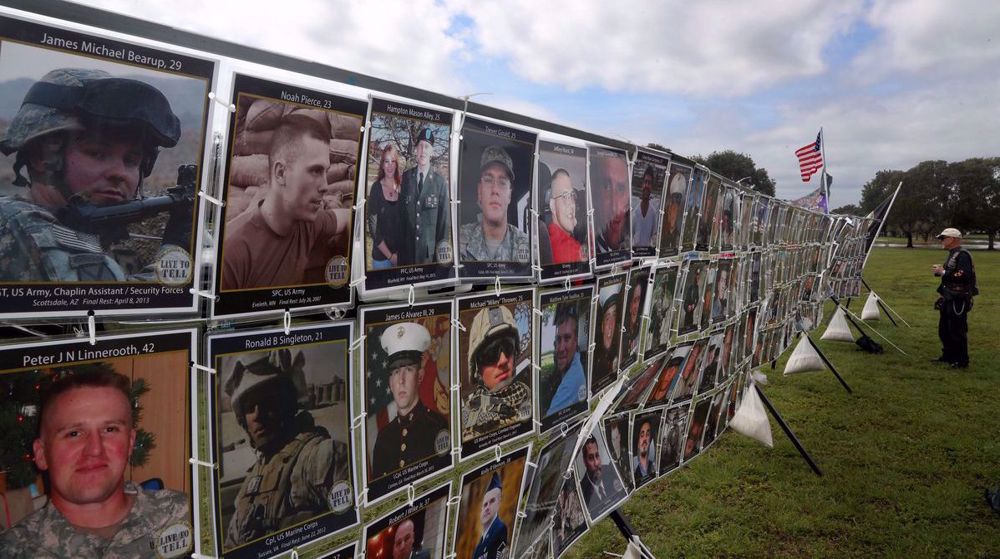
Endless war has taken a toll on the mental health of US troops. An alarming surge in suicide deaths among US troops has happened in recent years, according to new figures from the Pentagon.
USA Today reported on Thursday that 580 American troops died by suicide in 2020. The newspaper confirmed the Pentagon’s new statistics with congressional and Defense Department sources before they were made public.
Some 504 US troops committed suicide in 2019, according to USA Today. But in 2018, at least 543 US troops reportedly died by suicide.
The report noted that Alaska has been a site of several suicides, where six suicides happened in the first five months of the year. USA Today reported that the Army has spent more than $200 million in an attempt to improve the quality of life at its bases in the state.
A recent study has found that more than 30,000 active-duty personnel and veterans of wars that were launched following the September 11, 2001 terrorist attacks have died by suicide.
That number was almost thirty times more than the people who died in the 9/11 attacks and about three times as many US service members who were killed in post-9/11 war operations.
Following the 9/11 attacks, the United States under the presidency of Republican George W. Bush invaded and occupied Afghanistan, despite the fact that no Afghan was involved in the attacks. The occupation continued for 20 years. Hundreds of thousands of Afghans died in the US war on the country.
US officials assert that the 9/11 attacks were carried out by 19 al-Qaeda terrorists, but many experts and independent researchers have raised questions about the official account.
They believe that rogue elements within the US government, such as former Vice President Dick Cheney, orchestrated or at least encouraged the 9/11 attacks in order to accelerate the US war machine and advance the Zionist agenda.
Wesley Clark, the retired 4-star US Army general and Supreme Allied Commander of NATO during the 1999 War on Yugoslavia, said in the famous 2007 interview that the purpose of the 9/11 attack was to take out the governments of seven countries in five years. These seven countries were Iraq, Syria, Somalia, Libya, Sudan, Yemen, and Iran.
Clark’s interview serves as a reminder regarding the diabolical timeline of the American Empire’s hegemonic project. All of these countries have been directly or indirectly been the object of US aggression.
Iran has been a target of malicious US intentions but the United States failed to launch a war against it due to the Islamic Republic’s strong defense against the global hegemon.
Whereas the QUAD and AUKUS aim to place the US at the centre of the Indo-Pacific region as a bulwark against China, these two different yet interconnected strands of US policies are unlikely to be accepted by the ASEAN. Specifically, these projects could overpower ASEAN, as well as neutralising the regional configuration’s own political ambitions as the centre of economic activity and growth. A dominant US/UK/Australian position in the region naturally comes at the expense of a regional system that ASEAN countries have been nurturing for some years. It is the same regional focus that led these countries to enter into a trade deal with China, one of the biggest trade pacts ever signed in the history of the world. Therefore, at a time when the ASEAN countries are looking to build upon the momentum generated through the trade deal, the Regional Comprehensive Economic Partnership (RCEP), and finalise the Code of Conduct for the South China Sea in 2022, the war-drums the US is beating through the QUAD and AUKUS could derail the progress these countries have made in their quest to normalise ties with China. For the US, this normalisation is counterproductive. An ASEAN-China normalisation minimises the space for the US and its allies to exploit tensions to their own advantage.
Specifically, the US’ evolving outlook for the Indo-Pacific is at odds with ASEAN’s own outlook on the Indo-Pacific. While ASEAN countries do aim to adhere to a rule-based maritime system, they aim to do this not by appropriating Western help, but mainly by developing regionally negotiated mechanisms. In this behalf, the Code of Conduct that ASEAN has been negotiating with China for quite some time now fits the overall outlook for the region that the grouping offered in 2019 and reaffirmed in 2020/21.
So, whereas ASEAN’s own outlook articulates an inclusive and cooperative “vista” on the framework with the hope to present “an inclusive meeting place for the competing visions of regional order offered by great and regional players” and to maintain ASEAN’s relevance and Southeast Asia’s strategic autonomy in this discourse, the nuclearization of the region through AUKUS appears to be completely antithetical to the inclusive ideas of these countries; hence, the potential for growing conflict of interest between ASEAN and the West. Under AUKUS, the US will transfer nuclear powered submarines to Australia, as well as giving access to under-water drone technology. The ostensible purpose of this deal is solely to maintain balance of power in the Indo-Pacific vis-à-vis China.
So, despite the fact that Joe Biden reiterated that the US was/is not starting a new cold war with China, the AUKUS deal calls for rotations of US fighters and bombers to northern Australia and potentially to “acquire more rotational basing for its submarines in Perth, Western Australia.” Therefore, the US will eventually be using Australia for its surveillance and deterrence of China in the South China Sea. This is specifically a sort of global power competition typically characteristic of cold war. It is essentially seeking to build alliances and enlist support of as many regional countries as possible to side-line China.
ASEAN countries are acutely aware of the dangers that this new configuration and anti-China build-up poses. Indeed, AUKUS, in many ways, is in variance with the purpose and intent of the Southeast Asian Nuclear Weapons Free Zone Treaty (SEANWFZ), a pact signed by ASEAN member states on 15 December, 1995 as a commitment to preserve the ASEAN as a region free of nuclear and other weapons of mass destruction. AUKUS is also a misfit for the region in view of the ASEAN “Zone of Peace, Freedom, and Neutrality Declaration” signed by the Foreign Ministers of ASEAN in 1971 in Kuala Lumpur. This treaty envisioned an ASEAN region free from interference by outside powers, practicing peaceful coexistence and preserving the independence and sovereignty of individual states. The fact that the new security arrangement is displacing existing arrangements means ASEAN has many legitimate concerns.
Australia’s prime minister recently spoke with Indonesia’s president to assuage his concerns with regards to threat of nuclearization that the AUKUS poses. Indonesian foreign ministry expressed its deep concerns “over the continuing arms race and power projection in the region.” The foreign ministry further called on Australia to maintain its commitment to regional peace and stability, and reiterated its respect for international law.
These concerns are rooted in a realisation that the US plan to revamp the QUAD and nuclearize the region through AUKUS are more focused on containing China than about assisting ASEAN maintain its own centrality in the region. In other words, for ASEAN the potential payoffs that the QUAD and AUKUS offer do not outweigh the actual loses that the region will have to suffer by accepting the US overlordship. Not only will ASEAN lose its own centrality, but will also be left with facing an aggressive and assertive China. On top of it is the fact that taking the US as an ultimate security guarantor is a risky business. Its recent conduct in Afghanistan and its withdrawal from the Middle East leaving its allies ‘un-protected’ makes accepting the US as a reliable security partner quite difficult.
For a majority of ASEAN countries, the increasing US presence and role in the Indo-pacific could equally prompt China into strengthening its own military footprint. This is besides the fact that ASEAN countries’ support for AUKUS could potentially jeopardise the on-going negotiations for the Code of Conduct for South China Sea.
There is, therefore, not enough potential in the US proposed arrangements for the regional countries, except Australia. If geo-politics can be understood as a game in which actors take steps by calculating potential benefits and loses, jumping on the US bandwagon does not outweigh the potential benefits ASEAN countries can reap by not militarising and nuclearizing the issues.
Salman Rafi Sheikh, research-analyst of International Relations and Pakistan’s foreign and domestic affairs, exclusively for the online magazine “New Eastern Outlook”.
The news comes amid reports that Baghdad has once again played host to a meeting between Iranian and Saudi officials
On 30 September, Iraqi authorities announced that the Jamima border crossing with Saudi Arabia will be reopened for the first time since 1991.
The Iraqi Border Ports Authority issued a statement saying: “The Jamima border crossing has been reopened after the Saudi side agreed to open its side of the terminal and to prepare all the infrastructure and requirements.”
Thursday’s move follows the reopening of the Arar border crossing in November 2020, which had been closed for 30 years.
Saudi Arabia and Iraq are linked by a border strip of more than 830 kilometers.
The Jamima border crossing has been closed since 1991 following the Second Gulf War. Prior to this, it had been used for trade between the two countries, for the transit of travelers, and for movement of pilgrimage convoys.
This latest thawing of relations between Baghdad and Riyadh comes six years after the two nations resumed diplomatic relations, which were severed after Iraq invaded Kuwait in 1990.
It also comes as Iraq powers up its regional diplomatic outreach, mediating talks between long-time rivals Iran and Saudi Arabia, among other initiatives.
On 29 September, local sources in Iraq reported that Baghdad played host to another round of talks between Iranian and Saudi officials.
According to Iraqi media, officials confirmed the talks took place this week, with reports quoting an unnamed official as saying: “An Iranian official met with a Saudi official in Baghdad, following previous meetings between the two countries.”
These talks, which began in April of this year, have reportedly led to “serious progress” regarding Gulf security, according to a statement made by Iranian Foreign Ministry spokesperson Saeed Khatibzadeh on 23 September.
Strategic Council Online – Opinion: China and Russia also want to create a financial system outside the US supervision that will have sufficient authority and power in the world. Ali Khansari – International affairs analyst
The dollar has been the world’s most important currency since World War II; it is the most common reserve currency and the most widely used currency for international trade and other transactions worldwide.
The removal of the dollar from economic relations among countries and agreements to replace it with national currencies or other currencies in world trade is not an uncommon issue, but in recent years the process has intensified due to the measures of the US administration under Trump and Biden. In fact, political tensions between Washington and other countries have tarnished credibility of the US dollar in international markets.
Since 2014, China and Russia, the two superpowers of the international system, have sought to use national currencies to trade with each other and reduce their dependence on the US dollar. It was after the US administration imposed sanctions on Russia after the Crimean crisis that the two countries sought to take more serious steps to phase out the dollar. This trend was accelerated after Donald Trump imposed tariffs on hundreds of billions of dollars on Chinese goods. In 2014, Beijing and Moscow signed a three-year foreign exchange deal worth 150 billion yuan (24.5 billion dollars). Also during Chinese President Xi Jinping’s visit to Russia in June 2019, Moscow and Beijing agreed to replace the dollar with national currencies and develop payment mechanisms in national currencies to settle international accounts.
China and Russia also want to create a financial system outside the US supervision that will have sufficient authority and power in the world. The two countries are trying to accelerate their global trade through de-dollarization and using national currencies, along with major currencies such as the euro, as well as mitigating the negative effects of the current and possible US sanctions. In addition, they intend to trade with countries that have been sanctioned by the United States by eliminating the dollar in world trade.
At the same time, improvement of relations between Russia and China in recent years have contributed to this trend. In the current situation, the two countries have reached a common understanding of the threat and international trade; holding joint strategic exercises and increasing trade and political exchanges between the two countries also promises stronger ties than ever before, which could guarantee the independence of Beijing and Moscow and be a warning for the United States. Therefore, strengthening of the bond between the two countries has accelerated the process of eliminating the dollar.
In addition, China’s major economic project, based on the “One Belt One Road” (OBOR), has boosted demand for the yuan in foreign exchange reserves due to the large number of countries involved in the project, which has accelerated the gradual elimination of the dollar.
But what are the consequences of the phasing out of the dollar; the gradual elimination of the dollar has dire political and economic consequences for the United States. Various countries have been affected by oppressive US sanctions; both the sanctioned countries and the countries that had good economic relations with the sanctioned countries. With the elimination of the dollar in trade between those countries, the impact of this powerful US political-economic lever is practically reduced, which is a big blow to the most important lever of the US foreign policy in recent years.
Also, by reducing the use of the dollar, the US dominance in world trade will decrease, and this country, as in the past, cannot impose huge fines on various companies under the pretext of their relationship with the sanctioned countries.
It is also possible that other countries and unions will join the process. China, Russia, India, Turkey and Iran are now trying to use more national currencies or alternative currencies to the dollar in their trade with other countries. Pakistan also makes its payments to Chinese companies in yuan, and the number of countries that reduce the dollar from their trade is expected to increase with the possible addition of the BRICS group.
In economic terms, the common use of the US dollar helps the administration to issue government bonds at a lower cost (meaning that it does not have to pay much interest to attract buyers, which is a big advantage for the country). It is worth noting that the Russian government has been steadily reducing its investment in the sector since May 2017 in response to White House sanctions.
The military power and superiority of the US dollar, which have been two important and influential factors in the exercise of the US domination, will be dealt a major blow with this process, and the US will decline with more speed.
A boy walks along a street selling Taliban flags in Kabul, Afghanistan on September 16, 2021. (Photo by AFP)
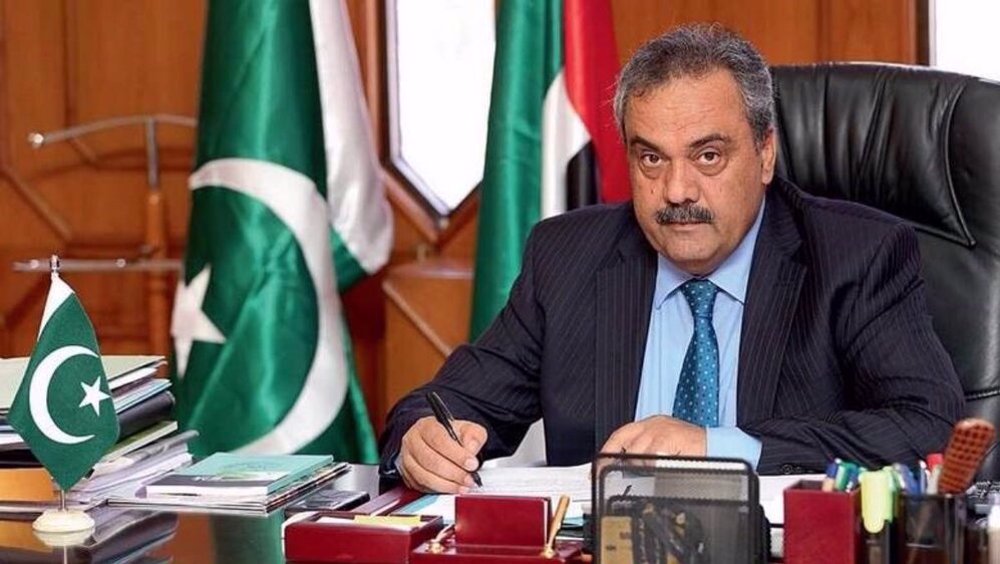
Asif Durrani is a former ambassador of Pakistan to Iran and United Arab Emirates, who also served in Afghanistan as Deputy Chief of Mission. Currently, he is working as a senior research fellow at Islamabad Policy Research Institute (IPRI). What follows is a transcript of an interview conducted by Press TV’s website with Ambassador Durrani.
Press TV: The Taliban have managed to take over Afghanistan not once but twice. In their first government, established in 1996, a mere three foreign governments recognized them. This time around, international recognition is subject to guesswork of course, since their government is basically an entity in progress. How do you think they will move forward as far as relations with other countries are concerned? Some countries have designated them “a terrorist organization;” what options do you think they have to try to change those perceptions of them?
Amb. Durrani: The significant difference is that the American-led coalition left Afghanistan after an agreement with the Taliban. It implies that the Americans recognized the Taliban as a stakeholder and accepted the Taliban’s assurances that Afghan soil would not be allowed to be used by the AQ/Daesh terrorists against the US and its allies.
Another difference you can notice is that unlike the Taliban’s first government (1996-2001), only three governments (KSA, UAE, and Pakistan) had recognized the Taliban regime. This time all the immediate neighbors of Afghanistan (Iran, China, Russia, Pakistan, Turkmenistan, Uzbekistan and Tajikistan) were on the same page about the pullout of the American troops from Afghanistan. Earlier, Iran, Russia, and India supported the erstwhile Northern Alliance while Pakistan supported the Taliban. It created tensions in the region then. However, the situation has changed now. It could be said that the immediate neighbors of Afghanistan may consider recognizing the Taliban regime if the latter is flexible enough towards an inclusive government by according adequate representation to all the ethnic and religious groups.
Asif Durrani, a former Pakistani ambassador to Iran and the UAE
Press TV: Let’s move to the Taliban’s relations with the United States. The US toppled their previous government in 2001; they fought the country for two decades since then. What has changed their will to cooperate with America, as opposed to fight it, given the history and the many animosities? Is this a rational, strategic calculation that the Taliban need to stop fighting a superpower, which practically controls global trade, and which to this day does not recognize their government? Or the agreement with the US was just a means to end the war and have the American military leave, notwithstanding what would come next?
Amb. Durrani: The Taliban fought the Americans to regain control as they thought they were the legitimate government when the Americans toppled them. It was, undoubtedly, a long struggle; in fact, it was the longest war of American history and the longest war of Afghan history. Prima facie, the American withdrawal was affected in an amicable environment. Since the signing of the agreement between the Taliban and the US on 29th February last year, not a single American or NATO soldier was killed. However, the Taliban will be facing the challenge of recognition at the international level. Already the US has made human rights, including women's rights, conditional for the recognition of the Taliban regime.
Press TV: And Pakistan. What is the status of Pakistan with the Taliban? Did the Pakistani government in any way try to influence the formation of their government?
Amb. Durrani: I don’t think Pakistan was ever in a position or had the inclination to influence the formation of the Taliban government. If others, with massive resources, could not control the Afghans, how could Pakistan affect fiercely independent people?
Press TV: Let’s get to domestic policy. First and foremost — and I think this is the biggest question now — how do the Taliban plan to enforce governance? Do they or do they not have absolute control over their fighters across the country? And how can they switch from militancy to governance? Mr. Zabihullah Mujahid said in August that women had better stay home because rank-and-file Taliban fighters are not trained on how to treat women. Going forward, do you think the Taliban will actually get down to training fighters on such a social matter?
Amb. Durrani: I think there is a marked difference in the make-up and behavior of the Taliban in 2021 from the one we knew during their first government. If you see today’s Kabul, the people have an everyday life. Educational institutions are open, although the Taliban have enforced separate seating arrangements for male and female students. However, it is an improvement compared to the last tenure of the Taliban when they were totally against women’s education, especially in colleges and universities. Hopefully, the Taliban would stay the course and improve further as they consolidate their hold over the levers of power.
Press TV: Will the Taliban want to or be able to contain terrorist groups inside of Afghanistan? We know ISIL already struck at the Kabul airport, with massive casualties. Will the Taliban be able to prevent another such attack?
Amb. Durrani: It depends on how quickly the Taliban control the situation in the country, establish good governance and overcome economic difficulties. The US has frozen $ 9.5 billion of the Afghan Central Bank; the Taliban regime is unable to pay the salaries of the government servants, three fourth of which comprise teachers and health workers. It is intriguing how Ashraf Ghani left the power with empty coffers. One wonders how his government was run a day before the Taliban’s capture of Kabul.