Saturday, August 01, 2020

Syrian Christians in Aleppo, Victims of US-EU Sanctions

By Steven Sahiounie

St. Elijah Maronite Cathedral in Aleppo re-opened after years of disuse due to the severe destruction the 18th century cathedral endured during battles in the period of 2012 to 2016
Aleppo had been Syria’s largest city and its commercial and industrial hub before the conflict which began in March 2011.  Syria is a secular nation, with the pre-war population ratio standing at about 80% Sunni Muslim, and the remaining divided between Christians, Jews, and other Muslim sects.
It is estimated that only 30,000 Christians remain in Aleppo, compared to a pre-war population of 180,000.  Aleppo is now the second largest city after the capital, Damascus.
At least three extensive missile attacks and numerous smaller attacks left the cathedral in ruins. It suffered its worst damage in when terrorists following Radical Islam, which is a political ideology, attacked the Christian areas in an attempt to eradicate all Christians and their churches.
The Syrian Arab Army liberated East Aleppo in December 2016, with at least 34,000 armed terrorists and their families removed under a negotiated settlement which the UN oversaw.
“This victory represents a strategic change and a turning point in the war against terrorism on the one hand and a crushing blow to the terrorists’ project and their supporters on the other hand,” the Syrian army statement said.
The cathedral celebrated Christmas 2016 despite the utter devastation parishioners observed. Monsignor Joseph Tobji, Maronite Archbishop of Aleppo, gave several recent interviews in which he detailed the restoration of the cathedral.  He recalled his first sight of the cathedral in its gravest condition, and marveled at how the cathedral had protected the neighborhood residents, and he said, “This house (the church) played a role in receiving the blows themselves in order to protect the surrounding civilians.”
Monsignor Joseph Tobji noted the obstacle to rebuilding churches, homes and lives in Syria is not confined to lack of funding only, but also to the US-EU sanctions which prevent any foreign company from selling any product to any Syrian company, including medical needs and the supplies  fight against COVID-19.
“It’s a sign of hope and rebirth, not only in a material sense but for the entire community, despite the fact that the numbers of Christians continue to dwindle, due to extreme poverty linked to the sanctions imposed on the defenseless population,” he said.
Recently, the UN Secretary General Antonio Gutierrez has publicly urged the US and EU to lift sanctions on Syria in order to fight COVID-19.
He recalled the Christmas 2016 mass, and the moment during the service when the child Jesus was placed in the manger, which had been constructed from parts of the collapsed roof. He was deeply touched emotionally at the scene, as were other attendees who were crying, laughing, clapping and cheering with joy.
The rebuilding of the cathedral’s roof, which was made of wood, required Italian architects, Italian lumber, and a roofing expert from abroad to complete.  The pontifical foundation, ‘Aid to the Church in Need’ (CAN), funded the laborious project.
Baroness Caroline Cox is a cross-bench member of the UK House of Lords and founder of Humanitarian Aid Relief Trust (HART). Baroness Cox,  a Christian peer and human rights campaigner, has been a visitor to Syria during the darkest days of the conflict, and is opposed to the British government’s foreign policy regarding Syria, which is one of ‘regime change’.
The UK Foreign Office urged her not to travel to Syria. In an interview she revealed,
“We get criticized for a lot of the things that we do, like Syria in particular, and yes it does hurt,” because “it detracts from the main issue of what you’re trying to do,” she carries on, “it detracts from the suffering of the people.”
Her Syrian trip, as part of a British delegation, was widely criticized by the UK media, which prefers to sell their own narrative on Syria.  She visited Damascus, Homs, Aleppo and the Christian town of Maaloula, and was invited by the Syriac Orthodox Patriarch, the Grand Mufti and other Church leaders.
Baroness Cox spoke with Syrian people, as well as the Church leaders, and realized the alternative to President Assad would be worse, and the Islamist terrorists were the real enemy of the people, regardless of the western media portrayal of them as ‘rebels’.
She recalled the Islamist terrorists had taken 4,000 hostages in East Ghouta, and they promised to release them as part of a negotiated settlement in which the terrorists and their families could leave safely. However, only 200 of the hostages were released, as the terrorists had massacred the remaining 3,800 persons.  With atrocities like this in mind, Baroness Cox felt the priority for the Syrian people is to get rid of ISIS and all the other related Islamist groups, and that should be a priority for the UK as well.
She feels the UK government is prolonging the Syrian conflict, and there has been evidence that the UK funded groups affiliated with the terrorists, which has prolonged the suffering of the Syrian people in a proxy war.
Baroness Cox assessed the Syrian people as deeply civilized, and capable of deciding their own political future.  She is opposed to the UK government’s continuing commitment to ‘regime change’, which is reminiscent of Iraq and Libya.
She is also deeply concerned about the harsh US-EU sanctions which prevent ordering medicines, medical machines and their parts, and even chemotherapy drugs.  The director of the UN World Health Organization in Damascus has stated repeatedly the sanctions on Syria affect the health of Syrian civilians, including children with cancer.
Baroness Cox witnessed that the Armenian Christian Church in Aleppo, which was horribly damaged in the conflict, has rebuilt six schools, with four of them in Aleppo. The sanctions make it almost impossible to order certain re-building supplies and technical parts from abroad.
A Chaldean Catholic priest thanked Baroness Cox, and the delegation and urged them to go and bear witness to the western world of what they have seen and learned in Syria. The priest said to them,
“Thank you for coming. You have put your hands into the wounds of our suffering, now you believe, go and tell.”
*Steven Sahiounie is an award-winning journalist. He is a frequent contributor to Global Research.

What does the Future Hold for Tunisia?

Vladimir Danilov

TUN783542

Tunisia is popular tourist destination in North Africa, a cultural melting pot, with Roman, Arab, and Western cultural influences and European progressiveness.

However, Tunisia’s attractiveness as a holiday destination has not been the only reason why the country has been in the news over the past decade. Tunisia was where the wave of color revolutions that later swept through almost every other Arab country arose in January 2011, with the Tunisian Revolution and the ousting of former President Ben Ali from power.

Its natural borders are delineated by the Mediterranean Sea and the Sahara Desert, and the neighboring countries Tunisia shares its land borders with — Algeria and Libya — have always had an influence on the situation in Tunisia, and they still do. Although Tunisia is not rich in natural resources like its neighbors, Algeria and Libya, there have always been many countries that could see the advantages of Tunisia’s location on the north coast of the African continent, who have sought to consolidate their presence and influence in the country. The United States has shown great interest in Tunisia’s strategic location, focusing much of its attention on this country in recent years as part of a broader plan to strengthen the US military presence in Africa, and America has sent into Tunisia soldiers from the private military company (PMC) Engility, a PMC with plenty of experience leading secret military operations in a variety of countries: Afghanistan, Kuwait, Bosnia, Georgia, Yemen, the Philippines and Colombia. If the recent American operations in Iraq, Syria and Afghanistan are anything to go by, it cannot be ruled out that these PMCs have also been given orders from Washington to take control of key infrastructure in Tunisia and create special military zones on the country’s territory, which could serve as a springboard for the United States to expand the US influence throughout the region in the future.

In 2015, Barack Obama declared his intention to make Tunisia one of America’s non-NATO allies. In January 2017, Democratic senators Alcee Hastings and David Schweikert submitted a bill to US Congress to provide “assistance to support the military readiness of the Government of Tunisia,” “assistance to support efforts of the Government of Tunisia to combat terrorism,” “assistance to strengthen and reform the security sector of Tunisia,” “economic reforms and assistance,” “assistance to support democracy and civil society in Tunisia” and “assistance to support increased border security for Tunisia”. However, despite Washington’s desire to develop a close partnership with Tunisia, the Tunisian government was not open to US intervention in the country’s domestic policy, by expressing its opposition to having US and NATO military bases established on Tunisian soil, and opposition to Washington’s intervention in the Libyan Civil War under the pretext of the fight against terrorism.

By the turn of the 21st century, Tunisia had one of the best education systems in the region, and the country was focused on rolling out computerization and developing ties with Western Europe. However, none of this helped Tunisia make progress and improve the political, economic and social situation in the country. The many years of rising inflation and chronic economic crisis this North African country has already endured have influenced the domestic political landscape, which has proven itself to be in a weak and dependent position, including being left at the mercy of external factors such as the actions of both Western and regional players.

All of this affects the political climate in the country. The Ennahda Party (“Renaissance Movement Party”) who won the last parliamentary elections in October 2019 may position itself as a moderate Islamist party, yet we must not forget that it is essentially an offshoot of the Muslim Brotherhood terrorist group (banned in Russia – ed.), from where it draws its inspiration and ideology. The Ennahda Party must have realized that having an Islamist lead the government as the President is not ideal for developing relations with the West, which are very important for Tunisia, so they seem to have found their own kind of compromise behind closed doors, which is to have a secular Prime Minister appointed who can negotiate with the international community.

Moreover, despite the campaign funding Ennahda received from abroad (supposedly from the Gulf states), it began to show that the party has no real experience running the country, and foreign investors do not have enough confidence in them to allow Ennahda to compensate for their incompetent governance with cash injections.

Today, people in Tunisian society itself are well aware that most of the country’s problems stem from poor governance. All of this adds to the pressure on the parliament, the government and all the political parties. However, there is a lot that depends not only on the actions of the Tunisian authorities and the government. Neighboring Libya has a major influence, and a significant percentage of the Tunisian economy has followed Libya, slipping into the informal sector, where no taxes are paid, no auditing is done, and people live outside the laws that regulate the formal economy, the taxpayers that the authorities depend on so greatly.

In June, Tunisian Prime Minister Elyes Fakhfakh warned that officials predict the country’s economy could contract by almost an unprecedented 7% due to the coronavirus pandemic. At the same time, the Prime Minister stressed that state debt has reached “frightening” proportions, totaling $32 billion, which is equal to 84 percent of Tunisia’s domestic national product. Due to negative economic growth, the state budget will have a deficit of more than $ 1.7 billion, which means that most government organizations will face bankruptcy. The Tunisian authorities had already sent the International Monetary Fund (IMF) a Letter of Intent in April, stating Tunisia’s intention to resume negotiations with the IMF in the near future in order to secure a successor Extended Fund Facility (EFF) arrangement. The IMF and a number of other foreign creditors had previously refused to cooperate with Tunisia, as Tunisia was included on the FATF blacklist for illegal money laundering and financing terrorist organizations. However, given the gloomy economic situation in Tunisia due to the coronavirus pandemic, with border closures and expected losses of $ 1.4 billion in the tourism sector, the IMF approved a $745 million emergency assistance loan in April to help the country tackle the coronavirus crisis.

Tunisia’s political crisis and the country’s social unrest have not died down amid all of these economic concerns and high unemployment rates. As a result, due to the major conflict between the Tunisian parliament and government, President Kais Saied made an official request for Prime Minister Elyes Fakhfakh to step down on July 15 at a meeting also attended by the parliamentary speaker Rachid al-Ghannouchi, and Fakhfakh, who had been in office since February this year, complied by handing in his resignation. Relations between Fakhfakh and the Ennahda Party led by parliamentary speaker Rachid al-Ghannouchi soured in July, when the former Prime Minister announced he planned to reshuffle his cabinet, potentially leading to six party ministers from this party losing their posts. As this conflict unfolded, several political alliances in Tunisia’s Assembly of the Representatives of the People (unicameral parliament) decided to invite members of parliament to vote on a motion of no confidence in Fakhfakh’s government.

In his statement of resignation, Fakhfakh accused Ennahda of complicating the work of the government and undermining stability. “These calls are destroying the principle of solidarity in the government, leaving no doubt that Ennahda is moving away from the commitments and promises it has made to coalition partners of its patriotic intent to save the country and its shattered economy,” said Fakhfakh.

In these circumstances, Tunisia’s future remains uncertain. Like the United States, France is also trying to hold onto its influence in Tunisia, where Tunisian President Kais Saied was welcomed on an official visit to Paris in late June, who engaged in an active talks with French President Emmanuel Macron. According to reports, the talks mainly dealt with rather sensitive issues such as the situation in Libya and an ongoing discussion in the Tunisian parliament to have France apologize for crimes permitted against Tunisians in the past during the colonial era and pay reparations. Countering Turkey’s influence in Libya and in North Africa in general is an important foreign policy issue for President Macron, especially following an incident which recently took place off the coast of Libya involving Turkish warships and a French naval vessel. In light of this, there is this notion in Paris that separating Tunisia from Ankara is now of particular importance for France. Following the events of the Arab Spring, Ankara provided substantial financial aid to the new Tunisian authorities in the hope of growing its influence in North Africa, a region which was once part of the Ottoman Empire, including through Islamist parties that share similar ideologies with the Muslim Brotherhood (banned in Russia – ed.), which many countries declare an illegal terrorist organization, with views shared by Turkish President Recep Tayyip Erdoğan. In addition, as the French media has highlighted on numerous occasions, the Tunisian island of Djerba has been used as a military stopover by Turkish intelligence, with regular transit flights from Turkey to Libya landing in Djerba-Zarzis Airport, carrying cargo for various purposes for Prime Minister Fayez al-Sarraj’s Tripoli-based Government of National Accord (GNA). However, France is considered one of the countries that supports al-Sarraj’s opponent in the Libyan conflict, commander of the Libyan National Army Khalifa Haftar.

Nevertheless, Tunisian President Kais Saied decided it was better to say nothing about Macron’s attempts to win Tunisia over to his side in the Libyan conflict. In a telephone conversation in June, he assured Emmanuel Macron that Tunisia values its sovereignty, and would not be used as a military stopover by anyone.

Yet, this has in effect already happened…

Vladimir Danilov, political observer, exclusively for the online magazine “New Eastern Outlook”.

US fighter jet clash with Iranian passenger plane is part of a wider power struggle

By Jamal Elaheebocus

The latest example of US aggression toward Iran saw a US F-15 fighter jet flying dangerously close to a Mahan Air passenger plane over Syria while supposedly carrying out ‘a visual inspection’. The plane was forced to suddenly change altitude and as a result, several passengers were injured. One was shown bloodied and one was seen lying immobile on the floor, while many passengers were screaming in fear. Iran has lodged a formal complaint to the International Civil Aviation Organization.
This move is yet another flashpoint in a series of incidents of dangerous US hostility toward Iran. The country has been the target of a “maximum pressure” campaign from the US since President Trump withdrew from the Iran nuclear deal and imposed new, widespread sanctions on Iran’s economy. These have caused the economy in Iran to shrink dramatically and ordinary people have been hit hardest by the sanctions.
Tensions reached their height when Iranian Lieutenant General Qassem Soleimani was killed by a US drone in Iraq in January. Iran responded by launching missiles at US military bases and tensions have remained high since those unprecedented clashes.
A new set of sanctions was imposed while Iran was facing a coronavirus outbreak. These targeted five companies across Iran and Iraq, and 15 Iranian officials. These sanctions, combined with the fact that the US blocked an attempt from Iran to get a five-billion-dollar loan from the World Bank, meant that Iran faced shortages of essential medical equipment and that their ability to deal with the virus was severely hindered.
This latest escalation comes at the same time as Iran and China, both targets of severe economic sanctions from the US, are on the verge of agreeing an economic and military deal. This will allow for billions of dollars of Chinese investments in banking, telecommunications, and transport – effectively canceling out the effect of Trump’s sanctions. 
Perhaps more significantly though, the deal strengthens the military cooperation between the two countries. They will carry out joint weapons development and military training, as well as intelligence sharing. This will undoubtedly aggravate the Trump administration, as it underlines that their efforts to contain Iran and China’s economic and military growth have been completely unsuccessful.
The fighter jet incident demonstrates that Iran is still very much a US target. The same is true of China, whose growing economic and military power is seen as a major threat to US hegemony. It is no coincidence that Trump has tried to use the coronavirus crisis as a way of launching fresh attacks on China.
Within the antiwar movement, we must be alert to these developments and be calling out the continued economic warfare against Iran and China, while campaigning against any new attempts to ramp up tensions with either country.
Source: Stop the War Coalition

US is already fighting a conflict with Iran – an economic war that is hurting the wrong people

Many are worried about the risk of war with Iran after the Trump administration leaked discussions of a troop deployment in response to claimed threats to U.S. warships in the region.
And in recent days, the rhetoric has only gotten more heated, with President Donald Trump saying a war would be “the official end of Iran.” Iranian officials responded in kind.
But the truth is, the U.S. has been fighting a war with Iran for decades – an economic war fought via sanctions that has intensified over the past year and has already been devastating to innocent civilians in the country.
Not only that, it’s also undermining long-accepted principles of international cooperation and diplomacy, a topic I’ve been researching for the past 25 years.
U.S. officials have been reviewing military plans involving a war with Iran. Reuters/Jonathan Ernst

Carrots and sticks

Many nations have recognized that sanctions work best as tools of persuasion rather than punishment.
Sanctions by themselves rarely succeed in changing the behavior of a targeted state. They are often combined with diplomacy in a carrots-and-sticks bargaining framework designed to achieve negotiated solutions.
Indeed the offer to lift sanctions can be a persuasive inducement in convincing a targeted regime to alter its policies, as was the case when successful negotiations involving the U.S. and Europe led to the Iran nuclear deal in 2015, which ended sanctions in exchange for Tehran shutting down much of its nuclear production capacity.
A year ago Trump withdrew the U.S. from that accord and not only re-imposed previous sanctions but added further restrictions, including so-called secondary sanctions that penalize other countries for continuing to trade with Iran.
In 2006, sanctions against Iran were multilateral in nature, which made them more effective. AP Photo/Frank Franklin II

Multilateral vs. unilateral sanctions

In an increasingly globalized world, unilateral sanctions like these – in which one country goes it alone – are rarely effective at achieving their end result, which in this case is regime change.
Multilateral sanctions involving several or many countries have greater impact and make it more difficult for targeted individuals or regimes to find alternative sources of oil or other goods. And getting authorization through the United Nations or regional organizations provides legal and political cover.
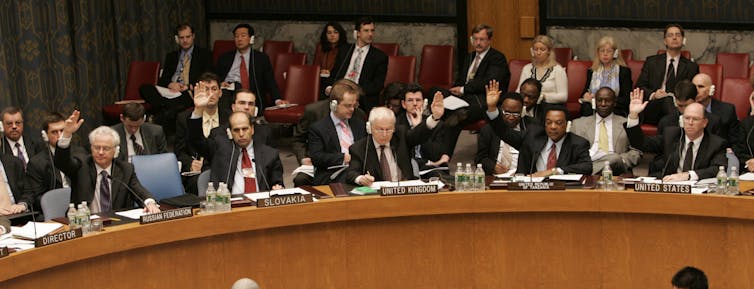
When the U.N. Security Council imposed targeted sanctions on Iran in 2006 over its illicit nuclear activities, for example, members of the European Union were able to join the U.S. and other countries in applying pressures that brought Iran to the bargaining table. That’s what led to the negotiated nuclear deal nine years later.
The U.S. circumvented this voluntary multilateral process when it withdrew from the accord and unilaterally imposed “extraterritorial secondary sanction.” These barred nations or companies that buy Iranian oil or other sanctioned products from doing business in the U.S.
Although most countries disagree with the U.S. withdrawal from the Iran deal and some reject such sanctions as an infringement on their own sovereignty, they are powerless. They cannot afford to lose access to dollar financing and the U.S. economy and thus are forced against their will to do Washington’s bidding.
Many Iranians blame the U.S. for their deteriorating economic situation. AP Photo/Vahid Salemi

Iranians pay the price

And the Iranian people are paying the price.
Oil exports and national income are dropping, inflation is rising, and economic hardships are mounting. The Iranian rial lost more than 60% of its value in the last year, eroding the savings of ordinary Iranians.
Life is becoming increasingly difficult for working families struggling to make ends meet. There are indications that the new sanctions are inhibiting the flow of humanitarian goods and contributing to shortages in specialized medicines to treat ailments such as multiple sclerosis and cancer.
Cargill and other global food giants have halted shipments to Iran because of the lack of available financing.
Punishment of the Iranian people seems to be a deliberate policy. When asked recently how the administration expects sanctions to change the behavior of the Iranian government, Secretary of State Mike Pompeo acknowledged they won’t be able to do that and instead suggested it’s up to the people to “change the government.”
In other words, the pain of sanctions will force people to rise up and overthrow their leaders. This is as naïve as it is cynical. It reflects the long-discredited theory that sanctioned populations will direct their frustrations and anger at national leaders and demand a change in policy or the regime. Sanctions have never worked for this purpose.
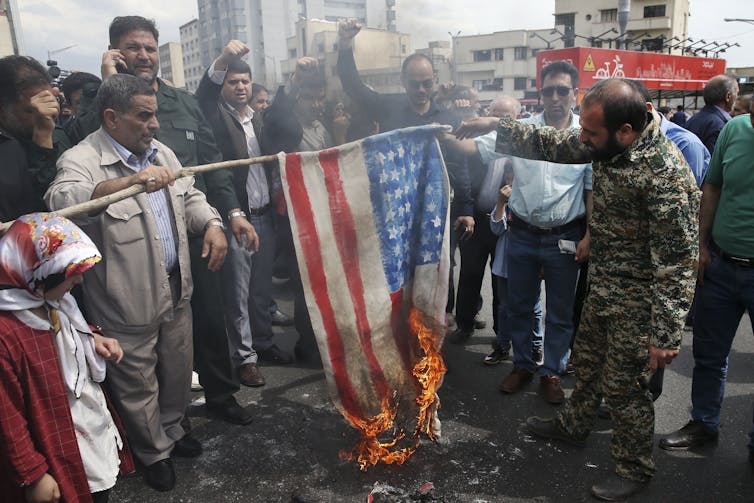
The more likely result is the classic “rally around the flag” effect. Iranians are critical of their government’s economic policies, but they also blame Trump for the hardships resulting from sanctions. Governments subjected to sanctions are adept at blaming economic hardships on their external adversaries, as Iran’s religious and elected leaders are doing now against the United States.
Tehran is likely to respond to tightening sanctions by giving greater authority to companies associated with the Iranian Revolutionary Guard Corps, a major branch of the Iranian military, further empowering the very hardline forces Washington claims to oppose.
The White House is ignoring these realities and pressing ahead with draconian trade sanctions, hoping to increase the pain until Iran’s leaders cry uncle. There is no sign of surrender yet from Tehran, nor is there likely to be, but over time pressure may build on both sides to reach a settlement.
The damage done to the institutions of diplomacy will remain, however, along with the need to restore confidence in the principles of international cooperation.

Syrian army forces find human organs intended for trafficking inside ex-militant redoubt

Human body organs, being kept in chloroform chemical compound, are found inside a house at a former hideout of militants in the village of al-Ghadfa, Idlib province, northwestern Syria, on July 29, 2020. (Photo by SANA)

Syrian military forces have discovered a large number of human body organs persevered in chloroform and intended for trafficking while conducting clean-up operations in the country’s northwestern province of Idlib.
A local source, requesting anonymity, told Syria’s official news agency SANA that a doctor affiliated to foreign-sponsored Takfiri militants had transformed a house in the village of al-Ghadfa into a medical laboratory, where many packages of human organs, including eyes, hearts, lungs, livers and kidneys, were being kept in chloroform solution.
The report added that the packages were marked with male and female names, while there were records inside the house containing the names of people with descriptions of their general health conditions.
Human body organs, being kept in chloroform, are found inside a house at a former hideout of Takfiri militants in the village of al-Ghadfa, Idlib province, on July 29, 2020. (Photo by SANA)
Back in November 2019, Russian experts warned that members of the so-called civil defense group White Helmets are involved in forcible removal of organs from Syrians living in militant-controlled areas.
“They (White Helmets) were a key element in this illegal scheme of organ removal. We learned about those incidents from the people whom we interviewed. This information came as an unpleasant surprise to us,” the director of the Russian Foundation for the Study of Democracy, Maxim Grigoryev, said at the time as he presented a survey entitled “White Helmets: Terrorist Abettors and Sources of Disinformation” at the Russian Foreign Ministry in Moscow.
Human body organs, being kept in chloroform chemical compound, are found inside a house at a former hideout of Takfiri militants in the village of al-Ghadfa, Idlib province, northwestern Syria, on July 29, 2020. (Photo by SANA)
He noted that Russian researchers made the discovery while interviewing residents of Syrian regions where White Helmets were most active.
Grigoryev and his colleagues conducted more than 100 interviews not only with residents of the major cities of Aleppo, Douma, Dayr al-Zawr and the southern town of Saqba, but also with over 40 members of White Helmets and some 20 former militants.
According to eyewitnesses’ testimony, White Helmets were involved in extracting human organs from the bodies of ill-fated people whom they had promised medical assistance. After that, their relatives received bodies with some vital organs missing. This came to light when the bodies were examined and weighted, he pointed out.
US-backed SDF militants impose curfew across Hasakah
Meanwhile, Kurdish-led militants from the so-called Syrian Democratic Forces (SDF) have imposed a raft of new restrictions across Syria’s northeastern province of Hasakah.
Syria’s pro-government and Arabic-language al-Watan newspaper reported that the new restrictions came into force on Thursday, in addition to implementing an open-ended lockdown during Eid al-Adha (the Feast of Sacrifice), which marks the culmination of the annual Hajj pilgrimage.
Under the new measures, local residents have to stay at their homes and movement of individuals is prohibited. Moreover, all social gatherings and visits and intercity travels are banned during Eid al-Adha.

US-backed SDF officials allege that they have adopted the measures in response to an alarming increase in cases of coronavirus infection across Hasakah over the past few days.

Lebanon PM: Israel tried to change battle rules with border attack

The file photo shows Israeli army Merkava IV battle tank conducting maneuvers near the Lebanese border. (By AFP)
Lebanon’s prime minister warns sternly about potential escalation in the aftermath of a recent Israeli border incursion, saying the occupying regime is trying to manipulate the rules of engagement with the country.
"The enemy is trying to change the rules of battle with Lebanon," Hassan Diab tweeted on Tuesday. “I call for caution in coming days because I fear the situation will deteriorate in light of heightened tensions on our border,” he added.
A day earlier, Israel fired dozens of shells into Lebanon’s Shebaa Farms, which Tel Aviv has occupied since 1967. A Reuters’ witness counted dozens of Israeli shells hitting the occupied area.
The regime claimed it launched the attack after an attempt by Lebanon’s Hezbollah resistance movement to “infiltrate” into the occupied territories.
The movement has roundly rejected the claim, saying the regime has come up with the account to falsely claim a “victory” against the resistance and try to psych up its forces.
Implications for UNIFIL’s mandate
"The enemy is trying to change the UNIFIL's mandate,” Diab added.
The force deployed by the United Nations to Lebanon’s southern border has been monitoring the situation there since 2006, when Israel was forced by Hezbollah to withdraw after launching a 33-day war on the country.
Lebanese President Michel Aoun also addressed the unwelcome implications that the Israeli aggression could have for the UNIFIL.
“The attacks constitute a threat to stability in the south especially that the United Nations Security Council will soon discuss the mandate of the United Nations Interim Forces in Lebanon (UNIFIL)," he said.
According to Lebanon’s Elnashra news outlet, Aoun also said the Lebanese cabinet had decided to complain to the UN over the border incident.
‘Nasrallah dictating agenda to Israel’
Addressing the recent developments, Amiram Levin, former commander of the Israeli military’s Northern Command, said “It is [Hezbollah’s Secretary General Seyyed Hassan] Nasrallah that dictates the agenda to Israel.”
He cited the case of the Israeli incursion -- that came with apparently no provocation on the part of Hezbollah -- as an instance of the regime going off half-cocked due to its fear of the resistance group.
“The security incident of the last day is shameful,” Levin said.
Former Israeli foreign minister Avigdor Lieberman, meanwhile, acknowledged the regime’s fearfulness of Hezbollah.
He attributed the trigger-readiness of the regime’s forces to Israel's assassination of a Hezbollah member near the Syrian capital Damascus last Monday. The atrocity warranted outspoken warnings from the resistance movements.
Lieberman said the entire northern part of the territories that are under Israeli occupation have become “crippled” since the assassination of Ali Kamel Mohsen, who was martyred during the latest Israeli aggression against Syria that was staged from the Tel Aviv-occupied Golan Heights.
Although Hezbollah has said it reserves the right to retaliate for the atrocity, the movement asserted on Monday that “the answer to the martyrdom of [our] brother,  Ali Kamel Mohsen, in the vicinity of Damascus airport has not been given yet.”

“Zionist occupiers must still wait for that answer and their punishment at the hands of the resistance forces,” it added, refuting Tel Aviv’s claims that it tried to strike the occupied territories in an act of revenge.