
by Dr James M Dorsey
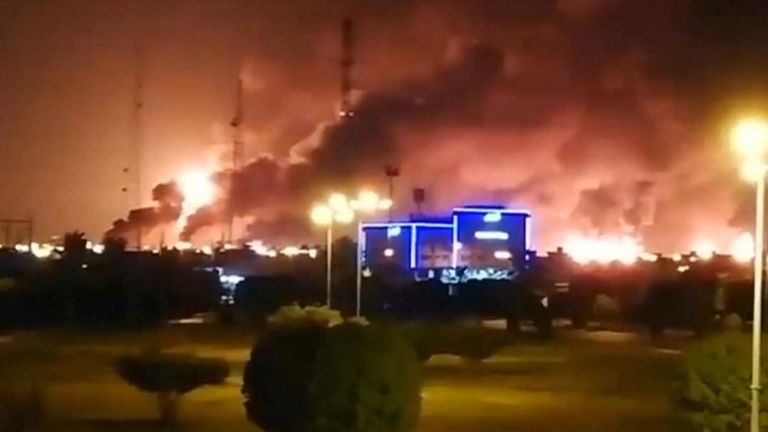
Neither Saudi Arabia nor the United States is rushing to retaliate for a brazen, allegedly Iranian attack that severely damaged two of the kingdom’s key oil facilities.
That is not to say that Saudi Arabia and/or the United States will not retaliate in what could prove to be a game changer in the geopolitics of the Middle East.
Yet, reading the tea leaves of various US and Saudi statements lifts the veil on the constituent elements that could change the region’s dynamics.
They also shine a spotlight on the pressures on both countries and shifts in the US-Saudi relationship that could have long lasting consequences.
With US Secretary of State Mike Pompeo visiting the kingdom to coordinate what his office described as efforts to combat “Iranian aggression in the region,” Saudi Arabia and the United States will be seeking to resolve multiple issues.
These include collecting sufficient evidence to convincingly apportion blame; calibrating a response that would be appropriate but not drag the United States and the Middle East into a war that few want; deciding who takes the lead in any military response and managing the long-term impact of that decision on Saudi-US relations and the US commitment to the region.
A careful reading of Saudi and US responses to the attacks so far suggests subtle differences between the two. They mask fundamental issues that have emerged in the aftermath of the attacks.
For starters, Mr. Pompeo and President Donald J. Trump have explicitly pointed the finger at Iran as being directly responsible, while Saudi Arabia stopped short of blaming the Islamic republic, saying that its preliminary findings show that Iranian weapons were used in the attack. Iran has denied any involvement.
The discrepancy in the initial apportioning of blame raises the question whether Saudi Arabia is seeking to avoid being manoeuvred into a situation in which it would be forced to take the lead in retaliating against the Islamic republic with strikes against targets in Iran rather than Yemen.
Political scientist Austin Carson suggests that Saudi Arabia may have an interest in at least partially playing along with Iranian insistence that it was not responsible. “Allowing Iran’s role to remain ambiguous could reduce Saudi leaders’ need to appear strong… The Saudis are reportedly unconvinced by shared US intelligence that attempts to link the attacks to Iran’s territory. Some experts suggest this may reflect a more cautious approach to escalation,” Mr. Carson wrote in The Washington Post.
Saudi Arabia’s initial reluctance to unambiguously blame Iran may have a lot to do with Mr. Trump’s America First-driven response to the attacks that appeared to contradict the Carter Doctrine proclaimed in 1980 by President Jimmy Carter.
The doctrine, a cornerstone of the Saudi-US relationship, stated that the United States would use military force, if necessary, to defend its national interests in the Gulf.
Mr. Trump’s apparent weakening of the United States’ commitment to the defense of the kingdom, encapsuled in the doctrine, risks fundamentally altering the relationship, already troubled by Saudi conduct of the more than four-year long war in Yemen and last year’s killing of journalist Jamal Khashoggi in the Saudi consulate in Istanbul.
Signalling a break with the Carter doctrine, Mr. Trump was quick to point out that the attacks were on Saudi Arabia, not on the United States, and suggested that it was for the Saudis to respond.
“I haven’t promised Saudis that. We have to sit down with the Saudis and work something out. That was an attack on Saudi Arabia, and that wasn’t an attack on us. But we would certainly help them,” Mr. Trump said without identifying what kind of support the US would be willing to provide.
Despite blustering that the United States was “locked and loaded,” Mr. Trump insisted that “we have a lot of options but I’m not looking at options right now.”
Mr. Trump’s response to a tweet by US Senator Lindsey Graham, a friend of the president who favours a US military strike against Iran, that “the measured response by President @realDonaldTrump…was clearly seen by the Iranian regime as a sign of weakness” was equally telling.
“No Lindsey, it was a sign of strength that some people just don’t understand.” Mr. Trump said.
Mr. Trump further called into question the nature of the US-Saudi defense relationship by declaring that “If we decide to do something, they’ll be very much involved, and that includes payment. And they understand that fully.”
The Saudi foreign ministry maintained, with the attacks casting doubt on the Saudi military’s ability to defend the kingdom’s oil assets and Mr. Trump seemingly putting the onus of a response on Saudi Arabia, that “the kingdom is capable of defending its land and people and responding forcefully to those attacks.”
Only indisputable evidence that the drones were launched from Iranian territory would incontrovertibly point the finger at Iran.
So far, the Saudis have stopped short of that while US officials have suggested that the drones were launched either from Iran or by pro-Iranian militias in southern Iraq.
Holding Iran responsible for the actions of a militia, whether in Iraq or Yemen, could prove more tricky given long-standing questions about the degree of control that Iran has over various groups that it supports, and particularly regarding the Houthis.
The argument could turn out to be a slippery slope given that by the same logic, the United States would be responsible for massive human casualties in the Yemen war resulting from Saudi use of American weaponry.
Military retaliation may not be immediate even if the United States and Saudi Arabia can produce convincing evidence that Iran was directly responsible.
“No knee jerk reactions to this – it’s very systematic – what happens with patience is it prevents stupid moves,” a US official said.
The United States is likely to attempt to first leverage that evidence in meetings on the sidelines of next week’s United Nations General Assembly to convince the international community, and particularly the Europeans, to drop opposition to last year’s US withdrawal from the international nuclear accord with Iran and the harsh economic sanctions that the Trump administration has since imposed on Iran.
Both the United States and Saudi Arabia will also want to use the opportunity of the UN gathering to try to ensure that the fallout of any military response is limited and does not escalate into a full-fledged war that could change the geopolitical map of the Middle East.
Said foreign policy analyst Steven A. Cook: “How the Trump administration responds will indicate whether U.S. elites still consider energy resources a core national interest and whether the United States truly is on its way out of the Middle East entirely, as so many in the region suspect.”
Dr. James M. Dorsey is a senior fellow at Nanyang Technological University’s S. Rajaratnam School of International Studies, an adjunct senior research fellow at the National University of Singapore’s Middle East Institute and co-director of the University of Wuerzburg’s Institute of Fan Culture

