
By Hassan Lafi
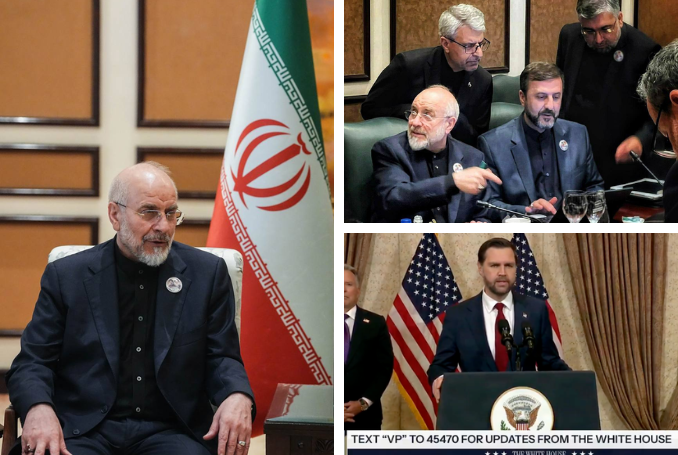 The US delegation left Islamabad as talks with Iran collapsed. (Photos: video grab, social media. Design: Palestine Chronicle)
Iran does not perceive the primary threat as limited to its nuclear program, but as part of a broader strategy aimed at its geopolitical encirclement. It therefore operates with the logic of a state engaged in an existential struggle—seeking to preserve its political system while deterring external attempts to undermine its sovereignty.
The announcement of a temporary, two-week truce between Iran on one side and the United States and Israel on the other—reportedly mediated by Pakistan—initially suggested that the latest escalation might be contained, potentially opening a pathway toward renewed negotiations.
Yet subsequent developments quickly made clear that this was not a genuine settlement, but rather a fragile ceasefire designed to manage the conflict while allowing all parties to reposition themselves politically and militarily.
The first round of post-truce negotiations failed to produce any tangible breakthrough. Tensions persisted across both military and political fronts. On the military level, Washington escalated pressure by imposing a naval blockade on Iranian ports, tightening economic constraints and increasing the cost of diplomatic delay.
Tehran responded by briefly closing the Strait of Hormuz after announcing its reopening to navigation—an unmistakable signal that it retains strategic leverage and is willing to threaten global trade routes in response to economic coercion.
At the political and media level, the US president reverted to a familiar negotiating style: rhetorical escalation through public statements and social media. Within a single month, threats to target Iranian infrastructure and energy facilities alternated with calls for dialogue, illustrating a deliberate strategy of pressure through ambiguity.
In contrast, Iran refused to participate in a new round of talks in Islamabad, arguing that negotiations conducted under military threat and economic blockade lack both credibility and parity. Nevertheless, Washington announced an extension of the ceasefire and urged Tehran to present a “clear and comprehensive vision” for a solution—without specifying a timeline, thereby preserving strategic flexibility.
Tehran’s response was cautious but firm. Iranian officials rejected the notion that a unilateral ceasefire extension carries political or legal weight, while maintaining military control over key maritime routes. This reflects a consistent principle: reciprocity, and a refusal to accept unilateral management of the crisis.
This dynamic raises several fundamental questions. How should these negotiations be interpreted through the lens of international relations theory? What tools of power are being deployed by each side? And are these developments leading toward de-escalation—or merely postponing a larger confrontation?
The Nature of Negotiations: Pressure as Process
These negotiations diverge from traditional diplomatic frameworks, where a ceasefire precedes structured dialogue. Instead, what is unfolding is negotiation under sustained pressure.
Military, economic, and informational tools have not been suspended—they have been integrated into the negotiation process itself.
The United States employs sanctions, naval restrictions, military threats, and media messaging to extract concessions. Iran, in turn, leverages geography, energy chokepoints, and strategic patience to resist pressure and signal its capacity for escalation.
This is not diplomacy replacing force. It is diplomacy conducted through force.
Interpreting US Strategy
Political Realism: Reasserting Balance of Power
From a realist perspective, US actions reflect a clear objective: preventing Iran from converting its military resilience into long-term geopolitical influence.
Washington’s priorities include limiting Iran’s ability to weaponize maritime routes, curbing its regional reach, and imposing a stricter post-conflict framework—all while reassuring allies and reinforcing its own global standing.
This explains the dual approach of rhetorical de-escalation combined with operational escalation.
Coercive Diplomacy
US behavior also aligns with coercive diplomacy—using credible threats to force negotiations on favorable terms. Repeated warnings about targeting Iran’s energy infrastructure serve less as immediate war signals and more as instruments to raise the cost of defiance.
Dual-Level Negotiation
American messaging is not directed solely at Tehran. It also targets domestic audiences, Congress, allies, and the security establishment. This produces apparent contradictions between threats and flexibility, as each message serves a different political function.
Interpreting Iranian Strategy
Defensive Realism and Survival Logic
Iran operates under the assumption that external pressure is not limited to specific policies, but threatens the system itself. As a result, it rejects negotiations conducted under duress, refuses imposed timelines, and avoids unilateral concessions.
From Tehran’s perspective, yielding under pressure invites further demands.
Asymmetric Deterrence
Faced with conventional military imbalance, Iran relies on asymmetric tools: control over the Strait of Hormuz, missile and drone capabilities, regional alliances, and endurance under sustained pressure.
Its continued use of maritime leverage—even during a truce—reflects this strategy.
Political Identity
Iran’s posture is also shaped by political identity. Presenting itself as an independent actor resisting external domination, it views negotiations under coercion as a threat not only to policy, but to legitimacy.
The Role of Mediation
Pakistan’s involvement highlights the growing influence of middle powers in crisis management. Its ability to engage both Washington and Tehran positions it as a useful intermediary, capable of facilitating temporary de-escalation.
However, mediation alone cannot produce lasting outcomes without genuine political will from the primary actors.
Strategic Objectives
The United States seeks to neutralize Iran’s leverage over global energy routes, secure a new security framework that protects its regional allies, and demonstrate that sustained pressure yields results.
Iran, by contrast, aims to lift sanctions, secure recognition of its regional role, obtain guarantees against future attacks, and ensure that negotiations occur on equal footing.
Israel’s position remains more uncompromising, favoring the degradation of Iran’s capabilities and opposing any agreement that could consolidate Tehran’s strategic gains.
Possible Scenarios
The most likely outcome is a limited interim arrangement—partial easing of pressure, controlled reopening of maritime routes, and continued negotiations without resolving core disputes.
A prolonged truce without agreement is also plausible, reflecting ongoing crisis management rather than resolution.
A breakdown leading to renewed escalation remains a constant risk, particularly in the event of miscalculation or a triggering incident in the Gulf.
A comprehensive agreement, while possible, appears unlikely in the current climate of deep mistrust.
Conclusion
The current trajectory suggests that neither side seeks full-scale war, yet neither is willing to make decisive concessions. What emerges instead is a pattern of managed confrontation—temporary ceasefires interspersed with calibrated escalation.
In this context, negotiation is no longer separate from power; it is an extension of it.
The future of Iranian-American engagement will not be determined solely at the negotiating table, but across strategic waterways, energy markets, deterrence calculations, and domestic political arenas.
This is not merely a dispute over policy. It is a struggle over the shape of the regional order to come.
(This article was originally published in Al-Mayadeen Arabic. It was translated and edited by the Palestine Chronicle)

No comments:
Post a Comment