Showing posts with label “regime change” in Tehran. Show all posts

Wednesday, September 11, 2019

The Catastrophic Tenure Of John Bolton

John Bolton (Christopher Halloran via Shutterstock)
by Joseph Cirincione
John Bolton’s tenure was a complete disaster. The national security architecture after Bolton looks like the Bahamas after Hurricane Dorian. 
Seventeen months ago, before Bolton became Donald Trump’s third national security advisor, the United States still had a deal that had stopped Iran’s nuclear program in its tracks. More, it had rolled it back to a fraction of its original size and boxed it into the most intrusive inspection regime ever negotiated. It was a deal for the ages. All of Trump’s military, intelligence and security advisors and our closest allies urged Trump to stay in the accord. Bolton destroyed it in two months, pushing Trump to violate it and impose draconian sanctions on Iran.
“Withdrawing from the Iran Nuclear Deal should be a top Donald Trump administration priority,” Bolton tweeted in July 2017, months before his appointment. “The declared policy of the United States should be the overthrow of the mullahs’ regime in Tehran,” he shouted at an MEK rally in July 2017, promising them that they would all celebrate in Tehran “before 2019.”
Today, Iran is slowly pealing away from the deal, too, taking baby steps towards restarting capabilities that someday could allow it to make the material for a bomb, should it decide to do so. No new deal. No better deal. No regime change. No celebration in Tehran. “Trump has spent years making a mess of Iran policy for no reason other than right wing politics and incompetence,” tweeted former Deputy National Security Advisor Ben Rhodes as news of Bolton’s sacking spread. 
Before Bolton, the United States had kept Russia from building a particularly dangerous class of missiles for over 30 years. Bolton blew apart the landmark Intermediate Nuclear Forces Agreement that President Ronald Reagan had painstakingly negotiated with then-Soviet leader Mikhail Gorbachev. The treaty had broken the back of the nuclear arms race. For the first time, the two nuclear superpowers agreed to destroy, not just limit, nuclear weapons. It paved the way for other sweeping nuclear reductions treaties and big unilateral cuts—most done under Republican presidents.
Bolton hated these agreements. In 1999, he ridiculed the liberal “fascination with arms-control agreements” and blustered about “the Church of Arms Control,” insisting that America could rule the world through force of arms, not pieces of paper. In a classic Bolton move, he used the real fact of Russian violations of the INF treaty, not to insist on their compliance with the pact, but to destroy it entirely. “Violations give America the opportunity to discard obsolete, Cold War-era limits on its own arsenal and to upgrade its military capabilities to match its global responsibilities,” Bolton wrote in 2014.
The U.S. abrogation of the treaty was a gift to Vladimir Putin. It did not reverse the Russian violations; it permitted them. Today, there are no limits whatsoever on what missiles of this range Putin can deploy.
Bolton was also on course to destroy the last remaining nuclear reduction treaty, the New START agreement that limits US and Russian long-range nuclear weapons. Again using the phony right-wing tactic of blasting agreement because they do not cover all possible threats, Bolton trashed the accord as “flawed from the beginning” because it only limited long-range weapons (hence the name, “strategic arms reduction treaty”) and not short-range weapons as well.
Before Bolton, there were also fragile negotiations with the Afghanistan Taliban. Bolton “waged a last-minute campaign to stop the president from signing a peace agreement at Camp David,” reports The New York Times.
Before Bolton, there was the real possibility of a deal with North Korea that would have traded sanctions relief for serious nuclear dismantlement. Bolton killed it at the Hanoi summit by convincing Trump that Democrats would criticize him if he did not bring home Kim Jung-un’s complete surrender of all his nuclear, biological and chemical weapons. “John Bolton appears to have locked the U.S. administration into a policy death spiral,” I wrote at the time. The spiral has now dragged Bolton to his political death.
Finally, and very seriously, before Bolton there was a functioning national security interagency process where leaders and experts from all agencies and departments could vet policies and build consensus. The National Security Council had been the principal forum for consideration of key policies for 72 years. Bolton destroyed it in 17 months.
“There was no process under John Bolton,” Former U.S. Ambassador to the United Nations Samantha Power told Rachel Maddow the night of Bolton’s firing. Bolton halted meetings, restricted access to Trump and packed the staff with loyal Boltonites. “The national security adviser’s principal responsibility has traditionally been to oversee a disciplined policymaking process that includes the State Department, the Pentagon and intelligence agencies, and to tee up big decisions for the president,” editorialized The Washington Post the same night, “Mr. Bolton didn’t do that.”
Bolton could not have wreaked this destruction if he had not been chosen, empowered and tolerated by Donald Trump, who must bear ultimate responsibility for Bolton’s legacy — what the Post summarized as “chaos, dysfunction and no meaningful accomplishments.” It was Trump who allowed Bolton to come within ten minutes of getting the war with Iran Bolton had sought for two decades, before halting the strikes. Trump created the storm, but Bolton aimed it expertly. An aerial view of the White House post-Bolton would reveal a devastated landscape.
“Any jackass can knock down a barn,” former House Speaker Sam Rayburn said, “It takes a carpenter to build one.” Bolton was the biggest jackass in the administration. There are no carpenters in sight.
Joseph Cirincione is the president of Ploughshares Fund

Monday, November 05, 2018

Europe and America clash over Washington’s economic war on Iran

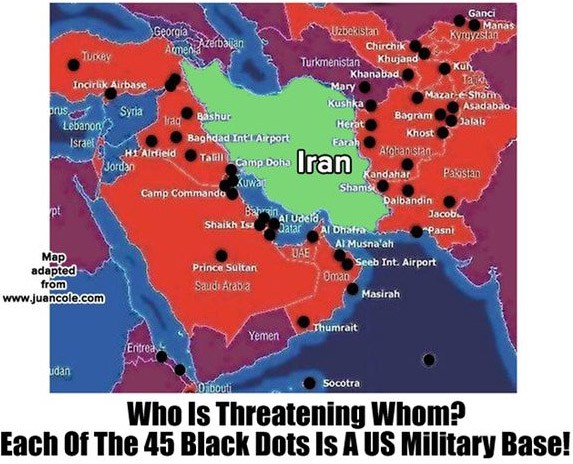
Washington’s imposition of sweeping new sanctions on Iran—aimed at strangling its economy and precipitating “regime change” in Tehran—is roiling world geopolitics.
As of today, the US is embargoing all Iranian energy exports and freezing Iran out of the US-dominated world financial system,so as to cripple the remainder of its trade and deny it access to machinery, spare parts and even basic foodstuffs and medicine.
In doing so, American imperialism is once again acting as a law unto itself. The sanctions are patently illegal and under international law tantamount to a declaration of war. They violate the UN Security Council-backed 2015 Iran nuclear accord or Joint Comprehensive Plan of Action (JCOPA)—an agreement that was negotiated at the behest of Washington and under its duress, including war threats.
All the other parties to the JCOPA (Russia, China, Britain, France, Germany and the EU) and the International Atomic Energy Agency, which is charged with verifying Iranian compliance, are adamant that Iran has fulfilled its obligations under the accord to the letter. This includes dismantling much of its civil nuclear program and curtailing the rest.
Yet, having reneged on its support for the JCOPA, Washington is now wielding the club of secondary sanctions to compel the rest of the world into joining its illegal embargo and abetting its regime-change offensive. Companies and countries that trade with Iran or even trade with those that do will be excluded from the US market and subject to massive fines and other penalties. Similarly, banks and shipping insurers that have any dealings with companies that trade with Iran or even with other financial institutions that facilitate trade with Iran will be subject to punishing US secondary sanctions.
Israeli Prime Minister Benjamin Netanyahu, who like US President Donald Trump has repeatedly threatened to attack Iran and ordered military strikes on Iranian Islamic Revolutionary Guard forces in Syria, has hailed the US sanctions as “historic.” Saudi Arabia and the United Arab Emirates, two other US client states, are pledging to ramp up oil production to make up for the shortfalls caused by Washington’s embargoing of Iranian oil exports.
But America’s economic war against Iran is not just exacerbating tensions in the Middle East. It is also roiling relations between the US and the other great powers, especially Europe.
On Friday, the foreign ministers of Britain, France, and Germany and European Union (EU) Foreign Policy Chief Frederica Mogherini issued a statement reaffirming their support for the JCOPA and vowing to circumvent and defy the US sanctions. “It is our aim,” they declared, “to protect European economic operators engaged in legitimate business with Iran, in accordance with EU law and with UN Security Council resolution 2231.”
They declared their commitment to preserving “financial channels with” Iran, enabling it to continue exporting oil and gas, and working with Russia, China and other countries “interested in supporting the JCPOA” to do so.
The statement emphasized the European powers’ “unwavering” “collective resolve” to assert their right to “pursue legitimate trade” and, toward that end, to proceed with the establishment of a Special Purpose Vehicle (SPV) that will enable European businesses and those of other countries, including potentially Russia and China, to conduct trade with Iran using the Euro or some other non-US dollar medium of exchange, outside the US-dominated world financial system.
Friday’s statement was in response to a series of menacing pronouncements from Trump, Secretary of State Mike Pompeo and other top administration officials earlier in the same day. These fleshed out the new US sanctions and reiterated Washington’s resolve to crash Iran’s economy and aggressively sanction any company or country that fails to fall into line with the US sanctions.
In reply to a question about the European SPV, US Treasury Secretary Steven Mnuchin, said he had “no expectation” it will prove to be a conduit for “significant” trade. “But if there are transactions that have the intent of evading our sanctions, we will aggressively pursue our remedies.”
Trump officials also served notice that they will sanction SWIFT, the Brussels-based network that facilitates secure inter-bank communications, and the European bankers who comprise the majority of its directors if they do not expeditiously expel all Iranian financial institutions from the network.
And in a step intended to demonstratively underscore Washington’s disdain for the Europeans, the Trump administration included no EU state among the eight countries that will be granted temporary “waivers” on the full application of the US embargo on oil imports.
Germany, Britain, France and the EU are no less rapacious than Washington. Europe’s great powers are frantically rearming, have helped spearhead NATO’s war build-up against Russia and over the past three decades have waged numerous wars and neocolonial interventions in the Middle East and North Africa, from Afghanistan and Libya to Mali.
But they resent and fear the consequences of the Trump administration’s reckless and provocative offensive against Iran. They resent it because Washington’s scuttling of the nuclear deal has pulled the rug out from European capital’s plans to capture a leading position in Iran’s domestic market and exploit Iranian offers of massive oil and natural gas concessions. They fear it, because the US confrontation with Iran threatens to ignite a war that would invariably set the entire Mideast ablaze, triggering a new refugee crisis, a massive spike in oil prices and, last but not least, a repartition of the region under conditions where the European powers as of yet lack the military means to independently determine the outcome.
To date, the Trump administration has taken a haughty, even cavalier, attitude to the European avowals of opposition to the US sanctions. Trump and the other Iran war-hawks like Pompeo and National Security Adviser John Bolton who lead the administration are buoyed by the fact that numerous European businesses have voted with their feet and cut off ties with Iran, for fear of running afoul of the US sanctions.
The Financial Times reported last week that because they fear US reprisals no European state has agreed to house the SPV, which, according to the latest EU statements will not even be operational until the new year.
The European difficulties and hesitations are real. But they also speak to the enormity and explosiveness of the geopolitical shifts that are now underway.
Whilst European corporate leaders, whose focus is on maximizing market share and investor profit in the next few business quarters, have bowed to the US sanctions threat; the political leaders, those charged with developing and implementing imperialist strategy, have concluded they must push back against Washington.
This is about Iran. But also about developing the means to prevent the US using unilateral sanctions to dictate Europe’s foreign policy, including potentially trying to thwart Nord Stream 2 (the pipeline project that will transport Russian natural gas to Germany under the Baltic Sea and which Trump has repeatedly denounced.)
As Washington’s ability to impose unilateral sanctions is bound up with the role of the US dollar as the world’s reserve currency and US domination of the world banking system, the European challenge to America’s sanctions weapon necessarily involves a challenge to these key elements of US global power.
The European imperialist powers are taking this road because they, like all the great powers, are locked in a frenzied struggle for market, profits and strategic advantage under conditions of a systemic breakdown of world capitalism. Finding themselves squeezed between the rise of new powers and an America that is ever more reliant on war to counter the erosion of its economic might and that is ruthlessly pursing its own interests at the expense of foe and ostensible friend alike, the Europeans, led by German imperialism, are seeking to develop the economic and military means to assert their own predatory interests independently of, and when necessary against, the United States.
Those developing the SPV are acutely conscious of this and have publicly declared that it is not Iran-specific.
Speaking last month, only a few weeks after European Commission President Jean-Claude Juncker had used his State of the EU address to called for measures to ensure that the Euro plays a greater global role, French Finance Minister Bruno Le Maire declared the “crisis with Iran” “a chance for Europe to have its own independent financial institutions, so we can trade with whomever we want.” The SPV, adds French Foreign Ministry spokesperson Agnes Von der Muhl, “aims to create an economic sovereignty tool for the European Union … that will protect European companies in the future from the effect of illegal extraterritorial sanctions.”
The strategists of US imperialism are also aware that the SPV is a challenge to more than the Trump administration’s Iran policy. Writing in Foreign Affairs last month, former Obama administration official Elizabeth Rosenberg expressed grave concern that the Trump administration’s unilateral sanctions are causing the EU to collaborate with Russia and China in defying Washington, and are inciting a European challenge to US financial dominance. Under conditions where Russia and China are already seeking to develop payments systems that bypass Western banks and the future promises further challenges to dollar-supremacy and the US-led global financial system, “it is worrying,” laments Rosenberg, “that the United States is accelerating this trend.”
With its drive to crash Iran’s economy and further impoverish its people, the Trump administration has let lose the dogs of war. Whatever the sanctions’ impact, Washington has committed its prestige and power to bringing Tehran to heel and to making the rest of the world complicit in its crimes. The danger of another catastrophic Mideast war thus looms ever larger, while the growing antagonism between Europe and America and descent of global inter-state relations into a madhouse of one against all is setting the stage—absent the revolutionary intervention of the international working class—for a global conflagration that would dwarf even the world wars of the last century.