Showing posts with label “Saudi” Arabia is a tribal society. Show all posts

Friday, August 09, 2019

Saudi Arabia is badly bogged down in Yemen, which for the past four-and-a-half years has thwarted the designs of the regime in Riyadh to browbeat it into submission through the most intense bombing the world has seen in this century that has resulted in the death of almost a hundred thousand men, women, and children, in addition to the destruction of the infrastructure of the Arab World’s most poorest country.
Stay with us for an article in this regard on the ‘Lobe.Log’ site, titled: “MBS’ Yemen Quandary”.
The author is Thomas W. Lippman, a Washington-based author and journalist who has written about West Asian affairs and American foreign policy for more than four decades, specializing in US-Saudi relations. In 2003 he was the principal writer on the war in Iraq for the daily ‘Washington Post’.
The recent decision by the United Arab Emirates to withdraw most of its invading troops from Yemen is unlikely to end the multiple conflicts raging in that unhappy country, but it could have wider implications for relations between the UAE and its most important regional partner, Saudi Arabia.
Saudi Arabia, in the person of Heir Apparent Mohamed bin Salman, or MBS, is committed to the war against the popular Ansarallah Movement defending Yemen, and is usually identified as the leader of the “coalition” conducting the long-running operation. But it is the UAE that has been doing most of the fighting on the ground; the Saudis have limited themselves almost entirely to air strikes.
Even with the UAE fully on board, the Saudis are no closer to achieving their aims than they were when they intervened in the Yemen conflict over four years ago. Now they remain committed to the campaign but lack their most important tool for waging it.
UAE officials have said that the withdrawal decision has been under discussion for some time and that the Saudis were on board with it, and so far the Saudis have not said otherwise, at least publicly. But it is hard to escape the conclusion that the UAE withdrawal has left Saudi Arabia to play a much weaker hand.
A recent report in the New York Times put it bluntly: “While the Saudis have fought almost entirely from the air, the Emiratis, seasoned by years of combat alongside the American military in Afghanistan and elsewhere, led virtually every successful ground advance. Behind the scenes, Emirati officers, weapons and money played an equally critical role in holding together a fractious alliance of mutually hostile Yemeni militias, which have already begun jostling to fill the power vacuum left by the Emiratis. The Emirati drawdown has also severely weakened the Saudis’ bargaining power, raising the potential cost to MBS of any negotiations to end the disastrous war.
Nevertheless, former U.S. ambassador to Yemen Gerald Feierstein predicted recently that the Saudis “will carry on their campaign regardless of what the Emiratis or the United States do” because they believe they have no alternative.
The Saudis believe that the conflict with Yemen’s popular Ansarallah Movement is a war of necessity, not a war of choice. The intransigent Saudis, whose resources are being drained, are not prepared to tolerate an independent Yemen, although they cannot stop the regular targeting of Saudi airports and oil/industrial installations through radar escaping missiles and drones.
As recently as May, after meeting in Washington with Secretary of State Mike Pompeo and White House National Security Advisor John Bolton, the UAE’s minister of foreign affairs, Abdullah bin Zayed Aal-e Nahyan, gave no indication that his country was preparing to retreat either from the war against the Ansarallah Movement or from the separate conflict in central Yemen against al-Qaeda in the Arabian Peninsula.
Now, however, the Emiratis say they need to redeploy some of their forces back home since they have trained enough Yemeni soldiers that the Yemenis can carry more of the burden.
While the UAE and Saudi Arabia have supported different factions in the complicated Yemeni conflict, they have otherwise been acting in policy lockstep all around the region, especially against the Islamic Republic of Iran. Mohamed bin Zayed or MBZ, the Heir Apparent to his elder brother Sheikh Khalifa of the Emirate of Abu Dhabi, has been a mentor and friend to his equally reckless Saudi counterpart, MBS.
Together they were the architects of the boycott imposed on neighboring Qatar by their countries, along with Egypt and Bahrain. And they have been united in financial support for the autocratic Egyptian regime of Abdel Fattah as-Sisi. The boycott of Qatar, like the Yemen campaign, has not only failed to achieve its goal of forcing Qatar to turn on the organization known as the Muslim Brotherhood, it has driven Qatar into closer economic cooperation with Iran. Nor has Qatar shut down the cable news network al-Jazeera or expelled a Turkish military contingent, as the Saudis and the Emiratis demanded.
The boycott disrupted family life, work patterns, and air travel all around the Persian Gulf, but the Qataris soon adjusted. They substituted goods from Turkey and Iran for products they used to buy from Saudi Arabia, and are carrying on their lucrative natural gas export business as before. The only substantive accomplishment of the boycott has been the all-but-official breakup of the Persian Gulf Cooperation Council, a grouping of the six sheikhdoms on the Arab side of the Persian Gulf aimed at fostering trade and economic integration.
With the UAE, Saudi Arabia and Bahrain united in boycotting Qatar, the two remaining members, Kuwait and Oman, have been left to futile efforts to heal the breach.
Nine months have passed since Pompeo called for an end to the war in Yemen. The United States, he said, “calls on all parties to support UN Special Envoy Martin Griffiths in finding a peaceful solution to the conflict in Yemen based on the agreed references.”
Griffith is still at work, looking for some political formula that could bring an end to the war, but he has failed so far because none of the combatants has been damaged enough to feel compelled to settle. Now the pressure on Saudi Arabia to find some face-saving exit can only increase.
After over four years of what was supposed to be a quick war against the Ansarallah Movement, there is no indication of success. Saudi armed forces have never ventured into Yemen, and whatever casualties they have suffered were in the attacks launched by the Yemenis across their northern borders.
The Emiratis and several thousand Sudanese mercenary troops have done most of the fighting on the ground, and according to military analysts Saudi pilots avoid anti-aircraft fire by flying at altitudes the guns can’t reach—which unfortunately leads to inaccurate targeting and to civilian casualties.
The UAE’s reduced commitment to the war in Yemen may not presage any larger breach between MBZ and MBS. But if it does, it could force the headstrong MBS to rearrange Saudi Arabia’s positions all around the region. If he can’t count on MBZ to stand with him, who else is there?

Thursday, October 18, 2018

Bin Salman Pushes Clan-based Nationalism!

Couldn’t fool ‘em with the other stuff, so give this a try

Zafar Bangash


Lest the concrete and steel buildings mesmerize some into believing that the Bedouin kingdom is making progress, “Saudi” Arabia remains a tribal society. The regime itself says there are at least 18 tribes in the Kingdom. The tribes guard their tribal identity rigidly. There are also numerous clans.
The crown prince (popularly known as the clown prince) Muhammad bin Salman keeps throwing up half-baked ideas that are not grounded in reality. His “Vision 2030” is already stumbling and is not likely to materialize into anything significant. He continues to harp on it but what else can he do? Similarly, the idea of floating Aramco on the international stock market has fallen apart. Now Bin Salman has come up with another idea: “Saudi nationalism.” Will it fare any better than any of his other half-baked plans?
To the uninitiated, the idea of “Saudi nationalism” may not sound like such a big deal. After all, nationalism is the over-arching construct of most Arabian regimes: Egyptian, Syrian, Algerian, Tunisian, etc, but here is the reality of Saudi Arabia.
The Saudi ruling family comprises at most about 7,000 members. The Kingdom’s total population is about 28 million. Thus, a miniscule minority rules the country to the exclusion of the overwhelming majority that stands disenfranchised. So on what grounds is Bin Salman pushing “Saudi nationalism”?
He wants to impose his own imprint on the Kingdom moving away from archaic practices of the past: compact with the religious establishment, reliance on tribal affiliations and cohesion within the ruling family. He is trying to impose a new version of modernity on the population: “Saudi nationalism.” Gone are appeals to Islamic solidarity or even Arabism.
Like most regimes in the Muslim East, “Saudi” Arabia is also an artificial construct. It is the creation of colonialism and exists to serve colonialist-imperialist interests. Now it has also become the slave of Zionists. “It would not last a week without US support,” Donald Trump blurted out during a Washington press conference with visiting French President Emmanuel Macron not long ago.
Let us also probe Arabism a little deeper. The Arabian regimes have established what is referred to as the “Arab League.” Few take it seriously. It has never done anything worthwhile throughout its existence. On the rare occasions when it has held meetings, these have degenerated into internal Arabian squabbles. Little useful has ever come out of such meetings.
The same goes for the Gulf Cooperation Council that drowned in the even sillier squabble between Saudi Arabia and Qatar. As for the Organization of Islamic Cooperation (OIC), the less said the better. It does not qualify even as a joke!
Successive regimes in Riyadh have toyed with the idea of “Saudi-ization.” Whenever implemented, its victims have been poor expatriate workers from such countries as Pakistan, India, Bangladesh, Sri Lanka, the Philippines, and Indonesia. Given the regime’s financial woes in recent times, more than 700,000 expatriate workers have been forced to leave because of exorbitant visa fees and other levies.
The poor foreign workers have been victimized twice. First, they were paid a pittance in wages for back-breaking jobs that no Saudi would touch. Now, they are being asked to pay for the ill-conceived ideas of the rulers. Many simply left the Kingdom, unable to meet the financial demands made of them.

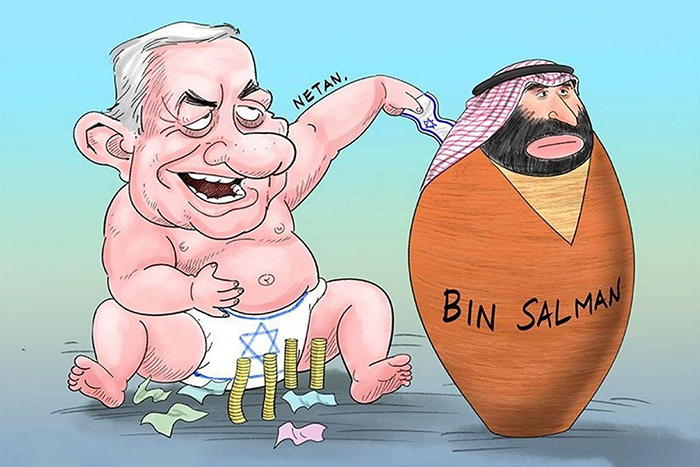
An artist’s rendition of the forces involved in maintaining Muhammad bin Salman in the seat of Saudi power, even as he overturned decades of business-as-usual succession policies. The script is written in Tel Aviv, bolstered by Washington, and then executed by some of the greatest and most unrepentant sellouts in Muslim history. One of the factoids that was just recently revealed in Bob Woodward’s book about the Trump administration, “Fear: Trump in the White House,” is that the President’s son-in-law, Jared Kushner, who is a known enabler of some of the most virulent elements of the Israeli colonial forces in the Holy Land, orchestrated the palace coup utilized by Bin Salman to consolidate his power play by persecuting his own family, not to mention the very religious Wahhabi establishment that has been underwriting the Kingdom’s sectarian wars around the world.
The Saudi youth are led to believe that these jobs are now available for them. This may be true on paper but Saudis are not used to working. On the rare occasion that they come to work, all they do is drink endless cups of coffee served by a poor Indian or Pakistani worker. No more, but the big question remains: are the Saudis capable of doing any work? Unemployment among the Saudi youth stands at 30% and youth under the age of 25 constitute 51% of the population. In the absence of job prospects — and quickly — the re-gime is sitting on a time bomb.
So what is behind Bin Salman’s bright idea of “Saudi nationalism”? And why has he abandoned even the pretence of Islamic solidarity or Arabism? This is all part of Bin Salman’s plan to consolidate power in his hands. But how successful would he be in his attempt at such social engineering?
Despite the thin veneer of modernity that the Saudi state has applied, at its core, Saudi society remains tribal in nature. Identities are shaped not by some nebulous concept of “nationalism” but by tribal affiliation. Even Bani Saud are guilty of this. How many top government posts including governors are occupied by members of other tribes? The Bani Saud clan occupies the overwhelming majority of top positions in government. Is there no talent outside the clan?
The sins of Bani Saud have a long history. They were British agents at the beginning of the last century. It was the British that installed them in power and then supported ‘Abd al-‘Aziz ibn Saud, the brigand and thief, to rename the Arabian Peninsula as “Saudi” Arabia and declare himself king. At a stroke, 1,400 years of Muslim history was set aside by the Bedouins of Najd. Even before that, Bani Saud hordes had perpetrated horrific crimes in Makkah and Madinah.
In order to camouflage their nefarious designs, they imprinted the kalimah on their flag to project themselves as champions of Islam. Mass murder, pillage, and rape, crimes that Bani Saud committed, clearly put them in the category of degenerate reprobates. But their gimmicks unfortunately hoodwinked millions of innocent Muslims into believing that they are “good Muslims.”
Bani Saud’s fraud is now getting exposed. Even ordinary Muslims are waking up to the truth. Apart from their paid agents, there are few Muslims in the world who have a positive opinion of the Bani Saud.
Bin Salman’s antics are further exposing the clan. Made up of a bunch of cruel, greedy and uncouth Bedouins, they have no regard for Islamic principles or norms. Their only concern in life is to cling to power. For this, if they have to align themselves with the devil (the US and Zionist Israel), they will do so. And they have.

Like his other half-baked plans, the one about shoving “Saudi nationalism” down the throats of other tribes will backfire and bite the dust. It may even lead to a revolt among the tribes. This will not be a bad development at all.