
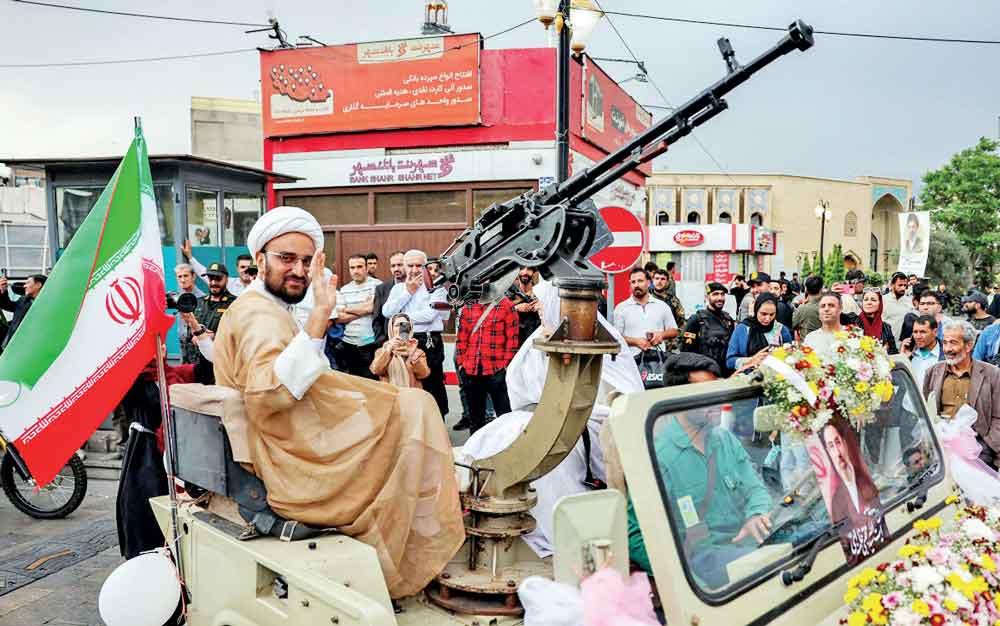
Spread love, not war: A Muslim cleric waves while riding in a military jeep with a couple as they arrive for a public mass wedding ceremony at Imam Hossein Square in Tehran on Monday. AFP

In the US, rising fuel and essential prices have become a political liability for the ruling Republican Party, led by President Donald Trump. In Britain, the government has expressed fears of the economy sliding into recession. This week, the people of Kenya took to the streets in protest against the government after a steep rise in oil prices. Four people were killed in clashes with security forces.
In India, the government has urged economists to propose measures to cushion the oil shock, while peace mediator Pakistan is implementing drastic fuel-saving measures. In Sri Lanka, an import-dependent economy, commodity prices rise almost daily following upward revisions of oil prices and electricity tariffs for high-end consumers, amid a rapid slide of the rupee against major currencies. Nations await the news of a peace deal with bated breath, while analysts and international relations commentators are left at a loss when promising developments are dashed within hours by news of the war’s imminent resumption.
Peace is not impossible between Iran and the US. Both parties know there is more to gain from peace than war. Yet the uncompromising positions they have adopted—one side expecting the other to concede to maximalist demands— make reconciliation seem impossible when what is needed is bridge-building and narrowing gaps in their respective stances. It is easy to strike a deal with a defeated party. For instance, Venezuela succumbed to US military pressure after Washington flexed its muscle and captured President Nicolás Maduro.
Venezuelas new president, Delcy Rodríguez, accepted the Trump administrations dictates in a clear sign of surrender. After World War II, Japan signed a surrender document and later a security treaty—agreements that left it virtually constrained as a nation, unable to form its own army, with its military sovereignty compromised under the US-imposed constitution. But Iran is not a defeated party.
By enduring lethal US and Israeli firepower for forty days, Iran proved it did not lose the war. As proof of victory, it highlights the destruction inflicted on nearly all US military bases in the region. It also claims to be the first nation to down an F-35, a sophisticated radarevading aircraft in the US arsenal. The war ended in a ceasefire, not because Iran could not sustain it, but because the US-Israeli axis and Gulf nations feared the worst was to come.
Iran still holds many trump cards beyond its missile and drone capabilities. It has demonstrated control over the Strait of Hormuz, the vital chokepoint through which one-fifth of the world’s energy flowed before the war started, and it can potentially shut down the Bab al-Mandab gateway in the Red Sea. If it chooses, it could even target undersea internet and telecommunication cables in the Strait of Hormuz, severely disrupting global trade and connectivity.
The Trump administration failed to account for these leverages when Israeli Prime Minister Benjamin Netanyahu pushed the US president into a war he could not win—a plan Netanyahu had tried to sell to successive US presidents for forty years until he found a sucker in Trump. Much to the chagrin of Netanyahu, the need for peace was emphasised in the recent high-level meetings China’s President Xi Jinping held with US President Donald Trump and Russian President Vladimir Putin. These meetings underscore China’s growing global leadership, which it seeks to project in a multipolar context—where there is no room for hegemonic wars or designs.
President Xi’s Iran policy aligns with his Global Governance Initiative (GGI), the fourth in a package of China’s diplomatic frameworks to reshape the international order. The other three initiatives are the Global Development Initiative (GDI), the Global Security Initiative (GSI), and the Global Civilisation Initiative (GCI). China’s national interest is closely tied to West Asian peace. If peace prevails in West Asia, the global economy will flourish, enabling nations to trade more freely.
As the world’s leading marketplace, China stands to gain significantly from such stability. The biggest obstacle to peace, however, remains Netanyahu. He continues his genocidal campaigns in Gaza and Lebanon despite ceasefire agreements and is also accused of meddling in US domestic politics, opposing candidates critical of Israeli policies. On Tuesday, Kentucky Republican Congressman Thomas Massie lost the primaries—a defeat he attributed to interference from Israel. Reports this week said that Trump had a heated argument with Netanyahu during a telephone conversation about the Iran peace deal.
The chance of a breakthrough in the ongoing peace process with Pakistan’s mediation is more likely if Trump keeps Netanyahu out of it. The longer Trump delays peace, the more unpopular and politically costly the war will become. Reports yesterday indicated progress, with Pakistan’s military chief Asim Munir visiting Tehran shortly after Interior Minister Mohsin Naqvi made two visits to the Iranian capital within this week. Another positive sign was increased movement of ships across the Strait of Hormuz.
A further confidence-building measure was the release of an Iranian ship by the US after it had been seized by American troops in the Gulf of Oman. Iranian state media reported that Tehran is reviewing the US response—received via mediator Pakistan—to its peace proposal, while Iranian leaders warned they are doing so with their fingers on the trigger. Trump, meanwhile, said Iran and the US were ‘right on the borderline’ between reaching an agreement and resuming war, cautioning that failure to secure the ‘right answer’ could lead to rapid escalation.
The language from both sides highlights the fragile thread on which the peace process hangs. The thorny issues include the US insistence on an Iranian commitment not to pursue nuclear weapons and Iran’s demand for war reparations, along with the release of nearly $100 billion of its assets frozen in the US and other Western nations.
There appears to be some agreement on temporarily lifting sanctions—a move that would lower oil and gas prices, much to the relief of people suffering the economic consequences of the war. Although navigating these hurdles may seem difficult, the issues are not unresolvable. With safeguards, assurances, and guarantees, peace— as the world’s poor pray—could come soon and is not impossible.

No comments:
Post a Comment