
Israel’s firepower could destroy terrain, empty villages, and redraw contact lines – but Hezbollah’s rebuilt doctrine turned every meter of the ‘security zone’ into a trap.

The Cradle's Military Correspondent

Those familiar with south Lebanon understand that anger there is rarely spent in bursts. It is stored, worked over, and left to harden until the moment arrives. That instinct reaches back to the years when the Palestine Liberation Organization (PLO) withdrew into Beirut, abandoning what US military doctrine would call a swamp.
Between 1978 and 1982, the Shia current that had emerged from Fateh, the PLO, and the communist party left began to chart its own path. The Islamic Revolution in Iran entered the fight as a direct partner, not as a distant source of inspiration.
A resistance source tells The Cradle that the synchronized rocket salvos from Iran and Lebanon – with Yemen entering in the final days – were not incidental. “We lost the Palestinian rocket force in Gaza, but what happened militarily was an extraordinary feat. Israel knows the results better than anyone.”
After the 2024 war, the wager was patience fused with discipline. “The lesson is not only possessing power or preserving it,” the source says, “but how to use it in a way that protects our people from Israel repeating its genocide in Gaza, while still confronting the enemy skillfully and making it hurt – at the right time, by the right means, and in the right sequence.”
A doctrine rebuilt under fire
In meetings with planning and field commanders through 2024 and 2025, the outline of Hezbollah’s new battlefield method became clear. Its language carried echoes of the martyr Imad Mughniyeh and his generation: the next response had to come on Hezbollah’s initiative and from south of the Litani, as an act of defiance.
The defense would no longer resemble the model the Israeli military believed it understood. It would be hybrid, layered, and mobile: inducement, ambushes, hit-and-run action, martyrdom-style engagements, and persistent strikes from distance. The first Israeli entry had to be difficult, the advance harder, and every deeper push more punishing.
Hezbollah would not cling blindly to ground, but it would not surrender it cheaply either. What was lost geographically would be struck from afar. Every additional kilometer gained by the occupation army would stretch its forces, thin its protection, multiply exposed positions, and give the resistance more time to learn, observe, and strike again.
The security zone Israel sought could not be produced by destruction alone. It required permanent occupation – a burden neither Tel Aviv nor any international force could carry without paying for it.
The tactical lessons were equally blunt. Hezbollah would expand prepared ambushes, fight as much as possible from underground routes, move between houses through safer pathways and timings, reduce wireless and electronic signatures, rely more heavily on pre-planned scenarios, avoid crowding fighters on any front, rotate them more carefully, and use every drone or Almas missile hit to generate follow-on fire.
Thermal cameras were placed in expected avenues of advance, kept powered continuously, and used not only for first targeting, but also for guidance and documentation. Explosive traps and camouflaged devices became central: some planted before the battle, others after Israeli preparatory bombardment.
How Hezbollah hunts
Resistance fighters describe an unwritten protocol for matching each target with the right weapon. Abundance does not mean waste. A target that requires a Kornet gets a Kornet. A drone may follow if the first strike misses, but fighters say more than two attempts are rarely needed.
A direct hit from a heavy explosive device can turn a vehicle into scrap and kill everyone inside. A tank or armored carrier struck by anti-armor fire, if Trophy fails to intercept it, may be badly damaged; repeated hits can destroy it outright.
Almas is most effective when it drops vertically onto weak upper armor. FPV drones depend on the vehicle, the point of impact, and the operator’s skill – especially if a hatch or side opening is exposed. Jeeps are the easiest to destroy completely.
Empty vehicles are still hit when a missile or drone is already at the end of its launch path. Nothing is allowed to go to waste.
Drones became the clearest expression of this method. Hezbollah had used reconnaissance, attack, loitering, and defensive drones throughout the “support front” and the 2024 battle of “Uli al-Ba’s'” – the Possessors of Great Strength – but modifications and cheaper new models deepened the shock inside Israel.
Three control methods dominate: pre-programming, radio signal, and fiber optics.
Recent resistance videos show that many fixed-wing drones launched at Israeli positions are programmed before takeoff, making electronic jamming largely useless. They have to be shot down. Their smaller size, quick assembly, flexible transport, and simple launch platforms make them cheap tools for exhausting air defenses.
Signal-guided drones remain vulnerable to jamming, though high-grade encryption protects reconnaissance platforms such as the Hudhud. Fiber-optic drones, often quadcopters, are tethered to the operator by thin, hard-to-detect wires resistant to fire and cutting. Their range can stretch from one kilometer to 65, though longer fiber adds weight and reduces the warhead.
This method requires a skilled operator using goggles or a helmet that displays the camera feed. Israeli estimates place the operators inside fortified positions, controlling the drones with joystick-like devices. Because the drone is wired, jamming cannot bring it down. It has to be hit directly. The surprise was not only the technique, but its range and availability.
A resistance source says Hezbollah had already used fiber optics in 2023 and 2024. “We operated fixed-wing drones through these fibers to hit border positions, and even to fire missiles from some drones while filming at the same time. Either the Israeli does not know, or he pretends not to know to justify his failures.”
For new or high-value targets, Hezbollah uses larger, faster, more expensive drones with specialized programming, now reserved for important targets inside occupied territory, including one that struck a newly established military position in occupied Acre.
Israel’s late countermeasures
Hebrew media reported on 29 and 30 April 2026 that Israeli military intelligence had formed a dedicated team to counter Hezbollah’s two-stage attack method: first, a surveillance drone gathers intelligence and returns; then a fiber-optic attack drone, harder to detect or disrupt, is sent in to strike.
Israeli Prime Minister Benjamin Netanyahu had already said on 28 April that he had ordered a special program to eliminate the drone threat, while admitting that results would take time. Hebrew outlet Kikar reported that the Trophy active-protection system, despite updates against smaller threats, had failed to stop them.
Israeli forces then turned to “defense cages” – metal nets mounted over tank turrets to detonate drone charges before impact. Settler platforms mocked the measure, warning that the cages obstruct evacuation, increase the vehicle’s visibility to drones, create hazards in wooded terrain, and endanger soldiers under fire.
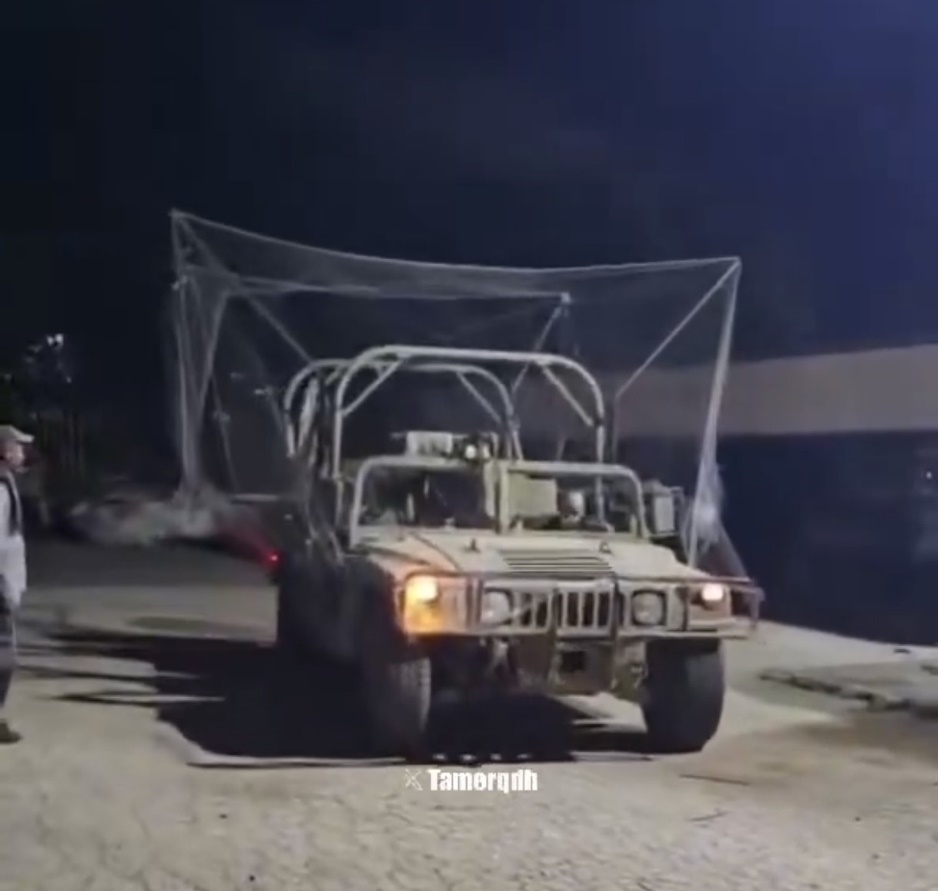
Graphic: Settler-platform video mocking Israel’s improvised anti-drone cages.
Israeli Army Radio reported growing frustration among field commanders, who said instructions were still largely limited to raising readiness levels and firing at drones once spotted. Israel Hayom claimed that soldiers had, in some cases, cut the fiber connecting a drone to its operator, but acknowledged that doing so requires unusual field skill. Talks have also begun with a foreign army – likely Ukraine’s – that has more experience confronting this threat.
Laser systems, electromagnetic weapons, drone-on-drone interception, Iron Dome launches, ground fire, helicopters, and fighter jets all remain partial answers. None offers full coverage, especially against dense attacks arriving from several directions at once.
Yossi Yehoshua of Yedioth Ahronoth captured the wider alarm, in a column headlined “The drone threat is spinning out of control,” writing that Hezbollah launches drones repeatedly and acts in the field “as if it were completely under its control.”
Ground Forces Commander Maj. Gen. Nadav Lotan responded by forming seven specialized teams to update doctrine, detect and intercept drones, manage the digital and spectral domain, improve passive protection, coordinate with defense industries, study Hezbollah drone units, and fold the lessons into training and procurement, according to Walla.
The ‘Yellow Line’ comes undone
By the final hours before the ceasefire on 16 and 17 April 2026, Israel was trying to turn dispersed fire pressure into a new map of the south: fragmented, depopulated, low-density, and easier to monitor, strike, engineer, and isolate. This was not occupation in the classic sense. It was an attempt to reshape the terrain before the truce took hold.
This was evident in the combination of air saturation, expanded evacuation orders, accelerated demolitions, bridge destruction, and the political and media push around a “security zone” reaching the Litani and beyond.
But the same pattern also exposed clear limits: Israel could produce destruction faster than it could turn destruction into control, while close combat remained costly and the axes of advance stayed vulnerable to attrition.
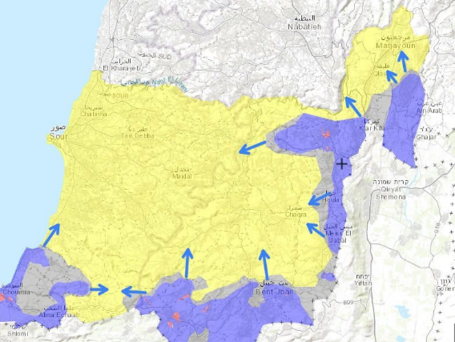
Map: Operations and advances up to 14 April 2026.
In the western sector – Tyre (Sur), Naqoura, Ras al-Bayyadah, and Shamaa – Israel treated the coastal strip as a platform for “depth by fire,” not as a conventional breakthrough front. The destruction of Al-Qasmieh Bridge and strikes around Tyre were meant to isolate the area south of the Litani.
But Hezbollah continued to hit artillery positions and new deployments in Bayyadah and Ras al-Naqoura, using anti-tank fire, ambushes, and drone interceptions to prevent the strip from settling into a stable zone.
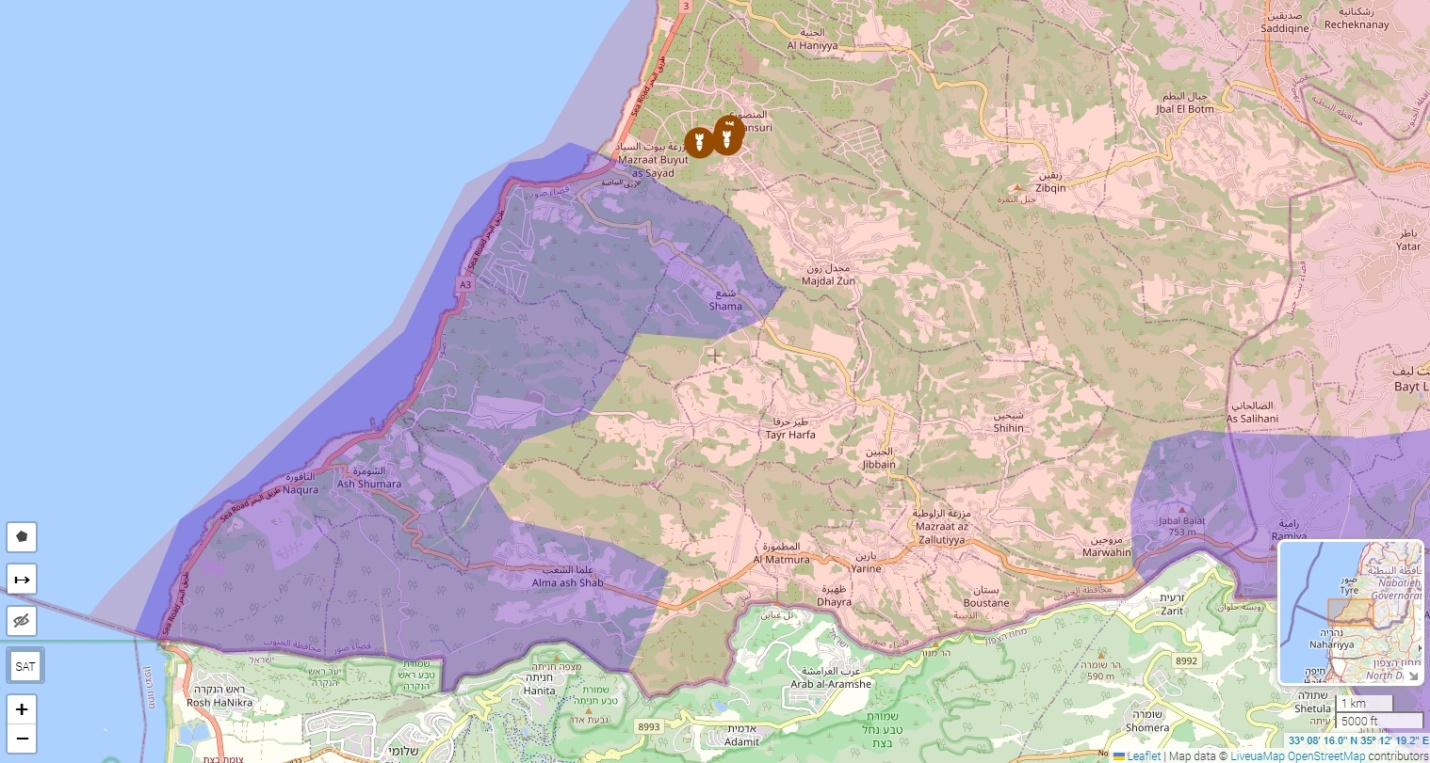
Map: Western sector status as of 9 April 2026, according to Israel Palestine Live.
In the central sector – Bint Jbeil, Ainata, Deir Seryan, and Houla – Bint Jbeil became the operational and symbolic center of gravity. Israel tried to impose a siege through urban destruction and limited penetrations from several axes.
But the fighting remained concentrated at the city’s entrances and decisive approaches. Strikes on tanks near the market and the northeastern edges, along with attacks around the Musa Abbas complex, Aqabat Ain Ebel, the Tahrir Triangle, and Al-Ishraq School, showed that Bint Jbeil had not become a captured space.
It remained a knot of attrition, delaying the link between axes and breaking the momentum of every push toward its center.
In the eastern sector – Mount Hermon, Qantara, Wadi al-Hujair, and the Bekaa approaches – Israel tried to push the proposed security zone toward commanding terrain around Khiam, Qantara, Deir Mimas, and the surrounding highlands.
But Qantara, Khiam, Taybeh, Odaisseh, and Rabb Thalathin pointed to the same pattern: fire pressure and limited thrusts rather than a coherent breakthrough. Repeated strikes on Qantara, destroyed armor, and attacks on newly established artillery positions turned the axes of advance into counter-kill zones.
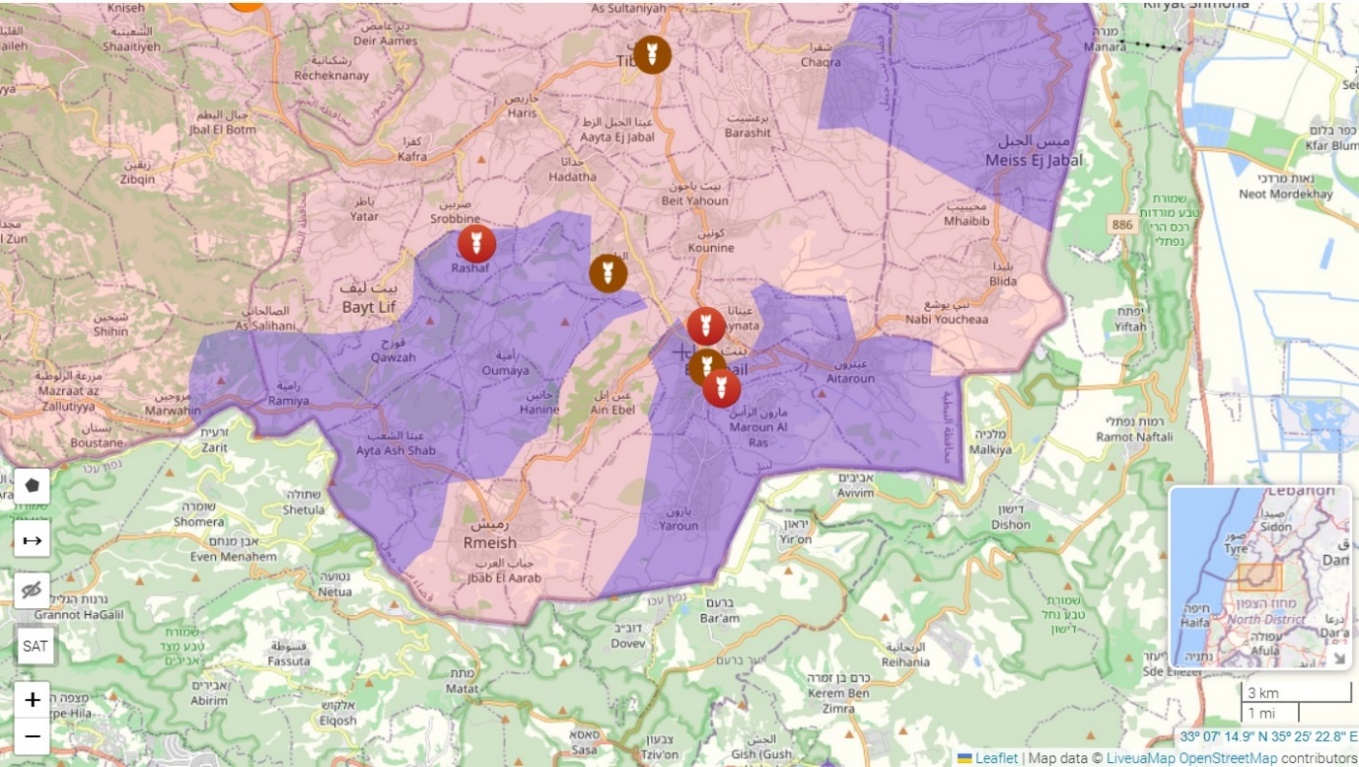
Map: Central sector status on the same date.
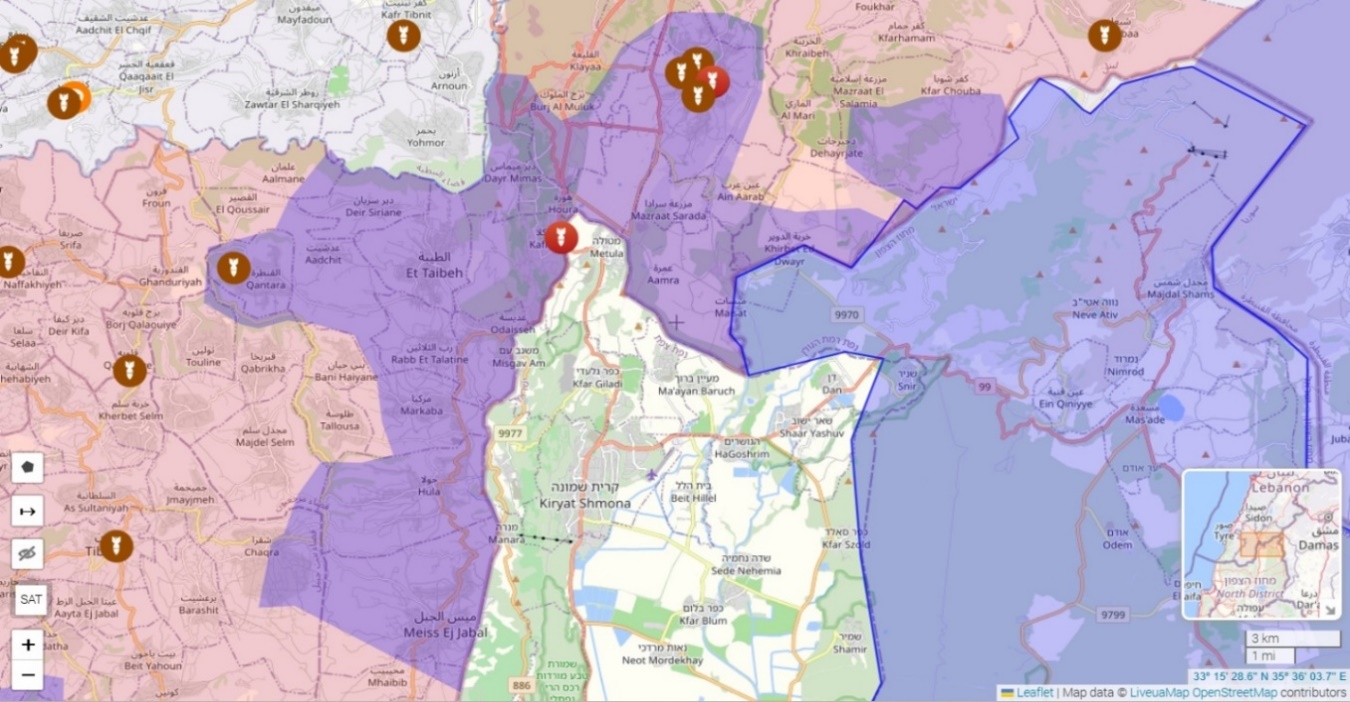
Map: Eastern sector status on the same date.
After the ceasefire, the western sector remained a battle over coastal and land isolation. The central sector remained an urban attrition zone. The eastern sector became a depth battle built on layered ambushes and contested air-reconnaissance superiority.
Across all sectors, the ‘Yellow Line’ failed to become a safe belt. It became a long strip of friction where Israeli forces were targeted from above ground, underground, and low air.
The period from 17 to 30 April did not reveal calm, but an armed truce. Israel imposed heavy destruction and coerced geography, but failed to turn either into stable control or deterrence. Hezbollah did not fight a conventional battle to retake land. It managed a precise attrition campaign in which every position, bulldozer, gun, or evacuation helicopter inside the yellow zone became a target.
The result was the collapse of the fortified buffer-zone assumption. A new equation emerged: a lighter occupation, but one more vulnerable to attrition before any formal collapse of the truce.
Amos Harel wrote in Haaretz on 24 April 2026 that Israeli claims of five divisions maneuvering in south Lebanon were exaggerated. The army, he noted, did not send reserve units into Lebanon. Most forces were partial brigade formations, largely regular troops, and many left after the US-imposed ceasefire.
Those who fought, Harel added, moved in and out of villages without continuously holding a defined defensive line. The reason, rarely admitted publicly, was that regular and reserve units were exhausted and could not be assigned more ambitious missions. Seizing the anti-tank defense line was a compromise.
The Israeli military, he concluded, still holds a line of hilltop positions eight to 10 kilometers north of the Lebanese border to prevent anti-tank missiles from reaching border settlements. But the scale of the force and the weight of its missions have shrunk sharply. That is why the talk is now of hundreds of fighters – not thousands or tens of thousands.
For Hezbollah, that is the point. Israel can destroy. It can depopulate. It can redraw lines on a map. But in south Lebanon, it still cannot easily hold what it breaks.

No comments:
Post a Comment