
As Washington and Tel Aviv squeeze Iran from the south, the Caspian is becoming the northern artery of a Eurasian supply network built beyond western reach.

The Cradle

But the more the US–Israel axis leans on the Gulf, the more Tehran’s strategic depth shifts northward, across a closed body of water that western planners cannot easily dominate.
The Caspian Sea now matters because it gives Iran and Russia something both states urgently need, a direct, politically controlled route outside the reach of hostile land corridors.
Overland trade must pass through states that are either aligned with Washington or unwilling to risk US secondary pressure. The Caspian, by contrast, links the two countries without a third-party gatekeeper.
Ships can still be hit by drones and missiles, but reaching them requires far deeper penetration into Iranian space and carries the danger of confrontation with Russia. In the short term, the Caspian offers Tehran a reliable supply line. Over the longer term, it could deepen Iran–Russia integration and become a central route connecting Russia to West Asia, India, and the wider world.
The legal battle over a closed sea
Is the Caspian really a sea? It’s not a trivial question. If it’s a sea, it’s subject to the UN Convention on the Law of the Sea (UNCLOS), under which territory extends 12 miles from the coastline, after which free navigation applies. If treated as a lake, the territory extends to borders mutually agreed upon by the surrounding states.
Until 1991, only two states occupied the Caspian: Iran and the USSR. In 1921, the Russo–Persian Treaty of Friendship prohibited other countries from navigating it. But when the Soviet Union fell, three new states joined the Caspian: Azerbaijan, Kazakhstan, and Turkmenistan. These former Soviet Republics disputed the 1921 treaty, insisting on negotiations that took UNCLOS into consideration.
All the former Soviet Republics, including Russia, wanted the Caspian to be treated like a sea, but because Iran’s short coastline would give it less territory, it insisted the Caspian was a lake. The potential for UNCLOS to apply would have also allowed the entry of foreign military vessels 12 miles away from Iran. This was not a hypothetical fear, given Azerbaijan's close alliance with Israel. Were it to host the Israeli navy, Tel Aviv could open a front in Iran’s north.
The failure to come to a consensus made the Caspian’s legal status ambiguous, depriving the region of further integration. For instance, the proposed Trans-Caspian Pipeline would connect Turkmenistan with Azerbaijan, bringing oil and gas from Central Asia to Europe. But with no clarity on who owned the seabead, the project stalled.
In 2018, the five states came to a decision. The Caspian was not a lake or a sea, but a unique body of water that would be subject to the Convention on the Legal Status of the Caspian Sea, also known as The Caspian Sea Treaty.
Similar to UNCLOS, states would have 15 miles of territory from the coastline and a further 10 miles for fishing. The remaining area would be shared, and any state party to the treaty could lay submarine cables and pipelines.
But unlike UNCLOS, states not party to the treaty were prohibited from stationing their armed vessels. Iran did not secure its maximalist demand to have the Caspian classified as a lake, but the exclusion of outside militaries gave it the protection that mattered most.
Caspian cooperation
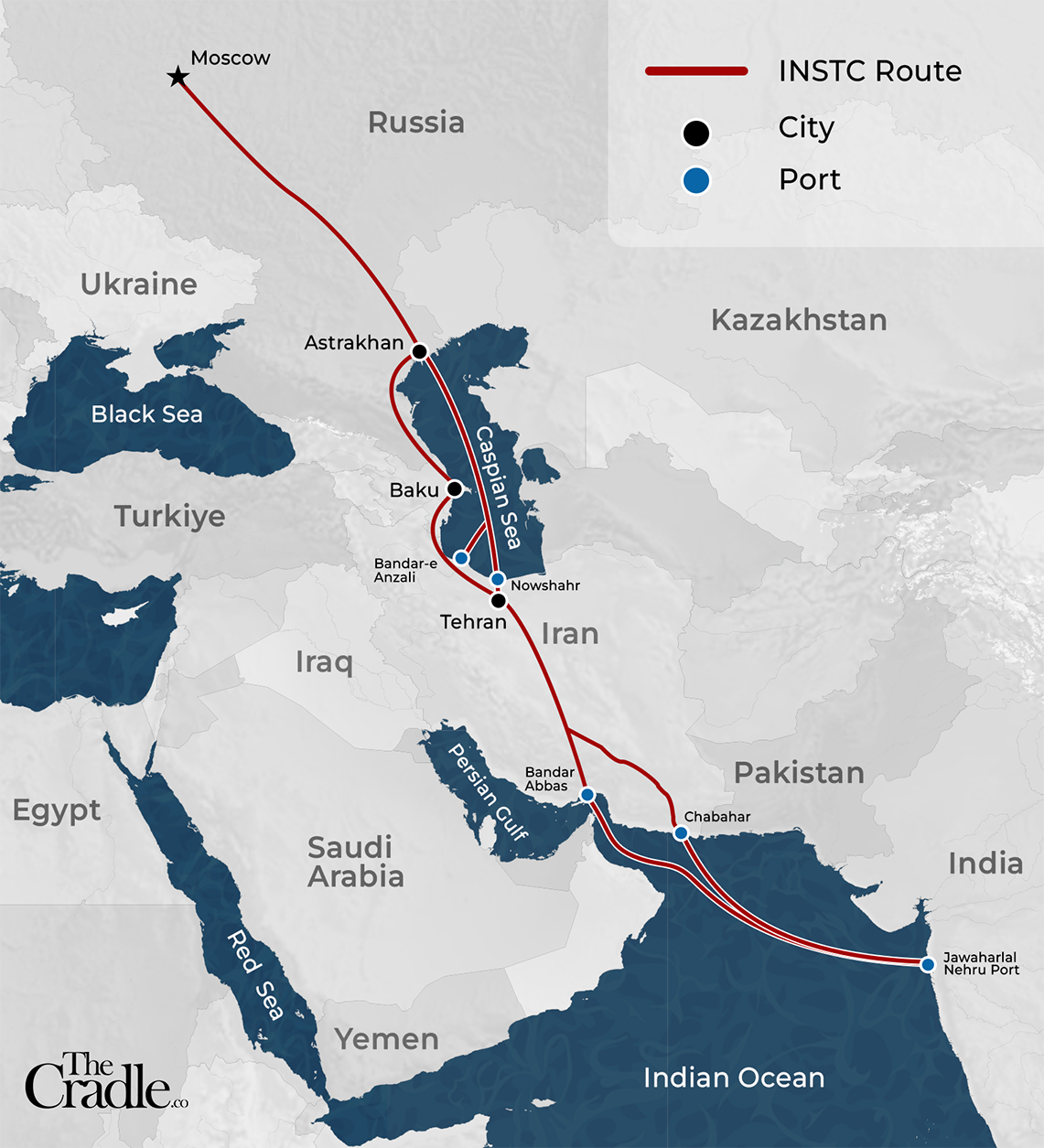
The treaty gave the littoral states a framework for cooperation, but for Iran–Russia ties, the Caspian remained underused as long as land routes were available. As cooperation over Syria deepened, Moscow proposed the International North–South Transport Corridor (INSTC) in 2013, a network of pipelines, railways, and highways linking Russia through Azerbaijan to Iran, then onward to India and the wider world.
Everything changed when Russia invaded Ukraine in 2022. While Azerbaijan did not impose its own sanctions against Russia, it did provide humanitarian aid to Ukraine and vocalized support for its territorial integrity, and claimed it was complying with secondary sanction rules.
Meanwhile, Iran–Russia cooperation accelerated. With Russia joining Iran in being sanctioned, there was no longer an incentive for Moscow to restrict trade with Tehran. Moscow also had to look for other suppliers for its military. Iran provided drones that were decisive on the battlefield.
Why rely on Azerbaijan when the Caspian was right there? Nearly 1,000 kilometers away from the Russia–Ukraine frontline, it provided a direct and covert route for weapons heading from Iran to Russia. In return, Russia supplied more goods to Iran.
In 2022, the Iranian port of Noshashr hosted its first Russian cargo ship in 21 years. That same year, Iranian and Russian shipping companies teamed up to form a new corporation that would develop the INSTC. In 2025, shipping at Iran’s port of Anzali was up 56 percent.
The northern route under fire
After the US-Israeli war of aggression on Iran, Washington blockaded the Persian Gulf. Land transport also became riskier, with neighboring states such as Azerbaijan, Pakistan, and Turkiye maintaining close ties with the US.
The Caspian became crucial again, this time with the flow reversed as Russia sent weapons and critical goods to Iran. A recent New York Times (NYT) piece alleges that Russia has been sending drone parts to Iran through the Caspian.
Drones proved vital for Russia in Ukraine, and they have also helped Iran strike US military installations across West Asia. Russian ships have reportedly carried basic goods, including food, to help Iranians withstand the blockade.
The US and Israel can strike ships or ports on the Caspian Sea, but the risks are significant. The Caspian sits far from Israel and US military bases near the Persian Gulf. Any attack on Iranian assets there also risks drawing Russia directly into the conflict, particularly when those ports serve as docking points and logistical nodes for Russian vessels.
That is why the publicly confirmed Israeli strike wave on Bandar Anzali in March 2026 triggered a sharper Russian response than a routine condemnation. The attack hit the largest Iranian port on the Caspian, a commercial and military hub tied into the same maritime route Russia uses to move cargo to and from Iran.
Russian Foreign Ministry spokesperson Maria Zakharova warned that the strike affected “the economic interests of Russia and other regional countries” with transport links to Iran, and said such “reckless and irresponsible actions” risked “dragging the Caspian states into the military conflict.”
The warning was repeated at a higher political level. After Russian Foreign Minister Sergei Lavrov spoke with his Iranian counterpart Abbas Araghchi, Moscow said both sides expressed concern over the “dangerous spread of the conflict provoked by Washington and Tel Aviv to the Caspian Sea area.”
Kremlin spokesperson Dmitry Peskov then said Russia would view any spillover of the Iran war into the Caspian “extremely negatively,” while declining to comment directly on reports that Israeli strikes had targeted vessels allegedly carrying Russian weapons to Iran.
Tehran also moved to turn the strike into a Caspian-wide security issue rather than a narrow bilateral matter. Araghchi warned that attacks on Bandar Anzali had “seriously endangered security and stability in the Caspian Sea,” calling on the coastal states to take a “firm and unified stance” against the destabilizing act.
The message was clear enough. Once the war reached Iran’s northern coast, it touched the interests of every littoral state that depends on the Caspian remaining outside the US-Israeli battlefield.
Ukraine has struck the Caspian three times in recent months. The timing, against the backdrop of the Iran war, is suspicious, though the targets so far have been Russian military assets. For Tehran, that means the Caspian route remains largely secure, especially when compared with the exposed southern approaches around the Persian Gulf.
Eurasian depth beyond the blockade
When the war ends, the Caspian will remain critical for both Russia and Iran. More than a decade ago, Moscow saw the INSTC as a way to reach India while bypassing Europe. Under conditions of western sanctions, war pressure, and the expansion of Atlanticist containment, that old plan has gained new weight.
If sanctions are eventually lifted and India moves further away from western dependency, the corridor could become one of the key arteries of a multipolar order. It would give Russia a route to the Indian Ocean, give Iran a central role in Eurasian trade, and weaken the US ability to isolate either state through maritime pressure or financial coercion.
Given its advantages, the Caspian took a surprisingly long time to reach its current importance. Its legal status was only clarified in 2018, and before the Ukraine war, overland routes still appeared viable. But as Moscow and Tehran tighten cooperation in a hostile international environment, the Caspian is no longer a secondary route. It is becoming one of the quiet pillars of the Eurasian answer to US hegemony.

No comments:
Post a Comment