
TEHRAN PAPERS:
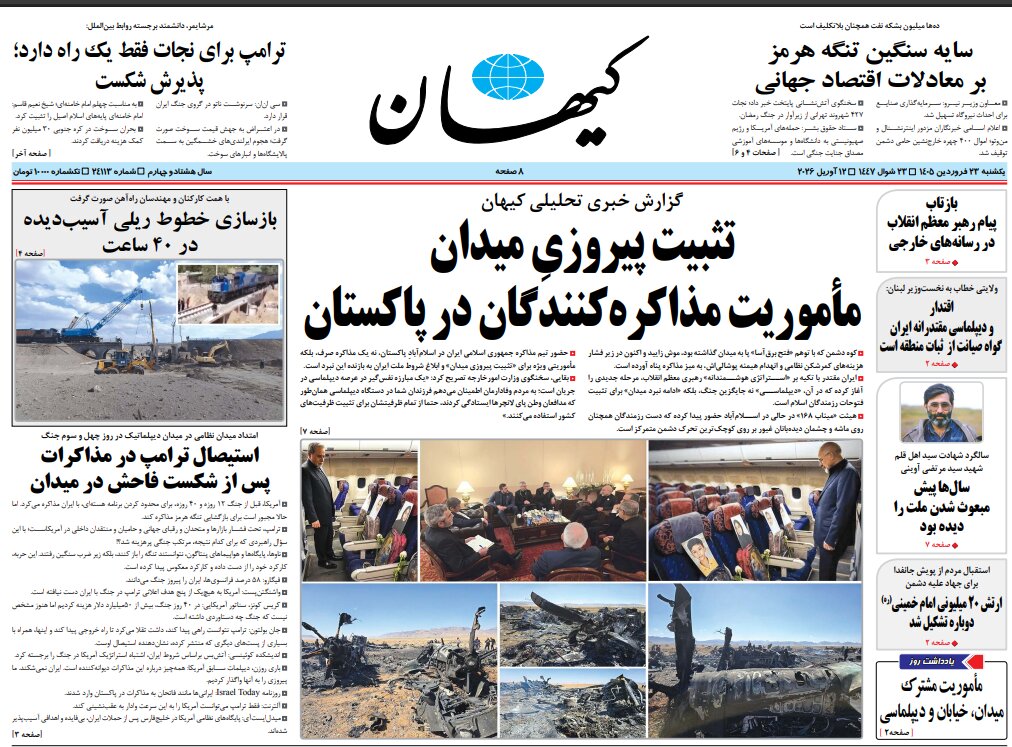
Kayhan, in a commentary, highlighted the importance of the Strait of Hormuz as a pressure lever for Iran in its confrontation with the United States. Managing the Strait of Hormuz can not only weaken the position of the United States, but, through collecting transit fees and generating revenue for the country, may even help ease sanctions.
Exercising legal sovereignty over the strait brings Iran multiple advantages. Under such conditions, Iran would be in a strong position against countries that have participated in sanctions against it, and could also collect lawful fees for securing this strategic waterway. Economic expert Hossein Raghfar argues that the West and the United States would face serious challenges if Iran were to assert control over the Strait of Hormuz; therefore, preserving this major strategic achievement is valuable at any cost.
Shargh: Artificial respiration for the strait
Shargh dedicated its editorial to the issue of keeping the Strait of Hormuz open during the ceasefire period. The US acceptance of Iran’s proposals merely as a ‘basis for negotiations’ carries no inherent concession. Typically, in negotiations, the US insists on its 15‑point plan and Iran on its 10‑point plan, resulting in no breakthrough—at best, an agreement to postpone talks for another week or two. In such a scenario, the Strait of Hormuz would effectively remain open for a month. Thus, the ceasefire becomes a form of artificial respiration for the strait and lifts the shadow of war from the pulse of the global economy. Negotiations, therefore, become a tool for the US to buy time and for the world to receive temporary relief.
Etemad: No contradiction between the battlefield and diplomacy
Etemad, in an analysis, argued that there is no contradiction between diplomacy and the battlefield. Quoting political figure Esmaeil Gerami‑Moghaddam, the paper states that he views the recent Iran–US understanding—mediated by Pakistan—as the product of coordination between ‘the battlefield and diplomacy,’ and as a sign of the United States’ strategic failure after four decades of confrontation with the Islamic Republic. Emphasizing three pillars—military capability, cohesion within the political‑military structure, and public awareness—he believes the recent potential understanding simultaneously showcased Iran’s military and civilizational power to the world. The recent ceasefire between Iran and the United States for negotiations is not merely a ‘temporary arrangement’ at the end of a security crisis; it marks an important point in the trajectory of a 46‑year confrontation between the Islamic Republic and the United States.
Javan: The US negotiates on behalf of Israel
Javan, in an article, examined the strong presence of the Iranian delegation in Islamabad for negotiations with the United States. According to the paper, analysts believe that the presence of high‑ranking military figures in Iran’s negotiating team symbolizes strength and reflects an assertive approach aimed at preserving the military and economic gains of the war. This assertive posture and deep mistrust were reinforced even before the talks began, through Iran’s declaration of two fundamental preconditions—especially after Parliament Speaker Mohammad Bagher Ghalibaf explicitly stated that Iran would not enter negotiations until a ceasefire in Lebanon is established and Iran’s frozen assets are released. The paper argues that Iran’s precise and calculated strategy—using all political, military, and economic tools to secure maximum concessions from these decisive negotiations—shows that Tehran, recognizing its battlefield successes, intends to enter the talks from a position of strength.
Jam‑e-Jam: The Strait of Hormuz, the bottleneck of the global economy
Following the start of the third imposed war and Iran’s closure of the Strait of Hormuz, Donald Trump stated that the strait was not important to him and that those who rely on it should work to reopen it. Yet he has now come to the negotiating table to hear Iran’s conditions for reopening the strait. Approximately 20 percent of the world’s oil passes through the Strait of Hormuz, and its management has come under Iran’s control. In recent years, the strait’s role has expanded into the realm of food security and survival. Additionally, the seabed of the Strait of Hormuz and the Gulf of Oman hosts a vast network of international fiber‑optic cables connecting China and India to Europe and the United States. These cables form the backbone of global data transmission, banking transactions, and the operation of international servers. The paper concludes that in today’s world, merely possessing a strategic location is no longer sufficient; rather, it is the intelligent and strategic use of that location that determines a country’s standing in global economic equations.

No comments:
Post a Comment