
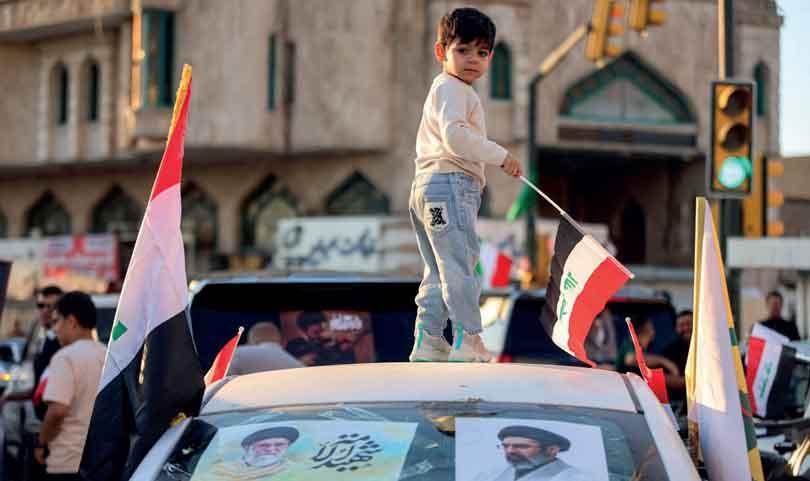
A boy waves an Iraqi flag from atop a vehicle displaying pictures of Iran’s slain and current supreme leaders Ayatollah Ali Khamenei and his son Mojtaba Khamenei, during celebrations welcoming the two-week ceasefire between the United States and Iran in Baghdad. AFP.

It is said that truth is the first casualty of war. But when men lacking integrity lead the world, truth becomes a casualty even in peace. Deception shrouds the 14‑day truce announced early Wednesday, just hours before the deadline US President Donald Trump imposed with a genocidal warning: “A whole civilisation will die tonight” unless Iran agrees to a deal to end the war and lift the blockade of the Strait of Hormuz.
Having been deceived twice, Iran does not trust the Trump administration, which resorted to war while diplomacy was bearing fruit—in June of last year and in February of this year. Iran entered talks in Islamabad with total mistrust. The fear that the US and Israel may use the truce to regroup and launch another attack has not escaped them.
The US was once respected for its word. No longer. Like Israel, the US is today a rogue state—a conceited bully, an aggressor, a violator of international law, and a misfit among nations claiming civilised behaviour in international relations.
Needless to say, a truce with such a rogue state is shaky. This is why Iran insisted that US Vice President J.D. Vance, who initially opposed the war, lead the talks in Islamabad.
The truce now hangs precariously on two delicate threads—the fate of Lebanon and the free passage of ships through the Strait of Hormuz.
Although the truce is touted as a pathway to peace, much to the relief of a world suffering the consequences of US‑Israeli aggression against Iran over the past 40 days, in reality it is neither war nor peace. Since the announcement of the truce, there has been more war than peace. Lebanon is being mercilessly pulverised by the Zionist regime, which has no qualms about launching a second genocide after Gaza.Is Lebanon part of the truce? Iran says yes. Pakistan, the mediator, says yes. But war-hungry Israeli Prime Minister Benjamin Netanyahu, the truce saboteur, insists the truce does not include Lebanon. He revels in the gruesome record of carrying out within ten minutes 100 strikes on Lebanon’s unarmed civilians on Wednesday. He is on an egregious attempt to annex part of Lebanon.
Trump, after endorsing Pakistan’s statement that Lebanon is included in the truce, changed his stance as soon as Netanyahu said it was not—once again exposing America’s sycophancy to Israel.
This was not the United States’ war. Trump fought Israel’s war. According to a New York Times article on Tuesday, Netanyahu, during his visit to Washington weeks before the outbreak of the war, presented Trump with a rosy four‑part war strategy to defeat Iran. No US president had ever fallen for Israel’s trap, but Trump—the Caligula—did. Netanyahu’s strategy envisioned US and Israeli airstrikes to kill Iran’s Supreme Leader Ayatollah Ali Khamenei, cripple Iran’s missile capacity, encourage a popular uprising against the theocracy, and bring about a regime change with a secular leader at the helm.
No amount of dissuasion by CIA Director John Ratcliffe, Secretary of State Marco Rubio, or the Chairman of the Joint Chiefs of Staff, Gen. Dan Caine, could make Trump see reason. He had swallowed Netanyahu’s bait—hook, line, and sinker. The rationale for the war was Israel’s security, but Americans were told Iran posed a threat to the US—a lie that failed. The war was highly unpopular among Americans and was undermining the Republican Party’s fortunes ahead of the November midterm elections.
Contrary to Netanyahu’s plan, Iran’s response turned out to be a shocker. Iran resisted with sheer grit that surprised the US, Israel, and their Gulf allies. Most of the Iranian dissidents the US‑Israeli war party was banking on for regime change rallied behind the government, even as leader after leader in the Iranian government and military was killed and Iran’s civilian infrastructure was destroyed in US‑Israeli attacks.
To cover the failure, the US, resorting to Orwellian newspeak, declared it had achieved its regime‑change objective, though it had not. Paradoxically, calls grew for regime change in the US, where legal experts, politicians, and activists were shocked to see an intention to commit war crimes in Trump’s final warning that the entire Iranian civilisation “will die tonight”. They opined it was high time the 25th Amendment was put in motion to remove Trump, whose genocidal warning shocked the Pope, the UN secretary‑general, and world leaders.
None could predict what horrible crimes a president who had lost his marbles might commit. In the US, calls grew urging the military to defy Trump if he ordered them to nuke Iran.
With pressure growing within the US, including from Trump’s MAGA base, he finally gave in. His much‑threatened boots‑on‑the‑ground plan proved a damp squib. Whatever little boots‑on‑the‑ground action took place on Sunday to rescue two US pilots ended in the loss of several US fighter aircraft. Pressure was also mounting on Trump from Gulf nations, which feared the worst if the war escalated.
All this led to the last‑minute shaky truce, with Trump relying on spin doctors, doublespeak experts, and rhetoricians to claim that the war had been won. War Secretary Pete Hegseth said on Wednesday it was a victory with a capital “V”.
On the other side of the divide, Iranians—some of whom were preparing for a doomsday scenario from a US nuclear attack—woke up to the news of a truce and took to the streets, celebrating the great victory the nation had achieved, forcing the US and Israel—two nuclear-armed nations—to come to a ceasefire arrangement on Iran’s terms: a ten-point proposal that included everything Iran wanted. They ask, “If this is not victory, what is?”
Trump wanted the ceasefire badly, and he surrendered, independent analysts argue. He accepted the Iranian proposal as a framework to initiate Islamabad talks. The Iranian proposal, among other matters, calls for US commitment to non‑aggression, continuation of Iran’s control of the Strait of Hormuz, Iran’s right to enrich uranium, removal of sanctions, war reparations, withdrawal of US forces, and a ceasefire on all fronts, including Lebanon.
An embarrassed US Vice President, who was in Hungary campaigning for strongman Viktor Orbán’s re-election, insisted this was not the ten-point plan Trump approved and even asserted there was a third ten-point plan. In delicate and deceptive international dealings, transparency is often a liability. Whatever the ten points are, Iran seems to be in control of the situation. Emboldened by the upper hand it now has, it went on to close the Strait of Hormuz when Israel and the US claimed that the truce did not cover Lebanon, where Iran‑backed Hezbollah fighters are resisting Israel’s invasion.
Iran, the US, and Israel may claim they have won. If both sides have won, who lost? The biggest losers are the Gulf nations. At Wednesday’s media conference, addressed by US War Secretary Hegseth and Chairman of the Joint Chiefs of Staff General Caine, Jordan and the Gulf nations—except for Oman—were praised for joining the US-Israeli war on Iran.
They not only allowed Israeli and US fighter jets to use their airspace but also permitted the US to operate from bases on their territory against Iran. Under UN Resolution 3314, which defines aggression, the Gulf nations have committed aggression against Iran. They endured damage to their energy plants and other infrastructure and found their friendship with the Zionists and the Americans would not guarantee their security. Despite these setbacks, they seem not to have learned the lesson.

No comments:
Post a Comment