
By Palestine Chronicle Editors
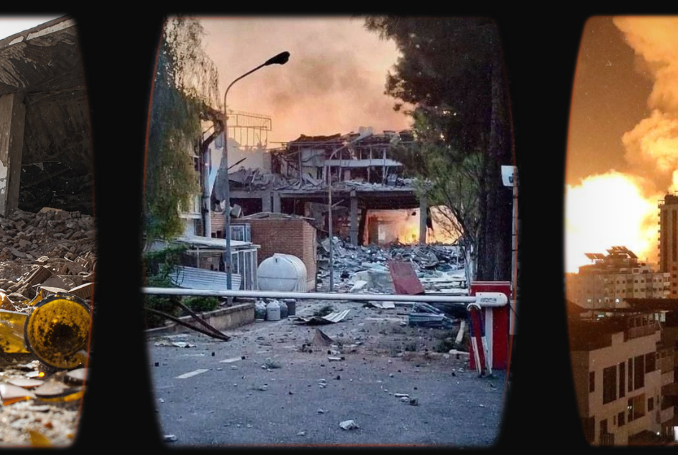 Iran’s Pasteur Institute and Sudan’s Al-Shifa are not exceptions—US-Israel attacks on healthcare follow a clear pattern. (Images: Al Mayadeen, Wikimedia Commons, UN News. Design: PC)
US-Israel strike on Iran’s Pasteur Institute revives scrutiny of past attacks on medical infrastructure, including Sudan’s Al-Shifa bombing.
One of the “long-standing pillars” of global health in the region has just been bombed in the ongoing US-Israeli aggression on Iran.
The Iranian Pasteur Institute, a historic research and public health center founded in 1920, was struck in an attack near Karaj, west of Tehran.
Iranian Health Ministry spokesman Hossein Kermanpour described the strike as a “direct assault on international health security,” warning that a century-old institution central to disease control and vaccine development had been targeted.
The institute is not a marginal facility. It has played a critical role in infectious disease research, vaccine production, and regional health cooperation for decades, and is part of the international Pasteur network. Its significance extends beyond Iran’s borders, positioning it as a key node in global public health.
Same Pattern
At first glance, this may appear as one of many incidents in a widening war—one of hundreds of civilian infrastructures destroyed or damaged in the course of escalating US-Israeli attacks on Iran.
But the story takes on a more complex meaning when placed within a broader pattern—not only across the Middle East today, but historically.
The actors are familiar: the United States and Israel.
The targets are also familiar: civilian infrastructure that sustains life, particularly healthcare facilities that serve millions directly or through research, treatment, and medicine production.
Gaza immediately comes to mind.
Since October 2023, the destruction of Gaza’s healthcare system has been extensively documented by international organizations, including the World Health Organization, which reported in May 2025 that it had recorded 697 attacks on healthcare facilities in the enclave.
At that time, only 19 of Gaza’s 36 hospitals remained operational, while at least 94 percent had been damaged or destroyed. The WHO described the scale of destruction in stark terms: “The destruction is systematic.”
Since then, the situation in Gaza became even worse, as Israeli attacks intensified with great ferocity and determination to destroy whatever remained of Gaza’s health care system.
Lebanon, too, forms part of this expanding geography.
Amnesty International warned in March 2026 that Israeli forces were attacking healthcare workers and facilities while making allegations about military use of medical infrastructure “without providing any evidence.”
The organization stated clearly: “Throwing out accusations … without providing any evidence does not justify treating hospitals, medical facilities, or medical transport as battlefields.”
That same month, reporting citing the World Health Organization indicated that nine paramedics had been killed in multiple attacks in southern Lebanon, while dozens of healthcare centers were forced to shut down.
Yet a particular historical case must not be ignored: the American bombing of Sudan’s pharmaceutical infrastructure in 1998.
Sudan Revisited
On August 20 of that year, under the administration of US President Bill Clinton, the United States destroyed the Al-Shifa pharmaceutical factory in Khartoum as part of its ‘response’ to the East Africa embassy bombings. Washington claimed the facility was linked to chemical weapons production and to al-Qaeda.
However, those claims were never substantiated.
The 9/11 Commission later revealed internal uncertainty within US institutions themselves. Then–National Security Council official Mary McCarthy warned that the United States would need “much better intelligence on this facility,” while Attorney General Janet Reno acknowledged that the “premise kept shifting.”
What was not in dispute, however, was the role of Al-Shifa within Sudan’s healthcare system.
The factory employed more than 300 workers and produced medicines for malaria, tuberculosis, diabetes, hypertension, and other essential treatments. It was widely described as Sudan’s largest pharmaceutical plant, supplying between 50 and 60 percent of the country’s medicines.
Its destruction had immediate and long-term consequences for a country already struggling with poverty, disease, and sanctions, severely disrupting access to basic pharmaceuticals.
The comparison with the Iranian case is not incidental.
In both instances, a health-related facility is transformed into a military target:
In both, the destruction is immediate.
In both, the consequences fall not on military actors, but on civilian populations dependent on fragile health systems.
Strategic Destruction
Even the political context invites comparison.
The 1998 strike took place as Clinton was engulfed in the Monica Lewinsky scandal, raising questions at the time about the timing of the operation.
Today, US President Donald Trump is similarly navigating mounting political pressures at home, even as Washington escalates its military posture abroad.
Therefore, these events cannot be dismissed as isolated incidents. They point instead to a recurring pattern in which healthcare infrastructure is repeatedly drawn into the logic of war—reclassified, justified, and ultimately destroyed.
The long-term effects are not limited to immediate casualties. They include the erosion of public health systems, the collapse of essential services, and the kind of social destabilization that can persist for years, if not decades.
If there is a lesson to be drawn from Sudan, Gaza, Lebanon, and now Iran, it is this: When medical institutions are targeted, the damage is not collateral—it is strategic.
What is being destroyed is not only buildings, but the very systems that sustain life: medicine, care, recovery, survival.
From the bombing of Sudan’s Al-Shifa factory to the dismantling of Gaza’s hospitals and the targeting of healthcare in Lebanon, the pattern is unmistakable.
Societies are not only attacked—they are weakened, or at least meant to be weakened – from within, stripped of their ability to heal, to endure, to rebuild.
Within that context, the strike on Iran’s Pasteur Institute is not an exception: It is the continuation of a method.
(The Palestine Chronicle)

No comments:
Post a Comment