
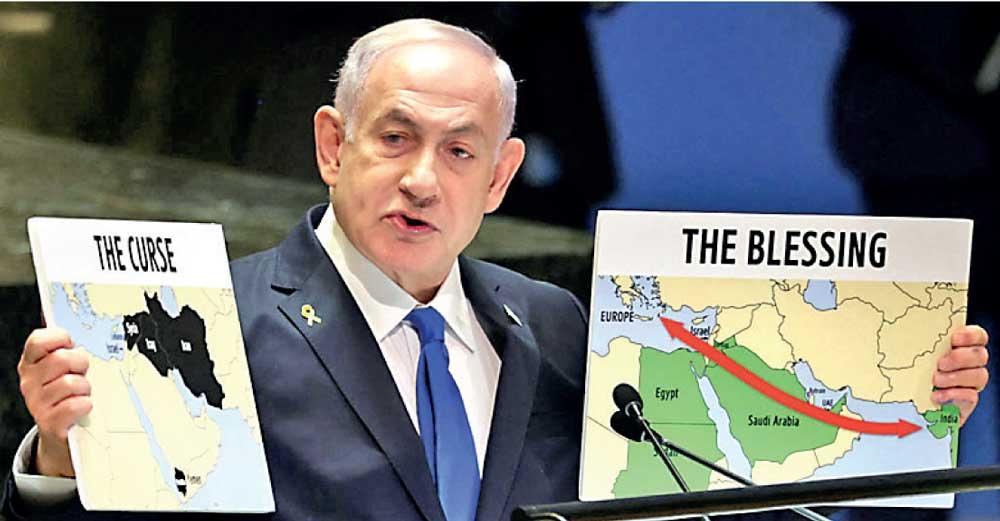
While Netanyahu may not have said he is backing down, there is growing support for peace and a ceasefire, even within Israel
- Netanyahu was scheduled to meet US President Donald Trump on September 29 in Washington. To date, he has rejected all calls to end his vicious war in Gaza. He has said that he will not recognise a Palestinian State

Israel, a small but very plucky country backed by the superpower United States and Western nations, has had its way since it was established in 1948. But now, it finds itself in a spot, cornered by the turning of the political tide at home and abroad.
A recent survey conducted in Israel found that a significant section of Israelis wants peace if only to get back the hostages held by Hamas. Abroad, at least 151 UN member States now officially recognise the State of Palestine. Leading European nations have announced their decision to recognise Palestine.
The US, Israel’s main sponsor, has proposed a 21-point plan that would not only bring about a ceasefire and the release of hostages but also lead to the establishment of a Palestinian State, eventually.
The reason for the change is the genocide by Israel in Gaza since October 2023. Between October 7, 2023 and September 17, 2025, at least 65,062 Palestinians have been killed in Gaza and 165,697 injured. Sixty per cent of the buildings in that narrow strip of land have been destroyed.
Many European countries have condemned Israel’s non-stop aggression in Gaza. UAE and Qatar, which had signed the Abraham Accords, have backtracked due to Israeli belligerence.
Change in US-Israel Relations
US-Israel relations, which, till recently, were considered to be iron-clad, are now strained. In a Daily Caller interview, President Donald Trump claimed that his administration had done more for Israel than any before, and yet, the once-dominant pro-Israel lobby in Congress, Washington and among young Republicans was getting weaker.
“Today, Israel doesn’t have that strong a lobby. People have forgotten October 7th,” Trump said, referring to the Hamas-led attack on Israel in 2023, which started the Gaza war.
“They’re not winning the world of public relations. It is hurting Israel. There’s no question about it. They’re gonna have to get that war over with… It is hurting Israel. Young people across the globe look at this with horror,” Trump said. He has never been so categorical about his assessment of Israel’s standing.
UK’s Revises Stand
Meanwhile, a number of Western countries led by France and Britain had announced that they would recognise a Palestinian State at the UN General Assembly in September. The UK said that it would give an additional £15m in aid and medical care for Gaza and the region.
David Lammy, now Deputy Prime Minister, decried the “man-made famine” in Gaza. “Since 1 July, over 300 people have died from malnutrition, including 119 children. More than 132,000 children under the age of five are at risk of dying from hunger by June of next year. I am outraged by the Israeli government’s refusal to allow sufficient aid,” he said.
Last month, the British government published a memorandum of understanding with the Palestinian Authority, which said that Britain is committed to “the Two-State solution based on 1967 lines” and “does not recognise the Occupied Palestinian Territory, including East Jerusalem, as part of Israel.”
The memorandum declares: “The West Bank, including East Jerusalem, and Gaza, must be reunified under its sole authority.” It further says that “the UK affirms the inalienable right of the Palestinian people of self-determination, including to an independent state”.
British officials had previously demanded that Hamas disarm and end its rule in Gaza as a prior condition, but that is not the case now.
France Leads European Pack
On September 22, dozens of world leaders gathered at the UN to embrace a Palestinian State in the face of fierce resistance from Israel and its close ally, the US. French President Emmanuel Macron announced that France would recognise Palestine’s Statehood at a meeting he convened with Saudi Arabia - a milestone that boosted Palestinian morale.
“We must do everything within our power to preserve the very possibility of a Two-State solution, Israel and Palestine living side by side in peace and security,” Macron said, drawing lengthy applause from the audience.
Ahead of the UN General Assembly session, Luxembourg, Malta, Belgium and Monaco on Monday also joined the more than three-quarters of the 193 U.N. members who already recognise a Palestinian state. Macron’s July pledge on recognition set the latest push in motion, with Britain, Canada, and Australia later stating they would follow, and they eventually did so.
Strangely enough, the Two-State solution was the bedrock of the US-backed peace process ushered in by the 1993 Oslo Accords. But the process suffered heavy pushback from both sides and died. No such negotiations over a Two-State solution have been held since 2014.
Netanyahu was scheduled to meet US President Donald Trump on September 29 in Washington. To date, he has rejected all calls to end his vicious war in Gaza. He has said that he will not recognise a Palestinian State. Until a few days ago, the US also was of the same view. But Trump’s latest 21-point peace plan for Gaza has the Two-State solution as its final goal.
Israel was given worthwhile peace proposals before, but it always spurned them. A top Qatari official said that Arab mediators had convinced Hamas to accept 98% of what the US negotiator Steve Witkoff had proposed, but Israel began demanding new concessions that made a deal impossible.
However, to the discomfiture of Netanyahu and his war-mongering cabinet colleagues, in Israel itself, there is support for a ceasefire and peace, according to a poll done by the Israel Democracy Institute (IDI).
Asked if Israel should agree to a deal that would release all hostages, end hostilities, and see the IDF pull out of Gaza, 64.5% said it should. Among Jewish Israelis, 62% backed such a deal, while 81% of Arab Israelis supported it.
On the political Left, 92% favoured such a deal, in the Centre 77% did, while on the Right, 47% were in favour and 44% were opposed.
“More than half of the voters of Likud, United Torah Judaism, and Shas support such a deal,” the IDI said in a statement. Among voters for Netanyahu’s Likud party, 52% supported such a deal.
Regarding the expansion of military operations in Gaza, which had required the call-up of tens of thousands of reservists, 49% said they opposed it, and 42% were in favour. Support was stronger among Jewish Israelis, with 49% backing the plan, while 81% of Arab Israelis, who make up about one-fifth of the overall population, opposed it.
Many Israelis prioritise bringing the hostages home even at a great cost, but if a deal could not be struck, they supported the expansion of operations in Gaza.
However, Jewish Israelis were 53% in support of Israeli settlements in Gaza, while 86.5% of Arab Israelis opposed them. Most on the Left and Centre opposed such settlements, while most on the Right backed them.
The poll found that support for peace increased in line with levels of religiosity, with the highest rate of support among the ultra-Orthodox (75%) and lowest among secular Israelis (21%).
However, the IDI found that just over a third of those who supported the expansion of the fighting and Jewish settlement in Gaza also supported a deal for the return of all the abductees that would also see the IDF withdraw.
Israeli Opposition Leader Yair Lapid has reiterated his longtime point that he is willing to give Netanyahu’s government a safety net to reach a hostage deal and end the war, even if hard-line ministers Ben Gvir and Smotrich threaten to bring down the government over the matter.
Even parties which are in coalition with Netanyahu have stressed the need to wrap up the war. Foreign Minister Gideon Sa’ar tweeted that “Israeli interest is to end the war and achieve its goals.” The Degel Hatorah faction chief, Moshe Gafni of the United Torah Judaism party, which left the government coalition but is not trying to topple it, said that his faction would support “ending the war and getting the hostages back”.

No comments:
Post a Comment