
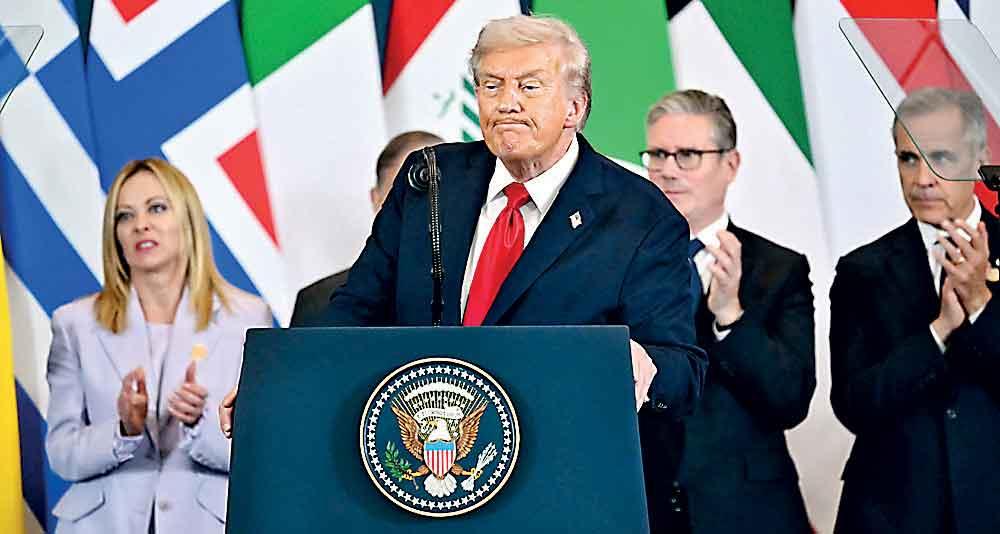
US President Donald Trump speaks during the Peace Summit in the Egyptian Red Sea resort town of Sharm el-Sheikh on October 13. AFP

What a sham at Sharm el-Sheikh! A spectacle choreographed to satiate one man’s thirst for glory. The same performance was on display in West Jerusalem just hours before the so-called world leaders’ summit at the Egyptian resort town on Monday.
United States President Donald Trump’s appearances in both countries projected him less as a statesman pursuing peace and more as someone afflicted with a psychological condition—perhaps a form of narcissistic personality disorder, which, according to the Mayo Clinic, causes the sufferer to yearn for grandiosity and admiration.
What could explain the presence of the leaders of Azerbaijan and Armenia in Sharm el-Sheikh, other than an opportunity for Trump to point at them and gloat in triumphalism—for the world to hear—that he made peace between them and to claim that he deserves the Nobel Peace Prize more than anyone else?
In Sharm el-Sheikh, Pakistan’s Prime Minister Shabbaz Sharif took flattery to a level unseen in modern history, nominating Trump again for the Nobel Prize. Many Pakistanis trolled their premier on social media. But Sharif was right—flattery works with Trump.
Excessive praise is the key that opens Trump’s heart; most world leaders and those in his administration know it. Praise him and get what you want—but do it with mastery. No one is better at the art of diplomatic flattery than the Zionists.
In their speeches in the Knesset, Israeli leaders—especially hardline Prime Minister Benjamin Netanyahu—praised Trump to the hilt. Trump, the first US president to address the Knesset in 17 years, responded in kind. Ego-massaging was the thread that bound Trump and Netanyahu together, as each hailed the other as the epitome of peace. The Israelis crowned Trump the “President of Peace” and promised him the nation’s highest award. Their applause—in one too many standing ovations—seemed to outnumber the words in Trump’s lengthy speech.
While returning the flattery, Trump congratulated Israel for winning the war and, turning towards Netanyahu, hailed him for doing a “great job”. What an obscene comment!
Who calls a genocide a “great job” other than someone so inhumane as to be indifferent to the 68,000 Palestinian deaths, which, according to some studies, may number in the hundreds of thousands? Trump is part of the genocide which he portrays as Netanyahu’s victory.
In his Knesset speech, the so-called Peace President bragged about how he supplied every weapon Netanyahu requested. Wasn’t he admitting complicity in genocide? His speech made no mention of Israel’s Gaza massacre, though he emphasised—with theatrical flair—the horrors of October 7, 2023.
Forget the boasts that please vainglorious Israeli and US leaders; if there was a true victor in Israel’s genocidal onslaught, it was the hapless Palestinian people. They finally proved the mettle of their Sumud, or resilience, by withstanding the missiles, drones, and bombs of one of the world’s most ruthless and well-armed militaries, along with its weaponisation of hunger.
No world power, nor any Arab or Muslim nation, intervened militarily on their behalf. Throughout the two-year battering, there were continued diplomatic efforts that yielded few results—yet the Palestinians prevailed.
With each passing day of suffering and hardship—amid a genocide live-streamed across the world by Al Jazeera and amplified through social media—the Palestinian narrative penetrated far and wide, winning more supporters and triggering a drastic erosion of pro-Israeli sentiment among the US public, especially the youth.
In Zionist-friendly countries, such as Britain, Canada, and Australia, governments began to realise that their complicity in or support for genocide was no longer sustainable. Support for “Palestinianism” has become politically correct for a vast majority of their people.
Even the Zionist Hasbara narrative—that Jews are divinely chosen—did little to win converts among Christians, while the learned people, including Jewish academics, distanced themselves from the crimes of Netanyahu’s Israel. Enlightened voices insist that God would not choose a people to kill women and children.
Before Israel began its genocide following the 2023 Hamas attack—made possible by an unbelievable or deliberate security lapse on Israel’s part—for most people in the Western world and non-Muslim countries, the Palestinian story had not been recognised as one of colonialism, occupation, and oppression, but rather as one of terrorism.
But today, even Zionist-infested Hollywood begins to acknowledge the Palestinian narrative. Its reach has become so far-reaching and widely accepted that it now defines political correctness. Hasbara—the Israeli propaganda juggernaut—has failed miserably. The demonisation of Palestinians no longer works.
The Palestinian story also gained more momentum in the hostage exchange between Hamas and Israel. While the Israeli hostages appeared healthy and bore no signs of ill-treatment, almost every Palestinian political prisoner released bore signs of torture and malnutrition. Israel failed again. When the rubble is cleared, more bodies are unearthed, and the true scale of Israeli horror is exposed, the Palestinian story will win; Israel will suffer defeat.
Lacking a clear idea of who the real winner is, Trump visited Israel and Sharm el-Sheikh on Monday—among other objectives—to seek accolades and recognition for his peace efforts, which were ignored by the Nobel Committee. Instead, in a move that did not resonate well in peace circles, it awarded the prize to Venezuela’s opposition politician Maria Corina Machado—a staunch supporter of global capitalism and an unabashed Zionist who once urged the US to invade her own country.
Beyond flattery, to discerning analysts, Netanyahu’s Knesset speech appeared to be an attempt to get back into Trump’s good books after a series of diplomatic setbacks in US–Israeli relations. First came Trump’s disapproval of Israel’s September 9 attack on Qatar, for which Netanyahu received a dressing down. Then came the second reprimand: at a White House meeting on September 29, Trump compelled Netanyahu to apologise to Qatar’s Prime Minister—an apparent message that Israel should, once in a while, heed the United States rather than expect unconditional endorsement of every crime the Zionist state commits with impunity.
Then during the September 29 White House event, Trump compelled a reluctant Netanyahu to accept his ceasefire plan, built on a blueprint presented by Arab and Muslim nations at a meeting on the sidelines of the 60th United Nations General Assembly.
With the ceasefire deal signed and sealed, the setbacks Netanyahu suffered healed with flattery, and the genocide whitewashed as a crime without a criminal—is peace finally dawning in the Middle East? Far from it. The Trump deal is hanging by a thread that may snap at any moment. Israeli leaders’ statements after Trump left Sharm el-Sheikh underscore this precariousness. The chances of the war resuming are greater than those of peace holding, even though Hamas is fulfilling its part of the agreement to the best of its abilities, despite the difficulties in locating the burial sites of hostages killed in Israeli bombings.
Since Monday, Israeli action—the continuous killing of Palestinians and the restriction of aid flow—has been manipulative and aimed at scuttling the agreement while shifting the blame onto Hamas. Whether Trump will prevail over Netanyahu and keep him on a tight rein to ensure the survival of his ceasefire agreement remains to be seen.

No comments:
Post a Comment