
By Robert Inlakesh
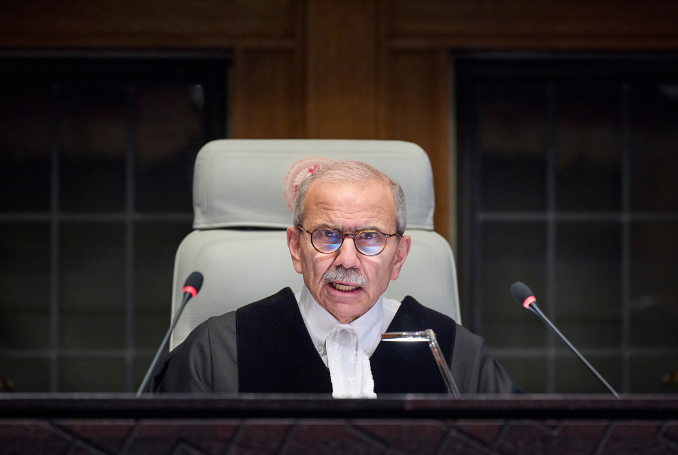 Lebanese Prime Minister Nawaf Salam. (Photo: via CIJ_ICJ TW Page)
If Lebanon is going to be free, the truth is obvious, its freedom is inseparable from the freedom of the Palestinians.
In an interview with CNN, Lebanese Prime Minister Nawaf Salam states that his government wants to see normalization with Israel.
While he caveated it on two conditions, the issuance of desire for a deal between Beirut and Tel Aviv has been widely condemned inside Lebanon. Despite US plots to bring about Lebanon-Israel normalization, it is unlikely.
“Normalization is part and parcel of the peace we would like to see tomorrow and not the day after”, stated the Lebanese PM earlier this week. He prefaced this remark with claiming he seeks to see a so-called “Two State” solution in Palestine, the withdrawal of Israeli forces from occupied territory and that Beirut is committed to the Arab Peace Initiative.
When CNN’s Becky Anderson asked Salam about his position on Israeli normalization, she herself phrased the question as to ask whether it was off the table, given a range of reasons. Yet, Salam responded by offering remarks in favor of the idea of normalization.
This, if anything, reveals a kind of pandering to US demands, but to no actual strategic benefit whatsoever. At this point, the only reason why a Lebanese leader would issue a comment in favor of normalizing ties with the Israeli government is because they have no regard for their nation’s strategic predicament and are in the process of pleasing a foreign power.
Even in the event that the Lebanese government was in the position to normalize relations with Israel, which it is not, comments like these already signal a weakening of the national position, to an embarrassing degree that stirs internal discontent.
In addition to this, if you remove the moral compunctions attached to the principle of refusing normalization and simply look at it from the perspective of a business agreement, such a Lebanese government should seek the best possible terms in this case.
In fact, if you look at Hezbollah’s tactics, prior to October 7, 2023, it is clear that they used the threat of their military power in order to pressure the Israeli government into accepting realities preferable to the Lebanese national interest.
An example of how this worked in recent memory was with the demarcation of maritime boundaries, granting Lebanon its rights over the Qana fields and hence opening the possibility for the nation to exploit its potential treasure trove of natural gas in the Mediterranean.
Now, Hezbollah’s measures taken in favor of the Palestinian people fall under a separate categorization. They decided to make moves that sacrificed their own leadership in the end, all in order to stand on the side of what they state is a religious and moral cause, that of the Palestinian people.
Along with Yemen’s Ansarallah, Hezbollah was the only party in the Muslim and Arab World that fully committed themselves to standing up for Gaza, while the rest continue to watch on as the Palestinians endure a genocide.
Back to Nawaf Salam and his ilk. If his government was truly seeking an agreement with Israel that would in any way benefit Lebanon, he would assume a position of strength. As he stated in his CNN interview, Lebanon is committed to the Arab Peace Initiative, which basically proposes that a Palestinian State and withdrawal from occupied territory equals normalization.
As his interviewer, Becky Anderson, jumped in to remind him, Israeli Premier Benjamin Netanyahu rejects the so-called “Two State” solution. While the CNN host said “so it’s not going to happen”, Salam came back with a vague reply and indicated Netanyahu is not the only player in Israel.
Anderson’s point is actually very much relevant here, because she is correct about Netanyahu’s position. However, it’s not just the Israeli PM’s position, it is also the Israeli opposition’s view too, in fact, the idea of a Palestinian State is simply a nonstarter for any Israeli administration.
So, why then would the Prime Minister of Lebanon issue his desire to see normalization? There are only three possibilities here: Salam is signaling his willingness to change the conditions under which Lebanon will normalize; he is a terrible negotiator to the point of utter incompetence; or he is so heavily controlled by foreign powers that he simply says what they want in order to please them.
If we take a look at the other initiatives of the PM, he seeks disarmament of the Palestinian factions in Lebanon and the handing over of Hezbollah’s arms to the State. Both of which are policies simply pursued for the sake of pleasing the United States and nothing more.
Take the issue of Palestinian weapons. There is a solid reason behind why the Lebanese authorities decided not to pursue disarmament prior to this new government’s reign, because it could potentially ignite a range of conflicts inside the country which could end up resulting in civil war.
The theatre of inviting the Palestinian Authority’s unelected pro-Israel dictator, Mahmoud Abbas, to Lebanon in order to work on the issue of disarmament is another testament to the pandering nature of the current Lebanese government’s priorities. Abbas may have some sway with Fatah and there could even be a symbolic handing over of weapons even, but ultimately the only way the Palestinians are going to disarm will be through force.
Even Fatah will not give up all its weapons, as this move would weaken them and their power inside the refugee camps. The idea that the numerous factions inside the camp are all going to listen to the most unpopular Palestinian leader, who is despised by everyone outside of the Palestinian Authority’s payroll and often some who are still employed by it, is ludicrous. Abbas speaks for no one but himself, those on his payroll and a special clique of elites.
As for Hezbollah, its Secretary General Naim Qassem has made it crystal clear that “the weapons of the resistance” are not up for negotiation, full stop. If the Lebanese State sought to try and take Hezbollah’s weapons, it would cause civil war and Hezbollah would batter any opposition. There is not even a question of who would come out victorious in such a horrendous and unnecessary conflict.
At this time, the Lebanese government has not even secured reconstruction following the devastating conflict and its army has not so much as raised a rifle in Israel’s direction, as it commits daily assaults on Lebanon. Over 3,000 violations of the ceasefire by Israel, yet the Lebanese PM who seeks normalisation hasn’t summoned the strength to stand up to daily violations of his country’s sovereignty.
Israel now occupies a portion of southern Lebanon, the reason for this is because Hezbollah decided to stop resisting and it is now the Lebanese Army that manages defense.
For anyone that was previously curious as to what it looks like when the Lebanese Army is left to defend the country alone, we are seeing exactly what that looks like right now. Daily assassinations, Israeli jets and drones over Beirut, occasional strikes on Beirut and the Beka’a, the gunning down of civilians in the south, abductions, and raids into villages.
The biggest joke of all is that the Lebanese Prime Minister and President Joseph Aoun both claim to stand on the platform of “sovereignty”. Of course, their definition of this word is evidently different from what is commonly understood of it or written in a dictionary.
“Sovereignty” for these kinds of officials means undermining entire segments of their own society in order to please the United States and European Union. It means [quite literally] a big Israeli flag in the south of your occupied country, while you pressure the only people capable of restoring stability to surrender.
Seizing the weapons of Hezbollah is strategically the worst possible move for the Lebanese State. As noted above, even from a purely materialistic business minded perspective, you must offer something in a negotiation. You don’t capitulate for the sake of capitulation, then hope that things magically get better for you.
This is the exact same mistake that the new Syrian authorities are making, negotiations for the sake of pleasing the United States so that the economic predicament of the country can improve. At least in the case of Syria, the economic recovery is slightly more viable due to the lifting of sanctions and actually in reach, if only partially to relieve pressure on the nation’s population.
History teaches us that when you are weak and have nothing to offer, refusing to stand up for yourself and are even willing to undermine yourself in order to please the opposition, you don’t get a good deal. This is common sense.
In Lebanon there is no national incentive to even discuss normalization with Israel. Even the Washington Institute for Near East Policy (WINEP), which essentially represents the think tank arm of the Israel Lobby in the US, recently held a conference on Syria, during which its panel unanimously agreed that normalization between Lebanon and Israel will come after Saudi Arabia makes the move first.
If Lebanon is going to be free, the truth is obvious, its freedom is inseparable from the freedom of the Palestinians. The same goes for Syria and every other nation in the region. Capitulation is not an option, which is why there will always be resistance.
(The Palestine Chronicle)

– Robert Inlakesh is a journalist, writer, and documentary filmmaker. He focuses on the Middle East, specializing in Palestine. He contributed this article to The Palestine Chronicle.

No comments:
Post a Comment