
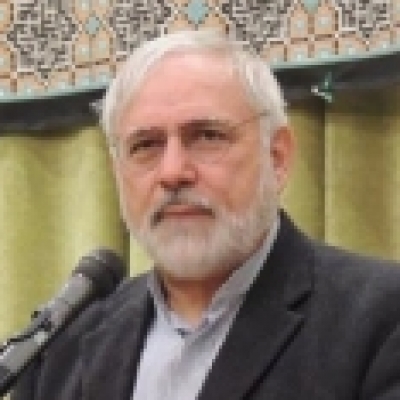
 Muhammad H. al-'Asi
Muhammad H. al-'Asi
 Imam Muhammad al-Asi is a Research Fellow of the ICIT. He is also elected Imam of the Islamic Center in Washington DC. He presented this paper at the International Seerah Conferences convened by the ICIT in Colombo, Sri Lanka (June 16-18, 2000) and Karachi, Pakistan (June 25, 2000).
The image that we have of our cherished Prophet (saw) is one of a man of morals, ethics, and social qualities, unparalleled. He has always stood out as a man of excellence in his family, community and extended society. No Muslim would dispute that the Prophet’s character is a model to emulate when it comes to issues of religious services, intra-family behavior, marital standards, inheritance, and the like.
But when we turn our attention to our Prophet’s example as an advocate of the Islamic cause and Islamic idea, we are dumbstruck to notice that information about his character in this area is virtually non-existent! The Islamic books that come our way from centuries past contain at best brief mention of the systemic way (the Sunnah) in which our Prophet promoted the ideological and political components of Islam. The authors of these books may have not been able to foresee the day when Muslims will no longer have an “Islamic state” or an “Islamic government”, and when they would have to reconstruct one, relying on the example of the Prophet as he went about communicating and publicizing Islam in the civic sense of the word. It did not occur to them that, about thirteen centuries after the Prophet’s success in Madinah, the Muslims would have to rebuild their own “Madinah” from scratch. It took thirteen centuries to secularize the Muslims; this was a result of Muslims’ failure to keep the Prophet’s “activist” character alive and crystal clear in their minds, and of the success of non-Muslims in imposing upon the Muslims an image of the Prophet (saw) which is strictly and stringently one of a “spiritual leader.”
Never in the history of ijtihad have we Muslims had to live in a time in which we no longer have in our possession a government which belongs to all the Muslims, or at the very minimum which is open to the Ummah’s popular affiliation. Now is the time for Muslims of good will, sound reasoning, and experience in the Islamic movement to focus on the state-building character and the statesman figure of Muhammad (saw) so that we are able to go about setting up our Islamic state the way he did.
The contemporary Muslim mind has to become “preoccupied” with how the Prophet (saw) went about putting together an Islamic state. Therefore, the information about this state-building has to occupy center-stage in our discussions, in our lectures, in our khutbahs, in our studies, and in our research. Islamic institutions and resources have to be committed to this urgent task.
When Rasulullah (saw) personally led the Ummah, he secured for people who became Muslims a refuge, a shelter, and a home which is the Islamic state. Thus when people became Muslims they would have the shelter of living in an Islamic dar (domain). Now, with all the Muslims there are in the world (the number is quickly approaching one and a half billion) they are living in a kafir domain; they are virtually adrift and homeless. The inherent condition of today’s Muslims who have lost sight of a Prophet as commander is a religious community of people who are beholden to the forces and powers of kufr: secular kufr and religious kufr, mental kufr and military kufr, as well as kufr by choice and kufr by force.
Our first priority should be to rediscover and relearn how our commanding Prophet approached the issue of power: how he set about dislodging the power of kufr and consolidating the power of Muslims. This should be the burning issue for every Muslim who no longer tolerates a continuation of generations and centuries that have been spent on explaining matters of personal hygiene, night prayers, and a terrifying argument about the exact minute if not the exact second when a Muslim should break his fast (in other words, does night begin with sunset or with nightfall?)! The millions of Muslims who are lost to hunger, illiteracy, malnutrition, refugeehood, and warfare every year do not allow us the ivory-tower and slow-motion ‘da’wah approach’ (favored and sponsored by those arch-enemies of the Prophet’s Sunnah and Seerah, the usurpers of the Haramain) that are responsible for our sad state of affairs from Morocco to Makkah as well as from Mongolia to Madinah. We should not be studying hair-splitting fiqhi issues in halaqat (study sessions and circles); we should be learning how to consolidate our social will-power and how to form active and status-quo-challenging units throughout our African and Asian lands to reclaim them for Islam.
We should no longer be concerned with who will lead the salah as much as we should be concerned with his ability to lead us before and after the salah. Leadership is absent in the Muslim conscience and therefore it is absent in the Muslim community. We have to have enough courage and selflessness as to define who is qualified to lead us in politics before prayers, in the public arena before the privacy of the masjid. This leader should have the allegiance and confidence of the Muslim Ummah as long as he remains within the reference of the Qur’an and the Sunnah. This galvanization of the Ummah needs every single Muslim. We do not have the comfort and leisure to exclude half the Muslim Ummah from this holy duty; ie. our womenfolk:
And [as for] committed Muslims, both men and women, they are superordinate to each other… (Al-Qur’an 9:71)
This whole effort cannot be realized without a break with the ritualistic Islam (patronized by the Saudi establishment) and promoted by well-meaning but misleading “Islamists” who will never breach the issue of authority, leadership and statesmanship and where these issues belong in today’s real and vicious world. Obviously, all of this spells out an “agenda” of Islamic political activity; not in the western definition of politics, which is sullied and corrupt, but in the Islamic definition of politics which is clean and healthy. What this means is that there has to be a solid base of committed Muslims who are aware that before they win the prize of being at the helm of state affairs and decision-making they will have to win over public opinion. The issue is one of public opinion. But you would not know it as things stand today. That is because there is a hypnotizing spirituality that freezes the Muslim will from entering into the struggle for the minds and hearts of the public, and this hypnotic spirituality is complemented by a cunning materialism that decays the Muslim will and causes the Muslims to join the “modern and developed” world!
Today’s reality is that Muslims have voluntarily elected to dismiss those parts of the Seerah of the Prophet (saw) that give meaning to a clash of concepts, cultures, and civilizations when such are at opposite ends of purpose (those that come from Allah vs. those that are from al-shaytan);and that many Muslims have become bewitched by “Islamic practices” that are traced all the way to the oilfields of Arabia, while others are intoxicated by an Islam that acknowledges American “legitimacy”. When such attitudes dominate so many of our masjids and ‘madrasahs’, it is no wonder we are where we are today.
Out of this mess emerge those Muslim “Uncle Toms” who are trying to get Muslims to join the systems of kufr. Muslim lobbies have popped up in Washington DC and other western cities, advising the Muslim public to join kufr political organizations and parties in America and Europe! Such attitudes come naturally to the Muslim minds that have been inactive for centuries, which argue that if it is right to join the parliament of Egypt, or Iraq, or Syria, if it is alright to become a member of the ruling classes in Saudi Arabia, Kuwait, Bahrain and the like, then there should be no serious inhibitions on connecting and entering into the governments in Europe and America!
In the absence of a Seerah culture, almost anything goes. And so we have “Islamists” who tilt with the highest bidder. Some of them will say in private that they are out-foxing the fox, outsmarting the enemy, and bedevilling the devil. They cannot find any reference for this in the Qur’an and Sunnah — lest the Muslims wake up and spoil their courtship of the kuffar — so they prefer to draw confidence from popular sources and place it squarely with the elites. Never was the Prophet of Allah (saw) beholden to the elites of his time; but you wouldn’t know it (it would not even occur to you to think about it) as this whole chapter in the Prophet’s struggle for an Islamic authority, government and state are off-limits.
The Islamic current coming from a core of committed Muslims in the Islamic movement has to charge the people who will in turn support the Islamic leadership of the committed Muslims in their struggle to marginalize the kuffar and to overturn the system of kufr. The catapulting result will be a popular Islamic revolution that will install a divine system that is capable of doing and sustaining justice and peace on earth. This is precisely what characterizes the Islamic movement/revolution in Iran as contrasted with “Islamist” parties and organizations that are more interested in bypassing or overlooking the “popular charge” of iman capable of taking on kufr in its political and military expressions.
Technical issues
There are some technical issues that we should be aware of at this level of thinking and activity. First, the Prophet (saw) was trying to convince non-Muslims of this Islamic responsibility and objective. Today, many of us have to convince “Muslims” of this same responsibility and objective. Second, the Prophet of Allah was implementing the Qur’anic meanings as they were revealed, over twenty-three years. But today we have the whole Qur’an in our possession.
If we were to retrace the Seerah and begin where the Prophet himself began, are we to expect our “Makkan” era to be followed by the equivalent of Madinah? In Makkah (prior to the hijrah) there was no Islamic authority (although there was Islamic legitimacy, represented by those parts of Allah’s Book that were revealed during that time-span, and by the Prophet himself) but because of the lack of authority that was contingent upon the attendance of a conforming Islamic public and the absence of a confronting kafir elite supported by public opinion, the Prophet could not function as the governor or ruler in Makkah. Therefore, there was no implementation of hudud (legal and criminal punishments), there was no call to arms (the Muslims did not have military force in Makkah at that early stage), and there were no bilateral or multilateral agreements that Muslims signed with other powers around (equivalent in our time to regional or international accords.)
Another question that is generated by this momentum is: are the Muslims accountable for establishing their Islamic social and political order within a certain period of time? Allah’s Prophet (saw) was able to do it in twenty-three years; should these twenty-three years be a litmus test for Islamic parties that claim they are putting the Prophet’s Sunnah to work? Or should it be an open-ended affair which may actualize in one decade or one century or whenever Allah wills it to be? If the latter, isn’t this tempting people to become lax in following through the whole range of issues raised from the first words of iqra onwards?
And if this whole program of the Prophet (saw) as registered in books of Seerah is not implemented in one generation, does that mean that the party trying to implement it is less than sincere, or does it mean that it has to re-evaluate its programs? Or does it mean that ‘Islam is no longer an option’ (na‘udhu billah)? Or could it mean that there are sinister powers who are setting up “Islamic” parties and associations who are meant to fail so that the Muslim public who were not won over by these very same parties become disillusioned and disenchanted by “all this talk about an Islamic government and an Islamic system”?
The reconsideration of how the Prophet (saw) dealt with opposing ideologies and politics has to be clear-cut and realistic to the public that will eventually disestablish kufr and establish iman. There are (mis)understandings and (mis)interpretations of ayaat and hadiths that deter from this Prophetic priority of gaining power and running the affairs of state. For example, some Muslims misinterpret the ayah: “O you who have attained to faith! It is [but] for your own selves that you are responsible: [those] who go astray can do you no harm if you [yourselves] are on the right path” (Al-Qur’an 5:105). Some people construe this ayah to mean that once you are guided it is no longer your responsibility to guide others!
There are also numerous hadiths that are misconstrued, such as: “it does not behove a committed Muslim to humiliate himself by exposing himself to that which he cannot tolerate.” Some people interpret this hadith to mean that a person should not put himself in a position that will cost him his job, or place him in prison, or cause him to lose position and status. This could be extended to mean that it is Islamically acceptable to co-operate with despots and autocrats.
Then there are those who say that this task of effectuating an Islamic authority and government can only be done by al-Imam al-Mehdi (saw). And from now until then no one should be concerned about having an Islamic government.
Whether these ideas are supported by an ayah or a hadith, or any other source, they amount to a distortion and an abuse of the Prophet’s relationship to Allah, and what our relationship is to both Allah and the Prophet (saw). Such interpretations, which may be technically defensible, but are clearly contrary to the spirit of the Prophet’s Sunnah and Seerah, must be recognised as such and judged according to the higher criteria.
Islam and Public Opinion
Let us assume for a moment that Muhammad (saw) had not gone public with Islam. Let us also assume that he did have the desire to go public with it but did not do so. Would you think there would have been any opposition to him? Would you think that he would have felt that “if he is guided then he need not worry about guiding anyone else”? And would you think that he would be “humiliating himself” by standing up to the powers that be, and it would have behoved him to “keep a low profile” and not “rock the boat”? The bulldozing answer to all that is that no Muslim in his right mind could imagine for one moment Muhammad (saw) disengaged from publicizing and calling attention to Allah and His declared Qur’an. Islam would never have had the influence that eventually accompanied later generations had it not been for the Prophet’s insistence on “mainstreaming” Islam. The combination of a human prophet with the word of Allah in full opposition to the errant norms and deviant “values” of the time had to be tangible, noticeable, and apparent to all humans around. It is in this capacity that a prophet and followers of prophets are evaluated, more so than by offering individualistic salaat, selfish siyams, and personal hajjs!
We sent all [these] prophets, breaking good news and delivering ultimatums, so that men might have no excuse before Allah. (Al-Qur’an 4:165)
This announcing and reporting of Islam was the Prophet’s priority. Had it not been for this insistence on bringing the Islam to the general public’s attention there would not have been any Islamic authority, any Islamic populace, and any Islamic community. But there is something of a “disconnect” between this driving force that characterized the ideological struggle in the formative and post-formative years of Islam in Makkah and Madinah as they were pioneered by the Prophet (saw) and his disciples, and the status quo mentality and behavior that characterize today’s “back-door” da’is who are more concerned with matters of taharah and najasah than they are with matters of justice and hostilities. It was clear to the Prophet and first-generation Muslims that the value of Islam was in its expansion and in its power; but this is not at all clear to those who have cut down and cut back on Islam until it has become today’s stagnant system sponsored by Saudi banknotes.
Accordingly, Muslims who have not thought out the power position in the Seerah of the Prophet (saw) have nowhere else to go but to channel “Islamic activism” into petty fiqhi matters that consume much-needed Islamic energies, times and efforts. Questions of where your hands belong when you are in your salat, or whether it is mandatory to pray two rak’aat as you enter the masjid while the khatib is delivering the jumu‘ah sermon, or other such issues, may be intellectual teasers when we have an academic Ummah; but when we have an Ummah that is burning at the center and at the peripheries, when we have wars that are incinerating our Muslim populations in military campaigns, and hostilities wherever we are minorities and wherever we are majorities, it is an insult to the Prophet (saw) to fiddle while Makkah is burning!
Isn’t he (saw) the one who said:
The parable of he who carries out the legalities of Allah as compared to the one who doesn’t is like people who boarded a ship. Some of these people settled on the upper deck while others settled on the lower deck. Those in the lower deck who drew water from the sea would slip by those in the upper deck saying that well, in our portion of the ship (the lower deck) we have the right to drill wherever suits us and in the process we are not drilling holes in the upper deck (which belongs to them)! If people in the upper deck permit this to happen, and those in the lower deck have their way, everyone will perish. But if those in the upper deck take corrective action then they and everyone else will be spared imminent destruction. (Al-Bukhari)
This above hadith may be referred to as the hadith of social solidarity. No Muslim is permitted to think, behave and act as if he or they have nothing to do with other Muslims who are not in their location, geography or “part of the world.” What binds Muslims together is their sense of belonging to truth and justice; and what drives them to their common destiny is their shared divine standard of cooperation and understanding, as the above hadith clearly demonstrates.
This socio-political feature of the Ummah is absent because the Ummah has neglected it in the character of its Prophet (saw). But the ayaat and the hadiths are categorical and unconditional about this:
Let there be of you an Ummah [of people] who enforce the ma’ruf [the observance of moral values and conduct] and who interdict the munkar [from social practice]: and it is they, they who are effective. (Al-Qur’an 3:104)
You are in truth the best Ummah that has ever been ushered in for people: you put the ma’ruf into effect and you get rid of the munkar; and you are committed to Allah… (Al-Qur’an 3:110)
And Allah’s human exemplar (saw) said:
By He who has my life in His hand, you [the Muslims] will decidedly see that the ma’ruf is done, and you [the Muslims] will decidedly see that the munkar is revoked; or else Allah in due time will visit you with penalty from Him after which you will call on Him but He will not answer your calls. (al-Tirmidhi)
He also said:
Whoever witnesses a munkar should change it by force, but then if he is unable he should try to change it by speaking out against it, but then if he is unable to do that, then he should object to it by his heart which is the weakest expression of commitment (iman). (Muslim)
But what is ma’ruf? And what is munkar? The simple definition of these two key terms (that have also been scrambled throughout the course of time) is that the ma’ruf is the preponderant and concurring popular understanding of what is good, moral, honorable, decent and proper. And the munkar is the preponderant and concurring popular understanding of what is bad, evil, disgraceful, nasty, and wrong. And because the public mind and ‘common sense’ is so aware of the ma’ruf and the munkar it becomes a social and a mass activity to see to it that ma’ruf is established and munkar is disestablished. But what happens when this human standard of understanding and conduct is diminished or reversed? What happens when a munkar such as totalitarianism is given a “good” name under the title of socialism or communism? What happens when a munkar such as economic exploitation is given a “good” name under the title of free-market operations and capitalism? What happens when a munkar such as ‘Saudi’ Arabia gets away with having a “good” reputation or arouses only passive concern among Islamists and certain ‘Islamic movements?’ And then what happens when generations of Muslims lose the capacity to identify these grand munkars and get bogged down in reducing the munkar to personal and family issues?
And thereupon, when they had forgotten all that they had been told to take to heart, We saved those who tried to prevent the actualizing of evil, and overwhelmed those who were bent on evil-doing with dreadful suffering for all their iniquity… (Al Qur’an 7:165)
The Centrality of Iman and the Priority of Its Implementation
Reduced to its very basics, Islam is a consistency of ma’rufs that extend from soul to society in one parallel; and, at the same time, Islam is also an obliteration of munkars that run the same stretch: soul-to-society. The powerhouse of ma’ruf is the deep-seated iman in Allah, the Day of Accountability, etc. Along with that is the munkar and its fireball is kufr. This is a closed-circuit dynamic: iman is alive and well, growing and increasing, energetic and flourishing only when there is a human effort to extend this iman into all spheres of life. That is why the Qur’an almost always mentions iman followed by ‘amilu al-salihat (commit to Allah and do what is right). Iman thrives when it gains people and power both. And to sustain both people and power together, the Prophet (saw) sought and struggled for a government that is instrumental in voiding the munkar and deploying the ma’ruf.
What our current day Muslims see in our Prophet (saw) is that he was pleading with his contemporaries to become “pious” and “God-fearing”; what they fail to see is that he was also working with them to secure the social and political environment that is inducive to the blooming and prospering of iman. There is only one way to remold society to meet this condition, and that is by being in control of the organization which is the governing authority of a political unit. This he eventually did by establishing the Islamic state in Madinah. The unacknowledged aspect of the Seerah of our Prophet (saw) was his life-long task of empowering the committed Muslims. And notice that once he did have an Islamic state in Madinah, he did not police people’s personal ethics. There were no moral patrols going around telling people to brush their teeth, or to close their shops for salat, or to enforce any other personal obligation in the private domain of a singular Muslim. The functions of the newly-established Islamic state in Madinah were at the level of combatting the munkar all the way down to its kufr sources and promoting the ma’ruf all the way down to its imani sources.
A committed Muslim is required to have faith, confidence, freedom from doubt, and trust in Allah, and only Allah. A committed Muslim is expected to know that Allah is the source of life; He is in control of “developments,” and He manages whatever happens on earth: what appears to humans to be negative or what appears to be positive. Allah is the highest authority and the sole authority of persons, peoples, and populations. No human adversary eludes or evades Him. A committed Muslim is certain that Muhammad (saw) is the final Apostle of Allah. A committed Muslim has unwavering trust in all that Muhammad (saw) said and communicated, as well as in the infallibility ( ‘isma) of this Prophet and what was revealed to him. The more a committed Muslim thinks about these issues and the more he is involved in communicating the power-issues therein the more he sustains and fosters his iman.
Individual Obligations vs. Collective Duties
If we were to examine the legacy of the Sunnah, we would find that there are two types of responsibilities: one is personal and the other is collective. The personal fardh (obligation) can only be discharged by each individual in the capacity of his own self. If this individual Muslim abandons any of his/her obligations it is not possible for anyone else, or society as a whole, to perform them on his/her behalf; all the Muslims in the world, should they desire to perform it, are not able to “fill in” for the personal or exclusive obligations required of each individual Muslim self. This means that every Muslim is personally responsible for the “do’s” and “don’ts” which are presented to us ad hominem as if they are the be-all and end-all of our dealings with God and our dealings with man! Of course any Muslim will tell you that salat, the fasting of Ramadan, the capacity to perform the Hajj, the paying of zakah, “honoring thy parents”, eating halal food, avoiding haram servings, refraining from lies, backbiting, and adultery, and so on, are all issues in which the Prophet’s character shines through: the good is to be gained and the bad is to be trounced.
The Prophet’s image is scrambled, though, when it comes to obligations pertaining to Muslims collectively. These obligations or responsibilities were the Prophet’s institutional concern before the individual’s “selfish Islam.” These functions and necessities are duty-bound on any plurality of Muslims. If this plurality of Muslims are incapable of shouldering these collective obligations and assignments, then all of them are living in sin until such time when these tasks and trusts actualize in the form of social order and a political direction. And an individual Muslim cannot hide behind the excuse that he is exempt from the task of the “plural Muslims” because there was no “solidarity” of Muslims around him, because if there isn’t such a solidarity he himself is responsible for putting one together. Even a Muslim as one is responsible for the Muslims as many: “and every one of them will appear before Him on Resurrection Day alone” (Al-Qur’an 19:95).
It may be of some consolation for opportunistic souls to “throw the blame” on other Muslims in this worldly lifetime, but on the Day of Judgment this single soul (whoever it is) will be held responsible for not bringing about a mass transformation of the human condition around him. A Muslim who has taken to heart the methodology of the Prophet (saw), and is serious about performing the Prophet’s Sunnah and emulating his Seerah, has no choice but to adopt the priorities of Muhammad (saw) and move ahead with utter reliance on Allah. Any Muslim who is not in that state of mind is guilty of betraying the Prophet even if he has worn out prayer rugs by his sajdat and fasted his stomach to an ulcer!
Therefore, a devout Muslim should take stock of the fact that a person who is dominated by rituals and ceremonies is self-centered. The figure of our most respected Prophet (saw) should return to our minds, schools, masjids, and families as a political ruler, a military commander, and a lawgiver. In his capacity as Rasulullah (saw), his overriding concern was to secure the right social climate for the prosperity of iman. There are issues now that have been off the radar screen of the Sunnah and Seerah. These issues are: governing in compliance with what Allah has revealed, jihad for the cause of Allah, ijtihad that relates revelation to reality, and identifying and then taking corrective measures in terms of the ma’ruf and the munkar. With very few exceptions, Muslims today are effectively living in sin because they are delinquent and blameworthy for neglecting and omitting this vital obligation that rests with the collective character of the Muslims.
Take, as an example, ijtihad. The Muslims are guilty of abandoning ijtihad. Even though there are a few isolated mujtahids here and there, as long as ijtihad is not an acknowledged institution in Muslim life, all Muslims are culpable for not having ijtihad a permanent feature of their public life. Even if we have some organizations or associations of Muslims who are working on “reactivating” ijtihad throughout the Islamic hemisphere, this does not relieve the rest of the Muslims of the blunder and offence of voiding ijtihad from their collective life. Only when the relatively small number of Muslim working in this area are able to reinvigorate ijtihad to its satisfactory level and function will the Muslims as a whole be released from the responsibility of re-instituting it.
By the same token, Muslims are guilty of diminishing the awareness of the Prophet (saw) as a statesman and the highest “official” in the Islamic state. The Prophet (saw) did not rest in Makkah until he founded the Islamic state in Madinah. And he did not rest in Madinah until he moved the powers and forces of Islam to all four corners of the Arabian peninsula; and it was the continuation of his policies his death that have seen the movement of Islam extended to the four corners of the earth. Therefore, founding an Islamic state is in the best tradition of the Prophet (saw). And every Muslim who has fooled himself or has been fooled by others to miss or drop this Sunnah of the Prophet (saw) is guilty of an offence against him. Even when we have Islamic “parties” and “leagues” that are working on bringing back an Islamic state, the rest of the Muslims are still guilty and living in sin because they still do not have an Islamic state that unites the Ummah and serves as the protector of all committed Muslims and the promoter of all the deen. Meanwhile, with these facts about the Prophet excised from our living memory and our textbooks, we have an Ummah that is scratching its head and hammered on the head at the same time!
The Prophet’s Lost Dimension
The lost dimension of the Prophet (saw)’s Seerah is the constructive and systematic element of his character that has been lost by the Muslims and on the Muslims. The Prophet’s work in Makkah was not haphazard or reactionary. He went about communicating Islam in his immediate society in a particularly methodical way; it is this that is the key to his Sunnah.
At first, when the Prophet (saw) was commissioned, he spoke to people around him about issues that polarized society: a very few committed themselves to Allah with him and the very many who denied him. These polar positions are what we refer to as iman and kufr. At first, Islam was not public; no one had heard of it before. But after a short while it became a “controversial” issue which would not go away. What we understand of the Prophet’s approach to empowering his side and weakening the opponents’ side was his two pronged strategy: on one level he would present an “ideological” Islam that is at odds with “ideological” shirk in public. On the other hand he would have secret meetings and congregations for those who committed themselves to Allah and His messenger (saw). Muslims had a center (not a masjid) called dar al-Arqam. This served as a schoolhouse and a retreat.
The ideological Prophet (saw) would approach anyone whom he thought is nonresistant to the meanings and intents of Islam, regardless of their age or social status, their tribe or origin. It also appears from reading through the books of Seerah that when the number of Muslims reached around forty the Prophet (saw) permitted all to go public with their Islamic ideological assaults against the kafir establishment in Makkah. And this included both men and women of a variety of backgrounds and age groups — many were young. There were also some who were well-established in society and some who were oppressed; some who were rich and some who were poor. All of this has to be understood in context. The total number of people in Makkah at the time was probably a few thousand. Makkah was the cultural and religious hub of the Arabians. Makkah was not an agrarian center; it was a settled town dependent on visitors and travellers, with an established hierarchy whose “legitimacy” centered around the Ka’bah and the customs and traditions of ancestors and heritage.
The thrust of the Prophet’s Sunnah was to publicize the message of Islam in its ideological dimension rather than in its ritualistic aspect. People in Makkah knew that Muhammad (saw) was advocating and promoting an alternative lifestyle. They knew that Muhammad had gained a homegrown following. They knew that Muhammad was preparing this following for an important mission. The Makkan public also knew that Muslims were keeping a low profile and concealing their identities. All of this meant that the Makkan population began to feel the challenge coming from this man Muhammad (saw). They did not know where the Muslims were meeting, but the Makkan Arabians had a feeling that something was brewing. What surprised the Makkan establishment and its public was not as much the public presentation of ideological Islam as it was the public expression by scores of Muslims who became the vanguards representing an ideological “provocation,” an element of potential “social instability,” and a possible element of “insubordination.”
The transition from being “underground” to going public was timed by Allah’s words:
Hence, proclaim openly all that you have been urged [to say], and eschew the mushriks [whose authority is aught besides Alllah]: verily, WE shall suffice you against all who [now] deride [this message – all] who assert that there are, side by side with Allah, other [rivaling] divine powers as well: for in time they will come to know [the truth]. (Al-Qur’an 15:94-95)
From here on the Prophet went from confidential activity to an all-out attempt to capture public attention and allegiance. This represented the clash of ideological and political concepts which ultimately becomes the clash of militaries and civilizations. The second not-well-known stage of the Prophet’s Seerah commences: the interaction and contra-action of ideas; i.e., mental iman vs. mental kufr. And indeed this was the most dangerous and intimidating stage of them all. The Prophet’s home was pelted with stones. Umm Jamil (Abu Lahab’s wife) would place filthy and foul substance (najasah) in front of his house. Abu Jahl would cast placenta or afterbirth effects of a sheep slaughtered for the idols on the Prophet (saw). Other Muslims were threatened and harmed.
The Makkan mouthpieces ridiculed the Prophet (saw) as he would pass by saying: “This is the son of ‘Abd al-Muttalib who claims that the heavens speak to him!” Makkah and its people were busy committing hate crimes against the Muslims, not because the Muslims were emphasizing prescribed procedures for conducting religious ceremonies such as issues of taharah, najasah, and the likes, but rather because Muslims were serious about deconstructing the system in Makkah and replacing it with one that comes from Allah.
Imagine if today’s Muslims were meticulous about adopting this methodology of the Prophet and reliving his character as he took on the powers of ideological and political kufr! Imagine if we were to save our energies which we expend in explaining issues of a private and personal nature, and instead concentrate on regaining control of our own societies and selves to have them molded in the image of the Qur’an and the Sunnah! Of course the “Islamic” religious establishments will cry foul, and of course the plutocrats of our time will use every trick in the book to deter us from Allah; but isn’t this exactly what the Prophet faced and hence isn’t it what we are expected to face? The power-brokers of the time made fun of Muhammad (saw) but we, the “sanitized” Muslims, do not want to sully our “esteemed” selves and become the “laughing stock” of the regimes around! Why? Are we smarter than Allah’s Prophet? Or are his Seerah and Sunnah outdated (nastaghfiru Allah)?
When Muhammad (saw) began to speak in terms of power, he was derided and mocked. The Makkan “media” would say: Why can’t Muhammad turn al-Safa and al-Marwah into gold? Why can’t a written book come down to him from heaven? Why can’t we see Gabriel? And why can’t Muhammad resurrect the dead? All of these statements and others like them were not mouthed against Muhammad because of his teaching on issues pertaining to the new Muslims’ private life; rather all these statements were expressed against Muhammad (saw) because he was addressing the issue of radical and uncompromising change for Makkah and the world on terms set by Allah, the Almighty.
Finally, a break-through occurred when people from Yathrib (Madinah) came and offered Muhammad (saw) the power base that he had sought through over a decade of consistent and principled struggle. It should be noted here that during those thirteen years in Makkah the Muslims did not have one masjid. The first masjid that was built by the Prophet (saw) was the one in Madinah. It would seem the masjid is a place where the regulation of power takes place through meetings, conferences, shura sessions, debating public policy, and the likes — something Muslims were not able to do in Makkah for the simple fact that they had no power. In our time and age, no one considers these delicate decisions and everyone is keen on building masjids precisely when and where Muslims have no power. Can building a masjid be in violation of the Sunnah? Given our mentality of “everything goes” the answer is obviously not!
Imagine if there were Muslims who took Islam as seriously as the Prophet did, and at this level of understanding, would we be where we are today? Billions of dollars that are spent of individualizing and secularizing Islam would become the concern of the Islamic movement that draws its inspiration from the way the Prophet of Allah set about on his 23 year mission of destroying the injustices that come from wealth and power accumulations and excesses. This much-needed reconsideration of Muhammad (saw) is the rapturous issue of our time; the past several generations have proven that as long as the Prophet is unidentified as a model for radical ideological change the Muslims will continue to limp from one setback to another.

No comments:
Post a Comment