Showing posts with label faith. Show all posts

Monday, December 09, 2019

The Crown, the moon landing, and the search for faith


Disclaimer: Here we are discussing the artistic achievement that is Netflix’s The Crown, and not basking in reverence of the Royal Family or the real-life figures the series, however accurate, attempts to portray.
In an age where television has arguably surpassed film, Netflix’s megalith of a production The Crown has won over critics and the public for its colossal production quality, stellar acting and near-perfect writing. One episode in particular however stood out for me, for its beautifully intimate look at something many seem to struggle with on their spiritual journeys: the search for faith.
Moondust (S3, Ep 7) focuses on the 1969 Apollo 11 moon landing whereby the first men stepped foot on the moon. Much like the rest of the world, Prince Philip, along with the rest of the royal family, is glued to the television in awe leading up to and during the historic feat. Philip is generally crass, assertive, and downright unpleasant, but here he is seen to bow before the television in a glimmer of innocent boyhood joy. It’s perhaps the first time we’ve seen his character astonished, usually unimpressed by the world of wealth and riches that commendeers his life.

Philip glued to the TV watching the moon landing / Netflix
His family, while certainly entertained, do not seem to share or understand his entrancement. Philip often tries to relate himself to them, “pilot to pilots”. In them he sees what he could have been were he not bound by the crown, later telling the astronauts, “Because of the position I’ve ended up in… I’ve not been able to achieve the things I would’ve liked to. Watching you three heroes at work – it was like watching a dream”. He sees men of true, world-changing action, and as a result, a spiritual enlightenment in man overcoming the greatest hurdles to achieve the utmost impossible. It is in this vacuum that he is lost, an onlooker of men embracing achievement, while he continues to live a life unfulfilled.
Invited by the new Dean of Windsor, Robin Woods, to a gathering of what Philip calls a “concentration camp for spiritual defectives”, Philip listens patiently while the group of priests complain about the church no longer being relevant, with the masses receiving a form of spiritualism from the moon landing that they once received from the church. When his opinion is asked, Philip loses his patience and proceeds to rant to the priests with words that I have many a time wanted to yell at our own preachers:
“What you lot need to do is to get off your backsides, get out into the world and bloody well do something. That is why you are all so lost. I believe that there is an imperative within man, all men, to make a mark. Action is what defines us. Action, not suffering. All this sitting around thinking and talking… do you think those astronauts up there are catatonic like you lot? Of course not. They are too busy achieving something spectacular. And as a result, they are at one with the world. And happy.”
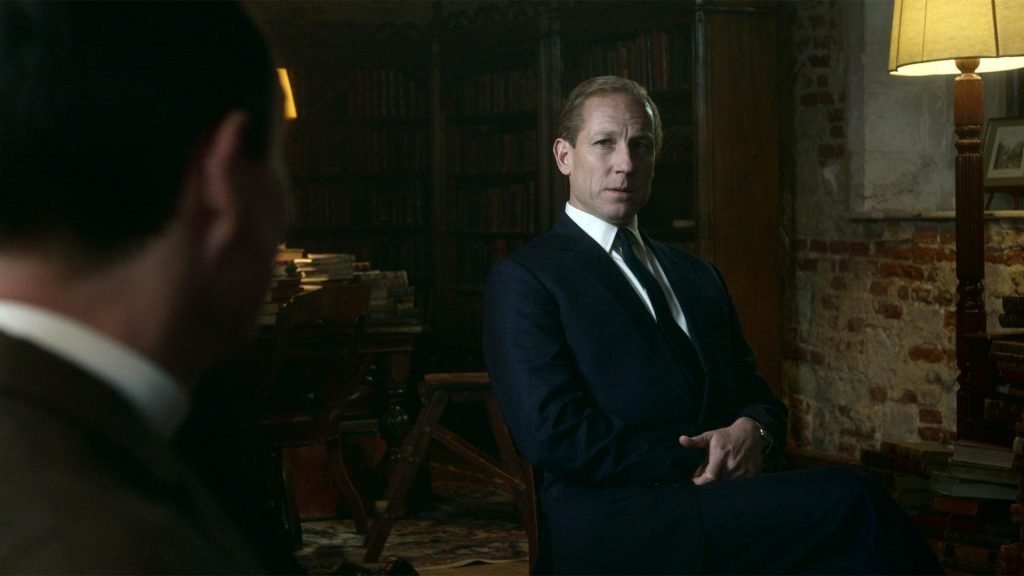
Philip lashes out at the clergymen/Netflix
His rant is not without reason. Imam Ali says in a narration:
Faith is acknowledging with the tongue and acting with the limbs.”
Ghurar Al-Hakim
In another narration, he says:
 The best faith is [based on] complete certitude, and the greatest honour is [in] doing good deeds.”
Ghurar Al-Hakim
Action is an integral part of faith, and, unfortunately, in a seeming struggle between traditional religious preaching and scientific discovery, the clergy can often be seen by disenfranchised worshippers as outdated, out of touch, and lacking significant impact on the world. I am happy to admit that many a time I have felt very disenfranchised hearing our speakers discuss topics that don’t seem to, using a metaphor that works in this context, aim for the stars. Is it because we are failing to utilise religion properly? Or is it because we simply do not aspire for more? Should the men of God and faith not be influencing the greatest of change?
While I do not wholly believe that frustration is unfounded (and it’s worth mentioning that historic Muslim contributions to science are what got us into the depths of space anyway), I also feel like it’s a trap that many of us can fall into. Often we can forget that an essential component of faith is the ability to work on one’s self and character. The soul needs fuel to keep it going, and oftentime that fuel can be found in the simplest of qualities: patience, modesty, piety, good manners, self-sacrifice, generosity, etc. Therefore, while there is room for criticism, we (and I) should adopt a more positive state of mind and appreciation to our preachers for reminding us of these basics. Imam Ali says:
Faith is a tree, its root is certitude, its branch is piety, its sunlight is modesty and its fruit is generosity.”
Ghurar Al-Hakim
Faith is the goal, yes, but it is also the companion to the goal, or the armour to assist the soul in its struggle through immense tasks. Man can still walk on the moon, but someone who has faith would view a trip to the existential beyond very differently to one without. Imam Ali says:
Faith and (action) are twin brothers and companions who do not part ways.”
Ghurar Al-Hakim
This is what Philip comes to learn. Much to his joy, he is granted a private audience with the three astronauts in their victory tour across the world. It’s here, however, that he struggles to relay to them his emotional attachment to their achievement as part of his desperate search for something bigger and greater, and when he finally does, they don’t really have the answers he’s looking for. After asking about their perspectives and observations of man’s place in the world, they reply, “To be honest, there wasn’t much time for that.. eyes are glued to the mission protocol to such a degree, you never really get to look outside.”
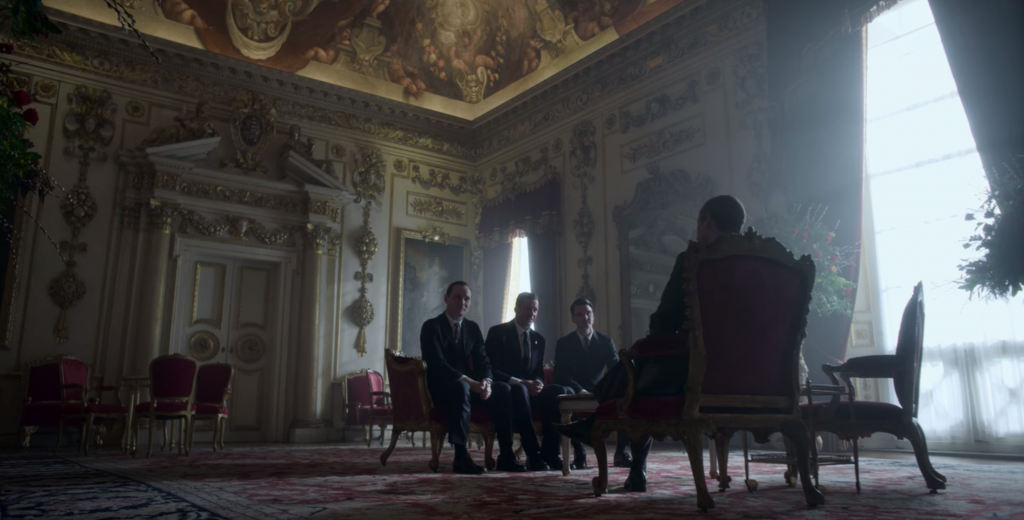
Philip meets the astronauts / Netflix
There, his journey in search of the greater answers hits a wall made of moonrock and NASA-produced metal. The weeks he spent following their journey and envious of their footsteps return to haunt him in a bitter taste of disappointment.
It’s here, after a moment of self-realisation, he returns to Dean Wood’s “concentration camp for spiritual defectives” and opens up about his own defected faith, saying:
“I’m here to admit to you that I’ve lost it. And without it, what is there? The loneliness and emptiness and anticlimax of going all that way to the moon to find nothing but haunting desolation, ghostly silence… gloom. That is what faithlessness is. As opposed to finding wonder, ecstasy, the miracle of divine creation, God’s design and purpose… I’m trying to say that… the solution to our problems, I think, is not in the ingenuity of the rocket, or the science or the technology or even the bravery. No, the answer is in here (pointing to his head). Or here (pointing to his heart), or wherever it is that… that faith resides.”
That is, indeed, the beauty of faith. A faithless man can head to the moon and see nothing but “haunting desolation”, while a man of faith can achieve the same task and find “the miracle of divine creation”. The mistake would be to look at the action as the source of faith, and not the heart and soul behind the action itself.
Imam Ali also says:
Faith is sincerity in action.”
Ghurar Al-Hakim
That is what faith is. And oftentimes, the wandering soul can remove soul and spiritual purpose from the equation of the task and be left to endlessly chase the marvel of achievement to no spiritual end.
It is here, among the clergymen, that the mighty Prince Philip swallows his pride to ask the priest for what he could previously never admit he needs: “Help. Help me.”
And that is where the true search for faith begins.

Monday, July 16, 2018

The Aql Is Not Reason – It’s Consciousness

بسم الله الرحمن الرحيم
One of the greatest tragedies befalling the mimbar today is an egregious mistranslation of the Arabic term العقل (al-aql). It is usually translated as “reason,” the devastating ramifications of which cannot be overstated. This (mis)translation is literally undercutting the foundation of all Islamic spirituality. What is the Aql? St. Thomas on the intellect
St. Thomas Aquinas, the foremost Christian scholastic Aql literally means that which binds. However, the best and most direct translation for this term is the Latin term intellectus, which in English is “the intellect.” Unfortunately the modern English rendition of this term no longer carries the historical meaning which can still be found in scholastic Latin. In Latin, the term intellectus was descriptive of the entirety of conscious experience; that which could be understood by the subject (in this case, you). One way in which you understand things is through rationality, which can range from mathematical truths like 2 + 2 = 4, to the conclusion of a reasoned argument as to the best foreign policy. You also have the ability to make empirical observations or inferences about the world, for example that there are two trees in your front yard or that the earth is round. But does that describe the entirety of your conscious experience? Of course not. Yet in the modern world, being rational and scientifically informed is what it means to be an “intellectual.” Your conscious experience includes a whole range of important states of being that are not included in the above. For example, you may feel love, hate, jealousy, admiration, humility, arrogance, etc. There are also transcendent values that we hold including justice, goodness, selflessness, mercy, and more. Furthermore, there are many truths that you intuit, that you simply know to be true before the application of any rational or empirical argument; for example, a contradiction cannot be true. In fact, the most important aspects of our conscious experience tend to not be rational or empirical in nature. In modern times, this side of our consciousness has been clumped together and pejoratively termed “emotional.” It is looked at with disdain. What is held to be supreme is to be “rational” and to believe in Science. This “emotional” side of our consciousness is viewed as entirely obstructive to the attainment of knowledge (which is thought to be purely rational or empirical in nature). Emotions are something to be overcome in order to attain knowledge, not a source of knowledge in and of themselves. I think the irony is lost on most atheists that the foundation of their so-called “rational” worldview is based on metaphysical knowledge that cannot be proven rationally (for example the law of non-contradiction). The modern view of the intellect is in stark contrast to the traditional Christian view (which all other religious traditions hold in common.) All of the world’s religious traditions, while they acknowledged and made use of rational and empirical truths, did not view them as the end goal. Rather, religions viewed consciousness as having vertical levels such that one could become conscious of more of reality (which exists on higher planes) through spiritual and ethical practice. The rational and empirical levels were viewed as among the lowest levels of consciousness for human beings, such that it was common between almost everyone. The entire religious project was to climb the rungs of consciousness such that one acquires greater and greater knowledge of Reality, whom we call God. What are called “emotions” today were divided and classified in different ways. I will explore this in detail in later posts. The Heart as a Modality of Consciousness heart-consciousness
Have you ever felt broken hearted? Has your heart ever yearned for someone or something? Has your heart ever burned when you failed to get what you desired? Has it ever recoiled in disappointment, hatred, or vindictiveness? Have you ever felt awe and wonder in the depths of your heart? Have you ever felt The Transcendent in your heart? Have you ever met someone who was good-hearted? What about a person so cruel you could only describe them as hard-hearted? The origin of these terms are not coincidental. What I mean when I say that the heart is a modality of consciousness is that it is a mode, or a way, in which we can be conscious of reality. Other examples of modalities of consciousness are sight and hearing. Through your ability to see, you literally have a way of being conscious of reality in a way that a blind person does not. It is a faculty or ability that is inherent within you. You can never explain to a blind person what it is like to see, because it is entirely subjective. Likewise, hearing is a mode or a way in which you are conscious, to which the deaf are not privy. What Islam came to tell us is one of the most important facts of human existence: your heart is like your eyes and your ears, you can use it to gain awareness of reality. But not just any reality. You can use your heart to gain consciousness of the highest levels of reality that will fill your entire being with everlasting joy, knowledge, and Being. One of the most important recurring themes in the Quran is that of awakening the heart. It talks in depth about “intellecting” with the heart (yes, that used to be a verb in Latin, to intellect. Certain traditionalists are trying to revive its use.) To intellect basically means to direct one’s consciousness through a particular modality such that you discover or realize truth. We are familiar with this process when it comes to rational thought (another modality of consciousness), but it seems alien when it comes to the heart. Just think of it like “thinking” with your heart such that you become conscious of new realities through your heart. Another way to understand it, is that it is like squinting with your eyes to see something, or like physically moving closer to an object in order to see it properly. Here are some ayaat to back up the claims I have made: The Heart Is Like Your Eyes And Ears أَفَلَمْ يَسِيرُوا فِي الْأَرْضِ فَتَكُونَ لَهُمْ قُلُوبٌ يَعْقِلُونَ بِهَا أَوْ آذَانٌ يَسْمَعُونَ بِهَا ۖ فَإِنَّهَا لَا تَعْمَى الْأَبْصَارُ وَلَٰكِن تَعْمَى الْقُلُوبُ الَّتِي فِي الصُّدُورِ So have they not traveled through the earth and have hearts by which to intellect (ta’aqul) and ears by which to hear? For indeed, it is not eyes that are blinded, but blinded are the hearts which are within the chests. (22:46) وَلَقَدْ ذَرَأْنَا لِجَهَنَّمَ كَثِيرًا مِّنَ الْجِنِّ وَالْإِنسِ ۖ لَهُمْ قُلُوبٌ لَّا يَفْقَهُونَ بِهَا وَلَهُمْ أَعْيُنٌ لَّا يُبْصِرُونَ بِهَا وَلَهُمْ آذَانٌ لَّا يَسْمَعُونَ بِهَا ۚ أُولَٰئِكَ كَالْأَنْعَامِ بَلْ هُمْ أَضَلُّ ۚ أُولَٰئِكَ هُمُ الْغَافِلُونَ And We have certainly created for Hell many of the jinn and mankind. They have hearts with which they do not gain deep understanding (tafaquh) they have eyes with which they do not see, and they have ears with which they do not hear. Those are like livestock; rather, they are more astray. It is they who are the heedless. (7:179) The Heart Is The Means Through Which Faith Is Experienced قَالَتِ الْأَعْرَابُ آمَنَّا ۖ قُل لَّمْ تُؤْمِنُوا وَلَٰكِن قُولُوا أَسْلَمْنَا وَلَمَّا يَدْخُلِ الْإِيمَانُ فِي قُلُوبِكُمْ ۖ وَإِن تُطِيعُوا اللَّهَ وَرَسُولَهُ لَا يَلِتْكُم مِّنْ أَعْمَالِكُمْ شَيْئًا ۚ إِنَّ اللَّهَ غَفُورٌ رَّحِيمٌ The bedouins say, “We have believed.” Say, “You have not [yet] believed; but say [instead], ‘We have submitted,’ for faith has not yet entered your hearts. And if you obey Allah and His Messenger, He will not deprive you from your deeds of anything. Indeed, Allah is Forgiving and Merciful.” (49:14) إِلَٰهُكُمْ إِلَٰهٌ وَاحِدٌ ۚ فَالَّذِينَ لَا يُؤْمِنُونَ بِالْآخِرَةِ قُلُوبُهُم مُّنكِرَةٌ وَهُم مُّسْتَكْبِرُونَ Your god is one God. But those who do not believe in the Hereafter – their hearts are obstinate, and they are arrogant. (16:22) The Heart Is A Means Of Divine Guidance مَا أَصَابَ مِن مُّصِيبَةٍ إِلَّا بِإِذْنِ اللَّهِ ۗ وَمَن يُؤْمِن بِاللَّهِ يَهْدِ قَلْبَهُ ۚ وَاللَّهُ بِكُلِّ شَيْءٍ عَلِيمٌ No affliction comes about but by Allah’s permission; and whoever believes in Allah, He guides aright his heart; and Allah is Knowing of all things. (64:11) Conclusion I could literally go on and on here, the Quran has dozens of verses talking about the heart. It is in fact the most important subject of the Quran, one which I will, inshaAllah, explore in future articles. The take away from this article is to simply connect with heart with consciousness. Right now, you can do a very simple exercise: focus the center of your consciousness on your heart. If you have not made serious and informed attempts to heal your heart from the degenerate filth of sin, you will no doubt feel a kind of pain that is centered in your heart. This is normal. Pray that I have the tawfeeq to detail, in future articles, how to soften the heart to the remembrance of Allah. I will also go into further detail into the aql in general, not just in terms of the modality of consciousness we experience through the heart, inshaAllah. Remember, the aql is not the same thing as the heart, the heart is just one way in which we can intellect (do ta’aqul, or use our aql.) God Willing, I will also speak about the relation between the aql and knowledge or truth. I will contrast this with theories of knowledge that have emerged from Western philosophy, which you have likely adopted, and which currently are lowering your happiness level significantly.