Showing posts with label Nelson Mandela. Show all posts

Saturday, May 04, 2019

Western hubris and double standards

Zafar Bangash
Hypocrisy is not the exclusive preserve of Western regimes but they are master practitioners of this evil craft. That explains why Western hypocrisy is often so easy to miss. Barring a few exceptions, even the most enlightened individuals in the West fail to challenge it.
This point can be best illustrated by looking at specific examples. That was the prelude of a piece authored by famous analyst Zafar Bangash, who is the Director of the Institute of Contemporary Islamic Thought (ICIT). His piece is titled, "Western Hubris and Double Standards".
Let us begin with how the West treated Nelson Mandela. He is considered an icon of the European 20th century. He led the anti-apartheid struggle in South Africa spending 27 years in prison as a consequence. Many other members of the African National Congress (ANC) also suffered the same fate, mostly at the notorious Robben Island Prison, off the coast of Cape Town.
While most people are familiar with Mandela’s anti-apartheid struggle, few would recall that it was Ronald Reagan’s regime (1981–1988) that branded him a “terrorist.” In 1986, a House of Representatives resolution calling for removal of Mandela’s name from the US terror list was defeated. Dick Cheney, who later became vice president, was among those who voted against it.
Mandela was released from prison on February 11, 1990 and sworn in as the first president of post-apartheid South Africa on May 10, 1994. He was awarded the Nobel Peace Prize in 1993. Following his release from prison, Mandela visited several Western capitals including the US but he remained on Washington’s terror list. The US State Department had to issue a waiver each time Mandela wanted to enter the US. His name was removed from the terror list only in 2008 when then US Secretary of State Condoleezza Rice found the whole affair embarrassing and an impediment to cultivating good relations with post-apartheid South Africa.
Months after Mandela’s release from prison and while holding direct talks with the apartheid regime, the New York Times still scolded him in its opinion pages for refusing to unilaterally renounce violence. “Why Won’t Mandela Renounce Violence?” asked a June 21, 1990, op-ed by congressional aide David G. Sanders.
In a 10-year survey about media demands of Muslims to “renounce violence,” published by the web portal, Fairness and Accuracy in Reporting (FAIR), Adam Johnson wrote (March 29, 2019), “There’s no evidence in the Times archives that South Africa’s apartheid government was ever asked the same question (in sharp contrast to Martin Luther King, Mr. Mandela continues to call for an ‘armed struggle’, a 1990 New York Times op-ed (6/21/90) complained)”. Perhaps one should point out to the Times editorial writers that Dr. King ended up being killed while Mandela walked to freedom and also freed South Africa from the shackles of apartheid, partly through armed struggle that ultimately forced the regime to negotiate with the ANC.
While Mandela’s case shows with stunning clarity the hypocrisy of Western regimes in dealing with opponents — real and imagined — there are other equally glaring examples that illuminate the point. Consider the possession of nuclear weapons. Why is it alright for some countries to have nuclear weapons but not for others, and who decides this?
The February 28 talks in Hanoi between Donald Trump and North Korean leader Kim Jung un collapsed because Trump demanded North Korea completely denuclearize and hand over all its stockpile of weapons and fuel to the US. The North Koreans considered such a demand insulting and rejected it. Trump then resorted to an outright lie by alleging that the North had demanded the lifting of all sanctions before they would agree to partial denuclearization. While not true and the North Korean Foreign Minister Ri Yong-ho categorically rejected this assertion, they would be in their right to make such a demand. After all, US sanctions against North Korea, as indeed against Iran and many other countries are completely illegal. Only the UN Security Council can impose sanctions following a vigorous debate and vote, not unilaterally by bullies!
The nuclear hypocrisy runs deeper. There is no problem with Western regimes and their Zionist and Hindu allies having nuclear weapons but no Muslim country should have them. Nuclear weapons of a Muslim country — Pakistan — have been christened as “Islamic bombs”! Do bombs also have a religion?
In the case of other Muslim countries that do not have any nuclear weapons or even plan to acquire them, they are still accused of trying to make them. Islamic Iran falls under this category. Despite its top leadership repeatedly rejecting the acquisition of nuclear or any other weapons of mass destruction, the Western regimes continue to accuse Tehran of trying to acquire them. These demands have now escalated to calling on Iran to abandon its defensive missile program as well. In other words, they want Iran to have no defensive capability so that Western warmongers would have a free hand to attack and possibly destroy it.
True, it would be far better if no country had nuclear weapons but would the US, Britain, France, or Zionist Israel agree to this? Trump has abrogated a number of arms limitation treaties with Russia including the Intermediate-range Nuclear Forces (INF) treaty and has allocated $1 trillion to upgrade America’s nuclear arsenal. This is absolute madness even if Western rulers have seldom shown much sanity in dealing with others.
There is another ploy the Western regimes use against those who defend themselves against imperialist and/or Zionist aggression. They are branded as “terrorists” even though the resisters are defending their homeland, life, and honor — a fundamental right recognized in international law and the UN Charter. The defenders are also called upon to “renounce violence.” No such demand is ever made of the aggressors.
This point can be better understood if we consider what the Americans, Zionists, and their allies demand of people they are attacking. Hezbollah in Lebanon, Hamas and Islamic Jihad in Palestine, and Kashmiris struggling against colonialism are constantly told to renounce violence. Surely, people under attack and colonial occupation have an inalienable right to resist their occupiers by whatever means necessary. The Fourth Geneva Conventions as well as the UN have affirmed this fundamental right of people to resist foreign occupiers.
Interestingly, Daesh terrorists in Syria were never asked to renounce violence. They were called “rebels” trying to overthrow a “dictator” even though the vast majority of Daesh members were not Syrians but foreign mercenaries. The US, Zionist regime, Saudi regime, and their allies supported, financed, trained, and armed these terrorists and unleashed them in Syria destroying the country.
A similar scenario is currently underway in Venezuela. Washington warlords are supporting a little known Venezuelan politician, Juan Guaido, claiming he is the “real president,” instead of the elected President Nicolas Maduro. This again reflects Western hypocrisy and hubris. The greater tragedy is that these hypocrites and warmongers never give up inflicting suffering on countless innocent civilians worldwide. They seem to take sadistic pleasure in killing innocent people whom they do not consider to be humans.

Tuesday, September 25, 2018

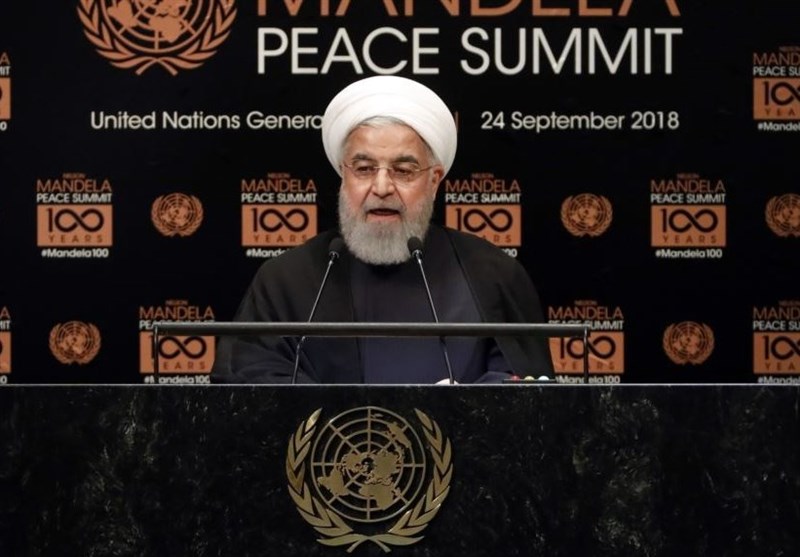
Rouhani at Mandela Summit in New York Urges Stronger Multilateralism

TEHRAN (Tasnim) - Iranian President Hassan Rouhani used his speech at Nelson Mandela Peace Summit in New York for reiterating Tehran's continued call for strengthening multilateralism and developing international peace and cooperation.


Rouhani at Mandela Summit in New York Urges Stronger Multilateralism (+Full Text)

"The Islamic Republic of Iran, during the past decades has presented before
this august forum inspiring initiatives as “Dialogue among Civilizations” and 
“World Against Violence and Extremism” in line with strengthening multilateralism 
and developing international peace and cooperation. Iran remains firm and 
resolute in its intention and warmly shakes the hands of all pro-peace 
and pro-tolerance leaders," Rouhani said, addressing Mandela Peace Summit 
held on the sidelines of the 73rd UN General Assembly Session in New York.
The full text of the statement of President Hassan Rouhani is as follows:
In the Name of God the Most Compassionate, the Most Merciful
Mr President,
At the outset, I would like to express my condolences over the martyrdom 
of some of our dear fellow Iranians in the terrorist attack in Ahwaz and 
emphasise the firm determination of my government in the fight against 
terrorism.
Commemorating the centenary of the birth of Nelson Mandela on the 
day that stands for global peace is praiseworthy on the part of the 
General Assembly of the United Nations.
Nelson’s Mandela long and formidable journey to freedom, from birth 
to growth in a small tribe to joining the anti-racism movement which 
resulted in long years of imprisonment and ultimately regaining 
freedom and ascending to presidency are distinctive and unique in the 
contemporary history.
Mandela was a close and loyal friend of the Islamic Republic of Iran. 
During the years before the victory of the Islamic Revolution, the then 
royal regime of Iran had established very strong relations with the Zionist 
entity and the apartheid regime which were among the closest allies 
of the United States. Iran in those years was the main supplier of 
energy for both regimes. However, after the victory of the Islamic 
Revolution, the Iranian government, inspired by the will of its people 
to support the liberation movement of South Africa, severed all its relations 
with both the Zionist and apartheid regimes. Following the collapse of the 
Apartheid regime and the establishment of democracy in South Africa, 
the relations between Iran and South Africa entered a new phase which is
increasingly developing.
Mr President
The suffering of the hard times of struggle did not force Mandela to 
abandon his method which was based on the pursuit of peace and 
accord. And Mandela’s treatment with his enemies and opponents after 
release from prison was so merciful that he sowed the seeds of amity and 
compassion in their hearts.
This is a historical reality that great statesmen tend to build bridges instead of 
walls. As racism, racial discrimination and xenophobia would make it easier 
to build walls and not bridges among the nations, dialogue, tolerance and 
peaceful co-existence constitute the building blocks of bridges between 
differences and divisions. I am courageous enough to declare that Nelson 
Mandela was one of the greatest men in contemporary history who 
considered the establishment of peace and friendship as an absolute 
necessity than mere expediency.      
The Islamic Republic of Iran, during the past decades has presented 
before this august forum inspiring initiatives as “Dialogue among 
Civilizations” and “World Against Violence and Extremism” in line with 
strengthening multilateralism and developing international peace and 
cooperation. Iran remains firm and resolute in its intention and warmly 
shakes the hands of all pro-peace and pro-tolerance leaders.
The remedy for racism, xenophobia, violence and hate must be sought in 
dialogue, tolerance and democracy. This is the same path Mandela 
has bravely demonstrated to real and genuine statesmen. The name and 
memory of this great man shall live eternally through history. May his 
soul rest in peace.
Thank you

Thursday, December 12, 2013

Why the West Loves Mandela (and Hates Mugabe)

By Stephen Gowans


In the wake of Nelson Mandela’s death, hosannas continue to be sung to the former ANC leader and South African president from both the left, for his role in ending the institutional racism of apartheid, and from the right, for ostensibly the same reason. But the right’s embrace of Mandela as an anti-racist hero doesn’t ring true. Is there another reason establishment media and mainstream politicians are as Mandela-crazy as the left?
According to Doug Saunders, reporter for the unabashedly big business-promoting Canadian daily, The Globe and Mail, there is.
In a December 6 article, “From revolutionary to economic manager: Mandela’s lesson in change,” Saunders writes that Mandela’s “great accomplishment” was to protect the South African economy as a sphere for exploitation by the white property-owning minority and Western corporate and financial elite from the rank-and-file demands for economic justice of the movement he led.
Saunders doesn’t put it in quite these terms, hiding the sectional interests of bond holders, land owners, and foreign investors behind Mandela’s embrace of “sound” principles of economic management, but the meaning is the same.
Saunders quotes Alec Russell, a Financial Times writer who explains that under Mandela, the ANC “proved a reliable steward of sub-Sahara Africa’s largest economy, embracing orthodox fiscal and monetary policies…” That is, Mandela made sure that the flow of profits from South African mines and agriculture into the coffers of foreign investors and the white business elite wasn’t interrupted by the implementation of the ANC’s economic justice program, with its calls for nationalizing the mines and redistributing land.
Instead, Mandela dismissed calls for economic justice as a “culture of entitlement” of which South Africans needed to rid themselves. That he managed to persuade them to do so meant that the peaceful digestion of profits by those at the top could continue uninterrupted.
But it was not Mandela’s betrayal of the ANC’s economic program that Saunders thinks merits the right’s admiration, though the right certainly is grateful. Mandela’s genius, according to Saunders, was that he did it “without alienating his radical followers or creating a dangerous factional struggle within his movement.”
Thus, in Saunder’s view, Mandela was a special kind of leader: one who could use his enormous prestige and charisma to induce his followers to sacrifice their own interests for the greater good of the elite that had grown rich off their sweat, going so far as to acquiesce in the repudiation of their own economic program.
“Here is the crucial lesson of Mr. Mandela for modern politicians,” writes Saunders. “The principled successful leader is the one who betrays his party members for the larger interests of the nation. When one has to decide between the rank-and-file and the greater good, the party should never come first.”
For Saunders and most other mainstream journalists, “the larger interests of the nation” are the larger interests of banks, land owners, bond holders and share holders. This is the idea expressed in the old adage “What’s good for GM, is good for America.” Since mainstream media are large corporations, interlocked with other large corporations, and are dependent on still other large corporations for advertising revenue, the placing of an equal sign between corporate interests and the national interest comes quite naturally. Would we be shocked to discover that a mass-circulation newspaper owned by environmentalists (if such a thing existed) opposed fracking? (Journalists will rejoin, “I say what I like.” But as Michael Parenti once pointed out, journalists say what they like because their bosses like what they say.)
Predictably, Saunders ends his encomium to the party-betraying Mandela, the ‘good’ liberation hero, with a reference to the ‘bad’ south African liberation hero, Robert Mugabe. “One only needs look north to Zimbabwe to see what usually happens when revolutionaries” fail to follow Mandela’s economically conservative path, writes Saunders.
At one point, Mugabe’s predilection for orthodox fiscal and monetary policy was a strong as Mandela’s. Yet after almost a decade-and-a-half of the Western media demonizing Mugabe as an autocratic thug, it’s difficult to remember that he, too, was once the toast of Western capitals.
The West’s love affair with Mugabe came to an abrupt end when he rejected the Washington Consensus and embarked on a fast-track land reform program. Its disdain for him deepened when he launched an indigenization program to place majority control of the country’s mineral resources in the hands of black Zimbabweans.
Mugabe’s transition from ‘good’ liberation hero to ‘bad’, from saint to demon, coincided with his transition from “reliable steward” of Zimbabwe’s economy (that is, reliable steward of foreign investor and white colonial settler interests) to promoter of indigenous black economic interests.
That’s a transition Mandela never made. Had he, the elite of the imperialist world would not now be flocking to South Africa for Saint Mandela’s funeral, overflowing with fulsome eulogies.