
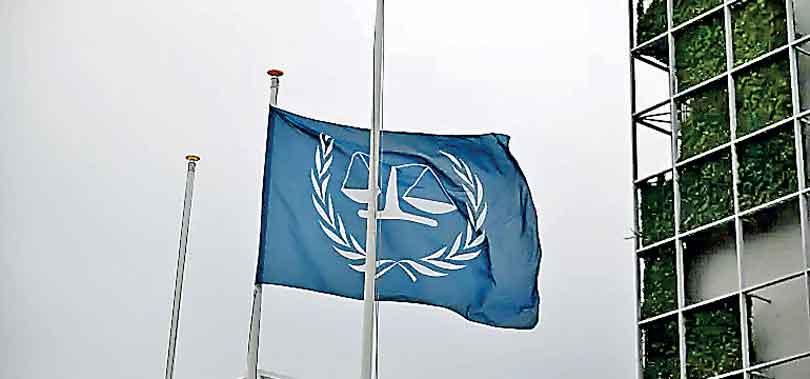
The International Criminal Court in The Hague: Facing a death blow from the Trump administration

Explaining the state of nature that existed before governments emerged, British social contract theorist Thomas Hobbes described the resulting lawless disorder as selfish, nasty, brutish and short.
Fast forward to 2026. Lawless disorder is no longer a hypothesis advanced by a 17th-century political philosopher. We are hurtling towards the very dystopia Hobbes envisaged to explain the conditions that necessitated the formation of government in the political evolution of human society. And the country most responsible for this reverse journey is the United States, whose very foundations, paradoxically, were built on liberty, justice and the rule of law.
The peace-loving global community was shocked last week and remains concerned by US efforts to institutionalise a lawless international order in which might is right, violence is the international currency for resolving disputes, oppression is normalised, and injustice is regarded as a virtue.
In yet another step towards the global order’s plunge into lawlessness, US President Donald Trump’s administration last week imposed financial sanctions on the International Criminal Court (ICC), in keeping with its pledge to dismantle the court. It mattered little to the Trump administration that the court was established pursuant to the Rome Statute, which was signed and ratified by states concerned about growing impunity for crimes against humanity.
In its preamble, the Rome Statute affirms that grave international crimes must not go unpunished. It also emphasises the duty of states to bring perpetrators to justice.
Now who, other than criminals, would call for the abolition of the police station in a town? By taking harsh steps to dismantle the ICC—established as a permanent institution to help end impunity, uphold the rule of law, and contribute to peace and international justice—the Trump administration has once again proved its criminal credentials.
The ostensible reason is to protect Americans from the ICC’s jurisdiction. But the undeclared reason was to shield Israeli Prime Minister Benjamin Netanyahu and some of his hardline cabinet ministers from ICC prosecution on charges of genocide in Gaza since October 7, 2023.
Of late, the US political establishment has shown little concern about its international standing being tarnished by its foreign policy decisions. Not only the Trump administration but also its predecessor, the Joe Biden administration, has demonstrated that the United States would go to great lengths to support the war crimes of Netanyahu, who, along with two former cabinet ministers, is the subject of ICC arrest warrants.
That the United States is a textbook example of global hypocrisy was vividly illustrated by its rush to embrace the ICC’s 2023 arrest warrant for Russian President Vladimir Putin, describing it as “fully justified” under President Biden, and its denunciation of the same court as a “rogue court” under President Trump.
Last Friday, US Secretary of State Marco Rubio, acting more like a conceited global bully than a composed diplomat committed to promoting US interests while upholding a peace- and justice-based global order, vowed to “dismantle the ICC piece by piece” and declared: “Either the ICC will end its threats, or we will end the ICC.”
“We will ban transactions with this rogue court, cutting off its resources and crippling its ability to operate against us. Because our message is clear: the United States and the American people are not subject to the jurisdiction of this fake ICC ... we don’t want that court and we don’t want it,” he said in a video post on X.
The financial sanctions are now in force, while US companies dealing with the Hague-based court have been given a 180-day period under a Treasury licence to wind up their dealings with the court. The Trump administration had earlier sanctioned more than a dozen judges and prosecutors, preventing them from accessing US-linked financial services.
The US and Israel are not parties to the Rome Statute, but when the treaty was being negotiated in the wake of the genocides in Rwanda and Bosnia during the 1990s, then US President Bill Clinton backed efforts to punish those who commit crimes against humanity. But when the treaty was opened for signature, the US backed out.
Washington’s allies condemned the sanctions, albeit in toothless statements that bark but do not bite. In response, the ICC said the move was an “assault on the rule of law and on the very foundations of the international legal order”. It called on its 125 member states to defend the institution.
“The Court cannot stand alone. Its fate now rests also in the hands of the states that created it,” the ICC said in a statement. “This is not just about defending a single institution, but about safeguarding the international order grounded in the rule of law. History will judge this moment.”
UN Secretary-General Antonio Guterres was “deeply alarmed”, while UN High Commissioner for Human Rights Volker Türk called for immediate measures to protect the ICC.
The ICC has convicted several suspects for crimes against humanity, and all of them were from Africa, drawing criticism that it lacks the courage to go after war crimes suspects like Netanyahu. But now that it has issued an arrest warrant for Netanyahu, it is facing near death rather than a global outcry to reinforce it in the greater interest of preventing crimes against humanity.
Last month, Netanyahu visited the United States to address the UN General Assembly sessions, flying over Greece, Italy, France, and Canada—all state parties to the Rome Statute—but none had the courage to force his flight down and arrest him, as the Rome Statute demands.
What is next? Will the US impose similar sanctions on the International Court of Justice (ICJ)—probably the last vestige of global justice—because it is hearing a case against Israel? The court has also delivered several judgments against Israel, which dismisses them in utter contempt for the court and still brags before the international community that it is the only civilized nation with a working democracy in the entire Middle East.
The US move to render the ICC defunct also raises fears that after the October 27 Israeli elections and the US midterms on November 3, the US will unleash a new wave of attacks on Iran and the use of MOAB (mother of all bombs), causing large-scale human casualties, which may be construed as crimes against humanity. It is also feared that the Zionist regime will begin the second phase of the genocide in Gaza. The perpetrators may legitimise their crimes as a lesser evil, just like Washington legitimised the use of atomic bombs on Hiroshima and Nagasaki, claiming it did so to end the war, which, if continued, could have killed many more people than the atomic bombs did.
Undermining international law and international institutions set up to uphold global justice will only expedite the United States’ fall from grace. It will morally disqualify itself from being the number one global power. Trump believes international law is whatever he deems it to be. He once said, “I don’t need international law” and that the only thing limiting his power was “my own morality, my own mind.” When powerful countries are not restricted by international mechanisms such as the ICC, the ICJ, and international agreements, we will soon inherit a primitive world order where only the fittest will survive.
Gone with Trump’s decision to sanction the ICC are humanity’s collective efforts over centuries to usher in a world order where the norm is to respect human rights, international law, and state sovereignty.

No comments:
Post a Comment