
By Sheida Eslami

At this juncture, revisiting the horrendous crime committed by the last ruler of the Pahlavi dynasty on “Black Friday” (September 1978) is more illuminating than any other event. This is because, beyond being a purely academic exercise, the process of studying history is an analytical necessity for understanding the nature of societal transformations.
In the case under examination, separating the January 2026 events from their historical context produces an incomplete and misleading picture—one that, as we have seen in recent days, Western propaganda apparatuses are attempting to construct by reducing “violence” to “protest,” “terror” to “dissent,” and “massacre” to the “inevitable cost of change.”
By revisiting the tragedy of 8 September 1978 (17 Shahrivar 1357) and enumerating similar or contrasting behavioral indicators of foreign and expatriate instigators and perpetrators, we seek to demonstrate that in both events we are confronted with a recurring pattern: the use of violence and hard confrontation alongside cognitive warfare and narrative engineering.
What occurred in early January 2026 was not a sudden eruption of violence; it was the result of an operation that, above all else, began in the realm of the mind and perception.
Deceived operatives were told that the “prince” was on his way. They were told to take comfort in the support of US President Donald Trump and Israeli premier Benjamin Netanyahu and to be confident that the fall of the Islamic Republic was imminent.
Promises of money, weapons, and foreign backing turned them into the foot soldiers of a terrorist urban warfare campaign whose foreign roots and origins—despite efforts to erase traces—were undeniable.
Only a few days after protests began in Tehran’s bazaar, trained leaders and foreign-linked handlers issued orders to initiate Daesh-style operations, and the matter was no longer about labor-related or economic protests by the people; the arena had become a battlefield.
A war in which stripping people naked, beheading them, amputation of hands, splitting bodies open with axes and swords, shooting at heads and eyes, burning people alive, attacking children and the elderly, and destroying buses, schools, mosques, libraries, and even ambulances and fire trucks became tools of the so-called “struggle for liberation.
Yet before Molotov cocktails and firearms appeared on the streets, the main operation had already begun on the cognitive warfare front. Cognitive warfare is no longer an abstract or futuristic concept; it is an operational reality in contemporary geopolitics.
In this type of war, the battle is not over land and resources, but over minds, beliefs, and ultimately collective will. Engineered narratives can unleash rivers of blood in the streets, because in such a battlefield, truth is the first casualty.
In January 2026, an organized attempt emerged to assassinate the audience’s perception, so that through inversion of events, omission of parts of reality, and amplification of fabricated narratives, armed violence could be redefined as “protest.”
The pattern and precedents
This pattern has precedent. The history of interaction between the Iranian nation and a front composed of expatriate counter-revolutionaries, the United States, Israeli regime, and their European supporters is replete with examples showing that today’s enmity of the West and Zionism is a continuation of yesterday’s hostility—carried out by the same actors and marked by the same behavioral contradictions; only the words change, each time donning a different disguise.
To understand this continuity, examining two key historical moments is essential: 17 Shahrivar 1357 (8 September 1978) and the terrorist events of January 2026.
These two turning points reveal a structural similarity in the strategy of exercising power through massacre and expose the lies of the remnants of the Pahlavi regime and their managers and organizers. This regime sealed its half-century domination over Iran with the blood of the people, even in the final months of its life in the year of the Islamic Revolution.
The tragedy of 8 September 1978 was not merely a security incident; it was an engineered operation aimed at reaching a “psychological breaking point” in public opinion. The Pahlavi regime, seeking to shatter collective will, decided to apply maximum violence within a short time frame.
In the days leading up to September 1978, amid the turbulence of events that led to the Islamic Revolution, the regime realized that Imam Khomeini, as a charismatic religious leader pursuing the political foundations of Islam, had become the true voice of the people.
Continuous demonstrations across cities—where, in a country of just over 30 million at the time, the number of participants in Tehran alone reached up to one million—signaled an irreversible movement.
This situation forced the regime to change its strategy. Accordingly, on 27 August 1978, Jafar Sharif-Emami, the Speaker of the Senate, was appointed Prime Minister to instill hope for change and reform.
However, the reality was that despite Sharif-Emami’s premiership, widespread demonstrations in most Iranian cities did not subside. The peak of these protests came in early September, coinciding with Eid al-Fitr prayers, when millions participated peacefully in demonstrations whose scale was unprecedented.
Le Monde described this march as unparalleled in Iranian history—so powerful that it shook the pillars of the Pahlavi regime. These protests were repeated for several consecutive days, and at dawn on 7 September, hundreds of thousands of people took to the streets of Tehran. Observers estimated that the number of marchers reached one million and that the lines extended several kilometers. Beyond the capital, other Iranian cities also witnessed mass public mobilization.
By this time, the regime’s extreme fear of the people’s movement drove it toward harsh military action. Thus, in the afternoon session of 7 September, the regime drafted a bill to impose martial law in Tehran and eleven other Iranian cities. But its leaders were so terrified of the people’s movement that they could not even delay the announcement of martial law by one day to allow the public to be informed.
As a result, the regime issued a notice at midnight, which was read on the morning radio news. However, a large portion of the population—especially because it was a Friday and no morning newspapers were published—remained unaware of this decision. Consequently, when a large crowd had gathered in Jaleh Square in Tehran, gunfire began and many were martyred.
A notable point is that under the single-article law ratified in 1950, the government was permitted to declare martial law only under extraordinary necessity and was obligated to submit its proposal, along with stated reasons, to the National Consultative Assembly and the Senate within one week for approval.
However, on 8 September, when martial law was enforced, Sharif-Emami and his cabinet had not yet completed the legal pillars of the regime: ministers had not been introduced to parliament, no program had been presented, and no vote of confidence had been obtained.
As a result, they had no legal authority to declare martial law, and the establishment of such rule from that date until the cabinet obtained legal legitimacy constituted a violation of constitutional principles and an infringement on individual and social freedoms.
Therefore, from a legal standpoint, its continuation until parliamentary approval lacked legal validity. Even more striking, to create a façade of legality, the Sharif-Emami puppet regime submitted the martial law bill to parliament, and the National Consultative Assembly, on 17 September, approved it retroactively for enforcement from 8 September with 152 votes in favor, 22 against, and 3 abstentions.
The reality on the ground, however, was that the people—especially on that Friday morning—were unaware of this decision. This very lack of awareness paved the way for the killing of a large number of protesters against the Pahlavi regime, the scale of which exceeded the official narrative even by foreign witnesses’ accounts.
Daybreak
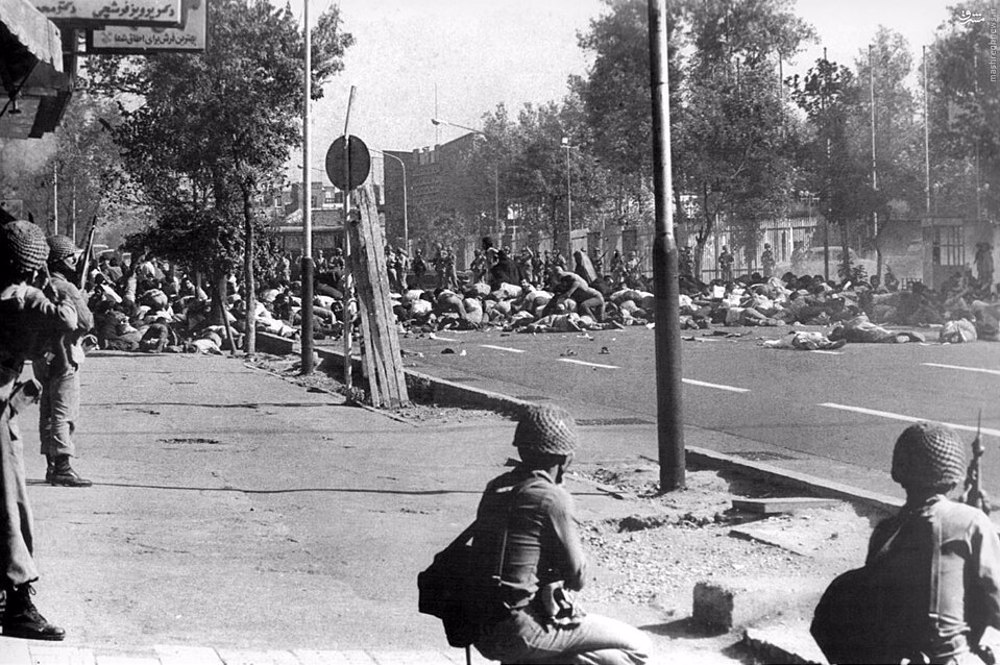
At 9:20 a.m., Jaleh Square was filled with a crowd carrying flower branches (to present to soldiers as a sign of brotherhood—an expression of revolutionary conduct common in popular demonstrations at the time), handwritten slogans, and photographs of Imam Khomeini, completely encircled.
Military forces entered not to disperse the crowd, but to annihilate it entirely. The use of armored vehicles, automatic military weapons, and even gunfire from helicopters against unarmed civilians created a scene that witnesses likened to an execution field.
A German eyewitness residing in the area reported gunfire from helicopters directed at demonstrators. The wounded, the unharmed, and the martyrs lay side by side. Women’s screams, cries, and pleas for help filled the air. Water channels were filled with men and women, and because many women wore black chadors, the canals appeared full of black fabric.
Children lay on the ground, young people writhed in blood, and countless shoes and chadors were scattered across the streets. The sight of abandoned shoes, chadors and headscarves, unconscious and martyred women piled atop one another, and the sound of wailing from all directions created a heartrending scene that would shake any sensitive human being.
Narrative-making
After the gory massacre, the second phase began with denial and distortion. On 9 September, the Pahlavi regime announced that the number of martyrs was 58 and the wounded 205. Two days later, the judiciary stated that the death toll had increased to 95.
The US Embassy deemed these figures unrealistic, noting that “several American and European eyewitnesses have indicated that the number must be far higher.” Parsons, the British ambassador, cited the number of martyrs as “hundreds.” According to US Embassy assessments, the actual number of those killed ran into the several thousands.
William Sullivan, the US ambassador to Tehran, reported that in Jaleh Square, “more than two hundred demonstrators had been killed.” An Iranian security official told the embassy that between 4,000 and 4,500 people died in Jaleh Square and several hundred more in the southern parts of the city.
John Stempel, a US Embassy staff member, citing medical sources, estimated the number of martyrs at “between 200 and 400.” Shapour Bakhtiar claimed: “I can say with confidence that the number of those killed did not exceed 700 or 800.” SAVAK, in a confidential report, wrote that 2,200 burial permits had been issued and another 1,000 bodies had been numbered.
Eyewitnesses estimated the number of martyrs at over two thousand and stated that two to three thousand pairs of worn and torn shoes remained on 17 Shahrivar Street and in Shohada Square.
Ali-Mohammad Besharati, a pre-revolution activist and later a minister in the cabinet of Ayatollah Hashemi Rafsanjani, recounts that he personally saw the number 1723 written on one of the bodies in Behesht-e Zahra cemetery.
It was clear that these bodies had passed through official channels such as SAVAK and that burial permits had been issued for them; that number corresponded to the serial numbering of those processed through these channels.
Foreign radio stations also reported that the number of martyrs had reached several thousand. Ultimately, no one was able to determine the exact number of those killed that day with certainty, but rumors indicated that several thousand people had been killed.
The Zionist footprint
What was already clear was that this violence did not occur without foreign backing. Correspondence from the US Embassy shows that the declaration of martial law was carried out with Washington’s knowledge and support.
At that time, the leaders of the United States, Egypt, and the Israeli regime were engaged in the Camp David negotiations. Carter held a telephone conversation with the Shah and “affirmed America’s support for him in the measures he was taking to restore order.”
His call to Mohammad Reza Pahlavi and his endorsement of the Shah’s actions to “restore order” conveyed a clear message: geopolitical stability and the continuation of US presence and its client Pahlavi regime took precedence over the lives of the people.
At the same time, multiple pieces of evidence pointed to Israel’s direct role in supplying repression equipment and even dispatching trained forces. From as early as 8 September, a rumor spread among the public that those firing on the people were not Iranian soldiers, but Israeli commandos who had entered Iran days earlier.
Reports circulated of three aircraft carrying Israeli military commandos landing at Mehrabad Airport on Wednesday night (15 Shahrivar). It was whispered among the people that the army had brought Israeli soldiers into the country to suppress the protesters.
Israeli media also revealed that the Israeli regime and its military officials, at the height of the Iranian people’s demonstrations against the West-backed Pahlavi regime, had provided the Shah with weapons to suppress the marches and confront the public.
According to these reports, following the intensification of protests, an air bridge was established from Lod Airport and the Ramat David military airbase near occupied Haifa to deliver equipment for suppressing demonstrators.
These Israeli outlets further added: “The Israeli government dispatched a company of personnel trained in urban suppression and guerrilla warfare to Tehran. This unit operated under the supervision of Israeli military intelligence and, with the final approval of Shin Bet (the intelligence and counterintelligence agency of the Israeli Prime Minister’s Office), was tasked with carrying out operations. Command of this unit was entrusted to Rehavam Ze’evi, who had previously served as commander of Israel’s Central Command in the 1960s and later as an adviser to the Prime Minister on the use of special munitions and counterterrorism techniques.”
The reports continued that this unit was transported to Tehran by aircraft of El Al Israel Airlines and, at the designated time, performed successfully in suppressing demonstrations in Iran’s major cities.
All members of this unit wore Iranian army uniforms while in Tehran. Israeli military experts, as well as members of covert Zionist organizations operating in Iran—such as the B’nai B’rith organization (established for the military defense of the Jewish minority and the dispatch of forces to Israel)—joined the Israeli contingent in Tehran.
To conceal their presence, Iranian regime officials spread the claim that these individuals were from Iran’s Baluchestan region.
A repeating pattern
This catastrophe in 1978 demonstrated that the Pahlavi regime possessed the capacity to kill and wound several thousand people with ease and within the span of a single day.
In the same manner, Reza Pahlavi, the surviving heir of this criminal dynasty, once again—through collaboration with the same foreign actors, namely the United States and the Israeli regime—ignited fresh terrorist attacks against the Iranian people in January 2026, which killed 3,117 people, of whom 2,427 were civilians and policemen, to his ambitions. His ostensibly supportive statements toward protesters were nothing more than a cover for the same savage and criminal disposition.
Just as all those actions were organized within a wrapping of deceptive language and reproduced in Western media to reframe what had occurred on the ground and on that blood-soaked morning in Jaleh Square, the same logic was repeated decades later in January 2026.
In the horrific events of 1978, the massacre was justified as a tool for maintaining order. In 2026, armed violence was normalized through the rhetoric of “war” and the “inevitability of casualties.”
Although the deceptive slogans of Reza Pahlavi and his supporters quickly lost credibility from the earliest days of engineered unrest in Iran, Pahlavi once again—perhaps unwittingly—revealed the hidden and overt objectives of his movement, his American and Zionist patrons, and his view of the Iranian people and nation during an interview with CBS News.
When a CBS News reporter asked him, “Is it responsible of you to encourage people to go out into the streets and protest…?” he replied: “This is war, and every war has casualties…”—a haughty, condescending, and contemptuous perspective, even toward those who lost their lives in the clashes.
This represents the naked essence of the Pahlavi mindset and that of its masters.
How Imam Khomeini became eternal in the hearts of Iranians
All of this stands in stark contrast to the memory that, following the 8 September massacre, Imam Khomeini described the declaration of martial law against a people who, with “the highest level of political and religious consciousness,” had held peaceful demonstrations and had “showered the army with flowers,” as a grave crime.
In his message, he expressed the wish: “If only Khomeini were among you and were martyred alongside you on the front of defense for the sake of Almighty God.” When this outlook is compared with Reza Pahlavi’s violent rhetoric, it opens a clearer horizon of the intellectual and spiritual worldview of Iran’s Islamic Revolution in contrast to the Pahlavi mindset and that of its patrons.
In reality, the expression used by Reza Pahlavi was not a verbal slip, but a reflection of the same instrumental view of human life—an outlook that also dominated Black Friday in September.
In the same vein, an analytical and investigative look at Bloody Friday in 1978 and the events of January 2026 reveals that these are not two separate incidents. They are links in a single chain—a chain in which naked violence is coupled with cognitive warfare and narrative distortion in order to launder the image of the perpetrators.
History shows that for the United States, Israel, and the Pahlavi family, human rights are not a universal principle, but a selective tool—used only when aligned with political and security interests.
This is precisely the pattern referred to in security studies literature as Hybrid Repression: a combination of naked violence, denial or distortion of reality, and the shifting of responsibility for massacre onto “inevitable circumstances.”
Academic studies on the Islamic Revolution also demonstrate that the Pahlavi regime in 1978 employed exactly this model: first through the declaration of illegal martial law, and then through efforts to control the narrative after the massacre.
Massacre as the ultimate objective
In the 8 September 1978 tragedy, the direct firing on an unarmed crowd that was unaware of martial law and engaged in peaceful assembly shows that the objective was not dispersion, but the breaking of collective will through maximum shock.
Likewise, in the January 2026 riots and terrorism, the calculated and pre-planned entry of armed elements—along with the recruitment of undesirable individuals, criminals, and domestic thugs through bribery and various promises—was aimed at shattering national cohesion and striking at the foundations of the Islamic Republic.
Just as the use of automatic military weapons, armored vehicles, helicopter gunfire, and similar means that day bore no relation to “crowd control” and, under international legal standards, constituted the killing of civilians, so too in the January terrorist operations the initial scenes of gunfire and destruction were carried out by saboteurs and terrorists while police forces were present on the scene unarmed and had made no decision to engage in any form of hard confrontation with those in the streets.
In pursuit of intimidation and the spread of terror, the January terrorists did not even spare the foot soldiers they themselves had brought into the field, to inflate the death toll, only to later exploit those numbers during the distortion and fabrication phase and attribute the cause of death to the Islamic Republic.
Disputed statistics: A war over truth
The Pahlavi regime’s behavior after the massacre stands as one of the clearest examples of cognitive warfare: announcing 58 deaths, gradually and carefully increasing the figures, and the US Embassy’s indirect admission that the statistics were unrealistic.
In contrast, reports from the British ambassador, medical sources, classified SAVAK documents, and others all point to a far greater scale.
This discrepancy was not accidental, but part of a strategy of denial and public opinion management—the same pattern repeated in January 2026 through fabricated and at times absurd casualty claims, to the point that even an image of former Israeli prime minister Naftali Bennett’s son was circulated as one of the dead, along with labeling victims, issuing false statistics that rose in conspicuously bizarre ways, omitting parts of reality, and more.
From political support to operational backing by the US and Israel
US diplomatic documents show that the declaration of martial law was carried out with the knowledge and support of American advisers, and that Carter’s direct contact with the Shah cemented Washington’s backing.
Regarding Israel, even if parts of the narrative about the direct presence of the regime forces remain historically contested, the shipment of repression equipment and military cooperation are documented facts. The Pahlavi regime’s efforts to conceal the matter through mass media—clearly visible in SAVAK documents—demonstrate that this cooperation was firmly embedded in the strategic Tel Aviv-Tehran relationship of the Pahlavi era, a reality also referenced in Israeli and Western sources.
In the January terrorist operations, however, the openness, incitement, and declared support from the United States and Israel were so explicit as to require little elaboration.
One example is Donald Trump’s political behavior in tweets such as: “If Iran shoots peaceful protesters and kills them violently, the United States of America will come to their aid. We are fully prepared to act,” or “Iranian patriots, continue your protest. Take over your institutions! … Help is on the way.”
These are merely samples of such interventions and support. Alongside other elements—such as additional statements and tweets related to Israel’s role and backing, the exposure of Mossad espionage networks, weapons shipments, and more, particularly in the period following the 8–9 January events—this completes the puzzle.
In recent days, another document has been published pointing to the involvement of the United States and the Mossad in the January incidents. Mike Pompeo, former CIA director and secretary of state, acknowledged US and Mossad involvement in armed riots inside Iran during an interview with Israel’s Channel 13, saying: “The United States did everything it could for the protesters in Iran.”
Pompeo said that US support was provided both openly and covertly, adding that Washington actively supports efforts that target Iran.
His remarks are considered among the most notable admissions of US and Israeli presence and interference in Iran’s recent externally-engineered unrest. He had previously written on X: “Happy New Year to all Iranians who are in the streets. And also to every Mossad agent walking alongside them.”
This amounts to a rare public admission indicating that the CIA, alongside the Mossad, has actively and operationally supported terrorist campaigns against Iran.
The key point is that for the United States and Israel, the issue has never been—and is not—“human rights,” but rather the preservation of a preferred geopolitical order; the same logic that, in January 2026, was repeated through silence, justification, or support for terrorist violence.
From 1978 to 2026: The continuity of a pattern
The connection between the catastrophes of September 1978 and January 2026 is not limited to “individuals,” but is embedded in the logic of action:
In 1978: “For the preservation of the monarchy—and the survival of the dominance and influence of the masters of the Pahlavi regime—mass killing is necessary.”
In 2026: “For the return of the Pahlavis—and the re-establishment of their masters’ domination over Iran—war is necessary, and every war has casualties.”
Ultimately, Bloody Friday of 1978 and the events of January 2026 are two points on a continuous line; a line in which violence is a tool of politics, narrative replaces truth, and human rights are merely a media façade.
History shows that for the United States, Israel, and the Pahlavi family, the lives of the Iranian people have never had intrinsic value; they only become “important” when they can be exploited in narrative warfare to shift equations in favor of plundering nations’ resources and dominating their destinies, in line with maintaining an order that safeguards their political and economic interests.
Sheida Islami is a Tehran-based writer, media advisor and cultural critic.

No comments:
Post a Comment