
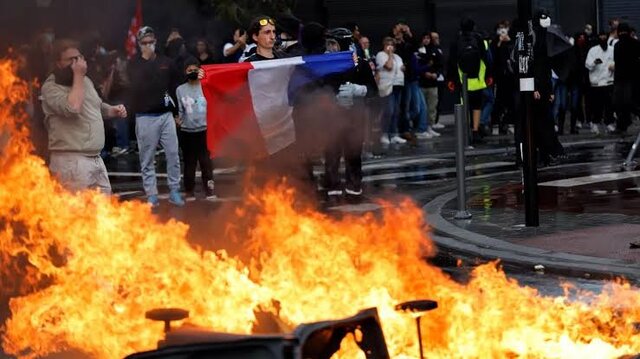
Abdollah Mehraban, in an interview with the Strategic Council on Foreign Relations’ website, regarding recent domestic developments in France, stated: “The combination of external and internal developments in France has placed the Macron government in a position where it must choose between playing an international role and meeting public demands.”
This expert on French affairs, noting that the new wave of protests in France is a continuation of the country’s previous protests, such as the “Yellow Vests” movement and opposition to pension law reforms, said: “French society is a dynamic society. France has consistently played a vanguard role in the global political arena, and its political society has long been regarded as progressive. Generally, political and social movements start from this country and spread to other societies and the Western world.”
Mehraban added, “If we want to examine this round of protests more seriously, we conclude that these protests reflect the prioritization of security over justice. Let’s not forget that justice, security, and freedom are important principles that rest on the shoulders of the political governance of every country. Therefore, when the balance between these principles is disrupted, it paves the way for protests and radical behaviors.”
According to this expert, France has adopted an approach in recent years that prioritizes security over justice, driven by a combination of domestic and external factors.
He said: “After World War II and the formation of the European Union, Western Europe, along with America, brought about massive economic transformations and succeeded in accumulating vast wealth and capital, and in this context, the collapse of the Soviet Union further fueled this capital accumulation. But after the 2008 economic crisis that spread from America to Europe, a rupture and discontinuity formed in this capital accumulation.”
This expert on French affairs continued: “The emergence of China as a global economic pole, as well as the BRICS countries, caused a significant portion of capital accumulation to leave Europe, leading Western Europe to an imbalance, and this itself could be a reason for Europe’s problems in recent years.”
Mehraban, stating that Donald Trump’s first presidential term was a significant shock for Europe, especially the troika, emphasized: “During that period, Europeans were forced to take measures for their own security against Russia and even China, and these concerns intensified during Trump’s second term. American pressure to increase NATO members’ contributions to up to 5 percent of GDP, especially after the Ukraine war, has largely placed Europe under budgetary and economic pressure. The reality is that part of France’s defense budget, like other European countries, was spent on supporting Ukraine.”
This expert on French affairs added: “Simultaneously with these events, France committed to increasing its defense budget to 3.5 percent and reaching 5 percent by 2035. This decision will undoubtedly put pressure on the French economy and the livelihoods of its people. Furthermore, during this period, France, as in the past, has taken actions to support democratic processes in the world, especially in its former colonies, examples of which we have seen even in Syria and some West Asian countries.”
He continued: “Recently, France has also emphasized the establishment of an independent Palestinian state, which is justifiable within the framework of these same policies and approaches. The French believe that to preserve and uphold their historical mission, they must act and spend. Naturally, these actions and expenditures impose additional pressure on France, and based on this, the Paris government’s debt has increased to several trillion dollars.”
Mehraban added, “Of course, these actions have not been taken unknowingly. The French government has been forced to accept these costs and measures to maintain its global standing and enhance its security. Still, the burden of this budget deficit has been imposed on the French people, which has practically further stimulated and radicalized domestic political currents, both left and right.”
According to him, “The reality is that France today is not on the same scale as it was in the post-World War II era. Moving away from America and the emergence of new global poles have also fueled this issue. Under these conditions, if the current government cannot respond to domestic demands, it will either be forced to distance itself from previous global policies or face greater problems domestically.”

No comments:
Post a Comment