Public support in the United States for "Israel’s" war in Gaza is eroding as civilian casualties mount, according to a new poll by The New York Times and the Siena Research Institute.
The survey found that 51% of Americans oppose providing additional economic or military aid to "Israel." Among them, 35% expressed strong opposition, compared to just 19% who strongly supported continued assistance.
When asked about "Israel’s" conduct, 40% said they believe it is deliberately killing civilians, while 62% agreed that it is not doing enough to prevent civilian deaths. Only one-quarter of respondents said "Israel" was taking sufficient precautions.
Despite shifting public opinion, the Trump administration has continued arms deliveries and military backing.
The Wall Street Journal recently reported that Washington is seeking congressional approval for over $6 billion in new weapons sales to "Israel," including Apache helicopters and thousands of infantry assault vehicles.
"Israel’s" offensive on Gaza, launched in October 2023, has so far killed more than 66,000 Palestinians — mostly women and children — and left the besieged enclave facing devastating destruction and severe food shortages.
TEHRAN-- In a study conducted by the Tehran Urban Research and Planning Center (TURPC) to examine the economic potential of smart tourism (using new technologies to enhance travel experiences and improve efficiency), in Tehran, it highlighted the economic benefits of smart tourism and provided evidence and documentation that clarified the grounds for implementing smart tourism projects in the metropolitan area of Tehran.
According to ISNA, the tourism industry has become one of the most important sectors of the world economy today, and smart tourism is one of the emerging forms of tourism that has emerged in the wake of information technology and has attracted the attention of global tourism stakeholders.
Smart tourism tools refer to a combination of mobile hardware, software, and networks to enable interaction between tourists, stakeholders, and physical objects. The communication must be able to provide personalized services and real-time information for making smart decisions. Three specific smart tourism tools are mobile applications, augmented reality, and near-field communications.
Currently, due to the benefits of this type of tourism, countries such as Spain, Singapore, the United Arab Emirates, and Saudi Arabia are working on projects to realize smart destinations.
A study conducted by TURPC to examine the economic capacities of the smart tourism in Tehran, showed that the creation and income generation from digital assets, attracting investment, increasing fees and taxes, advertising, holding events, direct sales of tourism services and products, attracting experts, selling data and information, profitability of the public transportation system, operational savings, and smart car parking spaces are among the most important capacities that Tehran Municipality can benefit from by developing the smart tourism.
Subsequently, the costs and revenues generated as a result of these capacities were matched with the expenditures and resources included in the latest municipal budget plan, and it was determined that by allocating part of the available credits in the relevant rows, the realization of the smart tourism destination in Tehran can be facilitated and its economic benefits can be enjoyed in the municipality's resources and revenues.
The results of the research indicate that the municipality should play its role in this field and facilitate the process of realizing smart tourism in a way that, while ensuring sustainability, tourists and citizens, stakeholders and managers can benefit from its benefits in various dimensions, including the economic dimension.
Alwaght- On the eve of the third year of the Gaza war, the US and Israel still talk about lofty dreams despite their defeats in battle against the resistance groups.
The US President Donald Trump on Sunday once again claimed "something special" is about to take place in the region, adding "we have a real chance for greatness in the Middle East."
Though Trump did not reveal details of his surprise for the region, since Palestine and especially the Gaza war is the main global focus, many observers think that the new Trump plan centers on Gaza.
This new version, the potential details of which have been recently presented by some Western officials and media, is connected to a temporary halt of the war in Gaza, pushing Hamas aside from the political arena, and even appointing a Western figure for the temporary administration of Gaza.
Within the same framework, some reports have pointed to the potential role of Tony Blair, the former British Prime Minister, as a 'temporary ruler' of Gaza—a plan that is intended to rebuild the strip and manage its transition, thereby paving the way for new scenarios by the Israeli regime and the US.
Al-Qassam's back-to-back blows to Israel
Despite the fact that by presenting new initiatives Trump and Netanyahu try to forge achievements against the Palestinian resistance, the field developments in recent weeks have unveiled other realities.
Meanwhile, as Trump spoke with grandiose rhetoric about a new plan for the future of Palestine, the Al-Qassam Brigades, the military wing of Hamas, unveiled a series of their operations against Israeli occupation soldiers carried out over the past weeks.
According to an Al-Qassam statement, in response to the crimes of the Israeli army on Sunday, three operations were carried out in Gaza City. In the first operation, Hamas fighters targeted Israeli soldiers who had taken shelter in a house using an anti-personnel rocket, resulting in a number of casualties. In the second operation, they targeted a n Israeli armored personnel carrier in the Tel al-Hawa neighborhood in southern Gaza City with a tandem rocket. In the third operation, an Al-Qassam sniper killed a soldier in the Al-Tuffah area in eastern Gaza City.
Al-Qassam's surprises were not limited to this. The brigades also released a video showcasing part of their successes over the past month. These operations, conducted in August, are considered the biggest blow to the occupation forces in the past two years.
What gives added significance and meaning to Sunday's operations and the release of the video of recent successes is their timing with Trump's statements. Through this psychological warfare, the Palestinian resistance reminded Trump and Netanyahu that the initiative and the battlefield have not yet been lost by the resistance factions, and as the saying goes, "don't count your chickens before they hatch." The message of these operations was clear: any plan for Gaza that does not include the presence and role of the resistance will be fundamentally invalid.
Hamas is alive and powerful
Over the past two years, Netanyahu and his allies have claimed that by assassination of Hamas leaders and field commanders and also destruction of the infrastructure of Gaza and this movement, they have pushed Hamas to the brink of obliteration. However, the reality on the ground has proven otherwise. Not only has Hamas not been eliminated, but it has also continued to powerfully sustain its existence through field operations and firing rockets into the occupied territories. The continuation of the resistance factions' regular operations shows that its infrastructure, despite the heavy military pressure from their occupying enemy, remains intact and has retained the ability to plan and execute complex operations.
This reality has even been emphasized on the international level. For instance, Emmanuel Macron, the President of France, recently in unprecedented remarks addressed to Trump and Netanyahu, emphasized that although Israel has managed to assassinate some senior Hamas leaders and this is considered a major achievement, Hamas still has as many ready fighters as it did on the first day.
Such statements from the leader of a Western country show that even Tel Aviv's closest allies do not believe that the project of destroying Hamas is feasible. In reality, the effort to eliminate Hamas has not only been unsuccessful but has also led to the strengthening of the discourse of resistance in the region.
Israeli media, contrary to the official claims of Tel Aviv, have also admitted that the number of Hamas forces has not only not decreased but has even increased compared to the beginning of the war. Some reports speak of tens of thousands of fighters within the military structure of this movement who are fully prepared to continue the war. This increase in forces demonstrates Hamas's capacity to recruit and organize new individuals even under siege and war conditions.
On the other words, a war that was impair this resistance movement has provided a chance of its boost. This point is what makes thd recent Al-Qassam operations in Gaza City meaningful since they were launched directly in response to the US and Israeli push to isolate Hamas from the military and political stages.
Past experiences with similar plans, such as the "deal of the Century," have shown that without considering the realities on the ground and the will of the Palestinian people, no external initiative will be able to change the equations. What is happening today in Gaza bears witness to this very fact.
Although Western and Israeli leaders speak of new scenarios at negotiation tables or international podiums, the resistance upsets their calculations through its field actions.
Therefore, the recent operations by Al-Qassam are, on one hand, a message to Trump and Netanyahu that the fate of Gaza is not decided in Washington and Tel Aviv, and on the other hand, a message to the Palestinian people that the resistance is still alive and capable.
Meanwhile, Washington and Tel Aviv are preparing for a Gaza without Hamas and the freedom of all Israeli prisoners while after two years, and despite having advanced equipment, they have so far failed to obtain any information about the hiding places of the prisoners. This issue shows that Hamas also has the upper hand in the intelligence arena.
Thus, this situation poses a fundamental question for Western leaders: If Hamas and other resistance groups are not being eliminated and their removal is impossible, what alternative remains to resolve the Gaza crisis?
Historical experiences have shown that whenever a popular movement is suppressed by external pressure, it eventually returns, sooner or later, with even greater power. In the case of Palestine, the deep historical and social roots of the resistance have eliminated any possibility of its complete eradication. Therefore, unilateral plans like the one Trump refers to as an "unprecedented event" are, in practice, nothing more than political fantasy.
Hamas’s coffin for "Riviera of the Middle East"
Earlier, Trump was seeking to expel the Palestinians from their land and seize the Gaza Strip so that, in his dream, he could turn the coastal enclave into "Riviera of the Middle East", but it seems that he now has walked back from this plan and even agreed for the Palestinians to stay. This shift is a product of the realities on the ground of Gaza, where the hard push to break the Palestinian resistance and its will for liberation has gone nowhere so far.
The operations of Al-Qassam in Gaza must also be evaluated within this same framework. These operations have not only dealt a serious military blow to the Israeli army but have also carried an important political message that the resistance still holds the field initiative and can change the equations at the most critical moments. Hamas seeks to prove that it still possesses deterrence power and that any political deal without its presence and role will be futile.
Overall, it can be said that Trump's remarks about an unprecedented event in West Asia are deeply disconnected from the realities on the ground in Gaza. Although he tries to position himself at the center of public attention with his flashy plans, the developments on the ground show that the resistance remains the decisive factor.
On the opposite side, Tel Aviv has failed to tip the scales despite all these attacks and assassinations and even worse it has given rise to new challenges. So, Gaza future is to be written by the White House or Tel Aviv, but by the free will of the Palestinian people.
ALWAGHT- Iranian Foreign Minister Abbas Araghchi stated that reaching an agreement on the so-called snapback mechanism in New York was impossible due to the United States’ excessive demands, supported by European nations.
Iranian Foreign Minister Abbas Araghchi, speaking before departing New York, reviewed his diplomatic efforts, including talks aimed at preventing the reimposition of UN sanctions, participation in the UN General Assembly, and meetings on the sidelines. He criticized Western powers for demanding “unreasonable and unachievable concessions,” while stressing that Iran had put forward “completely reasonable” proposals, which even Europeans admitted were fair.
The UN Security Council failed to pass two resolutions in September: one to block the activation of the snapback mechanism and another to extend the JCPOA and Resolution 2231. Araghchi said attempts to bridge differences collapsed because of Washington’s excessive demands, backed by European states. He revealed that Iran exchanged messages with the US, directly and indirectly, but negotiations ended without a settlement.
The minister emphasized that Iran’s diplomatic push demonstrated its consistent foreign policy, affirming Tehran’s readiness to take any action necessary to defend its interests. He linked the failed outcome to the long-standing position of Ayatollah Seyyed Ali Khamenei, who has maintained that talks with the US are at a deadlock. Ayatollah Khamenei recently reiterated that no nation of honor should accept negotiations under threats.
Addressing the economic impact, Araghchi argued that the revived UN sanctions would add little beyond existing US measures, though they could carry political and strategic consequences. He concluded that future decisions regarding sanctions and cooperation with the IAEA will be determined by Iran’s Supreme National Security Council, strictly in line with national interests.
Iranian President Masoud Pezeshkian slammed the misuse of the so-called snapback mechanism by Western powers, describing it as an attempt to legitimize unlawful actions.
Pezeshkian further underscored Iran’s consistent adherence to its nuclear commitments. He criticized the UN Security Council’s approval of the snapback mechanism, stressing that it lacked legal basis and was driven solely by US and European pressure. “We abided by the agreement we signed, but it was the US that violated it,” he noted.
The Iranian president highlighted the Cairo agreement, mediated by Egypt, as a framework for constructive cooperation with the IAEA, reiterating Tehran’s readiness for dialogue.
He added that Iran is open to negotiations with Washington but stressed that the US itself has refused to engage. “How can a country that allows “Israeli” attacks on Iranian facilities during negotiations claim it seeks dialogue?” he asked.
Pezeshkian dismissed Europe’s recent proposal as ineffective, pointing out that it sought Iran’s enriched uranium in exchange for only three months of talks. “Why should we hand over our assets just to wait for promises? Any genuine dialogue must address the entire issue,” he said.
On regional matters, the Iranian president reaffirmed that Iran has never sought instability, while the “Israeli” entity thrives on fueling unrest. “Our hand of friendship has always been extended to neighbors. Many in the region know we act on Islamic brotherhood, but the ‘Israelis’ profit from instability, not peace,” he said, his official website reported.
Reflecting on recent “Israeli” aggression, Pezeshkian stressed that it has strengthened Iran’s unity and social capital, as the people rallied in defense of the nation. He expressed confidence that through solidarity, cooperation, and resilience, Iran will overcome external pressures.
Touching on nuclear policymaking, Pezeshkian clarified that Leader of the Islamic Revolution Hi Eminence Imam Sayyed Ali Khamenei makes final decisions after consultations with the Supreme National Security Council and senior officials. He emphasized that unity among Muslims is vital to counter common threats. “If Muslims stand together as brothers, ‘Israel’ will not be able to act with impunity,” he stated.
The Iranian president finally reiterated Iran’s commitment to peaceful dialogue and regional cooperation, declaring that the Islamic Republic remains ready to extend its hand of friendship to all Muslim nations.
Rather than act to end Israel's genocide in Gaza, western leaders rally behind a French-Saudi scheme for fictive statehood that entrenches Israeli supremacy and props up the PA
Joseph Massad
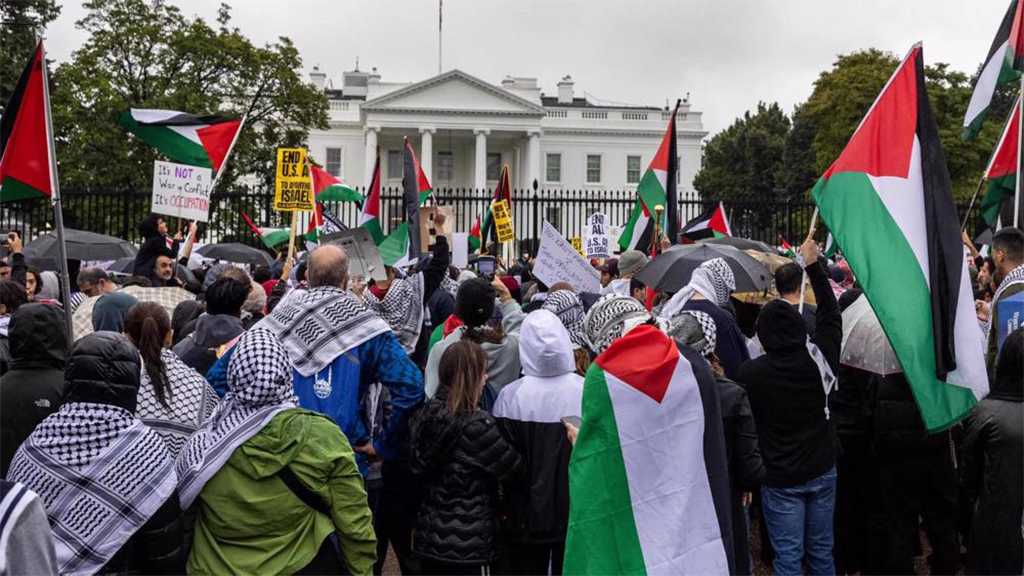
Pro-Palestine activists gather outside the United Nations headquarters in New York City on 9 September 2025 (Spencer Platt/Getty Images via AFP)
On 12 September, the United Nations General Assembly voted overwhelmingly in support of a resolution to revive a two-state solution.
Adopted by 142 states, the "New York Declaration" paves the way for a 22 September summit to push for greater recognition of a phantasmatic Palestinian state.
In recent months, a chorus of western governments has lined up behind this French- and Saudi-led statehood scheme.
The upcoming UN conference comes as Israel's genocide in Gaza nears its two-year mark, with at least 64,000 Palestinians killed and a catastrophic humanitarian crisis inflicted through weaponised starvation and the systematic destruction of the territory.
As Israel pursues its final solution against Palestinians, its belligerence has extended beyond Gaza to Lebanon, Syria, Yemen, Iran, Tunisia and even Qatar, where its strikes in Doha last Tuesday targeted Hamas negotiators and killed six people in the process.
Indeed, the very governments that continue to abet Israel's war of annihilation now claim to champion Palestinian "independence".
The ostensible aim of this manoeuvre is to achieve a "just and lasting peace in the Middle East". Its real purpose, however, is to save Israel from itself by safeguarding its right to remain a Jewish-supremacist state, underwritten by dozens of laws that privilege Jewish colonists and their descendants over the indigenous Palestinians.
When western powers recognise a non-existent Palestinian state in defiance of reality, the central issues of Israeli colonisation are relegated to the background
Western recognition of a fictive Palestinian state hinges entirely on their long-standing recognition of the racist state of Israel alongside it. It is also engineered to shore up the collaborating Palestinian Authority as a reliable subcontractor of Israel's colonial occupation of Palestinian land by christening it a "state".
When western powers recognise a non-existent Palestinian state in defiance of the reality of its non-existence, the central issues of ongoing Israeli Jewish colonisation - the takeover of East Jerusalem and the West Bank, the terrorisation of the indigenous Palestinians there, let alone the unremitting genocidal war on Gaza - are relegated to the background.
In view of French and Saudi efforts, the struggle is no longer to reverse Jewish settler-colonisation and the theft of Palestinian lands, or to halt the continuing pogroms in the West Bank. Instead, it is to direct all international efforts - including this obscene conference - to securing "recognition" of a non-existent state.
Earlier attempts
This month's summit is not the first attempt to establish a Palestinian state.
On 22 September 1948, the All-Palestine Government (APG) was founded in Gaza and claimed sovereignty over all of Mandatory Palestine.
In practice, it could only operate in what became the Gaza Strip, after the establishment of the Israeli settler-colony the previous May and Israel's occupation of half the territory that the UN Partition Plan had designated as a Palestinian state.
Six of the then seven members of the League of Arab States recognised the APG immediately. Only Jordan, in control of central and eastern Palestine, which it annexed the following year and renamed "the West Bank", refused to extend recognition. The West soon recognised the Jordanian annexation of the West Bank, though not of East Jerusalem.
Due to western hostility to the APG, and complicity in the division of Palestine between Israel and King Abdullah I of Jordan to prevent any Palestinian sovereignty, the APG faded and dissolved itself in 1953.
In 1988, the Palestine National Council - the Palestinian parliament in exile, an organ of the Palestine Liberation Organisation (PLO) - unilaterally declared "independence" in Algiers in support of the first Palestinian Uprising (1987-1993), which the PLO would ultimately crush as the price it pledged to pay for signing the 1993 Oslo Accord.
While dozens of countries rushed to recognise that non-existent independent state, the United States adamantly refused.
The US had, in fact, been the party responsible for blocking Palestinian independence in 1947, when it strong-armed several countries to change their votes at the last minute and support UN General Assembly Resolution 181 - the Partition Plan.
Thanks to American efforts, that plan awarded most of Palestine to the minority Jewish colonists, whose state the US recognised readily in May 1948.
The US also made sure not to recognise the APG, a strategy it maintained by denying recognition to the PLO's declaration of independence in 1988.
After Oslo
After the 1993-94 Oslo Accords, which created the Palestinian Authority (PA), negotiations with Israel on the core issues - independence, borders, Jerusalem and the return of refugees - never materialised, despite the passage of an agreed five-year interim period ending in May 1999.
When no "final status" talks were even started, PA President Yasser Arafat threatened to declare the independence of Palestine in the entire West Bank, East Jerusalem, and Gaza - territories where the PA exercised either extremely limited or no actual control. Amid American threats and warnings from pro-American Arab governments, Arafat backed down.
Subsequent PA attempts to be recognised by the UN as a state were met with the threat of a US veto and of cutting off US funding to UN organisations that dared to do so.
Unesco admitted Palestine as a member state in November 2011, but subsequently lost US funding.
Even though the PA never declared a Palestinian state (only the PLO did), following UN General Assembly resolution 67/19, which upgraded Palestine's status to a "non-member observer state" in November 2012 with an overwhelming majority, the PA officially began using the name "State of Palestine" on its official documents and called its mission office in Washington DC an "embassy" - which US President Donald Trump closed in 2018 during his first term in office.
Recognition drive
Capitalising on the Israeli genocide in Gaza, the PA, which has acted as a loyal enforcer of Israel's occupation since 1993, pushed for more recognition of the fantastical Palestinian state as a reward for its compliance with Israeli diktat from the very European countries that have been active participants in the Israeli genocide.
The PA, which has acted as a loyal enforcer of Israel's occupation, pushed for more recognition of the fantastical Palestinian state as a reward for its compliance with Israel
Last year, this effort accelerated to include several such countries, though not the principal abettors of the genocide.
As of May 2025, 143 countries out of 193 around the world had recognised Palestine as an independent state. That number is set to increase by at least half a dozen this month, including Israel's major partners in crime: France, Canada, Australia and the United Kingdom, as well as Belgium, Portugal, Malta and possibly Finland.
The US, Israel's chief accomplice in all its crimes against the Palestinian people, has maintained the position it has taken since 1948: preventing the Palestinians from establishing a phantasmatic state, let alone a real one.
Italian Prime Minister Georgia Meloni, however, has objected to the project of recognition, arguing that "recognising the State of Palestine before it is established could be counterproductive". She added: "I am very much in favour of the State of Palestine, but I am not in favour of recognising it prior to establishing it."
She has a point.
Empty declarations
The question of declaring the independence of a state before its creation and before its actual independence is not as strange as it first appears.
Some countries indeed declared independence long before they achieved it, including the US, which declared the very first independence in 1776, even though the British were not defeated until 1783. The French recognised US independence in 1778.
The Greeks followed suit by declaring independence in 1822, even though their revolution against the Ottomans was not victorious until the end of that decade. In 1830, European powers that had aided the Greeks recognised their new state - and promptly took it over.
In contrast, Haiti declared its independence in 1804, 13 years after the start of its revolution, and after the formerly enslaved succeeded in overthrowing slavery, the French settlers and the colonial French state. Still, the slave-holding US refused to recognise it until 1862.
In the case of the US, Greece and Haiti, those who declared independence were the ones who fought to evict the ruling empire from their state-to-be.
In the case of the PA, however, the European imperial countries are seeking to grant recognition of an independent Palestinian state not to the resistance fighting the colonists, but to collaborators with Israeli colonialism and occupation.
This may not be Meloni's point, but it should be the concern of those who think such recognition will end rather than deepen Israeli colonialism and control - and further strengthen their Palestinian collaborators.
Exercise in futility
After decades of denying Palestinians the right to independence, western imperialist states and white settler-colonies are now set to enlarge the number of countries recognising the Palestinian right to self-determination and statehood.
But next week's conference will do no more than reassure Israel that its right to exist as a Jewish-supremacist state will be best guaranteed by its sponsors' recognition of a fictive Palestinian state.
The US and Israel refuse to accept "yes" for an answer, and believe that the Palestinians, including the collaborator PA, must be forever denied even a symbol of independence and a state.
The Europeans and the Arab regimes driving this initiative, by contrast, believe that the trappings of "independence" are the best way to curtail Palestinian aspirations and derail their struggle for liberation into an illusion of statehood that does nothing to threaten Israeli Jewish supremacy.
What will therefore remain of this international recognition is the part that affirms Israel as a Jewish-supremacist state existing alongside a non-existent Palestinian state that will never see the light.
As I argued last year here, the only way for these states to penalise Israel diplomatically is to withdraw recognition of Israel's right to be a Jewish-supremacist state, and to boycott it and impose international sanctions against it until it abrogates all its racist laws.
Short of that, the entire conference is an exercise in futility and is further proof of the ongoing complicity of its participants in Israel's genocide against the Palestinian people.
Joseph Massad is professor of modern Arab politics and intellectual history at Columbia University, New York. He is the author of many books and academic and journalistic articles. His books include Colonial Effects: The Making of National Identity in Jordan; Desiring Arabs; The Persistence of the Palestinian Question: Essays on Zionism and the Palestinians, and most recently Islam in Liberalism. His books and articles have been translated into a dozen languages.
Venezuelan President Nicolas Maduro declared a state of emergency in response to what Caracas has labeled as escalating US aggression against Venezuela.
Earlier on Monday, Vice President Delcy Rodriguez revealed that Maduro had signed a decree granting him the ability to take action on matters of defense and national security should the United States "dare to attack our homeland."
The decree would allow Maduro to mobilize armed forces throughout the country and give the military authority over public services and the oil industry.
Maduro said that the Venezuelan people are "better prepared than ever are more confident, and have more tools to work against any situation that may arise."
The president said that its seems that a "third world war started with the scenario of NATO's threat to Russia, the massacre in Gaza, and the threat of Arab countries, Iran, Venezuela, and China."
The Venezuelan government has put its forces on high alert after the US deployed eight warships and a nuclear submarine near its coast, citing anti-drug operations.
Caracas, however, views the deployment as a provocation, particularly aimed at pressuring the Maduro government and forcing regime change.
In recent weeks, US forces have hit three vessels in the Caribbean, killing 14 people, citing drug operations without evidence. UN experts have warned the actions may amount to "extrajudicial executions."
Venezuelan Parliament Speaker Jorge Rodriguez warned of the dangerous consequences of any potential military escalation in the Caribbean region.
“In case brazen imperialism unleashes a state of war in the Caribbean, the consequences will be catastrophic for the entire American continent,” Rodriguez said during a meeting with the diplomatic corps accredited in Venezuela.
The parliament chief stressed that “the responsibility of defending this peace lies on all of us, and that we must defend it with action, initiative, and national unity.”
Speaking of Venezuela’s sovereignty, he underlined the “sacredness of the country’s land, sky, rivers, and seas,” saying, “We defend the entrance to our home, our sacred land, our sacred sky, our sacred rivers, and our sacred seas.”
Rodriguez stressed that the fight is about securing peace and a future for Venezuelan children, and firmly defending that right.
“Our Caribbean, our sea, our own sea—we must defend it as a region of peace, as a region free of acts of war,” he stressed.
The killing of 14 people on alleged drug boats has heightened tensions between Caracas and Washington. The US calls it anti-narcotics enforcement, while Venezuela condemns it as unlawful military aggression.
NBC reports, citing four unnamed sources, that US military planners are weighing expanding operations to targets inside Venezuela.
Rodriguez expressed confidence in the country’s readiness to resist. “Venezuela is united in the defense of our country,” she said. “We will never surrender our homeland.”
British recognition of a fictional Palestinian state continues a century-old strategy of granting official status to proxy leaders working to sustain Jewish supremacist rule
Joseph Massad
A Palestinian flag outside the Embassy of Palestine, formerly the Palestinian Mission to the United Kingdom, in London, as the UK recognises Palestine as an independent state, on 22 September 2025 (Vuk Valcic/ZUMA Press Wire)
Earlier this week, several European countries - including Britain and its settler colonies Canada and Australia, though with the notable exception of the United States - recognised a non-existent "State of Palestine", to be ruled by the unelected, collaborationist quisling regime of the Palestinian Authority (PA) and its head, Mahmoud Abbas.
This was not the first time Britain recognised Palestinian collaborators to speak for the people. That practice began as soon as it conquered and colonised Palestine at the end of 1917.
Following the issuance of the Balfour Declaration in November and the British military conquest of Palestine in December of that year (with full control over its territory by September 1918), more than 40 Palestinian organisations were formed between 1918 and 1920 to oppose British colonial rule and Zionist settler-colonialism.
They demanded independence, convened national congresses and adopted resolutions affirming Palestine's Arab character and calling for its liberation and unity within a Greater Syria.
Still, Britain consistently blocked Palestinian bids for recognition, which it always conditioned on their acceptance of the Zionist project.
Such tactics reflected a central colonial strategy across much of the world to deny the colonised their own representatives, then secure collaborators from among them and install those willing to betray their people as leaders. Palestinians are no exception, and are indeed a prime illustration of this strategy, whether under the British or the Zionists.
Over the century, every legitimate Palestinian body that spoke for the people was refused recognition, while collaborators were legitimised. It was only when the Palestine Liberation Organisation (PLO) abandoned its representative role in 1993 and recognised Israel's right to colonise Palestine at Oslo that it was accepted as the official voice of the Palestinian people.
The PA, now recognised as the head of a fictional state, is the latest expression of this century-old colonial strategy to elevate a collaborating regime that denies Palestinians their own leadership and agency.
Early resistance
The most prominent among the organisations to emerge after the British conquest of Palestine was the Palestinian Muslim-Christian Associations (MCA), the first branch of which was founded in Jaffa in 1918. They sought unity across religious lines in the struggle against British colonialism and Jewish Zionism.
'What the French could do in Tunisia, the Jews would be able to do in Palestine' - Chaim Weizmann
In November of that year, the Jaffa MCA submitted a memorandum to General Gilbert Clayton, the chief political officer and policymaker of the military administration, affirming the Arab character of Palestine as "our Arab homeland, Palestine" and rejecting Britain's policy of creating a Jewish national home.
The MCA convened the first Palestinian National Congress in Jerusalem from 27 January to 9 February 1919. The delegates called for the liberation of Palestine and all of Syria, including Lebanon, and demanded an independent and unified Greater Syria. A delegation was chosen to deliver these resolutions to the Paris Peace Conference, but the British blocked them from leaving the country. Even so, the resolutions had reached Paris.
Meanwhile, at the conference, Chaim Weizmann, the head of the Zionist Organisation (ZO), met with US Secretary of State Robert Lansing.
In his later account of the meeting, Weizmann recalled telling Lansing that the goal of the Zionists was for "Palestine [to] become as Jewish as England is English". He added that Lansing "took as [his] example the outstanding success which the French had at that time made of Tunisia".
A French settler-colony at the time, Tunisia was cited as a model: "What the French could do in Tunisia", Weizmann argued, "the Jews would be able to do in Palestine, with Jewish will, Jewish money, Jewish power, and Jewish enthusiasm".
Refused recognition
In June 1919, the American King-Crane Commission, dispatched by President Woodrow Wilson, arrived in Palestine to investigate the wishes of the peoples of Anatolia, Syria, Lebanon and Palestine, as part of efforts to mitigate British-French rivalry over their spheres of influence.
In Palestine, the commission interviewed dozens of Palestinians from the MCA and other clubs, all of whom demanded independence, with the younger nationalists calling for unification with Syria.
All Palestinians interviewed vehemently opposed Zionist settler-colonialism.
The commission submitted its report to the Paris Peace Conference in August 1919. It conveyed the Palestinian people's support for independence, albeit claiming they were not yet prepared for it. As a second choice, it recommended an American Mandate with a democratically elected assembly - rather than British or French control.
By then, however, London and Paris had already reached their own understanding and simply ignored the findings. The report itself was not published until 1922, after the US Congress had endorsed the Balfour Declaration.
In July 1920, the same month France conquered Syria, Britain replaced its military occupation in Palestine with a civilian administration and appointed the Zionist Jewish politician Herbert Samuel as the first high commissioner of its new Mandate.
A second Palestinian National Congress, scheduled for May 1920 in Jerusalem, was banned by the authorities. As a result, the MCA convened a widely attended third National Congress in Jaffa that December, with participants from all Palestinian clubs, organisations and associations.
The congress called for the independence of Palestine and elected a committee, the Palestinian Arab Executive (AE), to represent the people to the British government and in international forums. Samuel rejected the demand outright and refused to recognise the committee as representative of the Palestinian people.
The Palestinians managed to send a delegation to Cairo in March 1921, which met briefly with Colonial Secretary Winston Churchill, a Zionist and notorious antisemite.
More extensive meetings followed during Churchill's visit to Palestine days later. In response to Palestinian demands that Britain abrogate the Balfour Declaration, prohibit Jewish colonisation and grant independence, the anti-Arab racist Churchill declared that the British right to rule rested on its military conquest.
He added that the colonial administration "will continue for years, and step by step… shall develop representative institutions leading up to full self-government", stressing: "All of us here to-day will have passed away from the earth and also our children and our children's children before it is fully achieved."
When a delegation of Palestinian Anglicans petitioned him that August, Churchill dismissed them, reminding them that a great racial gulf separated them from English Anglicans, as the Palestinian Anglicans belonged to the "Semitic races".
Conditions for recognition
In 1921, the MCA appointed a delegation to travel to London. That July, the British colonial secretary wrote to Samuel, making clear that any administrative reform "can only proceed on [the] basis of acceptance of the policy of creation of a National Home for the Jews, which remains a cardinal article of British policy... No representative bodies that may be established will be permitted to interfere with measures (i.e., immigration, etc.) designed to give effect to principle [sic] of a National Home or to challenge this principle".
These would be the unshakeable terms under which Britain was willing to recognise indigenous Palestinian representation, which the Palestinians rejected throughout the Mandate period. The League of Nations likewise denied legitimacy to the Palestinians on similar grounds.
When the British offered to establish a legislative council for Palestine in 1922, they insisted that all candidates and parties recognise the legitimacy of the Mandate and its Zionist settler-colonial project.
The fifth Palestinian Congress, convened that year, launched a campaign to boycott the elections, denouncing them as a ploy to legitimise Jewish settler-colonialism and reiterating the demand for independence.
Coincidentally, this was also the year that Tunisians demanded equal rights with French colonists and proportional representation in an elected parliament. The sixth Palestinian Congress, convened in June 1923 after the League of Nations formally granted the Mandate to Britain, stressed non-cooperation with the authorities, including refusal to pay taxes.
As a result of British divide-and-conquer tactics that pitted the Jerusalem-based notable families, whose elders collaborated with the British but not with the Zionists, against families whose elders collaborated with both, the national movement split, delaying the convening of a seventh Congress until July 1928.
Colonial collaborators
Chaim Kalvarisky, a senior Zionist official in the Jewish Agency and head of the Zionist Executive's "Arab Department", funded the establishment of the Palestinian sectarian National Muslim Society (NMS) as an alternative to the MCA.
He encouraged sectarian Muslims to attack the MCA as vehicles of Palestinian Christian influence. Kalvarisky also financed members of elite families to form the "Agricultural Party" (al-Hizb al-Zira'i), which challenged rival notables who led the national Palestinian organisations.
Anti-colonial Palestinians considered both the NMS and the Agricultural Party as traitorous for accepting Zionist funding and accommodating Jewish colonisation.
The Agricultural Party would later serve as a model for Palestinian collaborators during the Great Palestinian Revolt of 1936-39, when the British and Zionists sponsored "peace bands" to assist them in killing Palestinian revolutionaries. The "peace bands" in turn would become the model for the PA security forces, which, since 1994, have suppressed Palestinian resistance on Israel's behalf.
The West's refusal to recognise the 1948-53 All-Palestine Government's (APG) sovereignty was yet another instance of denying Palestinians legitimacy while recognising those who did not represent them.
Instead of recognising the APG, the West upheld King Abdullah I of Jordan as the legitimate ruler of what remained of Palestine after 1948. This dynamic continued after the rise of the PLO in 1964, especially after the popular Palestinian guerrillas assumed leadership in 1969.
Much of the formerly colonised world recognised the PLO in 1974, particularly following PLO Chairman Yasser Arafat's 1974 address to the United Nations General Assembly and the UN's subsequent recognition of the PLO as the "sole and legitimate representative of the Palestine people".
Nevertheless, the US and its Western European allies refused to grant the organisation representational legitimacy.
Following the 1973 war, Egyptian President Anwar Sadat proposed a peace conference under UN auspices in Geneva, which convened in December of that year. Egypt, Jordan and Israel attended, but Syria refused to participate because the PLO was not officially invited.
Sadat had, in fact, extended an informal invitation to the PLO at the end of October, prompting major internal debate within the organisation about attending. Arafat even sent feelers to Henry Kissinger, signalling his readiness to take part.
In the end, with no official invitation forthcoming, the PLO opted not to participate, particularly as the conference was based on UN Resolutions 242 and 338, which required recognition of Israel in exchange for Israeli withdrawal "from territories" it occupied in 1967. The US, Israel and Jordan all opposed PLO participation.
Recognising submission
Indeed, despite the PLO's compromising of many Palestinian rights after its 1988 unilateral declaration of independence of 22 percent of historic Palestine in Algiers, the West and Israel adamantly refused to recognise the legitimacy of the organisation.
At the international Madrid Middle East Peace Conference of 1991, the US and Israel blocked the PLO from participating, instead insisting that a Palestinian delegation solely from the West Bank and Gaza join as part of the Jordanian delegation and not participate independently. Even then, the Americans and Israelis vetted the participants, rejecting those seen as "hardliners" or because they were from East Jerusalem, while approving others.
It was not until 1993, when the PLO ceased to represent the Palestinian people and submitted to Israeli and US demands at Oslo to affirm Israel's colonial domination over Palestine, that it was recognised as the "legitimate" representative of the Palestinians.
This was in line with British colonial conditions since the late teens, namely that only Palestinians who recognise the right of European Jews to colonise and steal their country would be recognised as legitimate representatives of their people, even when they lacked such legitimacy completely.
Only Palestinians who recognise the right of European Jews to colonise and steal their country would be recognised as legitimate representatives of their people
The PLO had transformed itself from the equivalent of the 1920s anti-colonial MCA to its collaborationist rival, the Agricultural Party.
When Hamas chose to run in the post-Oslo legislative elections sponsored by the PA under Israeli and US diktat in 2006 - resulting in a landslide victory for the resistance group - the US, Israel and Western Europe yet again refused to recognise it as the legitimate government representing the Palestinian people in the West Bank and Gaza.
They sponsored a coup in 2007 to remove Hamas from power, which succeeded in the West Bank but failed in Gaza. The experience of those elections convinced Israel and the western imperial powers that no further vote could be permitted under the quisling PA regime unless the outcome was guaranteed in advance, ensuring no challengers could threaten its collaborationist role.
Since 1994, the PA has gladly served as enforcer of Israel's occupation, helping to repress all resistance, especially in the past two years of the ongoing genocide against the Palestinian people.
Just last week, the PA regime of Kapos helped Israel uncover a planned resistance operation in the West Bank.
Adding insult to injury, infighting among PA officials recently led to the arrest of Brigadier General Riyad Faraj by the military intelligence agency on charges trafficking in antiquities and selling land belonging to the Deir Qal'a monastery in Jericho to Israeli settlers. He is the brother of PA intelligence chief Major General Majed Faraj, a favoured candidate to replace Abbas.
Britain and its settler-colonies' recognition of a fictional State of Palestine this week is a reward not for Hamas, as the Israelis are claiming, but rather for the PA's faithful service to the settler-colonial enemy of the Palestinian people, and for its insistence on recognising the right of foreign Jews to colonise their country.
Legitimising Jewish supremacy
In their very recognition of a fantastical state of Palestine, the historic enemies of the Palestinian people insist on removing Hamas, the last democratically elected political party chosen by a majority of the Palestinians living under occupation, from any political equation for the future of Palestine.
The British prime minister emphasised that "recognition was not a reward for Hamas" and vowed that "the UK will also take further action to sanction senior figures in the Hamas leadership in the coming weeks". Canada's prime minister insisted that its recognition "would empower those seeking peaceful co-existence and the end of Hamas".
The Australian prime minister spelled out the formula most explicitly: "The President of the Palestinian Authority has restated its recognition of Israel's right to exist, and given direct undertakings to Australia, including commitments to hold democratic elections and enact significant reform to finance, governance and education…The terrorist organisation Hamas must have no role in Palestine."
As Israel's extermination campaign in Gaza continues unabated, this week's statehood theatrics were designed above all to recognise its right to remain a Jewish supremacist state.
For their part in sustaining this order, the quisling PA collaborators were consecrated as the official representatives of the Palestinian people.
What the British started in the 1920s endures a century later in the 2020s. Plus ca change.
Joseph Massad is professor of modern Arab politics and intellectual history at Columbia University, New York. He is the author of many books and academic and journalistic articles. His books include Colonial Effects: The Making of National Identity in Jordan; Desiring Arabs; The Persistence of the Palestinian Question: Essays on Zionism and the Palestinians, and most recently Islam in Liberalism. His books and articles have been translated into a dozen languages.





%20headquarters%20in%20Manhattan%20on%20September%2009,%202025,%20in%20New%20York%20City-afp.jpg.webp)