Pew Center says findings were part of a survey examining views, in and outside India, of the country and its political leaders
By MEE staff
An Israeli Likud Party election banner in Tel Aviv shows Israeli Prime Minister Benjamin Netanyahu shaking hands with Indian Prime Minister Narendra Modi in 2019 (AFP)
The survey findings, released on Tuesday, echo growing ties between India and Israel and efforts to improve people-to-people contact between the two countries over the past decade.
Around 71 percent of Israelis hold favourable views about India while 20 percent hold unfavourable views, with nine percent choosing not to share an opinion, according to the survey.
The Israeli ambassador to India, Naor Gilon, said the findings of the report made him "very much content".
The US-based Pew Center said the findings were part of a survey that examined views of India and its political leaders both within and outside of India.
The study concluded that views on India are generally positive across 23 countries, with a median of 46 percent of adults holding a favourable view of India, and a median of 34 percent holding unfavourable views.
Though the study said there was overwhelming favourability among Israelis for India, it found mixed results when it came to the question of Prime Minister Narendra Modi.
According to the survey, 42 percent of Israelis did not have confidence in Modi to do the right thing regarding world affairs, 41 percent viewed him favourably, while 16 percent did not answer.
Indians were also "more likely than others to believe that India's power is on the rise", with seven-in-ten Indians believing their country has become more influential of late, compared with a median of 28 percent across 19 countries who said the same in 2022.
Spying on citizens
The study comes as a new report by the Financial Times said that Modi's government was using surveillance tools bought from Israeli companies to spy on its citizens.
The surveillance system has been installed on sub-sea cable landing stations, enabling Indian security agencies to collect the personal data and communications of its 1.4 billion citizens, according to the FT.
Several international human rights groups and Indian activists have raised concerns over attacks by Modi on the press and civil society as well as declining conditions for minorities in the country.
Nonetheless, the Pew study found that 79 percent of Indians surveyed held favourable views of Modi, including 55 percent who said they held very favourable views.
Ties between India and Israeli have grown over the past decade, especially since Modi became prime minister in 2014.
With lucid thinking and meticulous scholarship, historian Peter Shambrook's new book proves that Britain lied about its intentions concerning Palestine from the very start
Jewish worshippers walk protected by Israeli security forces at Al-Aqsa Mosque in Jerusalem on 5 April 2023, during Islam's holy month of Ramadan (AFP)
In the aftermath of the attack, James Cleverly, Britain's foreign secretary, called on “all parties to respect the historic status quo arrangements at Jerusalem’s holy sites and cease all provocative action”.
Cleverly would have known that there had been only one aggressor at Al-Aqsa - Israel. He would also have known that the status quo agreement places responsibility for internal security at Al-Aqsa with Jordan’sKing Abdullah II.
And that the status quo agreement gives no role to Israeli forces inside the Al-Aqsa compound. Yet Cleverly went ahead and cheerfully made his false statement.
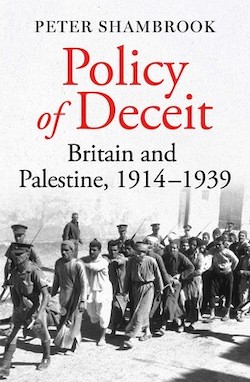
A magnificent new book by Middle East historian Peter Shambrook places Cleverly’s casual deceit in its tragic historical context.
In Policy of Deceit, Britain and Palestine, 1914-1939, Shambrook shows that Cleverly’s cynically misleading account of events inside Al-Aqsa - as well as countless other false and unbalanced statements by British officials - are part of a pattern of British dishonesty over Palestine that dates back more than a century.
In an admirable display of clear thinking and meticulous scholarship, Shambrook shows that Britain has lied about its intentions concerning Palestine from the start.
Britain and the Ottomans
At the heart of his forensic investigation is the deal struck between the British empire and the sharif of Mecca after the outbreak of the First World War.
Britain was then the greatest power in the world but became fearful that she would lose overseas "possessions" after the Ottomans sided with Germany.
Matters turned desperate when, against most expectations, the Ottoman empire repulsed the British invasion of Turkey in 1915.
In the wake of this disaster, the British concluded that they had no choice but to strike a deal with Hussein Ibn Ali, sharif of Mecca, a member of the Hashemite family who could trace his lineage back 41 generations to the Prophet Mohammed - and was chief religious authority for Islam’s holy shrines.
The deal was simple: the sharif would lead an Arab revolt against the Ottomans. In return, Britain promised to grant an extensive Arab state after the Ottomans were defeated.
Sir Henry McMahon, high commissioner in Egypt, was given the task of entering into correspondence with the sharif.
In this eye-opening book, Shambrook tells the story of the sharif/McMahon correspondence. This means entering a minefield, because the British state has never accepted that Palestine was included in the area promised to the sharif.
The British position has been supported by serious scholars. Professor Isaiah Friedman, in Palestine: A Twice Promised Land? (published 23 years ago) buttressed the British government's position. So does Elie Kedourie’s In the Anglo-Arab Labyrinth (1976).
Shambrook, through research in private papers and public records, refutes both Kedourie and Friedman’s findings, in the process dismantling the official account of events, concluding that the British government did indeed promise Palestine to the sharif.
What's more, he shows that the British lied about this from the start. Among the long list of British decision-makers who made misleading comments are David Lloyd George, Arthur Balfour, George Curzon, Winston Churchill - and numerous Foreign Office officials.
Cynically exploited
At the heart of the British deception was a wilful misinterpretation of the word "districts", which was rendered by the Arab word wilayat in the letters sent by McMahon to the sharif.
A very similar word - vilayet - was used by Turkish administrators. It had a subtly different meaning. This difference was cynically exploited by the Foreign Office to exclude all of Palestine from the area assigned to the sharif.
How this happened is a case study in British perfidy. In 1920 the Foreign Office invented an Ottoman "Vilayet of Damascus", the boundary of which stretched 300 miles south to the Gulf of Aqaba. No such province had ever existed.
Ottoman administrative districts were very precise geographically. The province included in the fictitious Vilayet invented by Britain was actually called - as any cursory look at an Ottoman map would have established - the Vilayet of Syria.
Shambrook establishes that McMahon was not making an innocent mistake when he used the term wilayat in his correspondence
This essential fact was well-known, not just to the Ottomans but among all the great powers, and was clear as day on the detailed map used by British generals in the War Office back in London during their strategic planning to defeat the Ottomans.
Furthermore, Shambrook establishes that McMahon was not making an innocent mistake when he used the term wilayat in his correspondence. The Egyptian high commissioner knew perfectly what the word meant in Arabic, and what vilayet meant in Turkish. We can be certain of this because alongside wilayat he also used the term vilayet in the correct sense in other parts of the correspondence.
Had McMahon specified in his letter that he reserved the whole region to the west of the Vilayet of Syria, then indeed all of Palestine would have been excluded from the deal he struck with the sharif.
But he did not.
Broken promise
Significantly, McMahon set out these facts in an explanatory letter despatched two days later to the Foreign Office. He told his masters back in London that he had excluded the northern coasts of Syria (modern-day Lebanon) from his offer to the sharif, which by no stretch of the imagination could include the Palestine region.
Shambrook goes on to prove that this was the accepted view of British military and diplomatic decision-makers right up to 1920. It was only then that the Foreign Office invented the Vilayet of Damascus. Even at this stage, the Foreign Office was clear there had been no ambiguity in the McMahon correspondence as far as Palestine was concerned.
But it needed to adjust to the new political reality of a Lloyd George government that was determined to implement a new pro-Zionist political machinery for Palestine.
Over the next 20 years the British government - on 24 separate occasions! - refused to publish the sharif/McMahon correspondence in the face of Arab and other demands.
The reason, as revealed in the records, is simple. Officials knew that it would be impossible to defend the broken promise to the sharif over Palestine in parliament.
This refusal, as Shambrook shows, soured Anglo-Arab relations throughout the inter-war period. Shambrook also shows that the only reason the British eventually published the correspondence in 1939 was to keep the Arab world close as another world war loomed.
No wonder that the great historian Arnold Toynbee, who was a Foreign Office official during the First World War, later wrote that “Palestine was not excepted from the area in which the British government promised in 1915 to recognise and uphold Arab independence, and that the Balfour Declaration of 1917 was, therefore, incompatible with a previous commitment”.
Toynbee added that this deceit “is almost the worst crime of which a professional diplomatist is capable, for it compromises that country’s reputation for straight-dealing”.
Festering wounds
Shambrook’s book is a major historical achievement. He has solved the mystery of the sharif/McMahon agreement. He has overturned the century-long British narrative that Palestine was excluded from the agreement with the sharif. He has also disposed of the notion, promoted by scholars from Albert Hourani to Martin Gilbert, that the truth about the agreement was mysterious or elusive.
More than that, he has shown that the sharif/McMahon correspondence may have contained greater legal weight than the famous promise to the global Jewish community two years later in the shape of the Balfour Declaration, which was a statement of intent and not (officially at any rate) an agreement between two parties.
We should remember today that the sharif fulfilled his part of the agreement, leading a revolt against Ottoman rule in the Hijaz. The British did not
We should remember today that the sharif fulfilled his part of the agreement, leading a revolt against Ottoman rule in the Hijaz.
The British did not.
The Palestinian people have been obliged to live with the consequences ever since.
Shambrook concludes his book with a call for Britain to acknowledge her broken promise.
“To heal the wounds of history anywhere requires acknowledgment of error and the willingness of all parties to be held to account for the policies they pursued," he wrote.
“In the Middle East, where such wounds have festered for so long, a British government’s acknowledgment, however late in the day, of the truth concerning the pledge given by a predecessor to the sharif of Mecca in 1915 would surely be welcomed.”
Peter Oborne won best commentary/blogging in both 2022 and 2017, and was also named freelancer of the year in 2016 at the Drum Online Media Awards for articles he wrote for Middle East Eye. He was also named as British Press Awards Columnist of the Year in 2013. He resigned as chief political columnist of the Daily Telegraph in 2015. His latest book is The Fate of Abraham: Why the West is Wrong about Islam, published in May by Simon & Schuster. His previous books include The Triumph of the Political Class, The Rise of Political Lying, Why the West is Wrong about Nuclear Iran and The Assault on Truth: Boris Johnson, Donald Trump and the Emergence of a New Moral Barbarism.
WEST BANK (KI) – Two months ago, Palestinian medical student Bara’a Fuqaha was notified of a decision by the Zionist regime to suspend her for six months from her university studies.
She had been a third-year student at the Faculty of Medicine, Al-Quds University, in the town of Abu Dis east of Al-Quds. Another woman, Batoul Dar Assi, majoring in medical imaging at the same university, received a similar decision suspending her for four months. Fuqaha, 24, says that on 25 June, she received a call from Zionist police summoning her to the Ma’ale Adumim police station, east of Al-Quds, where she was interrogated about her student activity at the university. “The questions were about my participation in student union activities. After they finished questioning, they handed me a paper containing the suspension order,” she told Middle East Eye. This Israeli policy is not new. In 2018 and 2019, the Zionist regime’s army issued similar decisions to suspend several Palestinian university students in the West Bank for several months, which hindered the completion of their studies and delayed their graduation with their colleagues. Despite Bara’a’s denial of all accusations at the Israeli police station, the suspension decision had already been made before the interrogation, she told MEE. Bara’a hired a lawyer to challenge the decision with the Israeli Ofer military court, but the appeal was rejected. Then, on 24 August, the court issued another decision confirming the suspension. The lawyer, Salih Mahameed, told MEE that he asked the court to freeze the decision until another session, during which he might be able to reduce the period. However, Bara’a, who lives in the village of Kafr al-Labad near Tulkarm, says she won’t be able to enter the town of Abu Dis until an annulment of the decision, which is “unlikely”, given the “escalating punitive Israeli policies in the West Bank against the Palestinians”. Mahameed pointed out that the decision is a military one and is part of a long list of decisions by the Zionist regime that devastate the lives of Palestinians, such as so-called administrative detention, administrative deportation, and administrative demolition orders.
Failures on the battlefield could push the Ukrainian military to move against President Vladimir Zelensky, retired CIA analyst Larry Johnson has said.
“Zelensky very well could be ousted in a coup within the next three to four weeks, because of the great disgruntlement among troops on the eastern front,” Johnson told Redacted host Clayton Morris in an interview posted over the weekend.
Ukraine’s grand offensive in Zaporozhye, launched in early June with Western-trained troops and NATO-supplied tanks and armored vehicles, has failed to achieve a breakthrough anywhere. Additional brigades, intended to exploit the intended breach, have been deployed to continue the frontal attacks instead, to the point that the US and its allies are publicly airing their frustrations with Ukrainian tactics.
Johnson is not the first American analyst to speculate about the military turning on Zelensky. Earlier this month, former US Marine officer Scott Ritter said the likelihood of a military coup was growing with each destroyed Ukrainian brigade.
“We could be reaching a Kerensky 1917 moment, where the military just says ‘We’re done’,” Ritter told MOATS host George Galloway. He also brought up a recent Politico article, which laid out who would run Ukraine if Russia somehow assassinated Zelensky. According to Ritter, however, Moscow has no intention of going after Zelensky, as he might be replaced by someone even more hardline.
Johnson told Redacted that the way the conflict is going, Ukraine’s survival as a country was “in great doubt.” Kiev is already entirely dependent on the West, and its needs will only grow while its capabilities will continue to shrink, the former CIA official said.
The US strategy for the conflict was to trap Russia in an unwinnable war and induce regime change in Moscow, according to Johnson. Instead, “that’s going to happen to Ukraine,” and Washington will have to figure out how to “back away” from the conflict, because it has massively underestimated Russia’s economic and military strength.
Russian Foreign Minister Sergey Lavrov reasoned along similar lines earlier this month, saying in an interview that Ukraine’s Western patrons are publicly committed to “fight until the last Ukrainian” but have a history of abandoning their allies and proxies, from South Vietnam to “Ashraf Ghani’s regime in Afghanistan in 2021.”
Faced with Western concerns about his legitimacy if he cancels the 2024 presidential election, Zelensky has proposed holding the vote – but demanded funding from the West to do so.
The Ukrainian leader has also voiced fears that he might be abandoned by the West if Ukraine goes too far in attacking Russia. His aide Mikhail Podolyak has since argued that the US and its allies have given their blessing for attacks on “occupied territories” – meaning Crimea, Donetsk, Lugansk, Zaporozhye and Kherson. Since Crimea voted to rejoin Russia in 2014 and the four regions did the same last September, Moscow considers them no less Russian territory than Belgorod or Kursk, which have also been targeted by Ukraine.
In 1915, at the height of the world war, and before the collapse of the Ottoman Empire, England and France, with the help of Tsarist Russia, secretly agreed to divide up the Arab territories in the hands of the Turks, by means of protectorates.
That agreement bears the names of the negotiators, Mark Sykes and Francois Picot, and was made public thanks to the Russian Bolshevik revolutionaries, who published it in 1917.
Soviet Russia renounced the territorial spoils granted to it by the pact. The Sykes-Picot agreement laid the foundation for the Zionist usurpation of Palestine.
Eduardo Artés talks about the topic this week, in the HispanTV program Negro y Blanco, with Rodrigo Karmy, Chilean-Palestinian and academic at the Center for Arab Studies of the University of Chile.
NAIROBI (AFP) – Climate change threatens to exacerbate conflict in fragile nations across the globe and lead to increased deaths, the International Monetary Fund (IMF) said in a report published Wednesday.
While climate shocks alone may not trigger new unrest, the Washington-based IMF said, they “significantly worsen conflict, compounding fragility” such as hunger, poverty and displacement. By 2060, conflict deaths could increase by 8.5 percent as a share of the population in so-called fragile and conflict-affected states (FCS), and by up to 14 percent in those nations facing an extreme increase in temperatures, the report said. In all, 39 countries that are home to nearly one billion people and 43 percent of the world’s poor are classified as FCS by the World Bank. More than half of these nations, which are disproportionately burdened by climate change, are in Africa. Over 50 million more people in these countries could be driven into hunger by 2060 due to lower food production combined with higher prices, the IMF warned. Economic losses resulting from climate shocks are more “severe and persistent” in fragile nations than in other countries, it added. In a separate blog, the IMF said it was vital that leaders gathering next week in Kenya for the first African Climate Summit come up with solutions for vulnerable nations. “Each year, three times more people are affected by natural disasters in fragile states than in other countries. Disasters in fragile states displace more than twice the share of the population in other countries,” the blog said. The IMF said that by 2040, these nations could face 61 days a year of temperatures above 35 degrees Celsius (95 degrees Fahrenheit) on average -— four times more than other countries. “Extreme heat, along with the more frequent extreme weather events that come with it, will endanger human health and hurt productivity and jobs in key sectors such as agriculture and construction.” The September 4-6 summit in Nairobi aims to address the urgent climate challenges facing the continent of 1.4 billion people and comes ahead of the next round of UN climate talks in the United Arab Emirates in November and December. For years, African governments have been demanding that the world’s top polluters pay for the harm their emissions have caused. “In the lead-up to COP28 in Dubai, it is essential to consider climate and conflict together,” International Crisis Group senior analyst Nazanine Moshiri said in a note to AFP ahead of the summit. “We only need to consider the situation in the Horn of Africa, where climate change and conflict feeds further instability with five consecutive poor rainy seasons, unprecedented floods and the world’s worst food emergency,” Morishi added.
MANILA (Reuters) – The U.S. military is in talks to develop a civilian port in the remote northernmost islands of the Philippines, the local governor and two other officials said, a move that would boost American access to strategically located islands facing Taiwan.
U.S. military involvement in the proposed port in the Batanes islands, less than 200 km (125 miles) from Taiwan, could stoke tensions at a time of growing friction with China and a drive by Washington to intensify its longstanding defence treaty engagement with the Philippines. The Bashi Channel between those islands and Taiwan is considered a choke point for vessels moving between the western Pacific and the contested South China Sea. The Chinese military regularly sends ships and aircraft through the channel, Taiwan’s defense ministry has said. Marilou Cayco, the provincial governor of the Batanes islands, said that she had sought funding from the U.S. for the building of an “an alternative port” there, which was intended to assist the unloading of cargo from the capital, Manila, during rough seas in the monsoon season. The Philippines has in the past year almost doubled the number of its military bases that U.S. forces can access, ostensibly for humanitarian assistance, and also has thousands of U.S. troops in the country at any given time, rotating in and out for joint training exercises. China has said these U.S. moves were “stoking the fire” of regional tensions. The move comes as Washington pursues closer ties with Asian nations to counter China in the Asia-Pacific region, including the Philippines, its former colony and treaty ally. Previous President Rodrigo Duterte had threatened to scrap the U.S.-Philippines alliance and realign the country with Beijing.