Monday, May 01, 2023

Kuwait demands UN hold Israel accountable for crimes against Palestinians

U.S. Secretary of State Antony Blinken attends the a U.N. Security Council meeting on the one-year anniversary of Ukraine - Russia war, at the UN headquarters on Friday, February 24, 2023 [Fatih Aktaş - Anadolu Agency]
Kuwait on Tuesday called on the international community, including the UN Security Council, to condemn the Israeli occupation and the increasing attacks against Palestinian civilians.

In a statement before the UN Security Council session on the situation in the Middle East and the Palestinian question, Kuwaiti Councillor Abdulaziz Amash demanded that Israeli perpetrators be held accountable for their repeated crimes that include settlement expansion, demolition of houses, forced evictions and restrictions on access and movement.

The Kuwaiti diplomat warned of the urgency of providing international protection to the Palestinian people in accordance with UN secretary-general's proposals, approved by the UN General Assembly.

He added that peace, security and stability across the Middle East will only be achieved when Palestinians are granted their legitimate rights, including their right to self-determination.

This, he emphasised, requires the end of the illegal Israeli occupation and the independence of the State of Palestine with full sovereignty over the land occupied since 1967 with Jerusalem as its capital.

Kuwait has on numerous occasions used international platforms to express its firm positions in support of the rights of the Palestinian people, condemn the occupation and reject normalisation.

During the UN session, council members from France, Ecuador, Ghana and the UAE expressed concern about the recent increase in violence in Jerusalem and urged a "deescalation of tensions." They expressed support for Palestinian rights and called for an end to the suffering of the Palestinian people.

More than 750,000 Palestinians were forced out of their homes to make way for the creation of the state of Israel, since then more than one million have been detained by Israeli occupation forces, many for posts on social media and for resisting the occupation of their properties. During the Muslim holy month of Ramadan two weeks ago, Israeli occupation forces raided Al-Aqsa Mosque and arrested some 400 Muslim worshippers.

Suicide cases soaring among Israeli forces, military chief says ‘extremely concerned’

Israeli soldiers hold their weapons during clashes with Palestinian protesters during a demonstration against the expansion of illegal settlements in the occupied West Bank village of Beit Dajan, east of Nablus. (Photo by Xinhua news agency)
The chief of general staff of the Israeli military has expressed concern over an alarming increase in suicide cases among Israeli troops and ordered more efforts by relevant authorities to deal with the issue.

According to a report published by the Israeli public broadcaster KAN, lieutenant general Herzi Halevi described the soaring increase in suicide cases among Israeli troops as a "dangerous and daunting" challenge for the regime’s armed forces.

He instructed military authorities to come up with a plan to put an end to the phenomenon.

KAN highlighted that Israel recorded a sharp increase in suicide cases among its military forces last year, and the chief of general staff of the Israeli military has, for this reason, ordered the allocation of more resources and forces in order to deal with the issue.

Israeli media reported that three Israeli soldiers have taken their lives since the beginning of the current month, of whom two committed suicide last week.

According to the Palestine Today news agency, suicide is still the leading cause of death within the ranks of the Israeli army in non-combat situations, and the number has soared dramatically in recent years. 

Official data from the Information and Research Center of the Knesset (Israeli parliament) show that the Tel Aviv regime registers 500 suicides each year, 100 of which are among young people in the 15-24 age bracket.

The Israeli military saw an increase in the number of soldiers killed in uniform over the past year — 44 compared to the previous year’s 31 — as well as a rise in the number of suicides, according to statistics released by the army earlier this year.

Suicide remained the leading cause of death, with at least 14 soldiers believed to have taken their own lives in 2022, compared to 11 in the previous year.

Most of the suicides in the Israeli military last year were conscripted male troops, Brigadier General Yoram Knafo, chief of staff of the army’s Manpower Directorate, told reporters. He said two of the 14 cases were lone soldiers, troops who either do not have family in the occupied territories or are not supported by their families there.

The Israeli military also noted a significant rise in the number of severely injured soldiers in 2022, with 158, compared to 92 in 2021. 

Chinese ambassador visits Ardabil, praises its hospitable people

TEHRAN – Chinese ambassador to Tehran Chang Hua toured the northwestern province of Ardabil during a three-day trip, which began on Thursday.

Accompanied by his wife, he visited tourist attractions and natural sights of the province, IRNA reported on Sunday. 

“During our visit to this region, we were deeply touched by the beauty of nature and the kindness and hospitality of its people,” the ambassador wrote on his Twitter account. 
    
On Thursday, Iran’s Cultural Heritage, Tourism, and Handicrafts Minister Ezzatollah Zarghami, inaugurated the “Ardabil 2023” event in the northwestern Iranian city.

The opening ceremony was attended by the ministers and representatives from the Economic Cooperation Organization (ECO) as well as foreign ambassadors and Iranian cultural and tourism officials.

Last July, Zarghami said that the “Ardabil 2023” would be a great opportunity to promote the province on an international scale.

As “Ardabil 2023” approaches, it is necessary to make the most of the opportunity to introduce the province internationally and to build infrastructure in the province, the minister said.

Ardabil province is rich in cultural heritage and tourism, but suffers from a lack of investment and infrastructure, he added.

Ardabil’s potential in tourism, as well as tourists’ interest in visiting this province, has created the need for better infrastructure and investments in this field, he explained.

In 2019, Ardabil along with Sari, the capital of Mazandaran province, were selected as the cultural capitals of the Economic Cooperation Organization for 2022 and 2023, respectively.

Last April, the tourism authorities of the province announced that they had developed extensive plans to draw more tourists during the winter to the province and make it the winter tourism hub of the country.

Sprawling on a high, windswept plateau, Ardabil is well known for having abundant natural beauty, hospitable people, and its silk and carpet trade tradition. It is also home to the UNESCO-registered Sheikh Safi al-Din Khanegah and the Shrine Ensemble.

The province is freezing in winter and mild in summer, attracting thousands every year. The capital city of Ardabil is usually recorded as one of the coldest cities in the country in winter.

TAGS

Anti-monarchy group: Call for public allegiance to King Charles III, ‘offensive, contempt of people’

Protesters wait for the arrival of King Charles III to visit Liverpool Central Library, in Liverpool, Britain, April 26, 2023. (Photo by Reuters
A British anti-monarchy group has decried calls on Britons to swear allegiance to King Charles III at his coronation as an insult to the people.

The remark was made on Sunday by Graham Smith, a spokesman for campaign group, Republic, which advocates the replacement of the United Kingdom's monarchy with a parliamentary republic.

He said the plans to ask the public to pledge their allegiance to the king during the coronation are "offensive, tone-deaf and a gesture that holds the people in contempt." 

 "In a democracy it is the head of state who should be swearing allegiance to the people, not the other way around," Smith added.

Charles III's coronation ceremony is slated to take place on May 6-8.

British anti-monarchs buckle up to assemble at King's coronation

The Republic's tirade came after the office of the Archbishop of Canterbury, Justin Welby, who will lead the ceremony at Westminster Abbey, called on all Britons to swear allegiance to the king. So far, only the British nobility were expected to kneel before the king and pledge allegiance to him.

However, the archbishop's office said the traditional "Homage of Peers," whereby only the royals take the oath, would be scrapped this year in favor of a "Homage of the People," which is expected to see the public swear allegiance to the monarch.

The campaign group, however, has announced plans to hold a massive demonstration in London's Trafalgar Square on Saturday to mount pressure on the royalty and their loyalists.

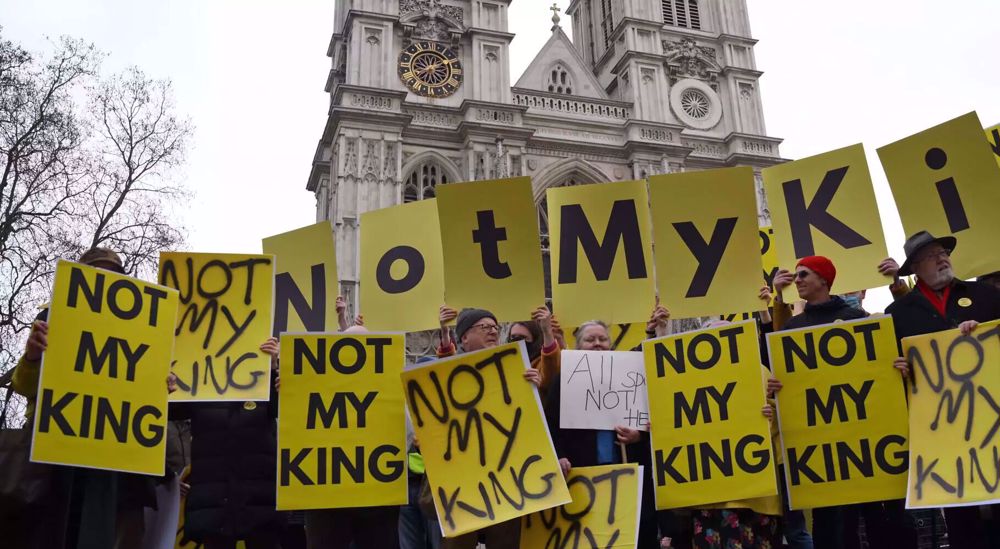
The protesters are set to hit the streets in yellow T-shirts and placards that would read #NotMyKing, a protest slur coined by the group.

Earlier in January, the group announced another plan for a peaceful demonstration at Parliament Square, which is overlooked by Westminster Abbey where Charles III is to be crowned.

"The coronation is a celebration of hereditary power and privilege, [and] it has no place in a modern society," Smith said at that time.

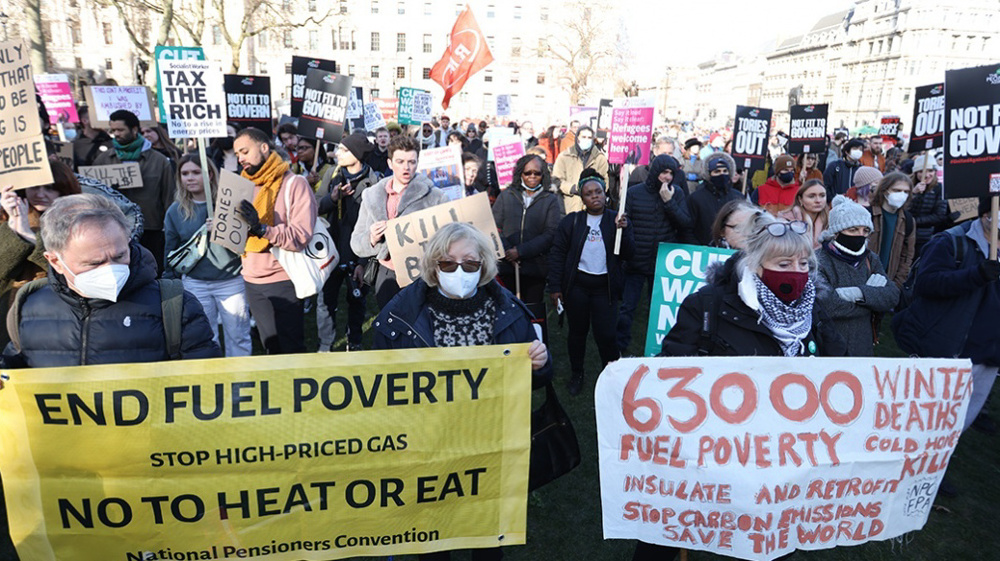
He also blasted the event's astronomical price tag, saying, "At a cost of tens of millions of pounds, this pointless piece of theater is a slap in the face for millions of people struggling with the cost-of-living crisis."

Anti-monarchists: King Charles’ coronation ‘slap in the face for people’ amid high inflation

The expensive ceremony comes as the latest figures show the UK's inflation stands at over 10 percent, the highest in four decades.

The inflationary spiral is growing at a much faster pace than the average pay rise across the country, with food prices skyrocketing almost 20 percent. Rising energy prices, along with soaring energy costs, have also largely contributed to the UK's cost-of-living crisis.

Many labor unions have launched industrial actions to press the government to enact salary hikes. The government, however, refuses to increase salaries, saying it would increase the inflation.

Experts, however, blame the existing crisis on Britain's leadership incompetence and turbulence that saw the country change several prime ministers over the past two years.

French people continue protests, laying bare EU’s democracy crisis

 By Ramin Mazaheri

For over two centuries, France was seen as the only Western country that mattered. It might sound like a sweeping statement, but the political history of the kings of Sweden, the Netherlands and England, and the bourgeois democracies of the United States, Italy and Switzerland shows they just did not cut it.

While speaking to people who have been protesting in France for months, they say it is not arrogance. You can’t blame them for knowing the historical record. They say they are fighting now not just to save their own crisis-hit country but they are fighting for all of Europe, and also for the whole world.

That’s why their current fight to get the already-enacted two-year hike to the pension age pulled back is so important: This is a major new test for our new era on the question of national sovereignty, which is a concept that was deemed irrelevant in the now-dead unipolar world.

The French people are now relying on tactics that worked pre-European Union, but will they work now? Can countries go their own way within the bloc?

France’s trade unions think so, but I would say they are making a promise they can’t keep, or they are living in the past, or they are on the cusp of revealing themselves to be actually powerless now.

They have decided to hark back to 2006 when protests successfully forced the government to revoke an unpopular law that had been passed into legislation.

Indeed, this is a last, desperate gambit to repeal the age hike, but the tactic has worked before.

In 2006, the offending law was one which made firing youth workers easier, and the pension hike affects even more citizens and thus can draw in even more participants.

Unions, NGOs and social activists are saying they can apply enough pressure on President Emmanuel Macron to revoke the law, just like they forced a revocation from then-President Jacques Chirac.

Color me skeptical

It’s far more than 17 years that separate the two social struggles - the entire weight of the EU now exists, and they have “won” everywhere ever since the Lisbon treaty came into full force in 2009.

Just look at the democratic failures of Greece and Spain (Syriza and Podemos, respectively) - they took a very mild, respectful, play-by-the-rules approach and were totally disregarded. 

Revolutionaries do not play by the rules of the status quo but impose new ones.

What so many in Europe fail to grasp is that their old, national laws have been superseded by European Union laws in so many vital areas - the EU was truly a Liberal Democratic revolution for Europe.

Of course, it was a reactionary one: Liberal Democracy is less advanced than Social Democracy (which reigned post-WWII in Europe), which in turn is less advanced than Socialist-inspired Democracy, and this is simply the historical record post-1848.

In France, we saw the Yellow Vest movement start in late 2018, and we saw how it was repressed with unprecedented savagery. That was anti-citizen violence unseen in the West since World War II, but it still failed to get more public opinion into policy-making, i.e. the true test of any democracy’s bonafide.

With unions forced to catch up with the Yellow Vests, they led the 2019-20 general strike - the longest labor movement in French history. That was also ignored by Macron and Brussels.

It would appear that to get the government to willfully revoke the age hike a social movement of an equal or greater amplitude than those two events is required. However, in response to the immediate protests after the age hike went into law last week, Macron imperiously scoffed: “I saw much worse with the Yellow Vests.”

Of course, he did. Nothing in Western political history for 75 years compares with the civic-minded self-sacrifice of that group. However, one wishes Macron had the guts to say that in front of the over 30 Yellow Vests who lost an eye while exercising the right to the free assembly under his quite-violent reign.

But can France’s grassroots groups come up with something which isn’t even “much worse” but just close to the Yellow Vests' ability to shine a light on the lack of democracy in France and the EU?

I don’t think so, but we aren’t going to really find out until after May 1, which is International Workers’ Day.

May 1 is a free pass - not for French protesters but for Macron

In the fight to get the age hike revoked, unions have promised a huge show of force on May 1, but major marches are pretty standard for France on May 1.

Anyway, I doubt it will be as bad as in 2019 - that wasn’t a march but a shooting gallery for the joy of the detested French riot police.

It was brutally repressed because it was the government’s coup de grâce to intimidate the average person from protesting, and (in conjunction with a litany of “anti-Yellow Vest laws” and judicial repression) it worked - people became too scared to join the Yellow Vests anymore.

Even if they top that, a big May Day - no matter how anti-democratically repressed - isn’t going to get Macron, the 1%, or Brussels to back down, history has shown. 

So throw May 1 out of the window - it’s what comes after that will count in this fight. Right now, the new thing is to hark back not to 2006 but to 1830: banging saucepans in front of city halls at 8 pm, or whenever Macron or his ministers make a public appearance.

These “casserole” protests may be the start of something big, but they have a long way to go to reach the impact of the Yellow Vests or even the recent general strike.

The year 1830 is worth mentioning to show how consistently the French have been ahead of the curve politically in the West:

Known as the “July Revolution”, it saw the Bourbon family - ousted in 1789 yet restored to power in 1815, but only after England led seven different Europe-wide coalitions for almost 25 continuous years to destroy the popular anti-monarchy French Revolution - pulled off the throne once again.

However, calling it the “Second French Revolution”, as some do, is incorrect because an overturning of society’s pyramid did not occur this time - another monarch merely took the old one’s place.

The new one consented to be called the king of “the French” instead of the king “of France”, and this is why 1830 isn’t as well known as 1789, 1848, or the Paris Commune of 1871.

However, this new awareness of the deserved primacy of the average citizen - so taken for granted to be true now but so politically radical back then, and a concession that was totally unobtainable everywhere else in autocracy-dominated Europe in 1830 - was a direct result of how the French Revolution empowered the European 99% for the first time ever.

It wouldn’t be until 1918, and the horrors of World War I, that the awful monarchies of Europe would have to accept the values first won in France in 1789.

This not-so-distant history of 1830 greatly influences the Liberal Democracy of today’s European Union: we see the same sleight-of-hand which tries to pass autocracy off as progressive politics.

It’s worth remembering that Macron’s book which declared his 2017 election project was titled Revolution - yet more faux-progressive sleight of hand which hides anti-democratic repression and shameless hypocrisy. 

If the French cannot influence their government on how a law is written, if protests can’t stop it from being rammed past the legislative branch by executive decree, and if protests can’t get the massively-unpopular law revoked, then French democracy is truly just a once-every-seven-years event.

They don’t elect a president, but a Presidential Dictator. Or perhaps more accurately, an “EU governor”, and one “of France” but not “of the French”.

There was a totally misplaced and desperate hope in France that the nation’s totally pro-status quo Constitutional Council would judicially strike down the obviously unconstitutional way the age hike was forced past legislative branch approval.

When the Council - in no surprise to those who realize the dependably reactionary nature of Liberal Democratic judicial branches - validated the law on April 14, yet another pillar joined the heap of discredited French democratic ash.

If unions fail after May 1, the flag of 2006 will also join that bin, and thus the fig leaf of democracy in France and the EU will shrink even more.

The EU, despite its belief that the non-Western world can’t comprehend what’s going on, will eventually run out of sleight-of-hand tricks. They only fool themselves, they should learn. 

There will be blood this May Day in France, yet again, and the West’s so-called human rights watchdogs won’t see a thing – which is a certainty.

The social movement which will come afterward in the fight to repeal the 2-year age hike seems very unlikely to reach the level needed to force the hand of Europe’s leaders, but - then again - the public will never force the hand of Europe’s leaders.

For over two centuries: if it does, then it must be France - and it would mean another French attempt at progressive revolution.
 

Ramin Mazaheri is the chief correspondent in Paris for Press TV and has lived in France since 2009. He has been a daily newspaper reporter in the US, and has reported from Iran, Cuba, Egypt, Tunisia, South Korea and elsewhere.

Explainer: What's Persian Gulf Day and why it matters?

By Syed Zafar Mehdi

The Persian Gulf, a strategic waterway and the world’s largest reservoir of oil and gas, is surrounded by eight oil-rich countries. Iran borders the entire northern shores of the water body, and its territory also forms the northern side of the Strait of Hormuz, the world’s most important oil passageway.

An arm of the Arabian Sea, the waterway produces one-third of the world's oil, half of the world’s crude oil reserves as well as a significant amount of global natural gas reserves. 

However, the importance of the Persian Gulf is not confined to oil and gas alone. It has been a scene of political and economic tension between regional and extra-regional countries for years. 

The United States, which splurges billions of dollars annually to consolidate its military presence in the strategic waterway, has in recent years made desperate attempts to stir up the hornet's nest by dispatching its hostile ships close to Iran's territorial waters or engaging in illegal oil smuggling. 

Another issue that has kept the water body in the news has been its name. Despite historians as well as international bodies unanimously recognizing it as the 'Persian Gulf', some Arab countries and their Western allies have wilfully tried to tarnish its universally accepted name - calling it 'Arabian Gulf'. 

As a reminder of the waterway’s Persian identity, Iran on April 30 every year commemorates the Persian Gulf Day, which coincides with the anniversary of the expulsion of the Portuguese Navy from the Strait of Hormuz in 1622 by the legendary Safavid dynasty ruler Shah Abbas I.

What is Persian Gulf?

The strategic waterway in southwest Asia and an extension of the Indian Ocean, the Persian Gulf is located between the coastlines of southwestern Iran and the Arabian Peninsula. The water body got its name from the Achaemenid Persian Empire, also known as Persian Hakhamanishiya, around 330 B.C. 

Sir Arnold Wilson, in his acclaimed book ‘The Persian Gulf’ published in 1928, writes that no waterway has been as important to geologists, archaeologists, geographers, traders, politicians, tourists and academics as the Persian Gulf. He

"Since at least 2200 years ago, this waterway, which divides the Iran Plateau from the Arabia Plate, has possessed an Iranian identity," Wilson states.

The Persian Gulf has also been featured in colorful travelogues of Ibn Battuta, Pythagoras and King Darius and others from the bygone era, which attests to its importance as a strategic waterway. 

The countries surrounding it include Iran, Iraq, Kuwait, Saudi Arabia, Qatar, Bahrain, United Arab Emirates and Oman. Iran is located on one side while the group of Arab states is on the other side. 

The deepest point of the Persian Gulf waterway is located in the Strait of Hormuz which sees more than 17 million barrels of oil pass through it every day, including most of the oil from OPEC countries.

The important Persian Gulf ports of Iran include Bandar Abbas, Bussher and Asaluyeh and the islands include Kish, Gheshm, Hormuz and Hengam — all of them major tourist attractions. 

Why Persian Gulf matters?

The Persian Gulf is significant for a host of reasons, most importantly for its abundant oil and gas reserves, which have given it the sobriquet of “world’s oil reservoir”. That’s one of the reasons Western powers, including the US, have sought to increase their footprint in the strategic waterway.

The region is home to two-thirds of the world’s total oil reserves and half of the world’s crude oil reserves. The volume of its natural resources is complemented by the size of oil fields and wells.

It is also a transit route for oil produced by regional countries including Iran, Iraq, Kuwait, the United Arab Emirates and Saudi Arabia, with the Strait of Hormuz being the main route for this oil.

According to rough estimates, the Persian Gulf region contains more than 730 billion barrels of oil and over 70 trillion cubic meters of natural gas. Most of it is refined in the region itself with countries surrounding the water body setting up major petroleum refineries in recent years.

The strategic ports along the Persian Gulf shores include Bandar Abbas, Bushehr, Bandar Lengeh, Kish, Khorramshahr and Mahshahr (Iran), Sharjah, Dubai, Abu Dhabi (UAE), Basra, Al-Faw (Iraq).

What adds to its strategic significance is the Strait of Hormuz, a 39-km strip situated between Iran and Oman that is the only passage for over one-sixth of global oil production.  

Persian Gulf or Arabian Gulf?

Legendary geographers such as Strabo (Greek) and Ptolemy (Roman) in no ambiguous terms referred to this important stretch of water as the Persian Gulf. It also appeared in world maps sketched by them.  

Arab historians, explorers and geographers, including the 10th-century writer Agapius, have also referred to it as the Persian Gulf in their seminal works.

Abdel Khaleq al-Janabi, a Saudi Arabian history scholar, says the name Persian Gulf has been used for the waterway by world-renowned historians including Ibn Khaldoun and Ibn al Athir.

There was no disagreement over the name of this strategic body of water until the 1960s when the emergence of pan-Arabism and Arab nationalism gave rise to the dispute.

Some Arab states, with utter disregard for historical records and driven by geopolitical ambitions, started calling it the Arabian Gulf or al-Khaleej al-Arabi.

Some reports also pointed to British government agents such as Charles Belgrave and Roderick Oven who first used the name ‘Arabian Gulf’ in their books before it gained currency in the Arab world.

The United Nations and other international organizations, however, refused to recognize this forged name and stressed that the name of the strategic water body continues to be the Persian Gulf.

In August 2018, Iran’s then-foreign minister Javad Zarif blasted the US military for the Persian Gulf misnomer, saying the US Navy “cannot seem to find its way around our waters”.

"Perhaps because it hasn’t figured out its name: Persian Gulf, as it's been called for 2,000 years longer than the US has existed. Or maybe it doesn't know what it's doing in our backyard, 7,000 miles from home," he wrote at the time.

More recently, in January this year, Iran took exception to Iraqi premier Mohammad Shia Al-Sudani’s use of a fake name for the strategic waterway.

“The use of the name, Persian Gulf, for this body of water is a historical, eternal, documented and undeniable fact and repeating a false name does not change facts and brings no legitimacy to the false name,” foreign ministry spokesman Nasser Kanaani wrote.

What is Persian Gulf Day?

On April 30 every year, Iran marks the Persian Gulf Day, which coincides with the anniversary of celebrated Safavid ruler Shah Abbas I’s military campaign against the Portuguese Navy in 1622 when the foreign colonial forces were driven out of the Strait of Hormuz.

The day was instituted in 2005 by Iran’s High Council of Cultural Revolution and is marked every year with countrywide events, especially in the coastal provinces bordering the Persian Gulf.

The annual event, according to officials, is a means of reaffirming commitment to safeguarding the country’s sovereignty and territorial integrity, especially in the wake of continuing attempts by some Western powers and their regional allies to destabilize regional waters.

On the eve of Persian Gulf Day on Saturday, the commander of IRGC Navy Rear Admiral Alireza Tangsiri vowed to resolutely “protect and safeguard” the Persian Gulf and its resources, while calling on the US and the Israeli regime to withdraw from the strategic waterway.

“The Persian Gulf is our home. We will resolutely protect and safeguard the Persian Gulf and its resources. We will not allow any act of aggression against its resources,” he was quoted as saying.

In 2010, Persian Gulf Day was registered as the country’s national heritage in a decision taken by the ministry of cultural heritage and tourism. It was in response to the campaign launched by Arab states that year to rename the waterway as ‘Arabian Gulf’.

What they said about Persian Gulf Day?

In a statement on his Twitter account on Sunday, Iran’s foreign minister described the Persian Gulf as an “important part of the undeniable and common identity of Iran and the region and a natural resource full of benefits for the residents around it”.

“Maximizing the benefits of the Persian Gulf will depend on the security, convergence and collective participation of the coastal countries of this proud water area,” he wrote, wishing Persian Gulf Day.

In a separate tweet, Iran’s foreign ministry said, “All historical and int'l sources - ancient maps, docs, books as well as UN directives - confirm that the body of water in the south of Iran has always been called the Persian Gulf”, dismissing claims made by Arab states.

Ali Bahadori Jahromi, the government spokesman, also took to Twitter to note that the Persian Gulf has “always been a historical symbol of Iran's solidarity, unity and strength”.


Syed Zafar Mehdi is a Tehran-based journalist, political commentator and author. He has reported for more than 13 years from India, Afghanistan, Kashmir and West Asia for leading publications worldwide.

In its quest for religious war, Israel is uniting Arabs and Muslims around Palestine

Book Launch of Ramzy's Baroud latest book - The Last Earth: A Palestinian Story on 27 March, 2018 [Jehan Alfarra/Middle East Monitor]


People protest the attack by Israeli forces on Masjid al-Aqsa in Bryazit Square on April 9, 2023 in Istanbul, Türkiye [Hakan Akgun/ dia images via Getty Images]
By ordering a brutal attack against Palestinian worshippers inside Al-Aqsa Mosque on the 14th day of the Muslim holy month of Ramadan, Israeli Prime Minister Benjamin Netanyahu knew very well that the Palestinians would retaliate. Netanyahu's motive should be obvious. He wanted to divert attention from the mass protests that have rocked Israel since January and divided Israeli society along ideological and political lines in ways never witnessed before.

Unwilling to relinquish his hard-earned decisive election victory and entirely right-wing coalition government, while fearing that major concessions to his political rivals could see his coalition dissolve, Netanyahu set his sights on Al-Aqsa Mosque.

History has proven that Israeli attacks on Palestinian holy places are guaranteed to provoke a Palestinian response. For Netanyahu and his extreme far-right National Security Minister Itamar Ben Gvir, the price of Palestinian retaliation was worth the political gains from uniting Israelis of all political backgrounds behind them. Ben-Gvir, in particular, knew that an attack on Al-Aqsa would reassure his far-right religious constituency about his commitment to imposing full Israeli Jewish sovereignty over Palestinian Muslim and Christian holy places in the occupied city of Jerusalem.

What Netanyahu and his allies may have not anticipated, however, is the intensity of the Palestinian response. Hundreds of rockets were fired towards the north and south of Israel. These came not only from the besieged Gaza Strip, but, even more strategically important, also from South Lebanon.

Although some damage was reported, the rocket response was a political game changer. This was the first time in years that fighters in two Arab countries coordinated their retaliatory action against Israel and hit back simultaneously.

It will be difficult for Netanyahu to claim any kind of victory after this, unless he takes his country to a major war on two fronts; three, if we are to consider the rise of armed resistance in the Israeli-occupied Palestinian West Bank.

However, even a major war could backfire. During Israel's attack against Gaza in 2014, the occupation state struggled to sustain a single military front as the war lasted 51 days, leading to an Israeli arms and ammunition crisis. Were it not for the decision of the Barack Obama administration to ship supplies of munitions to Israel to refill its depleted arsenal, Israel could have found itself in unprecedented difficulty.

The US, though, is no longer able to play the role of emergency weapons supplier, at least for now, due to its own ammunition shortage resulting from the Ukraine war. Israel was thus careful to limit its response to the Palestinian and Lebanese rockets. This episode shall prove decisive, as it will empower Israel's regional enemies and, instead of boosting Netanyahu's credibility within his own right-wing camp, it has the potential to undermine it.

How could Israel's most experienced political leader commit such an obvious strategic error? Aside from making the desperate decision to attack Al-Aqsa — likely under pressure from Ben-Gvir and the equally extreme far-right Bezalel Smotrich — Netanyahu is no different to other Israeli leaders in miscalculating the significance of the spiritual component of the Palestinian struggle, and how it ties to Arab and Muslim solidarity with Palestine.

While what is happening in Palestine is not a religious war, some Israeli officials and political parties are keen to have one. Although warnings against "religious wars" in Palestine — in fact, the entire region — have been mostly linked to Israel's current "most right-wing government in history", religious discourses have been the most dominant since the development of Israel's founding ideology, Zionism, in the late 19th century.

Paradoxically, despite the historical fact that Zionism has been situated within a religious context, the founders of the movement were mostly atheists. They used religion as a political tool to unify Jews globally around their new ideology and to romanticise in the minds of their followers what is essentially a violent, settler-colonial movement.

Nevertheless, over the years, the centre of power within the Zionist movement has shifted from liberal Zionism to Zionist Revisionism, and then in the past twenty years or so, to religious Zionism. For Israel's current generation of Zionist leaders, religion is not a political tool, but an objective. This is precisely why, as Palestinian men and women were being attacked so ferociously inside the holiest of all mosques in the country, Israeli Jews were attempting to enter the Muslim shrine to sacrifice animals as part of the Passover tradition. Although not many of them have succeeded in doing so, events suggest that a new kind of conflict is taking shape.

Historically, Israel has targeted Muslim and Christian sites to acquire political capital. Late Israeli Prime Minister Ariel Sharon did just that when he conducted a provocative "visit" to the Noble Sanctuary of Al-Aqsa with hundreds of soldiers in September 2000, and when the Israeli military completely destroyed or seriously damaged 203 mosques during its so-called "Operation Protective Edge" against Gaza in 2014.

Christian sites have also been attacked and confiscated. Israel's targeting of Palestinian Christians has led community leaders such as Archbishop Atallah Hanna to warn about "an unprecedented conspiracy against the Christian existence" in the Holy Land.

The attack on Palestinian religious symbols isn't limited to the Occupied Palestinian Territories; it is ongoing across historic Palestine, including today's Israel. The 13th-century architectural marvel, Al-Ahmar Mosque in Safad, for example, was turned by the Israeli authorities into a nightclub. A study published by the High Follow-up Committee for Arab Citizens in Israel revealed in July 2020 that scores of mosques have been turned into synagogues, barns, bars or restaurants by the occupation state.

Israel's targeting of the Arab and Muslim identity of Palestine is now being accelerated under Netanyahu's leadership, but this strategy is a double-edged sword as we have seen in recent days. In the video that went viral of Israeli soldiers beating up Muslim worshippers in Al-Aqsa, the distressing pleas of a Palestinian woman groaning in pain were heard as she cried "Oh Allah, Oh Allah" repeatedly. Palestinian mainstream and social media have published comments that the response by Palestinian resistance groups was specifically in answer to the pleas of the unidentified woman. This is the power of spirituality; it has the kind of logic that Netanyahu and his allies cannot possibly understand.

On 3 April, Jordan's King Abdullah stressed rightfully that, "It is the duty of every Muslim to deter Israeli escalations against Islamic and Christian holy sites in Jerusalem." In its quest for religious war, Israel is uniting Arabs and Muslims around Palestine.

When this happens, instead of isolating and browbeating Palestinians, it is Israel that will find itself even more isolated. Palestinians do not see themselves as fighting a religious war, but protecting their religious symbols stands at the core of their fight for freedom, justice and equality.