Showing posts with label Queen Elizabeth II. Show all posts

Saturday, August 31, 2019

Dictatorship Stick on democracy

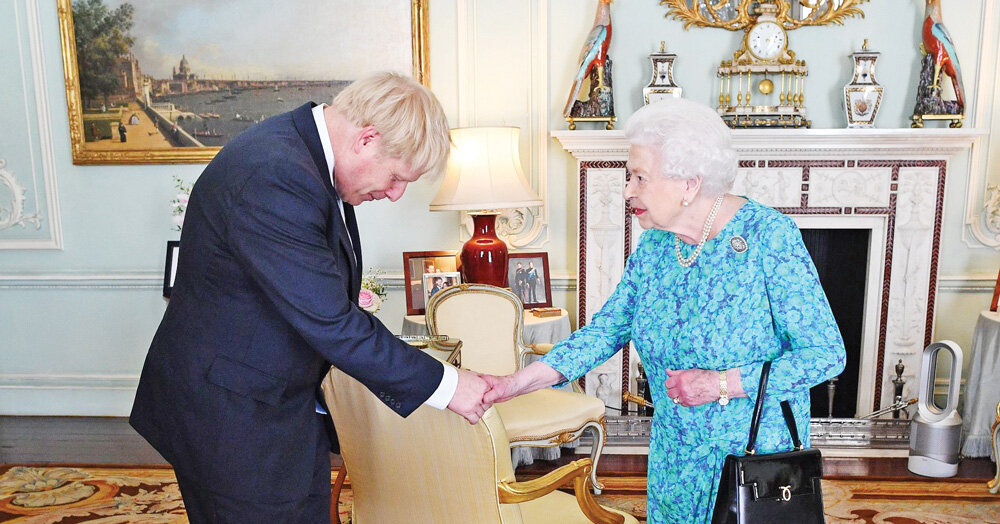
TEHRAN- Following a request from British Prime Minister Boris Johnson, Queen Elizabeth II has prorogued the U.K.’s Parliament—temporarily shutting down the United Kingdom’s deliberative body just weeks before the deadline for a no-deal Brexit hits. 
The move has caused fury, with Speaker of the House John Bercow calling it a “constitutional outrage” and Ruth Davidson, the extremely popular leader of the Scottish Conservative Party, resigning in protest. 
Labor to use Parliament to try to thwart no-deal Brexit
Britain’s opposition Labor Party said it would trigger an emergency debate in Parliament next week to try to stop Prime Minister Boris Johnson taking Britain out of the European Union without a withdrawal deal.
More than three years after the country voted in a referendum to leave the bloc, the United Kingdom is heading toward its gravest constitutional crisis in decades and a showdown with the EU over Brexit, which is due to take place in just over two months’ time.
Johnson enraged opponents of a no-deal Brexit Wednesday by using a parliamentary mechanism to order the suspension of Parliament for almost a month.
The speaker of the lower house of Parliament, John Bercow, called this a constitutional outrage as it limited the time the Parliament has to debate and shape the course of British history.
Labor Party leader Jeremy Corbyn said that as soon as Parliament returned from its summer break Tuesday, his party would initiate a process to legislate against a no-deal Brexit that he said would be damaging for the jobs and the economy.
“What we are going to do is try to politically stop him [Johnson] on Tuesday with a parliamentary process in order to legislate to prevent a no-deal Brexit and also to try and prevent him shutting down Parliament in this utterly crucial period,” Corbyn told reporters.
“This country is in danger of crashing out on the 31st of October with no deal,” he said. “We have got to stop that and that is exactly what we will be doing next Tuesday.”
Five other opposition parties, including the Liberal Democrats and the Scottish National Party, later issued a joint statement with Labor calling on Johnson to let legislators vote on whether Parliament should be suspended.
Economists have widely predicted that a no-deal Brexit would deliver a damaging blow to Britain’s economy.
Three-month sterling implied volatility soared, indicating traders are bracing for more big price swings between now and the expected Oct. 31 Brexit date. JPMorgan raised the probability of a no-deal Brexit to 35 percent from 25 percent.
Johnson’s plan to suspend Parliament used the date of the Queen’s Speech - to be held on Oct. 14 and preceded by a suspension of the House of Commons - to ensure Parliament will not sit between mid-September and mid-October.
In effect, the squeezed timetable forces opponents of a no-deal Brexit in Parliament to show their hand and act in as few as four days sitting next month. Parliament returns from its summer holiday on Sept. 3.
An election is likely, lawmakers said. Jacob Rees-Mogg, a Brexit supporter who is in charge of managing government business in Parliament, said opponents were confecting “the candy-floss of outrage” and dared them to do their worst. There is a small majority against a no-deal Brexit in the 650-seat House of Commons, but it is unclear if opponents of Johnson within the Conservative Party would collapse his government in a vote of no confidence. “It does look like next week is essentially the only opportunity that Parliament will have to maintain some control over this process and ensure that it has a say before we leave without a deal,” Conservative MP David Gauke said.

Friday, March 08, 2019

The Queen's Secret (4)

The life of Princess Diana had different ups and downs but it caused a big problem for Queen Elizabeth II.
Prince Charles, as the heir apparent of the British throne, married with Princess Diana at Saint Paul Cathedral on July 29, 1981. Princess Diana was from the Spencer family which had close relations with the royal family. The marriage was held after the approval of the Queen.
After a few years of marital life and having two children, the relations of Prince Charles and Princess Diana were not as warm as before and each of the spouses had found new loves. In 1992, their relations were exposed. Later on, then premier, John Major, announced that the couple want to part in an amicable manner. Finally, they divorced in 1997. This led to the royal family's clashes with Diana, especially, given that she made friends with an Egyptian called Dodi al-Fayed. They seemed to plan for marriage. On August 30, 1997, Dodi came to Paris and, along with Diana, they left Paris for London with a black Mercedes. They had hired the car to escape the attention of photographers. Three minutes after their departure, they had a serious collision in which Dodi died instantly. Princess Diana was breathing. 2 hours after the collision, she was taken to a hospital but at 4 a.m., her doctor announced her death. Queen Elizabeth II appeared on TV and read out the condolence message. There was a huge crowd in her funeral but there were doubts among masses on the causes of the event. The British mainstream media called these doubts as "Conspiracy Illusion", but many people believed that if Dodi had taken Princess Diana with his own car, this event wouldn't have happened. Richard Tomlinson, an MI6 member, announced that Diana had been under supervision of MI6 operatives before her death. However, he rejected his remarks shortly after and said that his memory was failing him.
The next investigations revealed that the black Mercedes of Diana and Dodi had crashed into a white Fiat but the French police couldn't find any trace of the Fiat. Dodi's father, Muhammad al-Fayed, assigned some people to probe into the issue on his own expense. Then he announced that the Fiat car belonged to a photographer journalist, called James Anderson. He had sold his car a few months after the incident. The police interrogated Anderson only to conclude that he had not been guilty. But, three years later, in May 2000, the news was released that Anderson's corpse was found in a BMW car in the forests in the south of France, while the doors of the car were locked and there was no switch. According to the official reports, Anderson had committed suicide. Hence, the file was closed. The Anderson family rejected the police claim and said that he had just found a new job and had high spirits.
Another dubious point on the death of Princess Diana and Dodi was the lack of any CCTV photos. There were 10 cameras in the area but no picture was recorded. The officials claimed the cameras belonged to an office which wasn't working at that time of night. This fiction didn't convince anyone because CCTVs record their pictures automatically round the clock.
By the way, what was the reason for the British royal family's dissatisfaction with Princess Diana? Perhaps, because she was pregnant and the coming British princes and princesses would probably have step-siblings from a Muslim father. This was an unprecedented and intolerable issue for the British royal family. Britain has no official religion in practice but the Queen is the head of the Church of England. The role of the Queen and royal family has been rejected in many wars and coups; but this event attracted many attentions to the royal family in Britain. However, the British courts announced that according to researches, the collision and death of Diana and her fiancé was unintentional and there was no conspiracy. This has failed to convince the public opinion.
Elizabeth II just thinks of safeguarding her grip on power. This has raised questions among the British public opinion. In 2007, BBC broadcast a documentary, titled Monarchy: The Royal Family at Work also known as One Year with the Queen which contained a scene of dispute by the Queen. The BBC officials immediately apologized the royal family members.
The awarding of Knighthood by the Queen to the apostate author Salman Rushdie in 2007 once more revealed the enmity of the royal family and the Queen herself toward Islam and Muslims. In 2008, Daily Mail announced that the British royal family intended to open a branch of stealth Freemasonry in Buckingham Palace. Nevertheless, the Queen's spokesperson said that she had not issued the official permission for the issue.
The British statesmen and state-run media constantly claim that the monarchy is merely a ceremonial establishment and has no power in the country!!! They say that the main policymaker and decision-maker in wars and coups are the governments and parliaments. Were the government and parliament the decision-makers in killing Princess Diana, too? 

Wednesday, March 06, 2019

The Queen's Secret (3)

From 1960s-1970s, 20 African countries got their independence from Britain. The legacy of the British colonialism was extreme poverty, political, economic and cultural backwardness. Zimbabwe – which used to be called Rhodesia by the British – was one of these countries.
Ian Smith, the white racist minister of the country, called for unilateral independence from Britain while announcing loyalty to the Queen. This announcement endangered the Queen's popularity as the Rhodesian government believed on white supremacy over the black. Thus, Elizabeth II was forced not to accept the communique for Rhodesia's independence. Rhodesia was under the dominance of the white for another decade and Britain didn’t do any serious and practical move to oppose them. Canada, as the largest dominion of the Queen, faced problems as well. In 1965, when Elizabeth II traveled to Quebec, the advocates of independence rebelled against her. The security staff were safeguarding the Queen but the protests showed that she is the embodiment of colonialism. Many of the Canadians were enraged to see their country under the British dominance. The Queen tried to beguile the people of Canada by a few changes in the Constitution. Before these changes, the Canadian laws used to be determined by the British parliament. The Canadians asked the Queen to nullify the role of the parliament and just let the monarchy remain.
Australia, like Canada, is administered by a governor-general under the UK. In 1975, when the Australian Senate rejected the budget bill proposed by Prime Minister, Gough Whitlam, governor-general, John Kerr, who had been appointed by the Queen, dismissed Whitlam. The prime minister enjoyed the majority vote the representatives and only the senate was opposed to him. Thus, the majority party demanded the Queen to interfere and rescind the view of the governor-general. But the Queen didn't interfere saying that she would not meddle in the authority of the governor-general!!! This stirred protests against the monarchy among Australians.
Another region that was dominated and colonized by the British in the 18th century was the Malvinas Islands which belonged to Argentina. The British put the name of Falkland on these islands. In 1982, the British royal army initiated a war against Argentina on the islands. The British were not intent to give back the islands to their original owners. The third child of the Queen, Prince Andrew, took part in the war and proved to all that the Queen is always complicit in the wars that her government wages.
The British war against Argentina extended to football, too. After the war which ended with the defeat of Argentina, the Argentinians were looking for an opportunity to retaliate and humiliate the UK. This opportunity was attained in 1986 in quarter final World Cup in Mexico. Four years after the British war and usurpation of the Malvinas Islands, the Argentine football team was playing vs. the Brits. Till the 51st minute the match had no goal, but Diego Armando Maradona scored a goal which was loudly applauded by the fans at the stadium. The Brits were demoralized and received the second goal within just two minutes, again by Maradona. Thus, Argentina defeated Britain 2-1 which eliminated the Brits from the competitions.
In the Vietnam war, which has been a very big blot on the US, the UK was not a neutral country but supported the US genocide of the Vietnamese and devastation of their country. During the 8-year war that was imposed by the US through its minion Saddam of Iraq, the UK regime stood on the US side and supported Saddam's aggressive army politically, economically and in terms of arms. During the first Persian Gulf War, the British supported the American invasion and sent more than 53 thousand troops to Kuwait. Afghanistan was another scene of the British partnership-in-crime with the US as they dispatched troops, through NATO, to help the American criminals in Afghanistan.
The last but not least, Britain was an ally of the US during the second war in the Persian Gulf which broke out in 2003 with no UN permission. During these years, governments have changed, elections have been held and everything has altered but the policies have remained fixed since the Queen is monitoring the world developments from the Buckingham Palace and has the first say in the UK.  

Tuesday, March 05, 2019

The Queen's Secret (2)

In the previous episode, we talked on the formation of Britain and its political regime. This time we will dwell upon the coming to power of Elizabeth II, the 93-year-old queen of the country.
Between the two World Wars, in the waning days of the British colonialist power, Elizabeth Alexandra Mary Windsor was born in London on April 21, 1926. In those days, nobody imagined that the newborn girl would one day become the Queen of the country. Her father Albert was the second son of George V. In 1936, George V died and his elder son Edward became the king as Edward VIII. The new king fell in love with and wanted to marry with a divorced American woman called Wallis Simpson. However, according to the British Church, the second marriage was possible only when the former spouse had died. But Simpson's husband was alive and she was not allowed to marry again.
This was not the first time that the marriage of the English king was making a problem. In the 16thcentury, Henry VIII faced problem when he wanted to divorce his wife and marry with another woman; since in those days, the English obeyed the Roman Catholic church which deemed divorce as forbidden. Thus, the king separated the English church from the papal authority and called himself as the head of religion in England; hence he decreed the permission for divorce. His chief minister was executed due to his opposition to the action.
The licentiousness of Edward VIII coupled with the reports of the British intelligence staff on the immorality of Wallis Simpson caused scandal for the residents of Buckingham Palace. Edward VIII would oppose the policies of the British government, too. The prime minister's threatening on resignation of the cabinet and reluctance of the parties to form a government forced Edward to resign on December10, 1936. Thus, his brother Albert ascended the throne as George VI. Now Elizabeth was the heir apparent of Britain. Three years after the breakout of WWII, Europe and some other countries were plunged in war.
Buckingham Palace is the residence of the British royal family. With an area of 77 thousand square meters, it has 775 rooms, 760 windows, 1514 doors and 800 personnel. Behind the doors, a woman lives who has been the longest reigning monarch and everything in Britain leads to her. Britain or United Kingdom is the name given to a land which comprises England and the usurped lands of Scotland, Wales and Northern Ireland. Elizabeth II is considered the queen of the Commonwealth countries (aka the lands which had long been colonized on gunpoint during the last centuries). Some of these colonies got their independence and possessed separate government and parliament; while the head state is considered the chief political person in their system and exercises its influence on them through the appointment of a governor general. The governor general is indeed the representative of the Queen in the country and enjoys a position superior to that of the prime minister of the country. These are called the Commonwealth countries. Antigua and Barbuda, Barbados, Trinidad and Tobago, Saint Kitts and Nevis, Saint Vincent and the Grenadines, Jamaica, Australia, Papua New Guinea, New Zealand, Canada and Granada are among these countries. All of these countries are under London's influence especially while voting in the UN.
MI6 is one of the most horrific intelligence apparatuses in the world. The British media pretend that this apparatus is working under the government and the Queen has no influence on them while in reality it is the tool in the hand of the Queen and has staged many coups in different countries. Perhaps Iran was the first country where the British Queen thought of wielding her trans-border power. In 1953, Britain in complicity with the US, toppled the legal government of Mohammad Mosaddeq and reinstated the Shah. After the coup, the British Queen entered the scene in 1961 in favor of the coup leaders and the illegal despotic regime of Shah. She came to Iran to show that she was ready to preserve the Iranian monarchy at any cost.
Egypt was the second destination of the Queen's intervention abroad. Gamal Abdel Nasser annulled monarchy and nationalized the Suez Canal after taking power. Both of the governments of Iran and Egypt were opposed to the illegal Zionist regime of Israel. Iran severed political ties with Israel and Abdel Nasser intended to bring Israel to its knees. Was the Queen supporting the royal system in Egypt? In response, it should be said that shortly after the nationalization of the Suez Canal, the British Royal Army fought alongside France and Israel against Egypt with the permission of Elizabeth II. The onslaught of the colonialist countries against the Egyptian nation caused grave scandal for the Queen. The designation of Harold Macmillan to premiership by the Queen, without referring to the votes of the conservative majority party, stirred ample criticism against the Queen. In 1963, with the resignation of Macmillan, the Queen appointed Alec Douglas-Home as the next prime minister. Thus, the Queen showed that the appointment and dismissal of ministers is actually in the hand of the Queen and she doesn’t consider it necessary to abide by the majority vote.   

Monday, March 04, 2019

The Queen's Secret (1)

The history of many countries in Asia, Africa and Europe is interconnected. For several centuries, the European colonialists used to subjugate different nations thousands of kilometers away from their own lands and pillage their riches and resources on gun-point.
Kings and queens have been the symbol of totalitarianism and despotism, hence their lack of popularity and repute among masses. Today, among almost 40 countries that are ruled by royal system of government, Britain has an especial status. It is due to the long colonialist record of this country which has given it the epithet of the Dotard Colonialist. Queen Elizabeth II is the longest-reigning British monarch. The 60th anniversary of her rule is a good opportunity to cast a brief look at the monarchic rule in Britain across centuries. This will be dwelt upon in 6 episodes.
In the northwest of Europe, there is an island called Britain or United Kingdom. In the old times, there used to live uncultured and uncivilized ethnicities in this land. These people were called Berbers by Romans. They were the colonies of the Roman empire for centuries. In late 9thcentury AD, a native called Alfred gathered the scattered people under a single flag and styled himself as Alfred the Great. He was the first English king who was actually the king of Wessex. Two centuries later, the Norman ethnicities of North France led by William the Conqueror, conquered England and set up a new rule there. Normans caused civilization and relative stability enter England. But this didn't last long. Within less than 80 years, the English were involved in an infight to seize the throne and civil war broke out. This civil war lasted for 18 months and thousands of people were killed. Shortly after, with restoration of stability in the country, Richard I left for Crusades to take part in the occupation of Palestine. During the 13thcentury, the English landowners who were composed of Barons and aristocrats, rebelled against the king and limited his power. This was the start of Constitutional system in England, yet, the English continued their life in war and bloodshed. This state of rebellion and unrest persisted till the time when William Wallace, one of the main leaders of the Scottish independence, was executed very brutally in London in 1305. The English government agents tied him with ropes and tore his body into four pieces among the people's loud applause. This was a very common way of execution in England.
The British expanded sailing and trade in the 16th century. The benefits of these trades soon turned into a tool of colonization. The trend of pillaging the riches and resources of different nations in Asia, Africa and America totally changed the conditions of Britain. This increased the power of kings and, with the help of the church, they attained a halo of sacredness. With the coronation in 1625 of Charles I, who believed in absolute monarchy, the king was believed to be beyond any rule and any opposition against him was contrary to the will of God. His rule was simultaneous with civil war. In 1649, Charles I was put on trial and executed by the representatives of parliament. The leader of opposition was one of the MPs called Oliver Cromwell. After the execution of Charles I, the royal regime ceased to exist for a while and it was replaced by a republic system led by Cromwell. This was the only time in which republicanism was successful in Britain. Later on, Cromwell's system collapsed and the British reinstated Charles' son to the throne.
Cromwell's act was considered such a grave treason that his corpse was taken out of the grave and his skull was separated from his body. However, the republican aspirations never perished in Britain. The French revolution invigorated republican zeal in the country as a result of which the parliament approved the so-called Treason Felony Act in 1848.  The full name of this act was "An Act for the better Security of the Crown and Government of the United Kingdom". According to this act, any endeavour for overthrowing the monarchy and changing the royal system was considered as "illegal" and the convicts would be sentenced to life in prison or exiled to Australia which wasn't that different from prison. Interestingly, this law was valid for more than 150 years (2003).