Fog of Western secularism cannot be cleared by Islamic slogans
Zafar Bangash
Influenced by Western political thought, most Muslims including many scholars and leaders of Islamic movements have stopped thinking in terms of Islamic principles. They accept Western definitions of right and wrong; of success and failure; and conduct of the affairs of state and society. Simply put, they suffer from profound mental colonization.
At the personal level, Muslims have accepted the West’s narrow definition of “religion”: that it is a personal matter with no role in the affairs of state. Social mores are flexible and dependent on the desires of small but noisy groups in society at any given time. Economic matters are best left in the “capable” hands of usurious vulture capitalists that know best how to manage wealth. And acquisition of wealth is considered the highest pursuit in life that supposedly brings happiness.
Muslims with even a limited understanding of the Qur’an and the Prophetic Sunnah and Sirah know that such definitions run counter to the values and ethos of Islam. Islam is a din (a comprehensive way of life, an ethical code and set of laws), not a religion — a Christian definition where separation of church and state is emphasized, although not always adhered to by the practitioners of statecraft in the West.
At the societal level, most Muslims yearn for change. The systems they live under are incompatible with their values but an average Muslim does not have the wherewithal to bring about the desired change. They jump at the opportunity when someone promises to recreate the prophetic model of Madinah.
Unfortunately, even most ‘ulama’ have been co-opted into the secular system that the colonial powers left behind. The colonial masters transferred power to brown sahibs who have intensified the plunder of state resources. Corruption has reached dizzying heights, as has oppression. The judicial system in almost every Muslim country is broken and fails to deliver justice. It is used by the rich and powerful to get away with serious crimes and even justify them.
What is the way out of this mess and is there any hope for Muslims? The picture is not totally bleak. In recent years, Muslims witnessed the victory of the Islamic Revolution in Iran. The Islamic movement broke the stranglehold of colonial domination. Led by Imam Khomeini and the ‘ulama’, there was no confusion about the colonial imposed order in Iran. The Imam insisted it had to be dismantled in its entirety before the edifice of a new order based on Islamic principles could be erected.
The Islamic Republic — fruit of the Islamic Revolution — is still a work in progress but it has shown through steadfastness and immense sacrifices what is possible if the leadership is sincere and committed to Islam. Despite the huge hurdles thrown in its way and the illegal sanctions imposed on it, the Islamic Republic has withstood all such pressures. Indeed, it has expanded its strategic depth through Hizbullah, the Islamic movements in Palestine as well as its close ties with Iraq and Syria. Even the Ansarullah in dirt-poor Yemen have shown what can be achieved if the leadership and people are sincere and truly committed to Islam.
Immediately after the success of the Islamic Revolution, there were great hopes for dramatic changes in other Muslim countries but no revolution occurred anywhere. Instead, Islamic movements in almost all countries were brutally suppressed when they tried to stage uprisings against tyrannical rulers.
Egypt offers a ready example. With a gory record of suppression throughout the 1950s and 1960s, the Egyptian regime was the first to launch a campaign of terror against its people soon after the victory of the Islamic Revolution in Iran.
Following Anwar al-Sadat’s execution-style killing at a military parade on October 6, 1981 for his treachery in surrendering to the Zionists, al-Jama‘ah al-Islamiyah staged an uprising in southern Egypt hoping that people everywhere will rally to its call. This was a strategic blunder. A movement needs careful planning; it cannot assume that people will automatically respond in a way desired by the movement. The response of the regime, backed and financed by the US and Israel, was brutal.
Not only was the uprising ruthlessly suppressed, kangaroo military courts were set up to prosecute regime resisters as well as their relatives and even defense lawyers. Thousands were rounded up, beaten, and charged with sedition and other spurious offences. Thousands more, who just happened to sport beards and be in the wrong place at the wrong time, were randomly picked up to show that the regime was being tough on Islamic “seditionists” and revolutionaries in an already volatile region of the world.
Hundreds of people were hanged or executed by firing squad after farcical trials based on “confessions” extracted through torture. Operatives of the regime, like other regimes in the Muslim East, also threatened to rape the wives, daughters, sisters, or mothers of the defendants, in order to extract confessions to crimes they had not committed. Aware that Muslims would rather prefer death than allow the honor of their women to be violated, the regime used such “confessions” to send hundreds of men to the gallows and consigned tens of thousands of others to the dungeons. The current regime led by ‘Abd al-Fattah al-Sisi is no less brutal. Circumstances for Islamic movements elsewhere are little better.
Muslims must, therefore, ask whether it is appropriate to resort to armed uprising to overthrow the imposed order in society. What other options are available if Muslims are dissatisfied with the imposed order and no other avenues to bring about change by peaceful means are available? These and similar questions must be addressed to achieve a better understanding of what has gone wrong and how not to repeat such mistakes in the future.
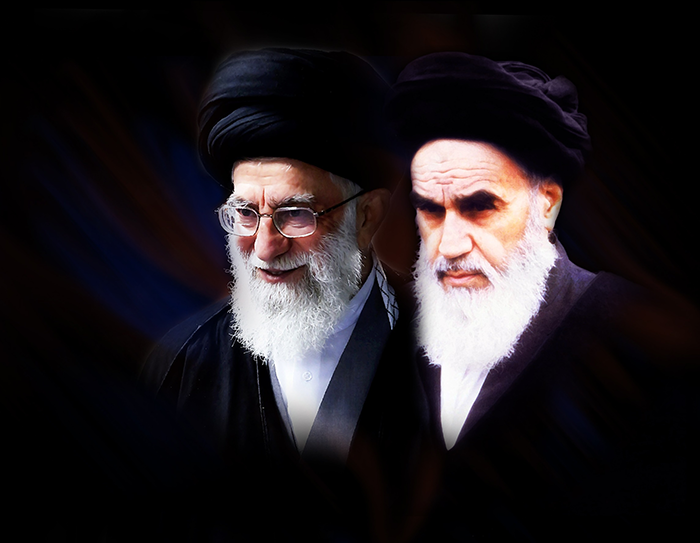
Imam Khomeini, right, the gold standard of Islamic resurgence and self-determination, flanked by his successor, Imam Seyyed Ali Khamenei. Despite the Islamic Revolution following the trajectory of the original Islamic State in Madi-nah and now representing a shining beacon on a hill that cannot be missed after myriad life-threatening struggles and ultimate sacrifices, its two leaders have not been designated by the bulk of the Ummah as its imams. Sad for the Ummah… especially since some emerging Muslim “leaders” are now calling for re-establishing a model of Madinah when one is staring them right in the face.
While it is natural to be impatient for change given the sorry state of the Muslim world, it is important to do the proper homework before starting an uprising. This is not merely a question of theory. First, there must be clarity of thought and purpose; second, there must be a critical mass of people willing to challenge the imposed order and sacrifice their lives in the struggle to overthrow it. If Iran-style revolutions are to occur elsewhere, it is imperative that similar efforts be made — both intellectually and physically.
Acquiring power is not the goal; it is a means to an end: the establishment of Allah’s laws on earth. The leadership of the movement must be muttaqi, not pursuing narrow parochial, class, or personal interests. Taqwa also has to be defined more broadly than simply being “pious.”
Projecting an image of piety in a narrow, ritualistic sense has become the norm. We need to rediscover the Qur’anic definition of taqwa that is rooted in firm commitment to Allah (swt), and the understanding that there is a Day of Reckoning when everyone must account for their deeds on earth. How does taqwa manifest itself in Islamic leadership? In short, leaders must have and display clarity; a key characteristic of successful leadership is clarity — clarity in knowing what to do, clarity in knowing who is going to do it, and clarity in holding accountable the doers for their deeds.
Great leadership demonstrates this clarity by properly understanding the present reality and then choosing a directional course to bring about the desired change. Clarity is a characteristic of those who know that the future is shaped by the decisions that we, as human beings, make today. Clarity is a feature of those who choose a directional course that establishes a sense of urgency, paints a just social and economic vision of the future, and satisfies the security and livelihood needs of every important constituency through the application of Allah’s divine law. In this vein, Allah (swt) says about the muttaqis, “…and as for he who protected himself [against Allah’s corrective justice], He will show him a [new] direction, and He will provide [directions] for him from places he would [otherwise] not have seen; and for everyone who places his trust in Allah, He [alone] is enough” (65:2–3).
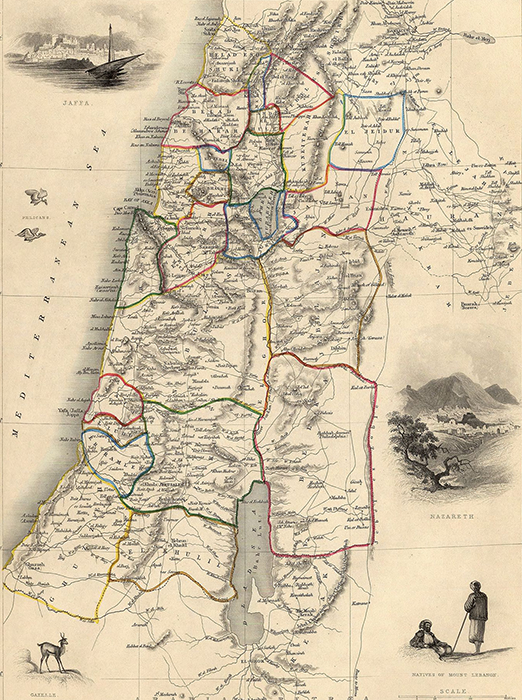
A map of historic Palestine. Are the ordinary Muslims and their less-than-forward-thinking leaders prepared to live confidently in a world that has no Israel? The leaders and military commanders of the Islamic Republic and Hizbullah, who are not disposed to hyperbole, are on track to leave this endowment for the Muslim Ummah within the next ten years.
What gets lost in the translation is that Islamic direction-setting manifests as a byproduct of the mixing of Allah’s Will and the muttaqis’ will. What is also evident in these ayat is that for an activity as important as this, Muslims need to look to none other than Allah (swt). Thus Muslims who merge their consciousness with Allah can emerge from the interaction as powerful leaders. In a nutshell effective leadership furnishes for its flock a strong, unambiguous directional course; direction-setting requires clarity; and Allah shows the way (that is, provides clarity by removing uncertainty). Stated another way, if a leadership claims to be Islamic and the direction it has chosen is not clear, especially to those who have core knowledge, then such leadership cannot be said to have taqwa, and therefore disqualifies from leading Muslims to a more secure and peaceful future.
Through a continual line of prophets from Allah (swt) and their evidence-laden revelations, muttaqi leadership of every era was given an example of how to align a critical mass of committed followers to Allah and His law. These messengers came to remind mankind of their duty to Allah and His creation so that there would be harmony and balance on earth. But Allah did not leave it there; He has commanded His servants to spend of what He has bestowed upon them to help near and distant relatives, the needy, the poor and destitute, and to take concrete corrective action to free people from debt, bondage, and oppression of every kind; in short Muslims must be socially responsible human beings (2:177). If we believe — as we must — that Allah created everything, then His sunan must be implemented in society, not that which we, as human beings with our limited knowledge, perceive to be the right framework for solving the problems of the world.
Equally important, there must be a much clearer understanding of the nature of the dominant systems in Muslim majority societies. There is a general lack of appreciation of this point among many Muslims, including many leading figures in the Islamic movement who mistakenly harbor the notion that there is nothing inherently wrong with existing systems in their societies. They feel that honest people in power positions is all that is required to make these systems work more efficiently and in the general interest of the people. They do not understand that injustice, inequity, and polarity are all threads interwoven into the very fabric of Western secular formulations. They do not understand that justice cannot be manufactured by simply tinkering with injustice. This simplistic approach has caused much confusion among Muslims and led many Islamic movements into a blind alley. Their dismal failure provides ample proof of lack of clarity in thinking. It is time to change this mindset.
That the Islamic movement has venomous and ruthless enemies appears to be among the most difficult lessons for Muslims to learn. In all the Islamic movement literature that we are familiar with, from that of the docile tablighis to that of the revolutionary jihadis, we have never seen a book (or even a booklet) called “Know Your Enemy”.
That the Islamic movement has venomous and ruthless enemies appears to be among the most difficult lessons for Muslims to learn. In all the Islamic movement literature that we are familiar with, from that of the docile tablighis to that of the revolutionary jihadis, we have never seen a book (or even a booklet) called “Know Your Enemy”. That unfortunate but inescapable reality is that Muslims have numerous enemies, both working together and competing to be the most effective in attacking us. The antagonism and revulsion now seen towards the Islamic movement (which is basically the attempts of Muslims to implement Islam) have become the headlines of newspapers, the talking-points of commentaries, and the breaking news of our times. And still large parts of the Muslim Ummah carry on as if the world around is friendly, congenial and – in the particularly fabulous fantasies of some day-dreamers – “sympathetic” to Islam and Muslims. This maladroit inability to recognize and publicize our obvious enemies is perhaps the most disabling shortcoming in all the programmes of the Islamic movement.
Not so with Islamic Iran; or at least not until recently. Imam Khomeini and his followers were never too shy or apprehensive to call an enemy an enemy. But who is this enemy, and how can he be identified? And the answer is simple. Imam Khomeini – as is the case with the Islamic movement in the world at large – stood for freedom from imperialism, liberation from zionism, and the independence of thought and action of Muslims and oppressed peoples everywhere. He took this position a step forward by rallying the Muslims in Iran around these Islamic principles, and then by ending the rule of self-defeatism represented by the Shah and his underlings, by terminating American intrusion in the affairs of Muslims in Iran, and ultimately by expelling Israel and its agents, who provided a crucial element in the relationship between the Shah’s regime and the US. Imam Khomeini and the clear-sighted Muslims around him did not send their military on a mission to conquer America, nor did they formulate a national liberation movement to overthrow the Shah; they did not throw even one grenade in occupied Palestine. All they did was to cleanse Iran of all traces of imperialism, zionism, and authoritarianism.
OVERVIEW
The Islamic Uprising in Iran a quarter of a century ago is too important and too special for Muslims to simply watch it wander from its original and true course. We remember all too clearly the impact this breakthrough had on Muslims everywhere. For the first time in modern history, Muslims had risen against a corrupt government and its imperialist and zionist sponsors, and were able to take control of their own country, and begin to show the rest of us how things should be done.
Of course, the road forward was not likely to be smooth. The sponsors of the Pahlavi regime could not be expected to sit and watch a people shape their own future on the basis of their Islamic faith and commitment. Throughout the last 25 years, America and Israel have been working to bring the Islamic government in Iran to its knees, with the support of their Western allies, Iran’s pro-Western neighbours and even supporters within Iran. Iran’s borders amount to some 8,000 kilometers; American troops are now based across six thousand kilometers of this border. This grim scenario has been gradually built over 25 years, and has passed almost unnoticed by most Muslims, and even most Iranians. There has never been any cessation of hostilities between the followers of the line of Imam Khomeini (r.a.), who refuse to compromise when it comes to the independence and sovereignty of the Islamic state, and the numerous other interests wanting to shape the state on their terms.
Part of our object in this new column is to look at some of the gaps that have developed since the passing of Imam Khomeini (r.a.), many of which are rooted in earlier events, and how these gaps have caused serious problems about which we can no longer remain silent. But before we walk into this sensitive area, one point needs to be made absolutely clear. This is that none of the points we make are intended to express any criticism of Imam Sayyid Ali Khamenei, the successor to Imam Khomeini (r.a.) as Rahbar of the Islamic State. Many of the points we make will be highlighting natural processes in the evolution of post-Revolutionary state and society. Others will indeed involve criticism of errors and failures in Iran, mainly on the part of those who have been responsible for aspects of Iranian government and policy at the executive level. It was inevitable that such errors and failures should emerge over a quarter of a century in an unprecedented and highly-pressured historical situation; unfortunately they have contributed greatly to what many now see as the Islamic experiment’s current stagnation.
Sometimes frank statements of truth can be bitter pills to swallow; we hope no-one will consider this column to be too bitter a pill. We say what we say only to express our honest understanding of the issues. If we are correct, we appeal earnestly to Allah to accept our humble words to our humble readers. If not, we request Allah’s forgiveness and correction from anyone able to do so; without, we hope, descending into personal issues or hidden agendas. Ameen.
It was at this point that the enemies emerged and began to reveal their true colors; and it was at this point that Imam Khomeini did not hesitate to stand firm and identify those enemies in clear, unequivocal terms: the governments of the the United States and the Soviet Union, the Ba’athists and Saddam, the munafiqeen inside Iran, those who opposed the Islamic Revolution and Islamic State, and Israel. This is a long and daunting list of enemies, but it is also a true expression of the reality Islamic Iran faced. With several enemies to confront, it is not wise to launch into war with all of them; the war must be against those who pose the most immediate threat. For Iran, the immediate aggressor was Saddam Hussein, the Ba’ath regime, and their military, which was of course backed also by other enemies. The war imposed on the Islamic State by Iraq ground on for eight long years, and still the Imam showed no sign of accommodating or compromising with the enemy. Iran’s Muslims fought with courage, commitment and strategies that shocked the technologically superior Iraqis and their backers, and tens of thousands of Iranian Muslims gave their lives for unwavering principles and firm belief in the justness of their cause.
And yet, even then, there were constant whisperings of doubt from diplomats, obfuscation from opportunists, even murmurs from committed “revolutionaries” asking ‘is there any end to this senseless war? The Iranians are out of their minds sending ‘children’ to the warfront’ ; and mata nasr Allah? – when shall God’s victory come? At that time no one could understand the mystical dimension of this pursuit of justice, but as the years went by the answer began to unfold. There were two attitudes in Islamic Iran to the enemy. One attitude was that of the late Imam and the fearless and death-conquering mujahideen, many of whom achieved shahada (martyrdom); the other attitude was that of quietist scholars, careerist diplomats, and the ever-present holier-than-thou traditionalists. (The last of whom are the most formidable obstacle of the three; we will have more to say about them in future, insha’Allah.)
There was no decisive victory at the warfront because a large infusion of disingenuousness had permeated the decision-making body in Islamic Iran, from the lower ranks of government to the highest places in the religious institutions. At the same time that Imam Khomeini was saying, in effect, that the US, Israel, and Saudi Arabia formed a core of enmity towards the Muslims and the oppressed, others inside Iran’s governmental departments, religious circles and commercial interests refused to accept that to be the case. They did not say so at the time; but now they feel it is safe to express themselves, and they say such things as: “Khomeini miscalculated”; or “Khomeini made mistakes”, or even “Khomeini was a disaster”! These are the same people who just a decade and a half ago were beating their chests and acclaiming the Imam. Today you look at them and they are “revolutionary ghosts.” These were the zealous followers of the Imam; now they have joined the elitists. They are content with paper-shuffling jobs, and some of them have filed their “revolutionary” pasts as a history to be recalled occasionally perhaps, but certainly not repeated. To them, Imam Khomeini’s days were a close call. And their behavior speaks volumes; they are no longer to be found at public gatherings; they are satisfied with an abridged ‘Shi’i’ version of Islam, one that throws off the ‘idealistic’ and ‘impractical’ issue of Islamic unity and the impossible identification with the affairs of the oppressed.
Allah’s victory comes at a high price. Many people were not willing to pay it. So victory was suspended at the warfront a decade and a half ago. To drive the point home, Saudi Arabia, the United States and (embedded in them) Israel – clearly identified as enemies in Imam Khomeini’s dictionary – have become numbers in the diplomatic directories of those who began this whole process by clamoring for a ‘dialogue of civilizations.’ You can almost hear them in Tehran’s Foggy Bottom, saying: “Let us begin to normalize our relations with Saudi Arabia. Later we can begin normalizing our relations with the United States. We cannot think about normalizing our relations with Israel, but if the Palestinians, one day in the future, reach an accommodation with the Israelis, then who are we to be more Palestinian than the Palestinians?”
Where is Islam in all this? Where are the Islamic principles for which Islamic Iran and the ‘Khomeini generation’ gave their precious sons, their best and brightest? We, the sons of the Islamic movement, are like a family. Some of us turn out to be obedient and others stray from the principles we hold. The weak and rebellious among us are those who railed against Saudi Arabia, the US and Israel yesterday, yet today are buddy-buddy with the Saudis, so-so with the Americans, and “can’t figure it out” with the Israelis. The temptations to deviate are obvious; our enemies offer attractive and seductive faces alongside their hostile ones, and tempt with promises of sweet rewards, even as they also issue dire threats. Many of their inducements and sweet words are proffered by Muslims who, however sincerely, are in effect working for our enemies rather than for Islam and Muslims. The oppressed of the world have little to offer but the promise of righteous struggles ahead, which can look very like problems and troubles to those whose eyes are clouded by pragmatism and dazzled by the mirages offered by our enemies.
But Muslims and Islamic movements of the world: take heed. You cannot have an enemy and a friend in the same entity at the same time. It is either your enemy or your friend. And if you cannot distinguish an enemy from a friend, how can you expect Allah to grant you victory?
 Zafar Bangash