
By Junaid S. Ahmad
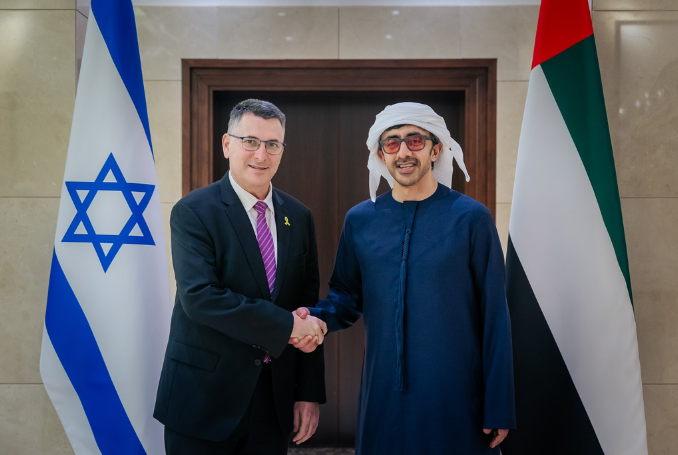 United Arab Emirates Deputy Prime Minister and Minister of Foreign Affairs Sheikh Abdullah bin Zayed Al Nahyan and Israeli Foreign Minister Gideon Sa’ar. (@OFMUAE X Page)
Abu Dhabi has engineered a 21st Century foreign policy machine: contain populism, suppress political Islam, neutralize democratic insurgency and cultivate compliant elites, from Libya, to Yemen, to Karachi, to Somalia, to Sudan. States have been turned into franchises.
Empires no longer need gunboats. In today’s Middle East, they arrive on private jets, armed with sovereign wealth funds, private intelligence outfits, and “humanitarian cargo” that occasionally rattles like something less charitable. And the most ambitious of these modern power-architects is not a sprawling giant – it is a glimmering federation on the Gulf: the United Arab Emirates.
Abu Dhabi has engineered a 21st-century foreign-policy machine – part venture capital firm, part covert-operations hub, part absolutist monarchy with a Silicon Valley UX. What it lacks in population, it compensates for in money, strategy, and a willingness to perform quietly what others no longer dare to attempt loudly.
According to both fans and critics, its doctrine is blunt: contain populism, suppress political Islam, neutralize democratic insurgency, and cultivate compliant elites from Tripoli to Karachi. It is an empire by liquidity rather than legions, annexation via influence rather than borders.
2011: The Panic that Built a Doctrine
The Arab uprisings terrified Gulf palaces. Where many saw citizens claiming dignity, Abu Dhabi’s ruling circle saw a biological threat – political contagion capable of toppling kings and colonels, alike. If ballots and minarets could dethrone presidents in weeks, what might happen in monarchies with vastly more wealth at stake?
So a worldview hardened: stability must be manufactured; dissent must be pre-empted; self-determination is a privilege reserved for stable neighborhoods, not fragile regions.
The method crystallized:
* Back generals, not voters.
* Fund patronage, not parliaments.
* Buy ports, train militias, shape media, lease loyalty.
* Manage states like subsidiaries in a region-wide holding structure.
And running quietly through this strategy, critics note, was growing coordination with Israel — long before the Abraham Accords made it fashionable. Intelligence contacts, security cooperation, shared hostility toward political Islam, and common cause against grassroots Muslim democratic movements formed a discreet strategic bonding agent. When formal normalization arrived, it merely illuminated what analysts say had existed in the shadows.
As one Middle Eastern scholar put it: The Abraham Accords were the wedding announcement, not the courtship.
Libya and Yemen: Field Tests in Proxy Rule
Libya became the first testing ground. A strongman is identified. Contractors fly in. Drones hum. Denials follow. Libya remains split, but a loyal enclave emerges along the Mediterranean — fragmented sovereignty, stable access.
In Yemen, the UAE entered as a coalition partner and then, mid-conflict, pivoted: empower southern secessionists, secure ports, exit the front-line bloodbath. The humanitarian ledger? Catastrophic. The strategic balance sheet? Impressively positive.
Sudan: Gold, Guns, and Ghost Networks
In Sudan, critics say the model reached its darkest efficiency: gold routes linked to weapons’ flows, a rebel apparatus evolving into a war-corporation, and a democratic transition strangled in the cradle.
International monitors documented suspicious supply chains; Sudan’s government went so far as to accuse the UAE before the world’s highest court. The case collapsed procedurally, but the ethical cloud has not lifted.
This is stability marketed as investment – profitable, deniable, devastating.
Pakistan: The Coup Conducted in Suits, Not Camouflage
But nowhere is this method more refined than in Pakistan. The coup came, not with tanks, but with televised parliamentary theatrics and generals on silent headsets.
Imran Khan – the first leader in decades to rally real mass energy – was deeply inconvenient. He rejected foreign military basing, resisted normalization with Israel, and championed Muslim sovereignty beyond Gulf tutelage. Critics argue that this placed him in the crosshairs of a regional order knit by Western security interests, Gulf absolutism, and deepening Emirati-Israeli strategic convergence. When Khan called for an independent foreign policy – and refused to genuflect before what analysts describe as a “Zionist-aligned regional security framework” – his political days became numbered.
April 2022 delivered the verdict. Pakistan’s military-political syndicate removed him, cheered quietly by foreign chanceries. Washington denies involvement; Abu Dhabi disavows comment. But few Pakistanis doubt the alignment of interests. Their democracy, fragile on its best days, was treated like a seasonal garnish – something to decorate state functions, not govern the state.
And, right on cue, Gulf investment delegations landed. Pakistan’s new military-dominated investment council – insulated from parliamentary oversight – rolled out the fiscal red carpet. Ports, mines, energy grids, aviation assets – all glistened with privatization prospects.
Remittances became leverage. Visas morphed into political signaling. Sovereignty began to resemble a negotiable commodity.
Pakistan’s rulers – generals, land barons, dynastic politicians – behaved not as guardians of a republic but as loyal franchise managers. Why use tanks when your oligarchs eagerly pre-empt the need?
This was not regime change by force. It was regime change by balance sheet.
Empire in the Age of Contracts
Across Libya, Yemen, Sudan, Somalia, and Pakistan, the pattern rhymes:
* Empower the faction hostile to grassroots politics
* Reward obedience, punish autonomy
* Acquire ports, corridors, security levers
* Call it “stability” – sell it as modernization
From Abu Dhabi’s vantage point, the logic is coherent: better a predictable general than a volatile electorate; better a compliant elite than a self-assertive public. And, for Israel, analysts say, this Gulf-led regional order is a geopolitical windfall – one that keeps democratic Islamic politics suppressed and aligns Muslim power centers with its strategic vision.
But states turned into franchises cannibalize themselves. A region stabilized only for rulers becomes a region primed for rupture.
After the Silent Empire
Western capitals remain tactfully mute. The UAE buys fighter jets, hosts military bases, invests in Silicon Valley, and is never sermonized about human rights. In a world of transactional geopolitics, that is diplomatic gold.
Yet, history whispers a warning: you can postpone democratic agency – not extinguish it. Bottled demands do not dissipate; they ferment.
When the bill for this micro-imperial experiment arrives, it will not be paid by princes or property moguls. It will be paid by citizens in Karachi, Aden, Khartoum, and Tripoli – people who never consented to be collateral in a regional security-finance pact.
The UAE’s model is undeniably effective. It is also undeniably brittle. You cannot indefinitely subcontract a region’s politics to generals, bankers, and foreign patrons and expect stability to last.
Even the quietest empire eventually hears the roar it tried to silence.

– Prof. Junaid S. Ahmad teaches Law, Religion, and Global Politics and is the Director of the Center for the Study of Islam and Decolonization (CSID), Islamabad, Pakistan. He is a member of the International Movement for a Just World, Movement for Liberation from Nakba, and Saving Humanity and Planet Earth. He contributed this article to The Palestine Chronicle.

No comments:
Post a Comment