
By Romana Rubeo
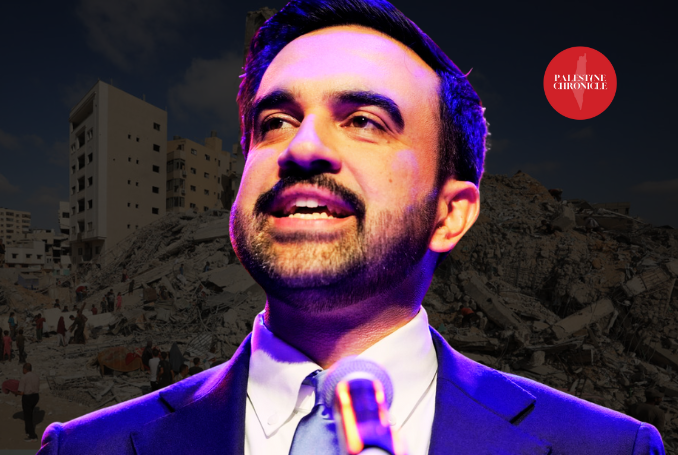 The newly-elected mayor of New York, Zohran Mamdani. (Photo: via Wikimedia)
Gaza has become a domestic political lens for a new generation of voters, reshaping how power is evaluated at every level of government.
Zohran Mamdani’s election as Mayor of New York City on November 4 is being interpreted in familiar terms: the rise of a progressive coalition, the strength of tenant and labor movements, and the persistence of grassroots campaigning in an increasingly unequal city.
These narratives are not wrong, but they obscure a central dynamic that played a decisive role in this race and is already reshaping political behavior far beyond New York: the influence of Gaza.
Israel’s genocidal war on Gaza over the past two years did not remain a foreign policy issue contained to Washington. It altered political consciousness across the United States, particularly among younger Americans and multiracial, working-class communities concentrated in cities like New York.
Mamdani’s victory is not simply a result of his individual platform or personality. It reflects the emergence of Gaza as a powerful organizing framework, one that connects global violence to domestic inequality and demands coherence across them.
While many candidates avoided the issue or approached it with caution, Mamdani has consistently referred to Israel’s actions in Gaza as a ‘genocide’, spoken consistently against US military aid to Israel and called for a permanent ceasefire.
This framing did not originate in campaign messaging rooms. It emerged from the ground.
Over the past two years, much of New York’s youth-led protest energy has centered on Gaza: university encampments, student walkouts, professional resignations, boycott campaigns, and neighborhood-based organizing. For thousands of young New Yorkers, Gaza became the issue through which they understood political responsibility and the nature of state power.
Polling during the 2024–2025 period consistently documented a generational shift: Americans under 35 were more likely to express sympathy for Palestinians than for the Israeli government, and more likely to oppose US military aid to Israel. These trends were strongest in major cities, and especially strong in New York.
What these numbers did not capture was the degree to which Gaza became a practical organizing infrastructure. Groups that had previously focused on housing, public space, policing, and labor conditions found themselves working alongside Palestine-focused mobilizations. Mutual aid networks became channels for ceasefire organizing.
This is where Mamdani’s campaign aligned with the movement that formed before him. He did not have to generate momentum around Gaza; it already existed. He did not have to persuade young voters that the war was relevant to municipal governance; they were already acting as if it was. His role was not to inspire the movement but to recognize it and speak in the language it had already established.
In contrast, candidates who attempted to bracket Gaza as “outside the scope” of city governance appeared out of step with the electorate that now understands political life as globally interconnected. The traditional division between domestic and international political responsibility has eroded. Gaza accelerated that process.
It also reshaped political trust. Politicians who refused to take clear positions on Gaza, or who softened their statements under pressure, were likely perceived as unreliable on other matters.
Whether Mamdani’s administration will satisfy those expectations is uncertain. Governing a city with entrenched financial interests, federal oversight constraints, and decades of policing infrastructure will place immediate limits on what can be achieved. The election result does not resolve those contradictions.
But it does make one reality unavoidable: Gaza has become a domestic political issue in the United States. Not in the sense of charity or humanitarian sympathy, but as a framework for understanding power.
(The Palestine Chronicle)
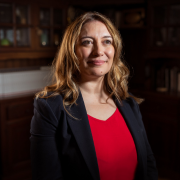
– Romana Rubeo is an Italian writer and the managing editor of The Palestine Chronicle. Her articles appeared in many online newspapers and academic journals. She holds a Master’s Degree in Foreign Languages and Literature and specializes in audio-visual and journalism translation.

No comments:
Post a Comment