
By Robert Inlakesh
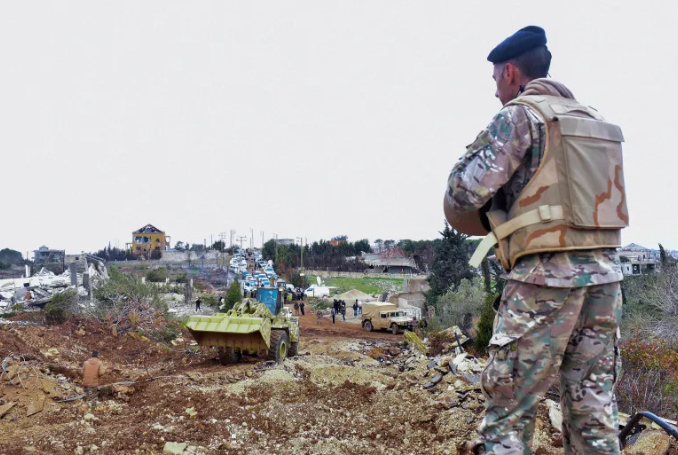 Lebanese soldiers in the south of the country. (Photo: via AJA)
Israel’s goal is to eliminate its regional opposition entirely. In Lebanon, the US-Israeli alliance has pursued the push to disarm Hezbollah. The Israeli strategy is to outmaneuver the Lebanese group by opening new rounds of war, while imposing immense suffering on the people.
Israel is now threatening to open up another war against Lebanon and is initiating a propaganda campaign to justify its actions. It has, in reality, violated the ceasefire every day since it was imposed and its strategy is to eventually push the State to internal chaos and collapse.
While it may be well known, at this point, that Israel continues full steam ahead on the war path with Lebanon, as it threatens to bombard Beirut and escalate its ongoing bombing campaign, there are two important points that are necessary to understand what is truly going on.
The beginning of any conversation on the issue is to understand that Israel alone is the reason for the conflict and that its propaganda surrounding Hezbollah’s disarmament is disingenuous. From there, we can properly assess what the Israeli strategy is in Lebanon and what it seeks to gain.
Israeli media is currently ripe with analysts and military officials commenting about the rapid re-armament of Hezbollah, even claiming that, in one year, the Lebanese group has managed to rebuild to the extent that internal estimates believed only to have been possible in a 15 to 20-year time frame. In the Hebrew media framing of events, it is clear that the justification for a new military operation in Lebanon is explained through a “security” lens, arguing that war is necessary to weaken their greatest adversary to the north.
Meanwhile, in the Gulf and Western-owned Arabic media, along with English-language corporate media, their coverage depicts a failure of the Lebanese government to disarm Hezbollah as the primary issue at hand. The framing harbors the point that the problem here pertains to Hezbollah’s weapons, that this is the reason for the conflict, and that, while Israel may not be helping the situation, the guilty party is the so-called “Iranian proxies”. This line of reasoning argues that, given Hezbollah’s disarmament, Lebanon will be transformed and return to some notion of its “glory days” of old.
Immediately, here there are two narratives that are not congruent, despite bearing some similarities and arguing from the same pro-Israeli point of view, which should be a major red flag for anyone who is looking at this issue critically.
Israel’s Claims about Hezbollah’s Weapons
Ever since the ceasefire was supposed to come into effect late last November, Israel has violated the deal over 7,000 times according to UNIFIL figures. Hezbollah, on the other hand, has not violated the agreement.
According to the ceasefire agreement, the Israeli military should have long withdrawn its forces from the south of the country, yet it has vowed to permanently remain inside what it now considers a security zone; in other words, an illegal occupation of Lebanese lands.
Meanwhile, the Lebanese army has adhered to the deal by dismantling sites used by Hezbollah south of the Litani River, while the group itself agreed to begin disarmament in this zone. Despite this and the work done to remove Hezbollah’s military presence in southern Lebanon, the Israelis only expanded the zone of illegal occupation, continued their strikes, murdered more civilians, and seized more Lebanese hostages. Israel has even struck the Lebanese capital a number of times since the ceasefire was imposed, to which there was no response from Hezbollah.
When it comes to the issue of total disarmament, Hezbollah has rejected this notion. Earlier this year, Lebanese President Joseph Aoun had attempted to reach a deal whereby Hezbollah would surrender its weapons to the Lebanese Army and integrate within it, as a national defense strategy was put together. Israel and the United States both rejected such an idea.
The Lebanese public was then polled on this issue and overwhelmingly expressed their opposition to disarmament, in the event that there is no national defense strategy in place, fearing that the Lebanese Army itself could not defend the country against existential threats posed by its southern and eastern borders.
Despite this, under the orders of US envoy Tom Barrack, Lebanese Prime Minister Nawaf Salam decided to push forward with the agenda to totally disarm Hezbollah by later this year, a task widely viewed as impractical and likely to lead to civil war if attempted violently. Both Washington and Tel Aviv pushed for this, regardless, offering Beirut nothing in return, only threatening to escalate tensions.
Hezbollah itself was born out of the 1982 Israeli invasion of Lebanon, created to resist the illegal occupation of southern Lebanese territory. Immediately upon its founding, it understood the importance of bearing arms and continuing to resist, until the very last drop of blood. The reason for this is simple: they had the example of what had just happened to the Palestine Liberation Organization (PLO).
After Israel murdered around 20,000 people in Lebanon and besieged the PLO’s leadership in Beirut, the group’s Chairman, Yasser Arafat, agreed to “end” the war through disarmament and moving his leadership to Tunisia. Once the Palestinian Resistance was no longer there, the Israelis then occupied southern Lebanon and, along with their fascist militia allies, committed massacres against innocent women and children. These massacres, which targeted primarily Palestinians, but also Lebanese Shia and others, were amongst the worst in the history of the conflict, such as the infamous Sabra and Shatila camp massacre that killed as many as 3,500 civilians alone.
What led up to the 1982 invasion was that the PLO found itself in a very similar scenario to Hezbollah today. The Israelis constantly violated the existing ceasefire agreement, attempting to draw a response that would justify further military operations, to which the PLO did not bite.
The PLO, for its part, was not only adhering to the ceasefire, it was also heading up a diplomatic mission that was paving the way for a “two-State solution” process, in line with the organization’s 10-point plan and Saudi Arabia’s Fez Initiative. The Israelis branded this as the PLO’s “peace offensive”, viewing it as a threat and seeking any excuse to invade Lebanon, which they finally found with an incident that the PLO had nothing to do with.
Hezbollah managed to struggle against Israel for decades, forcing them to abandon their occupation of the south in 2000, and later thwarting an Israeli invasion in 2006. After this, despite Israel still occupying the Sheba’a Farms and Ghajar village, Hezbollah’s weapons managed to cause a deterrence scenario, whereby they achieved nearly 17 years of relative calm. The Israelis would not dare to bomb their territory.
On October 8, 2023, Hezbollah’s Secretary-General, Seyyed Hassan Nasrallah, would then change this equation by entering into a support front battle, in order to fight alongside the people of Gaza and ensure their victory. The first operations carried out by Hezbollah targeted military sites illegally occupied by Israel in the Sheba’a Farms, a move not prohibited under international law.
The Israeli response then came against Hezbollah sites and civilians in southern Lebanon, soon including the targeting of journalists, medical workers, women, children, and the elderly. Therefore, Hezbollah began escalating its attacks and responding by hitting military sites, then eventually strategically striking settlements in a tit-for-tat battle. While Israel murdered hundreds of civilians in Lebanon, only a dozen Israeli non-combatants were killed by Hezbollah’s fire, which almost entirely focused on military sites and strategically hit settlements.
Even after Israel’s pager attacks across Lebanon, which murdered and maimed women and children, not just Hezbollah members, killing dozens and injuring thousands, Hezbollah still intended to keep its military operations limited to a support front and not all-out war. Then, the Israelis imposed a war on Lebanon, anyway, killed up to 5,000 people in total, assassinating Hezbollah’s senior leadership, and invaded the country with the intent of reaching the Litani River area.
Hezbollah managed to carefully manage the war, not letting it boil over into an all-out extermination campaign as had happened in Gaza, also succeeding in halting the Israeli military’s ground advances in the south.
Despite the words of Hezbollah’s martyred leader, Seyyed Hassan Nasrallah, in his last speech, vowing to continue firing until a ceasefire is reached in Gaza, the group eventually decided that it would agree to a ceasefire in order to stop the war from escalating to the next phase: anticipated to bring the all out destruction of Beirut.
What Israel’s Agenda Entails
At this point, after reading the above-mentioned context provided, a reasonable skeptic would argue the point that Israel agreed to the ceasefire and, therefore, they must be interested in peace or, at least, their intentions are not as malicious as is being argued. To which the natural answer has been that the Israelis repeatedly violated every tenet of the deal they had agreed to.
Yet, this explanation is not sufficient to explain away the Israeli counterpoint often made. A more rounded answer to this question not only explains why Israel agreed to the ceasefire at the time, but also what their current strategy is.
While Israeli propaganda has it that Hezbollah had been defeated, that some 90 percent of their weapons were destroyed and its mission was completed, the truth is that the war was reaching a boiling point.
In late September and early October of 2024, the Israelis had pulled off their most significant tactical victories against Hezbollah. Their pager attacks, bombings against major weapons depots, and assassinations of senior officials were all massive blows against Hezbollah.
Yet, by late November of 2024, the Israelis had failed to advance any significant distance in southern Lebanon on the ground; they had also gotten themselves tangled up in a deadly tit-for-tat battle. Although the Israeli strikes did far more damage, Hezbollah was revealing and firing new kinds of munitions, day in and day out, even striking high-rise buildings in Tel Aviv.
It was clear to anyone following the course of the war that Hezbollah had an abundance of weapons that were not about to run out, but that the group had also been greatly shaken up. On the Israeli side, their weapons were never going to run dry, yet they failed to achieve anything too significant after the first few weeks, and their ground forces were taking a beating.
After Hezbollah proved it still possessed ballistic missiles capable of striking high-rise buildings in the heart of Tel Aviv, it was clear from the threats being issued by the Israeli leadership that a new phase of the war was afoot. This clearly was not about defeating Hezbollah and would have resulted in destruction against Israeli-held cities that had not yet been seen.
Therefore, understanding that repeating the Gaza model of destruction in Lebanon was not going to serve either side, both agreed to a ceasefire. The result was a stalemate, yet politically and in terms of public perception, the Israelis clearly had the edge.
Hezbollah could not credibly claim a victory and was clearly desperately in need of repair, after suffering severe blows to everything, from its chain of command to its communication, intelligence wing, political standing, and even its weapons. According to multiple sources inside Lebanon, up to 25 percent of Hezbollah’s weapons were destroyed. Although this is nowhere near the Israeli numbers, it is certainly significant.
Tel Aviv saw that, through their actions, they were capable of seriously shaking Hezbollah and putting them in a terrible political predicament, but eliminating them altogether was a goal that clearly failed.
So, the next step was to pursue this goal through other means. Instead of dissolving and the public support for the group evaporating, the base of the group inside Lebanon had doubled down. To them, what was done specifically to their former leader, Seyyed Hassan Nasrallah, ignited an everlasting fire, inflicting emotional pain that exists in each household until this day.
Israel then sought to impose an equation whereby they could fire at will in Lebanon, while forcing the pro-American stooges picked to run the government to do their bidding. Naturally, the US and Israel knew that the disarmament of Hezbollah was never going to happen by the end of the year, and, without any roadmap as to how to achieve it, there was not even the slightest chance of success with this strategy.
Nevertheless, the US-Israeli alliance has pursued this push to disarm Hezbollah, the Iraqi PMU, Hamas, along all the Palestinian resistance factions, through political maneuvers and agreements.
While ceasefire agreements hold in both Gaza and Lebanon – translating to Israel reducing its attacks while its enemies actually respect the agreements – they scheme for the next inevitable round of confrontations.
Before proceeding with this line of analysis, it is important to establish Israel’s goal, which is to both conquer or impose its will on more territory and eliminate its regional opposition entirely. A perfect demonstration of what happens in the event of disarmament is the case of Syria, where the Israeli military continues to illegally occupy more territory, arm separatists to fight a government it is dealing directly with and refuses to allow the country to enjoy any sovereignty.
The new Syrian government has collaborated with the Israelis openly in the south of the country, worked on their behalf to stop weapons transfers into Lebanon, kicked out and disbanded all the Palestinian resistance groups in the country and is openly aligned with the US. Despite all of the Syrian regime’s pandering, the Israelis are still arming groups to divide the country into separate sectarian regimes and bomb it, at will, additionally refusing to allow the rebuilding of the Syrian army.
On October 7, 2023, the Israelis suffered a severe blow, yet they also saw an opportunity to go after every one of their opponents and to carve out their “Greater Israel Project”, which its Prime Minister Benjamin Netanyahu admits to and frames as a “seven-front war”.
In this regional war, Iran is its strongest opposition. However, they have no actual ground options against the Israelis, meaning that as long as any round of conflict with the Islamic Republic is short, they can survive. Hezbollah, on the other hand, has a ground force consisting of around 100,000 men, which makes up for the lack of parity when it comes to missiles and other capabilities.
Incapable of winning any decisive victory over Hezbollah, the Israeli strategy is to put the Lebanese group on the back foot, to open up new rounds of war that will set them back further, each time damaging them, but not inflicting a total defeat. This strategy means that the wars have to be limited and not all-out.
In the Israeli mindset, the Lebanon question is similar to the Gaza question. Solving it is not only destroying Hamas or Hezbollah, because another group will inevitably rise to assume their position. The issue is to use proxy groups, whether sectarian or extremists of whatever flavor, to divide society and turn their focus on within. It is a process by which the people there must be re-educated, propagandized, forced into internal division and controlled as slaves who adhere to Israel’s regional ambitions. Syria is a great example of Israel’s dream.
When we now turn to Israel’s most recent threats against Lebanon, we are in a phase of political pressure being applied upon the government in Beirut, but also on the public, which is collectively anxious about the perceived inevitability of war. Should that war soon come, the Israelis will seek to achieve their goals quickly, impose immense suffering and then go back to a ceasefire, similar to what we have now.
If Hezbollah fails to inflict a perceived defeat upon the Israelis, it will severely damage their image and even sow doubt amongst their own supporters, who all long for revenge. Not only do they seek revenge for what Israel did last year, but they continue to suffer daily oppression at the hands of the occupying force that remains in the south of their country.
The Israelis believed that symbolically imposing their dominance over the Lebanese people, something clearly on display with the fighter jet flyover of Beirut during the funeral of Seyyed Hassan Nasrallah, they could beat the people’s spirits down. For now, they have only grown more motivated towards revenge.
Broadly speaking, the public perception, even amongst Hezbollah’s most die-hard supporters, is that Israel is militarily superior and the old perception of the Lebanese group’s power is gone. From an Israeli perspective, this is a good thing, yet it could also serve as the opposite in any future battle.
Hezbollah was perceived as a massive victor in the 2006 war, not because they decisively defeated Israel, but because they were such a massive underdog and still managed to dictate the pace of the conflict in many regards. Mere survival for such an armed group was considered a victory, let alone the master-class pulled off by the group during the war. Back then, Hezbollah did not possess weapons that could hit Tel Aviv, let alone guided ballistic missiles and suicide drones. In many ways, it was comparable to the power of Hamas on October 7, 2023.
Therefore, if Hezbollah plays its cards correctly this time around, it could come off with what is considered a devastating defeat of Israel. The problem with this will be Israel’s reaction to its own failure, as we are no longer in the era of 2006-style battles being permissible, as was the case in Gaza; the Israelis could exit a battle, as occurred in 2014, and be content, but not now. If the Israelis start getting embarrassed in Lebanon, they could feel the need to escalate further.
This is where two major questions arise: Will Iran fight alongside Hezbollah? And how far are Hezbollah willing to go?
Under the scenario that Iran joins in, this could lead to two potential outcomes: A much broader war or an intervention that forces the Israelis to close the war and accept defeat. The Iranians also have their Iraqi Popular Mobilization Units (PMU) allies, who number above 250,000 and could potentially be used to fight Israel, also.
The reason why Iran could decide to throw its weight behind Hezbollah, this time, is down to the inevitability of another US-Israeli attack on them and the fact that losing Hezbollah could spell strategic defeat.
As for the question of how far Hezbollah is ready to go, if its current Secretary-General, Sheikh Naim Qassem’s rhetoric about waging “a Karbalae battle”, that is to say a war to the death, then we should expect their forces to enter the northern Galilee. If this occurs, Israel will interpret it as another October 7-style failure, meaning the number of civilians we can expect them to kill across Lebanon will be unprecedented.
If Hezbollah fighters breach the borders, this will provide a moment of truth for the Palestinian Resistance in Gaza, as well. What the groups in Gaza will do is impossible to predict, but there will certainly be major decisions that will have to be made in such a scenario.
All of this is, to some extent or another, understood by the Israelis. They know the dangers of pursuing this course of action and what happens if it spirals out of control, yet it appears as if they are willing to take these chances. So far, the Iranians have decided to hold back and so the Israelis have walked away from each round, having achieved some objectives and only suffering minor consequences.
If Israel gets its way, it will seek to continue its phased attacks on Gaza, Lebanon and even Iran, each time attempting to score new victories and to inflict major psychological blows on the populations inside these countries. Israeli victory hedges upon limited confrontations and maximum civilian suffering, to rob the people of their sense of stability, their faith in victory, and to divide them, turning the people on each other as a means of crippling their leadership.
(The Palestine Chronicle)
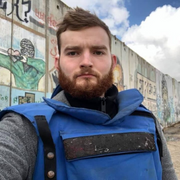
– Robert Inlakesh is a journalist, writer, and documentary filmmaker. He focuses on the Middle East, specializing in Palestine. He contributed this article to The Palestine Chronicle.

No comments:
Post a Comment