Saturday, October 31, 2026

The US Has Withdrawn Its Troops – But Has It Really Left Iraq?

By Robert Inlakesh

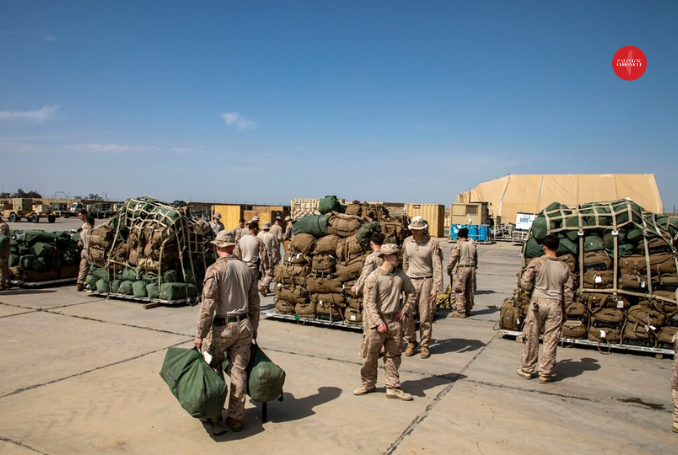
US troops have withdrawn from Iraq. (Photo: Military Times// Wikimedia Commons)

US troops have withdrawn from Iraq, but Washington retains extensive financial, political and security leverage over the country it invaded.

On the face of things, US President Donald Trump’s announcement of withdrawal from Iraq appears to be a step in the right direction, perhaps even the beginning of a new era for the nation that has faced endless decades of war. However, the picture here isn’t quite that simple.

More than 23 years after invading Iraq and overthrowing its government, the US has announced that its war is over and it has withdrawn all of its service members from the country. Now, its next step is disarming the country’s resistance factions and ensuring that it will wind up just as defenseless as it was in the face of the ISIS insurgency in 2014.

October 21, 2011, former American President Barack Obama announced the end of the Iraq War and full withdrawal of troops; only two and a half years later, he was sending his soldiers back, this time at the request of the government in Baghdad. The reason was the overwhelming force of the ISIS assault; the Iraqi military was simply incapable of defending against the Takfiri movement and required assistance.

When Obama sent soldiers into Iraq, he only authorized the deployment of 5,000 personnel and would go on to provide air support against ISIS militants. Meanwhile, militia groups began forming in June of 2014 to put up a real resistance to the terrorist takeover of their nation’s territories. 

Putting aside the question of who was truly behind the sudden emergence of ISIS, the bottom line is that the United States had gutted the Iraqi State and left in its place a corrupted shell. There was no army capable of upholding the nation’s sovereignty, as tens of thousands of militants alone easily took over major cities. The invasion in 2003, which turned into an occupation, followed up with a so-called nation-building project, was the twisted process of demolishing Iraq’s sovereignty.

The men who actually defeated ISIS on the ground belonged to militia groups, formed with the help of the Quds Force of neighboring Iran’s Islamic Revolutionary Guard Corps (IRGC). This collection of militias was called the Hashd al-Shaabi, or Popular Mobilization Units (PMU) in English. General Qassem Soleimani led this anti-ISIS project and helped build significant power for Iraqi militia groups, most of which were composed of Shia Muslims who owed allegiance to the Marja of Ayatollah Seyyed Ali Khamenei, Iran’s former Supreme Leader.

Iran jumped in to ensure that the Iraqis could resist ISIS for three primary reasons: They sought to prevent the ISIS insurgency from spilling over their own border; they owed allegiance to their co-religionists and sought to protect Shia Holy Sites; and they also saw an opportunity to expand the footprint of the Axis of Resistance.

Under the US’s so-called “Operation Inherent Resolve”, Washington was able to conveniently get a foothold inside Iraqi territory, granting it access to key supply routes that would later aid their regime change project in neighboring Syria. Without access to Iraqi territory, their occupation of north-eastern Syrian lands – where the country’s oil wealth and most fertile agricultural lands are located – would not have been possible.

Now that the regime change in Syria has been completed, they have become the backers of the new administration inside Damascus. In addition to this, during the 40-day war on Iran earlier this year, US bases and forces took enormous hits from Iran and its Iraqi militia allies alike. This military pressure, combined with the lack of a need to physically remain, prompted the withdrawal that Trump had pledged all the way back in his first term as President.

The US claims it “defeated ISIS”, when the reality is that they simply provided air support when it was convenient for them. The Hashd al-Shaabi actually defeated ISIS inside Iraq. Trump, meanwhile, assassinated leading figures within the PMU like Abu Mahdi al-Muhandis, alongside Iran’s top general, Qassem Soleimani. Even in neighboring Syria, the US only lost a few dozen service members fighting ISIS on the ground, while their Kurdish-led Syrian Democratic Forces (SDF) allies lost around 11,000 fighters doing so.

All of this is to say that the US departure may have been encouraged by Iraqi and Iranian attacks on their forces, but they have not actually left Iraq. The Prime Minister of Iraq, Ali al-Zaidi, is under the thumb of the United States and is by far the most pro-US Premier we have seen in many years.

The United States not only set up a Confessionalist Government in Baghdad, based on sectarian quotas, but they also ensured that it would be the most corrupt system possible. Baghdad’s revenues that feed its State budget are all deposited in the Central Bank of Iraq account at the Federal Reserve Bank, located in New York. This was a result of a mechanism built into the US’s Development Fund for Iraq.

Around 90% of Iraq’s State revenues come from its oil sector, which, as explained above, goes through a system that is totally dependent upon the United States allowing Baghdad access to its own funds. In order to grant the Iraqi State its funds, the US periodically transfers $500 million in physical cash shipments to the Central Bank of Iraq.

In addition to this, US corporations are invested in Iraq’s oil sector, its energy infrastructure, education, and even the transportation sector. America also asserts power culturally through an extensive network of non-governmental organizations inside the country too. Then there is the fact that the Iraqi State’s security sector is aligned with that of the US, which provides technology, engages in intelligence sharing, and is virtually joined at the hip.

When the US partners with regional countries to train their soldiers and ally with them in the security, military, and intelligence fields, they do so in order to ensure that they are dominated and do not act to damage their influence. Take Lebanon, for example: its Army is supplied and trained by the US armed forces, yet it is so weak that it basically functions as a glorified police force. Another example is the former government of Afghanistan and its armed forces, which fled immediately and collapsed like a deck of cards the moment the United States left the country.

Iraqi PM Ali al-Zaidi, Lebanese Premier Nawaf Salam, along with Syrian President Ahmed al-Shara’a, all talk about their intentions to restore national sovereignty – that is, while the United States tugs at the chains tied around their necks. None of them are allowed to develop any militaries capable of self-defense; none of them are granted the ability to determine their own policies vis-à-vis the region. All three of these Washington-backed leaders carry more or less the same message: Iran is the problem, and the solution is subservience to the West.

If Iraq truly wanted sovereignty, it would have to break away from its dependence on the US’s physical $500 million cash transfers, but in order to do that it would mean risking immediate creditor seizures connected to roughly 40 billion dollars of debt that had been racked up under the previous leadership of President Saddam Hussein.

In other words, the modern Iraqi State was built by the United States. It is not allowed to possess strategic weapons, has no sophisticated air defenses, has an army that has been limited by the United States, and its security sector is joined at the hip with the CIA. US and Western corporations are heavily invested in the nation’s infrastructure; its oil revenues are shipped off to New York and can be held hostage at any time if the White House doesn’t approve of the country’s policy decisions.

Yet, the argument is that because of naturally occurring trade ties with a bigger and more powerful neighboring country, one that hasn’t undergone a regime change operation tearing down the entire State, it is the Iranians who “occupy” Iraq. 

Pro-war Washington-based think tanks – the same ones that helped lie the US into the 2003 invasion – claim that the Islamic Resistance in Iraq is the biggest problem the country faces. This alliance of militias, which includes some of the prominent PMU groups, in addition to the newer Awliya ad-Dam movement, is presented as the big problem. However, without these groups, who would have defeated ISIS? Furthermore, without them, would the US even bother to withdraw its soldiers from the country in the first place?

The United States spent around $3 trillion on the Iraq War; it also spent a bare minimum of $12 billion dollars to ensure regime change in neighboring Syria – that we know about. They were never going to engage in such costly endeavors just to allow those countries to flourish the moment they “leave”. In fact, framing it as if the US has somehow left Syria and Iraq is simply wrong.

Iraq is a country that the US still holds hostage. Now its big project is to disarm the Islamic Resistance in Iraq, just as it is pushing to disarm the Palestinian resistance in Gaza and Hezbollah in Lebanon. In the cases of Iraq and Lebanon, the US-backed official armed forces of those nations are not capable of simply seizing the weapons of the resistance factions, moves that could trigger civil wars. For all these reasons and more, the US has not actually left Iraq; it will remain until a leadership takes over that is run by the Iraqi people and for the Iraqi people.
– Robert Inlakesh is a journalist, writer, and documentary filmmaker. He focuses on the Middle East, specializing in Palestine. He contributed this article to The Palestine Chronicle.


Britain’s Green Party Backs One Democratic State in Palestine: What Comes Next?

By Alain Alameddine & Saman Hasan

Britain’s Greens have formally adopted an anti-Zionist policy supporting BDS, Palestinian right of return and one democratic state. (Photos: Via Green Party IG Page)

This is not the first motion of its kind. This motion, however, has caused a louder stir. This should push a number of actors to move in this liberatory democratic direction.

On October 4, 2026, the UK Green Party officially adopted a motion formally establishing it as an anti-Zionist party and calling for the establishment of a single democratic Palestinian State with equal rights for all.

What are the motion’s key statements? What truth is there to accusations of antisemitism and anti-Palestinianism? And what does the motion mean next for Palestinians and allies?

Key Points

Named “Zionism is Racism”, the motion points to Zionism as an ideology that calls for the existence of an “ethnonationalist Jewish State in historic Palestine to the exclusion and/or domination of the non-Jewish population”, and a practice that has caused the “dehumanization, displacement, dispossession, disenfranchisement and destruction of Palestinians”. It also points to the fact that Zionism was based on European settler-colonial systems of domination and that it has created racial hierarchies between Jews. Accordingly, it labels Zionism as racist, and the Green Party as anti-Zionist. 

The motion also calls for a single democratic state in Palestine, including the right of return. Interestingly, it does not both-side the colonizers and the colonized by speaking of “Israel-Palestine” or of a binational state. Instead, it explicitly speaks of a single Palestinian state. This is in line with its assessment of Israel as a colonial endeavor and points to the need to dismantle all colonial relations of power in order to allow for true Palestinian self-determination—an obvious stance, indeed, but one that is often buried under the weight of Zionist cultural hegemony.

Does the establishment of one Palestinian state neglect the rights of Jews? Not at all. The motion explicitly states it is “not aimed at the religious or ethnic background of those who may identify as Zionists” and refuses to “equate Jewish identity with Zionist ideology or political practice”. To clear any lingering doubts, the document calls for “equal rights for all”.

Finally, the motion refers to the land between the Jordan River and the Mediterranean Sea as “historic Palestine”. However, those borders were carved by the British occupation. A number of regions that were carved out of it, such as the Golan Heights or today’s Southern Lebanon, were historically part of Palestine. The political administration of our region was different from the European concept of states with hard borders altogether. A more accurate expression would be Mandatory Palestine, 1947 Palestine, or simply Palestine.

Is the Motion Anti-Jewish?

The accusation that the motion is “antisemitic” is based on the claim that Zionism is simply “the right of the Jewish people to self-determination”. There are indeed several definitions of Zionism; this is one of them. However, the motion defines the Zionism it considers to be racist as “a political ideology which called for the creation – and, now it exists, the continuity – of an ethnonationalist Jewish State in historic Palestine to the exclusion and/or domination of the non-Jewish population”. Any reflections on the motion should be based on its definition, not on one it does not adopt.

Furthermore, the motion’s definition is indeed the one that the Zionist movement has adopted for more than a century. For example, the 1917 Balfour Declaration does not mention Jewish self-determination, but speaks of “the establishment in Palestine of a national home for the Jewish people”—a specific endeavor Jews worldwide were not consulted about and did not determine in any way. The state of Israel also follows the same definition of Zionism.

For example, although Green Party leader Zack Polanski is Jewish, the colony banned him from entering it, not following his renunciation of his Jewishness, but following his party’s support of democracy in Palestine. Zionism and Israel are therefore not about Jewish self-determination but about colonizing Palestine.

Finally, Jews are part of dozens of societies and citizens of dozens of states around the world. Just like other religious, cultural or other identities, they may feel they form a people or nation with those who share their identity, but this does not grant them political rights.

For example, Muslims also speak of belonging to one Ummah or nation. But this does not grant them the political right to enter holy Islamic lands such as Mecca without proper authorization by Saudi authorities. Politicizing Jewish identity —i.e., considering Jews have collective political rights on the basis of their being Jewish rather than on the basis of being citizens of their states— is an identitarian premise that Zionism has weaponized, not a universal concept it is racist to challenge.

Does the Motion Trespass the Palestinian Right to Self-determination?

This accusation is based on the premise that it is Palestinians, not a political movement in the UK, that must decide the proper solution to the occupation of Palestine. Although it might sound reasonable or possibly even anti-colonial at first glance, it is fundamentally flawed. Standing against the establishment of a democratic Palestinian state in all of Palestine in the name of Palestinian self-determination is a laughable contradiction. Democracy is, by definition, rule of the people. Democratic states are precisely the tool by which people self-determine.

Some point to polls that show a number of Palestinian support the “two-state solution”—a euphemism for the occupation of 78% of Palestine, akin to calling rape a “two-body solution”. However, this fails to consider at least four factors.

First, the majority of such polls are funded by U.S., European or pro-Israeli corporations. Second, those polls target Palestinians in the West Bank, i.e. Palestinians who are benefiting from the existence of some kind of a Palestinian authority, even if to a very limited extent, and who would understandably rather not lose that. Third, those polls often fail to offer proper definitions, such as whether the “two-state” proposal would be a final model or an interim one, or if the “one state” would be a liberated Palestinian state or one that still includes elements of Zionism.

But fourthly and most importantly, such polls fail to consider that Palestinians live under constant threat. Would you expect a Palestinian to actually prefer the occupation of 78% of their land over its liberation? Is it not more reasonable to conclude that, with the exception of a tiny minority of collaborators, Palestinians who tolerate the existence of the colony are settling for crumbs under duress rather than expressing their actual preference?

Indeed, did the world poll France before liberating it from German occupation, Ukraine before sending it weapons to fight the Russian occupation, or South Africa before standing with it against apartheid rule? Polls under occupation are ridiculously meaningless. If, in a liberated Palestine, Palestinians decide —for some strange reason— to give away 78% of their land, it will have been their free will for others to respect. Until then, standing with Palestinian self-determination means precisely standing with the establishment of a democratic Palestinian state on all of Palestine—this is the only thing it can mean.

What Next?

This is not the first motion of its kind. A number of movements such as Citizens in a State (Lebanon), the Democratic Popular Unity Party (Jordan), Democratic Socialist of America (USA), Diem25 (Europe) and others have expressed similar positions. This motion, however, has caused a louder stir. This should push a number of actors to move in this liberatory democratic direction.

First, Palestinians in Palestine and the diaspora must revive their historical vision for one democratic state with equal rights for all its citizens. This means formulating a single document that clarifies this program, as was the case with the Palestinian National Charter before Oslo. Where Palestinian political organizations do not shoulder this responsibility, individual Palestinians must.

Second, pro-Palestinian and anti-Zionist organizations must go beyond standing against genocide or expressing vague positions that avoid challenging the colony’s existence. Israel is an apartheid, occupation, genocidal settler state.

The Israel you have seen over the past three years is the one we have been seeing over the past 78 years. It is the only Israel there is—a danger to Palestine, Al-Sham and the world. The time for non-solutions is over. We must push forward for the dismantling of the settler state and the establishment of its antithesis.

– Alain Alameddine, coordinator at the One Democratic State Initiative

– Saman Hasan, coordinator at the One Democratic State Initiative

Friday, October 30, 2026

Why the Tehran Summit Is a Game-Changer

The ball is entirely on West Asia’s court. The U.S. is not even on the table.

Pepe Escobar

The optics were sensational.

The Saudi Minister of Defense, Prince Khalid, brother of MbS; the Turkey head of intel, Ibrahim Kalin; and the military head of Pakistan, Field Marshal Asim Munir, all three full members of the Mecca Defense Alliance, enter a lavish room in the proverbial Persian palace to greet – or kiss the ring – of the potentate, sorry, secretary of the Supreme National Security Council (SNSC), Moshen Rezaee, number two of the Iranian power structure right below Leader Mojtaba Khamenei.

This was not the Mecca Defense Alliance ostensibly on parade – representing neo-Ottomans, Arabs and South Asians. This was the Tehran Summit – as defined by the Persians.

Iran had only agreed to hold this ground-breaking summit – actually suggested by Asim Munir during his visit to Tehran last week – outside of the framework of the Mecca deal, and explicitly within the framework of discussing “endogenous regional security.”

So yes, they did discuss Palestine, Lebanon, Yemen, Gulf security and the Strait of Hormuz, in the spirit of reducing the proverbial “regional tensions” and ending the U.S. war against Iran and the Axis of Resistance.

The Tehran Summit may eventually signify the – reluctant or otherwise – acceptance of Iran’s security demands and the final status of the Strait of Hormuz, being elaborated via the Iran-Oman agreement.

It all depends, of course, on what the House of Saud will finally decide. And this decision is directly linked to how Riyadh will solve its deadly clash against Yemen.

Tehran was explicit: we are prepared to mediate and assist in resolving the Yemen dossier; however, it’s up to Riyadh to address – and accept – Ansarallah’s conditions. Otherwise, the – pre-existing – war will keep going on.

Deconstructing the “seven conditions”

It was Dr. Ali Bagheri Kani, the immensely competent Deputy Secretary of the SNSC, who offered the best inside view of what was being discussed at the table.

  1. The four nations identified Israel as the main source of regional instability, with Iran as its immediate target and other countries potentially next (italics mine). The other source is the United States. Imagine Prince Khalid agreeing to all of the above.
  2. An agreement on lasting security in West Asia must be built from within, without dependence on foreign powers.
  3. Tehran positioned itself as the central link (italics mine) connecting Saudi Arabia, Turkey and Pakistan. Feel free to be gobsmacked.
  4. All four nations agreed to continue talking. Iran will coordinate the next meeting. No date or location yet.

Now add to this already stunning framework a Mohsen Rezaee Unplugged special: he was definitely in a much more cheerful mood than usual.

Take this highlight:

“I feel the presence of a new atmosphere in the region. It has formed thanks to the resistance of the Iranian people and the capability of the armed forces. I have sensed an extremely positive atmosphere in the discussions with these gentlemen.”

Even as he praised “the success of this rhetorical discussion and statements”, Rezaee was cautious: “We preferred not to issue any statement at the present time, but we will issue a single joint statement in which we agree on these points and reach an understanding, and the implementation of these matters will be practical and real, and we will move forward with them.”

Meanwhile, a Sisyphean task remains: how to force the Empire of Piracy to understand diplomacy in West Asia.

Bagheri-Kani: “The United States must fulfill Iran’s seven conditions.” He then added, “Rezaee mentioned today that the seven-day plan could be shortened to five days or even four.”

Let’s deconstruct these numbers.

The seven conditions remain the same: they are the abridged version of that serially dead cat, the Memorandum of Understanding (MoU), which Trump himself tore up and insists it means nothing.

Recap: lifting sanctions; ceasing military threats; recognizing Iran’s right to the peaceful use of nuclear energy; ending support for Israel; acknowledging Iran’s sovereign rights over the Strait of Hormuz; halting interference in Iran’s internal affairs; and providing credible guarantees against future aggression.

Even camels in the middle of the Nejd know the Exceptionals will never fulfill any of these commitments.

What changes now is the timeline. According to the original plan, in the unlikely event the U.S. would fulfill the conditions, on the sixth day the Strait of Hormuz would be opened; and on the seventh day, like in an act of divine will, negotiations would begin.

Rezaee’s new proposal can only be interpreted as a joyful tease: everything can be done in five days or even four days, why not?

Rezaee is essentially saying that all the seven conditions remain; but if Trump is really interested in negotiations (he’s not: he wants a capitulation), Iran doesn’t need to wait for seven days. Four will do.

Whatever happens next – and after the U.S. mid-terms might well be a Trumpian military attack – it’s Tehran that still runs the clock. Plus the seven conditions – which are the prerequisites for any negotiation. Plus the timeframe. Plus the fact that if there’s no movement, the Strait of Hormuz will remain closed.

What Bagheri-Kani and Rezaee – the top two security guys – are emphasizing is that Iran has presented an invoice to the Empire of Piracy. By the way, every single item on the invoice has already been signed off on by POTUS himself, however he tries to extricate himself.

It’s “endogenous” security or bust

At first sight the Mecca Defense Alliance was supposed to be seen as a powerful Sunni-led collective security/defense alignment.

Yet the last thing the strategically deprived Empire of Piracy would expect is that the trio would start exploring avenues of cooperation with the nation they were being forced to treat as an existential threat.

Never underestimate the Persians. Displaying their usual finesse, what they have just done is to strategically turn containment of Iran on its head.

In the near future Iran might even contemplate joining the Mecca Defense Alliance – which quite a few serious Muslim scholars actually describe as a blasphemy on Mecca.

Before that, the petro-sheikhs – those Persian Gulf counterparts of the Baltic chihuahuas – may have met their doom, in case they are helpless to defuse the relentless Anglo-Salafi incitement of sectarian wars.

Iranians are as much worshippers of sacred Mecca and Medina as Yemenis – as both were directly praised by the Prophet (Iranians were singled out as unparalleled in the discernment of knowledge and the pursuit of wisdom).

And that ultimately explains why this meeting was defined as the Tehran Summit – with nothing to do with the notion of a “Mecca” pact.

As for Yemenis, Mohammad Ali al-Houthi, a key member of Ansarallah’s Supreme Political Council, laid down the law: he blasted Saudi Arabia’s claims of seeking regional de-escalation through Prince Khalid’s visit to Tehran, emphasizing that Riyadh’s diplomatic rhetoric contradicts the continued war, blockade, and occupation of Yemen.

After the Tehran Summit, Leader Mojtaba Khamenei met Mohsen Rezaee in person. Number One talking to Number Two.

Khamenei explicitly called for ending the current state of “neither war nor peace” by ensuring that the seven conditions are met, and by “maintaining control over the Strait of Hormuz.”

Rezaee actually briefed Khamenei on the idea of “endogenous” security across West Asia. Talk about a direct counterpart to the Russian drive for “indivisibility of security” in late 2021, which was then met by a non-response response by the U.S. and NATO.

Yet now, the ball is entirely on West Asia’s court. The U.S. is not even on the table. It’s up to Turkey, Saudi, Pakistan and Iran to make it happen.