Wednesday, July 01, 2026

The Iran war was intended to remove obstacle to Trump’s new world order

 By Batool Subeiti

LONDON – It is clear that the hidden objective declared at the beginning of the February war on Iran, namely the elimination of the government through decapitating leaders and creating overwhelming chaos, failed. The reason for the failure is that Iran is a rising power carrying the flame of liberation in the region and seriously defying American hegemony, where no other country dares to do so.

These hidden strategies were wrapped in titles that were repeated tirelessly, such as: "Iran intends to obtain a nuclear weapon" and "Iran will not obtain a nuclear weapon." These were policies and objectives based on pre-war strategies that concealed the real strategic objectives beneath secondary objectives and illusory propaganda, which served as a bridge to the primary objective.

The fundamental animosity toward Iran was not, in reality, about Iran's military capabilities or its nuclear program. Rather, the fundamental reason was Iran's position opposing Western policies in the region. Among the results of this Iranian position was the resurgence of resistance movements in the region and the degree of their influence on public opinion. This policy will also help create other anti-imperialist movements to the detriment of the American long-term strategies.

American calculations and assessments on the ground were flawed, reflecting a failure to understand the principled and strategic nature of their opponent. They rushed to war under pressure from the Israeli occupation entity, as a result of wrong calculations. Those arose from ignorance of the sources of strength within Iranian society by comparing it to regimes and peoples that submit to threat and oppression. They believed it would be possible to eliminate Iran through the submission of its people under destructive military power.

To their surprise, this war transformed Iran into an icon of liberation. It said "No" to what no one else dared oppose, and this affected people longing to say "No" to imposed injustice. There was little difference in this between the oppressed peoples of the world and the peoples of wealthy, arrogant states.

Those people then came to realize the magnitude of the false narrative that had been propagated against Iran when the conflict became the leading story across news outlets worldwide. The region's emancipatory goals that Iran sought to advance became increasingly evident. Ironically, it was Iran's adversaries who brought those objectives into sharper focus through the brutality of their unjustified aggression.

The titles under which Iran was attacked before the reality became clear were the nuclear title, missile title, and destabilizer of the region through "proxies". The war served to cast light on deceptive and malicious objectives intended to eliminate the government, in order to eliminate its allies easily. Therefore, Iran's independence and its resistance are the objectives.

An Iran that does not seek to establish internal regional security through the people of the region themselves does not threaten American hegemony. In the American view, the problem lies in a regional order that Iran seeks to establish.

The West, particularly the United States, would not object even if Iran possessed nuclear weapons or any other means of self-defense it had developed. Iran's military capabilities would not be an issue as long as the country remained within the Western sphere of influence and served Western interests.

However, Iran is an obstacle to the new world order that Trump wanted to establish. They started the war at the urging of the Israeli entity to remove this fundamental obstacle that is standing in their imagined world order and is resisting the Israeli vicious policies in West Asia and North Africa.

Iranian woman scholars issue formal indictment of US and Israeli war crimes

TEHRAN - A coalition of Iranian women scholars has released an open letter to international legal bodies, human rights organizations, and academic institutions, formally documenting systematic war crimes committed by the United States and Israel during their recent military aggression against Iran.

The letter, dated June 22, catalogs attacks that killed 3,519 Iranian citizens, including scientists, military commanders, teachers, rescue workers, and a significant number of children. The scholars place special emphasis on the strike against Shajareh Tayyebeh Elementary School in Minab, where a U.S. missile attack killed 168 civilians, including at least 140 schoolchildren. The school had operated as a civilian educational institution for more than a decade before it was struck.

The document enumerates specific violations of international law. It cites the U.S. use of force against Iran as a breach of Article 2(4) of the UN Charter, which prohibits wars of aggression. It further details attacks on universities, research centers, hospitals, and energy infrastructure, arguing these constitute violations of the Geneva Conventions and customary international humanitarian law.

"We believe that the crimes committed by the United States and the Israeli regime cannot be regarded merely as isolated incidents," the letter states. "Rather, these crimes must be understood as part of a systematic pattern of genocide and impunity."

The scholars note that Iran has invoked its inherent right to self-defense under Article 51 of the UN Charter in response to the aggression. They describe the attacks as part of a broader pattern of violence extending from Gaza and Lebanon to Iran, arguing that the repeated failure to hold perpetrators accountable has normalized conduct once regarded as a clear violation of international law.

The coalition calls for independent fact-finding missions, the prosecution of U.S. and Israeli officials responsible, and the adoption of boycott measures against the Israeli regime and complicit institutions. They further state that armed resistance against colonial aggression across West Asia must be explicitly supported.

"Neither commit injustice nor submit to injustice," the letter states, quoting the Quran.

"This letter is not written for today alone. If justice is delayed, it will remain as a record for history. Future generations should know that these crimes were documented, that warnings were issued, and that voices were raised in protest against them," the document concludes.

Internal divisions will weaken national strength, president says

TEHRAN– Iranian President Masoud Pezeshkian said internal divisions will undermine the country's national strength and embolden its adversaries, stressing that national unity and cohesion remain Iran's greatest strategic asset.

Speaking during a meeting with representatives of senior Shiite clerics' offices in Qom, Pezeshkian reviewed the country's key political, economic, social, and cultural challenges, emphasizing the need to strengthen social capital, uphold justice, improve livelihoods, and preserve national solidarity.

Referring to the aftermath of the 12-day war, the president said Iran's adversaries had expected pressure and insecurity to trigger domestic instability and state collapse. However, he said, the unity, solidarity, and Iranian's being on the ground thwarted those calculations and prevented their objectives from being realized.

Pezeshkian said his administration has consistently called for setting aside political differences and focusing on common national interests, warning that internal discord weakens national power and encourages hostile actors.

Addressing the country's economic situation, he acknowledged that the recent war had damaged parts of Iran's economic, energy, and industrial infrastructure. Nevertheless, he said the government had worked to prevent disruptions to the supply of essential goods and public services while safeguarding people's livelihoods despite mounting pressures.

The president added that Iran is now entering dialogue and international engagement from a position of strength, which he attributed to the resilience of the Iranian people, the capabilities of the country's Armed Forces, and the preservation of national unity. He reaffirmed that improving living standards, creating jobs, supporting vulnerable groups, and addressing economic challenges remain the government's top priorities.

Iran says 'no final deal' until US does its part

 By Faramarz Kouhpayeh 

Officials announce talks with Washington will not resume until all provisions of the June 17 memorandum are fully upheld

TEHRAN – Iranians are delaying the resumption of talks toward a final deal—one that would address Iran’s security and economic concerns in exchange for limits on its nuclear program—until the United States fully upholds the memorandum of understanding (MOU) that made the talks possible in the first place, Iranian Foreign Ministry spokesman Esmaeil Baghaei announced during his weekly press briefing on Tuesday.

"Negotiations on a final agreement with the United States will begin only after progress is made on several key provisions of the U.S.-Iran memorandum of understanding," the spokesman told reporters.

Baghaei noted that Iran will assess developments in the coming days before deciding when and in what format to resume negotiations.

The MOU was signed on June 17 thanks to mediation efforts by Pakistan. Since then, its first clause—which required a halt to hostilities on all fronts—has been repeatedly violated by the U.S. and its ally Israel, which has continued attacking Lebanon with American support and refused to withdraw its forces from occupied Lebanese territories. 

Last week, the U.S. violated another clause of the agreement by attempting to route ships through the Strait of Hormuz via a non-Iranian corridor. Iran had restricted passage through the strait at the outset of the war on February 28, and under the MOU, it agreed to allow shipping to return to pre-war levels within 30 days, provided that passage took place under Iranian arrangements. After Iran dismantled the unauthorized route by firing warning shots at violating vessels, the U.S. struck targets along Iran’s southern territories. Tehran responded with its own missile and drone attacks on eight American military installations in the region. 

Ebrahim Azizi, head of Parliament’s National Security and Foreign Policy Committee, said on Tuesday that the Strait of Hormuz is an “inseparable” part of Iran’s national sovereignty and its management is exclusively the responsibility of the Islamic Republic. Iran’s Deputy Foreign Minister for Legal and International Affairs Kazem Gharibabadi has also rejected a bid by France to demine the Strait of Hormuz in collaboration with its allies, saying the operation will exclusively be carried out by Tehran.

Following the recent exchange of fire over the control of Hormuz Strait, Iran appears to have called off sending a delegation to Doha to meet with American negotiators this week. Officials have said that only a team will be dispatched to speak with Qatari officials and discuss the release of Iranian assets from Qatari banks—assets previously held by the U.S. that were supposed to be returned to Tehran in 2023.

"The next round of talks depends on the implementation of clauses 1, 5, 10, and 11 of the memorandum, which relate to the lifting of the U.S. naval blockade, the restoration of shipping through the Strait of Hormuz, sanctions relief, and the enforcement of ceasefire arrangements," Baghaei said, adding that Washington must fully implement its commitments before a comprehensive agreement can be reached.

Iran and the U.S. have so far held one round of negotiations in Switzerland since the MOU was signed. The Iranians had already entered the talks with deep skepticism, given that both the recent war and the earlier U.S.-Israeli campaign launched against the country in 2025 began in the midst of diplomatic negotiations—with surprise attacks by the U.S. and Israel. The second round of U.S.-Israeli aggression has proven even more brutal and replete with war crimes. It commenced with the assassination of the Leader of the Islamic Revolution, Ayatollah Seyyed Ali Khamenei, who has now been succeeded by one of his sons—along with several other family members, including his 18-month-old granddaughter. Among the most harrowing attacks to date were those carried out on the very first day of the war, when American missiles struck a girls' elementary school in two separate strikes, killing 168 children. Bridges, residential homes, universities, roads, banks, power systems, and water desalination facilities have also been targeted by U.S. and Israeli strikes across Iran.

Washington’s failure to uphold the Islamabad memorandum has further deepened mistrust among Iranians and intensified domestic pressure on Iran's negotiating team to withdraw from the talks. Segments of the public are now calling for Iran to change its nuclear doctrine, rather than continue engaging in what they view as futile negotiations. Analysts say that the longer the U.S. fails to honor its commitments, the more opposition will grow—both among the Iranian public and among the country's conservative political factions, which have traditionally opposed talks with the United States and have reacted angrily to the current negotiations.

Tags

The twilight of American empire in Persian Gulf

 By Xavier Villar

MADRID – On June 16, the US President signed a memorandum of understanding with the Islamic Republic of Iran. Adopting a triumphalist tone to mask the magnitude of the defeat, Donald Trump urged the ships of the world to start their engines and let the oil flow once again. This epilogue, marked by the reopening of the Strait of Hormuz and the lifting of the naval blockade, represents the empirical confirmation of the structural exhaustion of US foreign policy in the region. 

By celebrating an agreement with the very country it swore to eradicate just six months prior, Washington has silently renounced its initial demand for regime change. This reversal reveals the bankruptcy of an imperial paradigm that believed it could subjugate geography and history through sheer military coercion.

To comprehend this failure, one must dissect the material foundations of the US presence in the Persian Gulf. For decades, Western understanding of this body of water has been articulated around a strictly extractivist and logistical logic. The Persian Gulf was conceived fundamentally as a transit corridor, a maritime highway designed to guarantee the uninterrupted flow of hydrocarbons to the consumption nodes of global capitalism. Roughly 20% of global oil used to pass through this strait daily, revealing the systemic vulnerability of an economy dependent on a single logistical node. This reductionist vision transformed the region's geography into a vast spatial engineering project. Entire cities, deep-water ports, artificial islands, and free trade zones were erected to serve as an efficient interface between subsoil rent and international financial markets, compressing time and space in favor of capital accumulation.

This spatial apparatus required a parallel security architecture, a martial urbanism superimposed upon the local landscape. US military bases, anti-missile defense systems, and deep-water ports for aircraft carriers functioned as nodes in a control network designed to protect commercial flows. In practice, it produced a security architecture that turned the region into a permanent target. Military bases, arms sales, sanctions regimes, intelligence cooperation, and Israeli freedom of action formed the central pillars of a Pax Americana in West Asia. Yet, in this war, those very same pillars transmitted violence across the entire region. The Persian Gulf states that initially opposed the conflict were struck precisely because they hosted US forces. A system ostensibly designed to secure the Persian Gulf ultimately turned it into a battlefield.

Faced with this mercantile conception of space, the Islamic Republic has maintained a radically distinct understanding of its environment. For Tehran, the northern coast of the Persian Gulf transcends the condition of a mere commercial chokepoint; it is a territory imbued with civilizational continuity and deep socioeconomic integration. This ontological divergence explains Washington's strategic blindness. The illusion that the state apparatus would collapse under external pressure materialized on the morning of February 28. In an eight-minute video, Trump announced the launch of Operation Epic Fury, a joint military campaign with Israel's Operation Roaring Lion. US and Israeli forces struck nuclear facilities, missile sites, military centers, and critical infrastructure. In one of the most devastating attacks, the Leader, Ayatollah Seyyed Ali Khamenei, was assassinated alongside other top commanders. As the bombs fell, Trump addressed the Iranians, telling them that when it was all over, they should take over their government. The message was unequivocal: America and Israel were seeking regime change.

The Iranian response was swift and devastating. Ballistic missiles and drones struck US military bases across the Persian Gulf, while Tehran announced the restriction of passage through the Strait of Hormuz. By controlling the strait, Iran interrupted the very heart of global capitalist logistics, demonstrating that supply routes can be severed by those who inhabit their shores. The closure of this energy node strained global supply chains and exposed the vulnerability of the US security architecture. Far from producing the institutional disintegration Washington anticipated, the Islamic Republic demonstrated remarkable resilience. This reconfiguration was the material result of decades of investment in autonomous military and social infrastructure. While distant powers rely on vulnerable extraterritorial bases, Iran has built a defense apparatus deeply rooted in its own topographical and human fabric. Underground bunkers, encrypted communication networks, and an asymmetric warfare doctrine transformed the country's geography into an effective containment device. The command structure was redistributed through an institutional framework forged over forty years of resistance to imperial coercion. This strategic depth demonstrates that national sovereignty, when materialized in tangible infrastructures, possesses a density that hegemonic powers are incapable of destroying.

For weeks, Washington's rhetoric oscillated between verbal escalation and coercive paralysis. After demanding unconditional surrender on March 6, Trump issued his most severe ultimatum regarding power plants on March 22. Iran did not yield, and before the deadline expired, Washington changed its tone, announcing productive conversations. This pattern of confrontation followed by retreat repeated itself throughout April: pauses in the bombings, claims about Iranian ceasefire requests, and social media messages that contrasted with the reality of a conflict overflowing its operational management capacity. On April 7, when Trump announced that an entire civilization would die that night and decreed complete and total regime change, the disconnect between maximalist rhetoric and actual military possibilities reached its limit of strategic coherence. Hours later, the announcement of a bilateral ceasefire confirmed that Washington had exhausted its coercive options.

However, the material reality of the conflict had already subordinated rhetoric to operational limitations. Throughout April and May, negotiations accelerated. In early June, Trump canceled another planned bombing. The negotiations had expanded beyond the immediate crisis, focusing on maritime access, the nuclear future, sanctions relief, energy security, and long-term guarantees over Hormuz. By mid-June, the memorandum of understanding was reached. The agreement sought to ensure freedom of navigation, establish a framework for the nuclear program, and create a pathway for sanctions relief in exchange for Iranian commitments. On June 16, Trump celebrated the completion of the deal, authorizing the toll-free opening of the strait and the immediate removal of the naval blockade. "Ships of the world, start your engines. Let the oil flow!" he ordered on his social media. While Trump proclaimed that the agreement would bring peace and security, one issue had silently disappeared from Washington's public messaging: regime change. He began this crisis by encouraging the overthrow of the government, oversaw a military campaign that assassinated the Leader, spoke repeatedly of toppling the Islamic Republic, and warned that hell would break loose. Yet, he ended it by celebrating an agreement with the very Islamic Republic he once appeared determined to overthrow.

This shift transcends mere tactical contradiction to manifest a historical exhaustion. US policy in the Persian Gulf, based on the premise that the region can be managed as a global gas station and a military backyard through military coercion, has reached its limit. The logistical urbanism of the Arab coast and the massive naval presence can no longer guarantee absolute hegemony. By resisting and forcing a negotiation on its own terms, Iran has demonstrated that control of the straits and the capacity to interrupt logistical flows provide a decisive strategic advantage against distant powers. The special relationship with Israel, which drove Operation Roaring Lion and the initial escalation, proved to be a liability rather than a strategic asset for Washington, acting as a chain that dragged the United States into a conflict it could not win. The colonial vision underlying the threat to erase a civilization crashed against the reality of a state with profound historical cohesion and capacity for resistance. Washington is forced to navigate a Persian Gulf that, in its historical and spatial complexity, no longer belongs to it. Ultimately, the Persian Gulf emerges from this conflict as a postcolonial territory in resistance, debunking the fiction of a space pacified by the empire, a scenario where the materiality of geography has ended up imposing itself over the abstractions of military power. The logistical asphyxiation attempted by the empire has become the evidence of its own obsolescence.

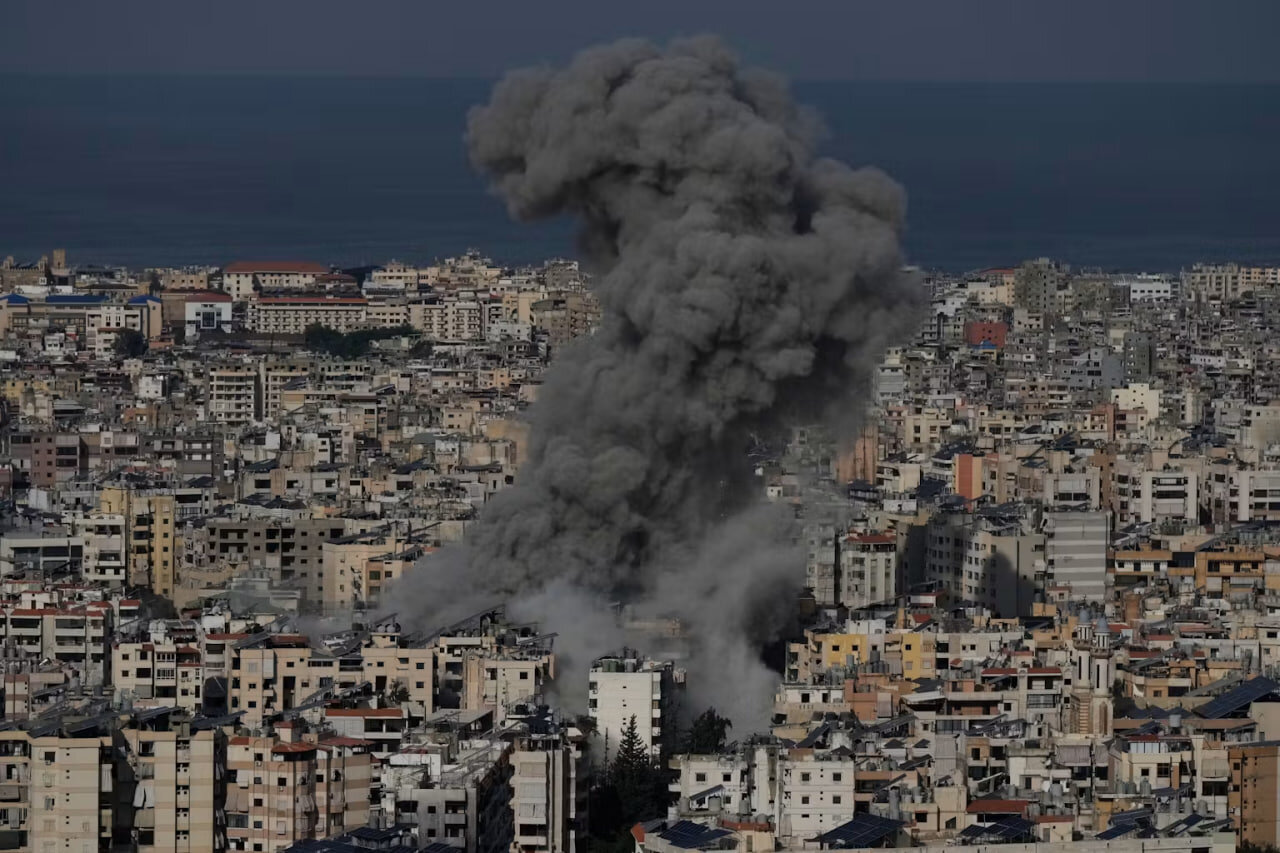
From The Rubble of War to The Fields of The Pledge

By Fatima Salemeh

From The Rubble of War to The Fields of The Pledge

This year’s Ashura procession in the Southern Suburbs of Beirut [Dahyieh] was more than a commemoration of the tenth of Muharram. For many participants, it reflected how the recent war had reinforced, rather than shaken, their commitment to Resistance, a commitment they described as inseparable from their daily lives and rooted in the enduring values of Ashura. Amid portraits of the martyrs held high, and among crowds of men, women, children, the elderly, and people with disabilities, one message echoed repeatedly in different words, becoming a defining theme of the day: “We remain loyal to the pledge”.

Among the participants was an elderly woman in a motorized wheelchair, proudly holding a photograph of her martyred son who fell while defending his homeland. She said her participation was an act of renewing her pledge to Imam Hussein [AS] and reaffirming her unwavering commitment despite the sacrifices her family had made. When asked whether she feared the possibility of an unexpected attack by the “Israeli” enemy during the procession, she answered with certainty that fear has no place among those who remain firm in their convictions. In her view, it is the enemy that should fear a people whose resilience, dignity, and determination remain unshaken.

Another participant reflected on what left the deepest impression on her during the procession. She described a community that had endured displacement, forced migration, and immense hardship. Families lost loved ones, entire villages were uprooted, and many were forced to seek refuge in different parts of the country or live in temporary shelters. Some, she said, even faced rejection instead of solidarity from fellow citizens. Yet what stayed with her most was seeing these same people return with their heads held high, carrying portraits of the martyrs and reaffirming a commitment that, in their words, has become inseparable from their daily lives. She said people stood side by side, united by the conviction that neither war nor persistent threats had altered their choice, adding that Ashura remains the moral and spiritual foundation of that commitment.

The Volunteer Team Coordinator at the Islamic Health Society [Al-Hayaa] explained that this year’s Ashura carries a profoundly different meaning. In her view, many of this year’s martyrs experienced circumstances that closely echoed events remembered from Karbala. Just as the bodies of Imam Hussein [AS] and his companions remained on the plains of Karbala for days before burial, some of today’s martyrs also remained in inaccessible areas, where their bodies could not immediately be recovered due to ongoing "Israeli" attacks. She described this not simply as a historical parallel, but as a reminder that Karbala is not viewed as a distant historical event, but as a lasting point of reference through which many people understand their present reality and reaffirm the continuity of their commitment.

In another interview, a young widow pushed her daughter’s stroller while holding a portrait of her martyred husband. When asked what distinguished this year’s Ashura, she replied in a few simple words: “We came as victors.” For her, victory is not defined by material gains or losses, but by refusing to surrender to oppression, remaining steadfast in one's principles, and preserving dignity despite profound sacrifice. Holding her husband’s portrait, she spoke with unwavering conviction, emphasizing that steadfastness itself is victory.

These words show that, for many participants, Ashura this year was not only a religious commemoration, but also a reaffirmation of identity, conviction, and collective steadfastness. Personal experiences of sacrifice and endurance converged with a broader belief that the values embodied in in Karbala, as represented in the figure of Imam Hussein [AS], continue to shape their understanding of the present. As portraits of the martyrs and Leaders filled the streets alongside thousands of participants, one message resonated throughout the procession: “We remain loyal to the pledge”.

Setting the rules of ownership in the Strait of Hormuz

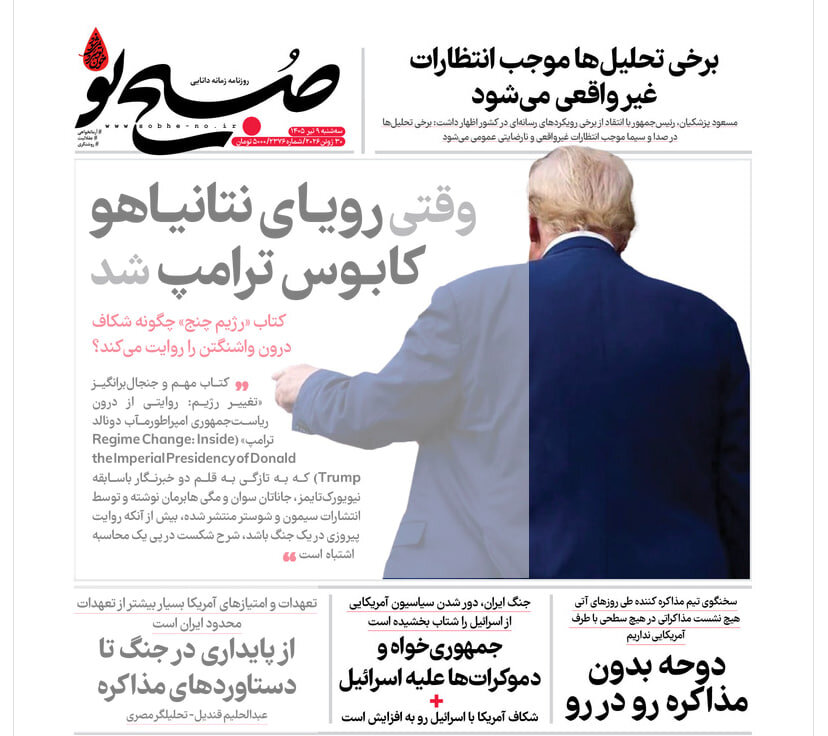
 TEHRAN PAPERS

Sobh-e-No analyzed the recent exchange of fire between Iran and the United States. The region has now entered a new phase of low-intensity but continuous tensions. Under such circumstances, a return to the previous situation seems highly unlikely. The most probable scenario is the continuation of an unstable ceasefire accompanied by limited clashes and reciprocal economic pressure.

Both sides use these confrontations as leverage in negotiations. Iran has turned sovereignty over the Strait of Hormuz into a “red line,” while the United States, due to domestic pressure, needs to project strength. In short, the recent exchange of fire is a battlefield for determining the ownership of the rules governing the Strait of Hormuz. The US seeks to change these rules through economic and military tools, while Iran aims to consolidate new rules through asymmetric warfare. In this game, implementing the memorandum of understanding has become a secondary goal, and the final victory belongs to the side that can impose its will on the other.

Jam-e-Jam: From a fragile truce to first test of the agreement

Jam-e-Jam analyzed the recent clashes in southern Iran, arguing that when the events of the past few days are juxtaposed, they form a picture beyond a temporary confrontation. Past agreements have shown that the main dispute sometimes arises not from the text of the agreement but from how it is interpreted and implemented. What is happening today in the Strait of Hormuz is not merely a legal disagreement over a single clause. From the outset, Washington defined its most important expected outcome of the agreement as restoring the Strait of Hormuz to its pre-war conditions. In this framework, the release of part of Iran’s financial assets, increased oil exports, and the facilitation of certain economic exchanges are not the end of pressure but part of a larger equation in which economic incentives are used alongside security pressure to push Tehran toward accepting the arrangements desired by the United States regarding the Strait of Hormuz.

Arman-e-Emrooz: New diplomatic opportunities 
Arman-e-Emrooz highlighted the new diplomatic opportunities and the need to make maximum use of them. Quoting political analyst Abdolreza Kahani, the paper wrote: Military strength, national cohesion, political management, and active diplomacy together created this opportunity for the Islamic Republic of Iran, and now the most important issue is how to use this capacity to secure national interests. The current regional environment—including the shift in approach by some neighboring countries and their increased willingness to expand relations with Iran—is the result of the change in balance of power and Iran’s enhanced regional standing. If this capacity is not used at the right time, it may gradually fade. Therefore, the foreign policy apparatus and decision-making institutions must, with coordination and strategic vision, use this moment to secure national rights, reduce external pressure, and expand regional and international cooperation.

Ettelaat: Iran’s valuable achievements

Ettelaat interviewed Mohammad Hashemi Rafsanjani, a member of the central council of the Executives of Construction Party, about the dimensions of the memorandum of understanding (MOU) between Iran and the U.S., which sets the roadmap for an agreement following the Feb. war against the Islamic Republic. The veteran politician says: Today, not only Iran but all regional countries need stability, security, and new economic opportunities. This agreement paves the way for significant gains in trade, the energy market, and especially oil. Politically, it has also had positive effects. Iran’s position, coupled with its regional and even global power, has increased. Today, Iran is recognized as one of the influential regional powers, and no one can easily think of weakening or eliminating it. Moreover, the Islamic Republic has clearly stated its positions on various issues, including negotiations, security, energy, and missile capabilities, and these issues have been addressed within the framework of the agreement. Therefore, we hope to see valuable achievements and favorable conditions for the country, the region, and even the world.

Farhikhtegan: US is creating parallel tracks to the agreement

Farhikhtegan examined the US approach after the recent agreement and wrote: The US Navy’s Joint Information Center announced the expansion of a maritime corridor near Oman’s coast—a route that, according to the US, increases the possibility of ships traveling in both directions. In response, Iran’s armed forces declared that the only safe and legal route for ships is the one managed by Iran, and vessels using unauthorized routes will be confronted. When these developments are placed alongside the clauses of the agreement, the message becomes clear: the United States is creating parallel tracks to the agreement. The Trump team is trying to define alternative routes to reduce international shipping’s dependence on Iran’s management in the Strait of Hormuz. Even if such actions are presented as facilitating passage, they can be interpreted as moves contrary to the agreement and as efforts to limit one of Iran’s most important leverage points.