Wednesday, December 01, 2021

France Slams UK for ‘Quasi-Modern Slavery’

TEHRAN (FNA)- France accused the UK of practicing an economic model that allows for “quasi-modern slavery”, as Paris called on London to change its policy on legal migration to prevent more Channel crossings.

 France has hit back at the UK over the ongoing English Channel crossing row after London urged Paris to do more to prevent migrants casting off from its shores. Speaking on Monday to France Inter TV, French Europe Minister Clement Beaune claimed that Britain’s economic model allows for the exploitation of illegal workers. 

"There is – let’s say it – an economic model of, sometimes, quasi-modern slavery or at least of illegal work that is very strong,” the outspoken politician stated, adding that the exploitation of illegal workers “is more prevalent in the UK than [in France] because there are less checks".

Beaune said the UK needs to introduce more checks as well as measures to create a “more humane, more compliant labor market regulation”. Unless this happens, he argued that there will still be a draw for illegal migration.

“We’re asking the British to change their framework,” he continued. 

Speaking at the same time, French Interior Minister Gerald Darmanin told BFMTV that the issue of Channel crossings is “first and foremost an English issue”. He noted Britain needed to create more mechanisms for legal immigration.

Migrants are choosing the risky path “because there is no legal path for immigrants to go to the UK... and because it’s possible to work without an ID card in England", he continued. 

Reiterating Beaune’s remarks, he claimed Britain's economic policy was a driver of illegal immigration.

“One of the engines of the English economic policy – not all of it, obviously – is to employ workers illegally,” he stated.

Britain and France have engaged in an ongoing war of words over the migrant crisis. Thousands of people have crossed from France to the UK this year in the hope of finding a better life.

Hezbollah MP: Lebanon Has Left the “Israeli” Era and Will Not Return To It

Hezbollah MP: Lebanon Has Left the “Israeli” Era and Will Not Return To ItTranslated by Al-Ahed News

The head of the Loyalty to the Resistance Bloc MP Mohamad Raad said, “We smell a coup against the Taif Agreement. This coup aims at reassuring the ‘Israeli’ enemy that the Lebanese people can't face its aggression, so that it dictates its normalization and authoritarian policies and control even deciding the fate of our gas wealth in our territorial waters, as gas exploration is confined to certain companies of certain countries. Despite all this, we still talk about independence and sovereignty, but we are incapable of building one power facility that supplies Lebanon with power 24/7”.

Raad made the statement during the memorial ceremony held by Hezbollah on the 40th day on the passing of Martyr Muhammad Jamal Tamer.

He added, "Our national currency collapsed because it depends on foreign currency. Tomorrow, our policy will collapse because it also depends on foreign policies. If the Lebanese people want this, it’s up to them, but we are sacrificing our blood and souls to protect those who don't know where there interest is in this period. Is it required that we commit suicide so that others are satisfied? We are keen to preserve the common living in this country; we want it to rule sovereignly and independently, and that its interests are in accordance with the aspirations, will, and national decision”.

"If anyone thinks that the equation has gone wrong and that the power balance became in the interest of the ‘Israeli’ axis and normalization and wants to turn against the Taif, we tell our people to pay attention to this miscalculation because Lebanon has gotten out of the ‘Israeli’ era and will not return to it; as all the methods of force that were used to twist the arm of the Resistance failed, and the sponsors of strife realized that the Resistance benefits from the national consensus on its role in Lebanon. So, let us not allow a faction of the Lebanese to undermine this consensus… The weapon of the Resistance has become on everyone’s lips, and media outlets have been bought in order to promote this issue,” Raad added.

Regarding the Tayouneh crime, Raad said, "What happened is not just a clash between the people of two areas, it's rather a designed and planned aggression in order to cause a strife and to push people to fight among themselves and mess up the whole situation, so that the killer gives his credentials to the people who hired and pay him regionally or internationally”.

Raad concluded saying, “From now on and without wasting time and opportunities, let's figure things out. Don't let anybody drag you to a new civil war in order to impose on you a settlement with new balances of power, as long as people are open to each other and ready for dialogue, and as long as they appreciate their common interests and have no enemies but one enemy, which is still occupying our land”.

Tehran Conference of 1943 determined the superpowers’ spheres of influence

Mohamed Bokreta

The Big Three: Plotting the world's future as if they owned it, at the Tehran Conference held in the Soviet embassy from November 28 - December 1, 1943
The present global configuration, although under severe strain, was established at a conference in Tehran in 1943.

The Second World War was still raging.

Three leaders—US President Franklin Delano Roosevelt, British Prime Minister Winston Churchill, and Soviet leader Joseph Stalin—got together for the Tehran Conference (November 28 and December 1, 1943) to coordinate strategy for the prosecution of the war against Germany and Japan.

The conference held in the Soviet embassy in Tehran was held after the Anglo-Soviet invasion of Iran.

They took a number of important decisions concerning the war as well as post-World War II era.

The most notable decisions of the conference focused on the next phases of the war against the Axis powers in Europe and Asia.

Roosevelt, Churchill and Stalin discussed the terms under which the British and Americans finally committed to launching Operation Overlord.

In return for the invasion of northern France, to be launched by May of 1944 that the Soviets had long been pushing the Allies for, Stalin agreed to launch another major offensive on the Eastern Front that would divert German troops away from the Allied campaign in northern France.

Stalin also agreed in principle that the Soviet Union would declare war against Japan following an Allied victory over Germany.

In exchange for Soviet declaration of war against Japan, Roosevelt conceded to Stalin’s demands for the Kurile Islands and the southern half of Sakhalin.

He also gained access to the ice-free ports of Dairen (Dalian) and Port Arthur (Lüshun Port) located on the Liaodong Peninsula in northern China.

The exact details concerning this deal were not finalized, however, until the Yalta Conference of 1945.

At Tehran, the three Allied leaders also discussed important issues concerning the fate of Eastern Europe and Germany in the postwar period.

In this context, Stalin pressed for a revision of Poland’s eastern border with the Soviet Union to match the line set by British Foreign Secretary Lord Curzon in 1920.

In order to compensate Poland for the resulting loss of its territory, the three leaders agreed to move the German-Polish border to the Oder and Neisse rivers.

This decision was not formally ratified until the Potsdam Conference of 1945.

During these negotiations, Roosevelt also secured from Stalin assurances that the Republics of Lithuania, Latvia, and Estonia would be reincorporated into the Soviet Union only after the citizens of each republic votes in a referendum.

Stalin countered that the matter would have to be resolved “in accordance with the Soviet constitution,” and that he would not consent to any international control over the elections.

Roosevelt, Churchill, and Stalin also broached the question of the possible postwar partition of Germany into Allied zones of occupation and agreed to have the European Advisory Commission “carefully study the question of dismemberment” before any final decision was taken.

Broader international cooperation also became a central theme of the negotiations at Tehran.

Roosevelt and Stalin privately discussed the composition of the United Nations.

During the Moscow Conference of Foreign Ministers in October and November of 1943, the United States, Britain, China (then ruled by Chiang Kai-shek), and the Soviet Union signed a four-power declaration.

The fourth point of the declaration called for the creation of a “general international organization” designed to promote “international peace and security.”

At Tehran, Roosevelt outlined for Stalin his vision of the proposed organization in which the future United Nations would be dominated by “four policemen” (the United States, Britain, China, and the Soviet Union) who “would have the power to deal immediately with any threat to peace and any sudden emergency which requires action.”

Finally, the three leaders issued a “Declaration of the Three Powers regarding Iran.”

Within it, they thanked the Iranian government for its assistance in the war against Germany and promised to provide economic assistance both during and after the war.

Most importantly, the US, British, and Soviet governments stated that they all shared a “desire for the maintenance of the independence, sovereignty, and territorial integrity of Iran.”

Roosevelt secured many of his objectives during the Tehran Conference.

The Soviet Union committed to join the war against Japan and expressed support for Roosevelt’s plans for the United Nations.

Roosevelt believed that he had won Stalin’s confidence by proving that the United States was willing to negotiate directly with the Soviet Union and, most importantly, by guaranteeing the opening of the second front in France by the spring of 1944.

However, Stalin also gained tentative concessions in Eastern Europe that were confirmed during the later wartime conferences.

Tehran conferenceWinston ChurchillJoseph StalinSecond World WarSoviet Union (USSR)

Who Gains From Ethiopia Tigray War?

 F. William EngdahlTIG934234

If you want to know who is likely to be at war, just look at who is given the Nobel Peace Prize by the Norwegian (NATO) Parliament. Obama got it just days into office before he escalated the war in Afghanistan. Henry Kissinger got it in the 1970’S. And two years ago the Prime Minister of Ethiopia Abiy Ahmed got the prize for making “peace” with Eritrea. Within a year, the much-praised peace deal between Abiy Ahmed and Eritrea’s dictator, President Isaias Afwerki, the two had united to wage war against the Ethiopian Tigray people in the province bordering Eritrea. The alliance of the two was clearly about eliminating the powerful formerly-ruling Tigray minority. Who now stands to gain in the growing debacle?

Today the reality is that Abiy Ahmed and his demoralized soldiers are in dire straits as the better-trained Tigray guerilla forces of the Tigray People’s Liberation Front (TPLF), approach Addis Ababa. There is good reason to believe that Biden’s Special Envoy to the Horn of Africa, Jeffrey Feltman, is manipulating events behind the scenes and not for peaceful resolution.

Nominally, the war was launched by Abiy because the Tigray state disobeyed the new government’s covid ban on scheduled elections. Clearly the Tigray, who ruled Ethiopia as a minority ethnic group for almost three decades until 2018–when it was forced by popular protests to yield rule to Abiy– were at a severe disadvantage, as Abiy gave a green light to Eritrea’s brutal dictator, Isaias, to invade the Ethiopian Tigray state from the north while Abiy’s military attacked from the south. Isaias’s soldiers carried out murder of thousands of Tigray civilians and carried out war crimes including rape and pillage in what has been called ethnic cleansing. The Eritrean forces, estimated at some 80,000 occupied a third of the region of Tigray. All communications were cut by the invaders.

Isaias and Nobel Peace Prize awardee Abiy Ahmed launched what can only be called a war of annihilation against the Tigray TPLF. They have imposed a siege of food supplies in the region and some 900,000 are reportedly on verge of starvation. Villages, cities and farms have been destroyed as the Eritrean forces reportedly used drones supplied by the UAE to bomb the land. The Tigray leadership and their trained military, the Tigray Peoples’ Liberation Front, TPLF, fled to the hills to wage guerilla warfare, as Abiy openly called the Tigray TPLF, a “cancer” on Ethiopian society, and to the TPLF as “weeds.”

Tigray Reversal

Now one year into the war to destroy the Tigray, the TPLF has managed to dramatically regain much of Tigray state occupied by Eritrean troops as well as unite with the anti-Abiy Oromo Liberation Army (OLA) to move on the capitol, Addis Ababa. Reportedly Abiy’s army has been devastated by military losses and mass desertions.

On June 28, 2021 seven months after the supposedly powerful Ethiopian National Defense Forces rolled through Tigray, the Tigrayan Defense Force (TDF), the rebranded military force of the TPLF, reconquered the Tigrayan provincial capital Mekelle, marching in with thousands of Ethiopian and Eritrean prisoners. By that point according to Alex de Waal, executive director of the World Peace Foundation of Boston, of 20 Ethiopian NDF federal army divisions, “seven have been completely destroyed, three are in a shambles.”

The situation is now so dire that in late November Abiy announced he was going to the front to lead his troops against the TPLF. And in early November he called on civilians to muster for the defense of the capital. That was not a sign of strength, but of desperation as his military is reportedly in total disarray. Abiy is from the ethnic Amhara group. The Amhara are the largest ethnic group with almost 35% of the 118 million population. Oromo have some 27% and Tigrayan, 6%. The military alliance of Tigray TDF forces with Oromo have reversed the odds in the ill-fated war. As of mid-November they were some 270 km from Addis Ababa.

Chaos to Spread

At this point the most likely outcome of Abiy’s two-year Tigray War is the breakup of Ethiopia into ethnic civil war, and the descent of Eritrea into economic and political disarray. As analyst Gary Brecher described the likely outcome, “What if the TDF/OLA forces go all the way to Addis and take control of ‘what is now Ethiopia’? It’s a pretty safe bet that their alliance would dissolve in a matter of months, and the country would descend to a multi-ethnic war between provinces, then between towns…”

Washington and several EU states are playing a covert role in fanning the war, while posing as “neutral.” The Biden Administration, guided on its Horn of Africa policies by Ambassador Jeffrey Feltman, sanctioned Isaias and his Eritrean military for its role in the war on November 12, tilting the odds to advantage potentially of the TPLF.

On November 21, a secret meeting via zoom took place moderated by Ephraim Isaac.

Ephriam Isaac, now at Institute of Semitic Studies, Princeton, is chair of a murky outfit known as The Peace and Development Center based in Washington, which calls itself, “an independent national not-for-profit and non-governmental organization working for conflict prevention, conflict resolution, peace building and development in Ethiopia and the horn of Africa.” Its website lists as sponsors the US National Endowment for Democracy, a self-admitted CIA front which specializes in regime change color revolutions; USAID, which has often been involved in CIA covert operations, and the UN.

Ephriam Isaac was close to the late TPLF Prime Minister Meles Zenawi, and was instrumental in helping to bring the TPLF to power in 1991. Present at the recent zoom meet were also Ambassador Vicki Huddleston, former US Deputy Assistant Secretary of Defense for African Affairs during the Zenawi era, along with Donald Yamamoto, one of the US government’s most senior Africa experts who just retired. And former and present senior diplomats from UK, France, and the EU. They all agreed that as Huddleston said, “Abiy should step down, there should be an all-inclusive transition government.” The secret video conference suggests that NATO countries, led by the US, are going out of their way to favor the TPLF.

Grand Ethiopian Renaissance Dam

This Tigray war at some point will bring into question the fate of the controversial Blue Nile River dam, the Grand Ethiopian Renaissance Dam, a huge project about 45 km east of the border with Sudan and close to the Tigray province. Despite the repeated efforts of Egypt, and partially Sudan, to diplomatically get Ethiopia to halt the dam, the Abiy Ahmed regime has refused to cooperate in any way. In July, Abiy proceeded with the second phase of a multi-year filling of the dam ignoring the protests of Sudan and Egypt who are both dependent on water from the Blue Nile for their survival.

The GERD, with a capacity of 6.5 gigawatts will be Africa’s largest hydroelectric power plant and the world’s seventh-largest dam. It can hold 74 billion cubic meters of water – more than the volume of the entire Blue Nile, originating in the northern Ethiopia highlands, origin of 85% of the Nile’s water flow. The temptation for Egypt to intervene, even covertly, on the side of the Tigray is huge and may in fact according to some reports, be ongoing. Were that intervention to sabotage the dam, the fuse would be lit for a war spanning from the Horn of Africa to Cairo. Among other things that would clearly impact shipping traffic through the Horn of Africa, the only link to the Indian Ocean via the Mediterranean. It is the entrance to the Red Sea which is the world’s second largest shipping lane.

Erdogan’s Turkey is also involved in the Horn of Africa. On November 21, Somalia’s Army Chief Gen. Odawaa Yusuf Rageh met Turkish Defence Minister Hulusi Akar in Anakara, where they reportedly discussed political and military cooperation. Turkey has also been supplying military drone aircraft to Abiy Ahmed’s army. Somalian President Mohamed Abdullahi Mohamed ‘Farmaajo’, joined the war on Tigray along with Eritrea and Ahmed. Somalia invaded Ethiopia in the 1977 Somali invasion of the Ogaden region of Ethiopia before being defeated by a Soviet-backed Ethiopian army. With Turkish backing, at some point Somalia could decide it opportune to again invade Ethiopia, especially if Tigrayans take Addis Ababa.

With Ethiopia in internal civil war, Sudan’s military could decide it might benefit from a war with Ethiopia as well. Already Ethiopia’s Abiy has accused Sudan of taking advantage of the war by seizing territory in Ethiopia. US Envoy and Color Revolution specialist Jeffrey Feltman was in Khartoum in October meeting with the Sudan military just a day before the military ousted the civilian Prime Minister. Unclear is what role the Machiavellian Feltman played in the military move. Despite a subsequent reinstatement of the civilian Prime Minister Abdallah Hamdok, the Sudan military is clearly now in control. Tens of thousands of Tigray war refugees fled across the border to Sudan. Situation highly unstable.

On November 23 US Envoy Jeffrey Feltman made a visit to Ethiopia and after, he commented that Abiy told him he was confident he can push the Tigray forces back to their home region in the north of the country. Feltman said, “I question that confidence.” That’s a strange comment from a US Envoy who claims to demand the Tigray forces withdraw from the territories they have gained. Were the Biden Administration serious about supporting the elected Abiy Ahmed government and preventing disintegration of Ethiopia they would clearly do more to make that happen.

In all this geopolitical spaghetti bowl there is also the case of the growing presence of China in the Horn of Africa where it has welcomed Eritrea into its Belt and Road Initiative and established a military naval base in Djibouti alongside a critical US base Camp Lemonnier, and gained a major share ownership of Djibouti’s container port, Port of Doraleh, via its state-owned China Merchants Group. Djibouti is also a participant in China’s BRI. Djibouti controls access to both the Red Sea and the Indian Ocean, and links Europe, the Asia-Pacific, the Horn of Africa, and the Persian Gulf. It lies directly across the Bab el-Mandeb Strait from Yemen and is Ethiopia’s only sea trade link.

China has kept a low profile during the Tigray War but it suggests the potential of a New Great Game for domination of the region from the Horn of Africa to Egypt along the Red Sea. US covert backing for the Tigray TPLF and the role of Feltman in the region suggests that Washington once more is determined to wreak maximum chaos as it did with help of Feltman in Syria and the Arab Spring color revolutions.

F. William Engdahl is strategic risk consultant and lecturer, he holds a degree in politics from Princeton University and is a best-selling author on oil and geopolitics, exclusively for the online magazine “New Eastern Outlook”.

Time to play trump card

By Mohammad Memarian

Time to play trump card

On May 8, 2018, President Trump announced unilateral withdrawal of the US from the Iran nuclear deal, officially known as the JCPOA. In order to bring Iran to the negotiating table to make a “better” deal, he wanted to pursue a strategy of “maximum pressure” by reapplication of sanctions which, in practical terms, had only been marginally relieved under the JCPOA. He had decided to almost immediately reinstate US sanctions on Iran. Somebody should’ve reminded him before he made his announcement, “what about UN sanctions, Mr. President?” And in all likelihood, somebody did. His reaction to that likely reminder is not public knowledge, but given the erratic nature of his presidential commands documented by as varied a repertoire of witnesses as it can be, it might have been anything from “don’t we own the UN?” to “we will reinstate them too,” or even “we will withdraw from the UN too.” An undeterred, responsible reminder should’ve insisted, “but, Mr. President, there are procedural issues at stake...” One could only imagine his possible reaction to such insistence.

Procedures, however, do matter. Under the JCPOA, as Iranian critics of the deal had fairly pointed out, the US was given an almost free hand to trigger snapback mechanism, leading to reinstatement of UN sanctions on Iran. Using that procedural privilege, President Trump as a participant to the JCPOA could unravel the whole deal without much of a real consequence or controversy. But a combination of personal ignorance, bad advisors, and institutional arrogance made up the recipe for a blunt foreign policy mistake. The mistake became abundantly clear to him almost three months later when Mike Pompeo, his secretary of state, pushed the UN to reimpose its sanctions on Iran but met with a humiliating – though not necessarily humbling – defeat. In a rare instance of universal support of Iran’s position against that of the US, the international community essentially declared, “if you wanted to snap back the UN sanctions under the terms of the JCPOA, Mr. President, you shouldn’t have pulled the US out from the deal. You can’t have it both ways.”

Even though America’s failure to reimpose UN sanctions under Trump didn’t bring about any material advantage for Iran and is not likely to do so in the near future, it was a moment of significant diplomatic gain for Iran. With Trump gone, the new US administration began its (so far) nominal efforts to revive the JCPOA. The negotiations started under Iranian President Hassan Rouhani and stretched to the new administration of President Ebrahim Raeisi. Diplomatic negotiations might sound too technical or complicated at times, but what Americans seek to achieve, bared to its essentials, is to be readmitted into the deal as a first step. Or in other words, they simply, and still quite arrogantly, want Trump’s mistake simply undone and forgotten for their benefit with no compensation for the damage it inflicted upon Iran.

From Iran’s perspective, being readmitted into the deal is not their right to be given, rather a privilege which Americans have to earn. Granted, it may be a bit arduous for them, given the fact that they have lost any credibility they might have had in the beginning of nuclear negotiations some eight years ago. But in all fairness, it was their system of governance which allowed a president of theirs to dishonor its commitment under an internationally endorsed agreement, a misstep he took for no more sophisticated a reason than making a fool of his predecessor. That doesn’t reek of a real party to a serious partnership.

Iran is now negotiating from a position of diplomatic strength, seeking real, verifiable advantages in exchange for letting the US back in the game. The ball is roundly in the court of Americans – they may counsel with VAR as much as they like. And as for the Iranian negotiators, the diplomatic game is theirs to lose.

In letter to UNWTO, Iran says ready to host10th Global Summit on Urban Tourism

Tehran Mayor Alireza Zakani has written to the World Tourism Organization (UNWTO), voicing the Iranian capital’s readiness to host the United Nations specialized agency’s 10th Global Summit on Urban Tourism.

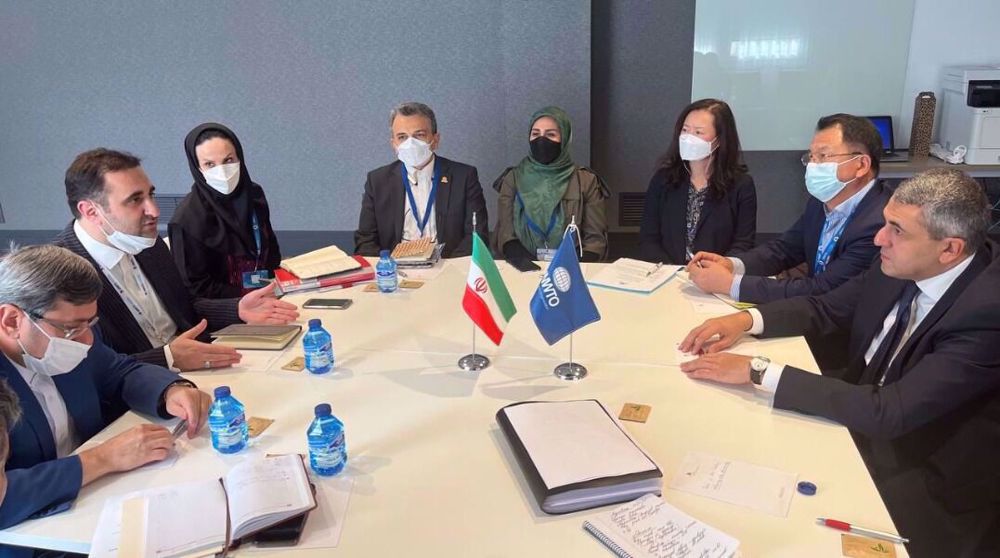
Iranian officials held a meeting on Tuesday with UNWTO Secretary-General Zurab Pololikashvili in Spain’s capital of Madrid, which is hosting the 24th session of the agency’s General Assembly.

During the meeting, Iranian Ambassador to Madrid Hassan Qashqavi submitted Zakani’s letter to the UNWTO chief, the IRIB news agency reported.

Meanwhile, Iran’s Deputy Minister of Cultural Heritage, Tourism and Handicrafts Ali Asghar Shalbafian, who was also present in the meeting, outlined Tehran’s latest plans to develop its tourism industry, saying the country’s new administration attaches special significance to this sector.

Iranian officials (L) meet with UNWTO delegates in Madrid, Spain, November 30, 2021. (Photo via IRNA)

Pololikashvili, for his part, extended his congratulations to Ezatollah Zarghami over his appointment as Iran’s minister of Cultural Heritage, Tourism and Handicrafts and praised his determination to develop the country’s tourism industry.

According to UNWTO, urban/city destinations for tourism “offer a broad and heterogeneous range of cultural, architectural, technological, social and natural experiences and products for leisure and business.”

The UNWTO’s Global Summit on Urban Tourism brings together mayors of major tourism destinations, heads of tourism administrations and organizations, and officials of related ministries and agencies, who share their experiences and visions on urban tourism during the event.

UAE played dangerous role in advancing normalizing ties of other countries with Zionist regime

The head of the press office of the Islamic Jihad Palestine

 “The UAE has played a dangerous role in advancing the Arab countries towards development and progress for the normalization of relations with the Zionist regime,” the Palestinian official said.

"The agreements signed with the UAE in the Ankara talks will start a new era in the relations between the two countries. I plan to travel to the UAE in February," Erdogan said in a speech to AKP party members yesterday.


"As we took steps to reconcile with the United Arab Emirates, we will take similar steps with Egypt and Israel," he added, according to the Anatolia news agency.


In this regard, Davoud Shahab, the head of the press office of the Islamic Jihad Movement, in an interview with Al-Mayadin, reacted to the stance of Turkish President Recep Tayyip Erdogan towards the Zionist regime.


“It is clear that the UAE government has taken the reins of normalizing Arab relations with the occupying Israeli regime,” he said.


“The UAE has played a dangerous role in advancing the Arab countries towards development and progress for the normalization of relations with the Zionist regime,” the Palestinian official added.


Shahab also said: “t is clear that pressure has been exerted on the Turkish government in some respects to force the country to take such a stand on Israel.”