
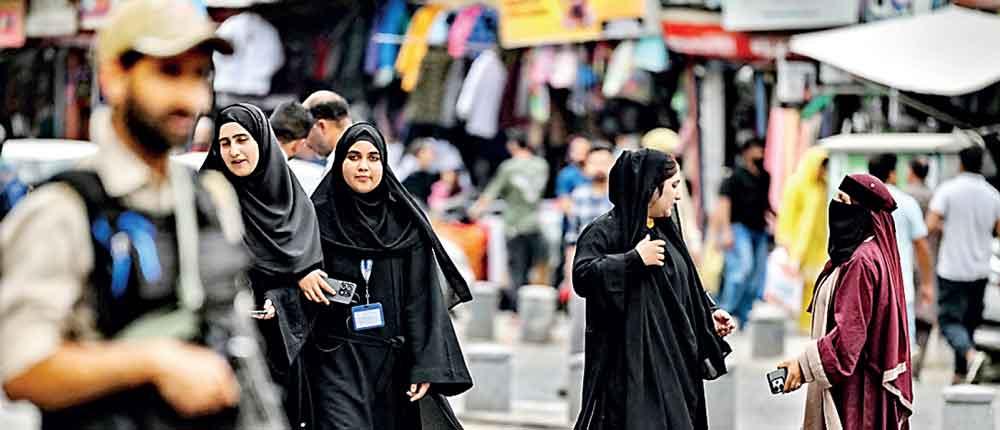
Indian police stand guard as Kashmiri students walk along a street in Srinagar. Nuclear-armed India and Pakistan have exchanged gunfire across their heavily militarised de facto border in contested Kashmir since an April 22 attack that New Delhi blames on Islamabad, claims it rejects. (Pic by Sajjad Hussain/AFP)
United States President Donald Trump is right when he said India and Pakistan would figure out the current crisis between them one way or the other. Then he displayed his historical illiteracy by saying that the two countries had been fighting over Kashmir for 1,500 years, putting history professors in a spin and making them scour the books they have read.
Unlike Trump’s flawed history, the Kashmiri problem has its origins in the 1947 partition. The princely state ruled by Maharaja Hari Singh during the British occupation of the subcontinent was predominantly Muslim. Under the partition plan, the Muslim-majority states were to join Pakistan, but the Maharaja resisted it. This led to the 1948 war, following an invasion by Pakistani tribal forces. In the face of the invasion, the Maharaja acceded to India the princely state of Kashmir.
The United Nations, then a nascent world body overflowing with the desire to prevent wars and bring about world peace, intervened, effected a ceasefire, and called for a plebiscite in Kashmir. Since then, a third of Kashmir has been controlled by Pakistan and the rest by India. With India vehemently opposing the plebiscite, it never happened. After three major wars and several battles and skirmishes across the border and the line of control, India in 2019 through a constitutional amendment revoked Kashmir’s special autonomous status under Article 370, bifurcated the disputed region into Jammu-and-Kashmir and Ladakh and declared them as union territories.
History apart, the burning issues are about the rising tension between India and Pakistan and a likely nuclear war. The war of words has been intensifying since the terror attack on April 22 at Pahalgam in the India-controlled Kashmir, which New Delhi regards as an internal part of India along with the Pakistan-controlled Kashmir. The responsibility for the attack was claimed by a little-known group—the Resistance Front (TRF). India says the group is linked to the Pakistan-based banned terror group Lashkar-e-Taiba.
As Trump has said, a major war won’t break out. It is not in the interest of either country. Both have nuclear weapons: India 180, Pakistan 170. Rational nuclear powers won’t court the horrors of a nuclear war. If at all, there will only be an escalation in the exchange of fire across the Line of Control.
Nuclear deterrence, a strategy based on the fear of nuclear retaliation, operates on the basis that in a nuclear war there is no winner but only mutually assured destruction (MAD).
However, there is no guarantee that the MAD doctrine or nuclear deterrence is ironclad and that nuclear powers would strictly adhere to it. A nuclear war can also happen over a false alarm or over an intelligence miscarriage.
There is no argument that India is much stronger than Pakistan in terms of military power and economic clout. Pakistan, at present, teeters on the brink of an economic crisis, and a war with India is the last thing it wants. However, publicly its rhetoric is high-octane, with Pakistani leaders vowing to repel any Indian adventurism with a fitting response. Logically speaking, it is the militarily weaker country that relies more heavily on nuclear weapons to deter any attack from a stronger nuclear-armed nation, as nuclear weapons provide military power parity.
A bigger fear is if irrational extremists come to power in a nuclear-armed country. If that happens, the C3 concept—Command, Control, and Communications—designed to prevent the misuse or accidental use of nuclear weapons could become ineffective, making a sudden nuclear attack a strong possibility.
Both in India and Pakistan, the rise of religious extremism is a serious concern. Nuclear deterrence experts often worry about Islamic extremists, or the so-called jihadists, capturing power in Pakistan and launching a nuclear attack on India. However, this has not happened in Pakistan, where successive governments have been hunting down extremists since the US invasion of Afghanistan in October 2001. However, India sees an exception in Pakistan’s war on extremism. It alleges Pakistan fosters Kashmir-linked extremist groups and accuses Islamabad of promoting crossborder terrorism—a charge Pakistan vehemently denies.
Pakistan, on the other hand, claims that India’s ruling party, the Bharatiya Janata Party, is a party of Hindutva extremists who undermine the country’s constitutional commitment to secular democracy and pose a threat to regional peace.
Amidst this debate over extremism, calls to punish Pakistan are growing in India while a statement made by Pakistan’s Army Chief Asim Munir is also causing ripples. Gen. Munir, a Hafiz—one who has memorised the entire Quran—said in a public speech days before the Pahalgam attack, “We (Muslims) are different from Hindus” in every possible way. Then he went on to describe Kashmir as Pakistan’s “jugular vein” and vowed Pakistan would “never abandon Kashmiris in their heroic struggle against Indian occupation”.
Pakistan also accuses India of fostering Baloch separatist terrorism in Pakistan. On November 9, 2024, terrorists from the Baluchistan Liberation Army launched a suicide bombing at the Quetta railway station in Pakistan’s Baluchistan Province, killing 26 people and injuring over 60 others.
Often linked to domestic political gains, charges and countercharges over crossborder terrorism have stood in the way of a thaw in relations between the two countries.
After the Pahalgam attacks, the two countries’ armed forces are in a state of preparedness. In both India and Pakistan, the political leaders have given their respective armed forces chiefs greater freedom to respond to any situation.
Terrorism in whatever form should be condemned, and the terrorists responsible for the Pahalgam attack should be hunted down and punished. The terrorists have betrayed the Kashmiri people’s peaceful pursuit of self-determination and greater political autonomy.
The terror attack, on the one hand, highlighted India’s intelligence and security failure in one of the world’s most militarised regions. On the other hand, the attack disproves India’s claim that it has restored normalcy in the region. If it is so, why did it, after the Pahalgam attack, bulldoze some 50 houses of likely suspects and arrest thousands of Kashmiris? Such high-handed action will only defeat India’s efforts to ‘Indianise’ the Muslim Kashmiris, a majority of whom are against the Modi government’s moves to change the demography in the region.
Meanwhile, friendly nations such as the United States, Saudi Arabia and Iran are working behind the scenes to defuse the tensions. Sadly, no country in South Asia, including Sri Lanka, is in a position to begin a diplomatic offensive to play the role of the peacemaker in the India-Pakistan dispute, at least by reviving the South Asian Association for Regional Cooperation (SAARC). When SAARC was active, its summits offered an opportunity for the leaders of the two countries to meet at least once a year, discuss issues, and build up a friendship.
A major war is not in the economic interest of both India and Pakistan. Peace between India and Pakistan, coupled with China resolving its border issues with India, has the potential to bring economic prosperity of Himalayan proportions to the region. Peace economy is the way forward.

No comments:
Post a Comment