Friday, February 28, 2025

How Islamophobia and anti-Palestinian racism were born together

The two ideologies emerged during the Crusades and continue to justify Israel's conquest, genocide, and western-backed settler-colonialism today

Joseph Massad

A young Muslim woman holding a Palestinian flag participates in an "against racism, against Islamophobia" march in Paris, France, on 21 April 2024 (Hans Lucas/Reuters)
Islamophobia and anti-Palestinianism were born together, inseparable from the start a millennium ago.

Long before these ideologies acquired their contemporary names as masks for conquest, Palestinians had already become a target. In the 11th century, just as they are today, they were marked for elimination because they are the native inhabitants of Palestine, and the majority are Muslim.

Palestine has had the misfortune of being the site of both the first European settler-colony and the last, a calamity from which the Palestinian people continue to suffer and against which they continue to resist.

Palestinians were certainly not the first Arab Muslims or Christians to be targeted by European armies.

The first were the Arab Muslims of Spain, Sicily, and southern Italy. The latter were conquered by the Normans to extend the frontiers of Latin Christendom and wrest these territories from Arab Muslim rule.

But unlike the conquest of Muslim Arab Sicily and southern Italy, the Muslims and Eastern Christians of Palestine were the first to be targeted by Latin Christendom in a "Holy War", subsequently known as the First Crusade.

The Crusade also inspired the zealotry of the so-called Reconquista in Iberia, which came to be seen as a "second march to Jerusalem". But unlike Muslim Arab Italy and Spain, Palestine did not border Latin Christendom, even if it was the territory where the events of the faith to which European heathens had converted originated.

The sin of the people of Palestine, in the eyes of the Crusaders, was precisely that they were not Latin Christians. Similarly, since the Zionist project for the conquest of Palestine began, the sin of the Palestinian people, in the eyes of the latest Crusaders, is that they are not Jews.

In both cases, Palestine was identified as a land that the Lord had bequeathed - first to Latin Christians and, since the turn of the 20th century, to Ashkenazi Jews, both of whom originated from what became Europe.

'War on Muslims'

While anti-Islam structured the Latin Crusader wars from the 11th century onwards, by the 19th century, it would be European white Christian supremacy and Orientalism that took on this role.

Islam remained a structuring factor but was now enmeshed with several questions that Europe articulated, emerging in the 18th century - what the British called the "Jewish Question" and the "Eastern Question".

Still, the war on Muslims between the end of the 18th century and the end of the First World War did not subside. Estimates suggest that as many as five million Ottoman Muslims were killed between 1820 and 1914, with six million more made refugees.

The Palestinian people were spared some of these murderous campaigns and, by the 20th century, were conceived by the Christian West primarily as Arabs - an identity most adjacent to Muslim. 

This Arab designation remained salient until 9/11, when Europe's most recent Islamophobia, which had seen its early manifestations following the triumph of the Iranian Revolution, came to be articulated as President George W Bush put it in 2001: a new "Crusade" that "is going to take a while".

It was then that Israel and the West re-identified the Palestinians as objectionable Muslims who must be defeated.

As Bush intimated, the Crusade has indeed been taking a while and remains with us. President Donald Trump's recent plans for the Palestinians of Gaza are resonant with the history of the Crusades, if not directly inspired by them.

In November 1095, Pope Urban II declared the necessity of recapturing the land where Christianity was born. Addressing the European converts to the Palestinian religion of Christianity, the Pope averred:

"Enter upon the road to the Holy Sepulchre; wrest that land from the wicked race, and subject it to yourselves. That land which as the Scripture says 'floweth with milk and honey', was given by God into the possession of the children of Israel. Jerusalem is the navel of the world; the land is fruitful above others, like another paradise of delights…This royal city, therefore, situated at the centre of the world, is now held captive by His enemies, and is in subjection to those who do not know God, to the worship of the heathens. She seeks therefore and desires to be liberated and does not cease to implore you to come to her aid. From you especially, she asks succour."

At the time, the majority of Jerusalem's native inhabitants were Arabic-speaking Christians, or what the Crusaders called "Suryani". One of the declared motives of the Crusade was to rescue them and the Eastern churches from the Muslims, even though no Eastern Christians had ever complained or appealed to the Latins for help.

Indeed, the Eastern Christians, especially those of Palestine, would be, along with Muslims, as historians have put it, the "most unwilling" and "unhappy victims" of the Crusades.

The crime of Palestine's Arab Muslims - these "enemies" of God, this "wicked race" of "heathens" - was their "unlawful possession" of the "holy" places which Latin Christendom coveted.

Frameworks of conquest

It was during the First Crusade that the fanatical Latin Christians first named Palestine the "Holy Land", replacing its biblical Old Testament nickname as the "Promised Land".

They also refused to use Jerusalem's real name, al-Quds, which had replaced its Aramaic name in the ninth century.

The people of Palestine served as a convenient foil for the papacy, as the internecine wars among Latin Christians were considered sinful by the Church and hindered their service to God.

Unifying the Latins and expanding Christendom territorially were deemed as crucial as redirecting Latin animosity towards Muslims.

Through the Bible and the sword, the Crusades established the first European settler-colony in Jerusalem following the genocidal extermination of its population

Since Latin Christians viewed Muslims as inconvertible, and the Church prohibited making peace with them, considering them heathens, they were to be slain, with any survivors expelled from the "Holy Land".
 
As for the Arab Christians, the Crusaders attempted to Latinise them by force but ultimately failed. Consequently, the surviving members of the large Muslim and Christian Arab populations, along with the small Arab Jewish community of Jerusalem, were expelled to make way for the Frankish settlers.

When the fanatical Crusades slaughtered between 20,000 and 40,000 of these "Saracens", as the Arab Muslims were also called, in Jerusalem and inside al-Aqsa Mosque in a horrific massacre on 15 and 16 July 1099, they were incensed that their victims fought back in self-defence.

Through the Bible and the sword, the Crusades established the first European settler-colony in Jerusalem following the genocidal extermination of its population. They called their settler-colony "the Latinate Kingdom".

After expelling the entire population, they brought in 120,000 Latin Christian colonists, who made up 15 to 25 percent of the population of the Frankish settler colony, which extended across Palestine and beyond.

In their settler-colony, the Crusaders instituted an "apartheid" legal system, as Israeli historian of the Crusades Joshua Prawer describes it.

Intertwined ideologies

Unlike Zionism, which has always been an ideology that combined religion and colonial nationalism, Palestinian resistance has largely remained intrinsically anti-colonial and nationalist rather than religious.

Still, following the tradition of the Crusaders, Zionists have used similar descriptions for Palestinians since the 1880s - portraying them as "dirty" barbaric Arabs, antisemites, and even Nazis.

After Hamas was established in 1987, the Israeli government began referring to them as antisemitic jihadist Muslims who needed to be crushed. 

In the immediate aftermath of the 9/11 attacks, early western media speculation frequently suggested that Hamas could be responsible, despite the fact that it had never carried out any act of resistance outside historic Palestine. The intertwining of Islamophobia and anti-Palestinian racism has only deepened since.

In June 2009, US President Barack Obama addressed not only a local Egyptian audience but also the entire "Muslim World" from Cairo University. He emphasised the importance of religious tolerance among Muslims towards Egyptian and Lebanese Christians and promised to end the institutionalised discrimination against American Muslims that followed 9/11.

Yet he justified the ongoing, murderous American military campaigns in Afghanistan and Pakistan - he could have added Yemen but did not - as necessary. His administration was not only killing non-American Muslims in these countries but also targeting non-white American Muslim citizens for assassination.

In the same vein, Obama sought to provide a theological justification for an American-sponsored policy: the imposition of a "peace" between Palestinians and Israelis that preserves Jewish settler-colonialism and occupation at the expense of Palestinian rights.

To achieve this, he declared that the "Holy Land of the three great faiths is the place of peace that God intended it to be; when Jerusalem is a secure and lasting home for Jews and Christians and Muslims, and a place for all of the children of Abraham to mingle peacefully together as in the [Quranic] story of Isra [sic], when Moses, Jesus, and Muhammad (peace be upon him) joined in prayer."

In doing so, Obama was clearly asserting - in a distinctly Zionist fashion - that Jewish colonisers of Palestine are exempt from the obligation to be tolerant. He argued that they are resisted not because they are colonists but solely because they are Jewish - hence his call for Muslim tolerance and ecumenical peace rather than for an end to Jewish settler-colonialism.

Of course, since the Iranian Revolution, Islamophobia has come to encompass all Muslims worldwide.

Yet, much like the Islamophobia of the Crusades, which targeted all Muslims - Turks and Arabs alike - while reserving a particular hatred for Palestinians, today's Islamophobia follows a similar pattern.

Palestinians, cast as the worst among Muslims, occupy a central place within it.

Current Crusade

Since 7 October 2023, when Palestinian resistance forces attacked Israel, Islamophobia has surged across the US and Western Europe, targeting all Muslims and those mistaken for them. 

If Islamophobia once drove anti-Palestinianism as a pretext for conquest during the Crusades, today, it is anti-Palestinianism that fuels Islamophobia in Europe and the US.

If Islamophobia once drove anti-Palestinianism as a pretext for conquest during the Crusades, today, it is anti-Palestinianism that fuels Islamophobia in Europe and the US

It is hardly surprising, then, that when Palestinians rise up and resist their white Christian and Jewish colonisers today, they threaten the entire ideological structure of the western world - one built upon the inaugural moment of the Crusades.

This is why every weapon at the "Christian" world's disposal, including Islamophobia, has been and must be deployed against the Palestinians in an effort to defeat them. 

Yet, a millennium later, the Palestinians continue to resist, and the new Crusaders persist in their attempts to crush them.

It is no accident that Trump's current Crusade for Gaza and his call for the expulsion of its surviving Palestinian population following Israel's genocidal extermination campaign echo the First Crusade and the Crusader-led genocide and expulsion of the survivors in al-Quds.

That both projects are rooted in white settler-colonialism in the land of the Palestinians is clear enough.

Just as the defeat of the Crusaders in the 12th and 13th centuries and the dismantling of their settler colony in Palestine brought an end to their rule, in view of the persistent and steadfast resistance of the Palestinian people, the prospects for the success of this latest Crusade are slim at best.

Joseph Massad
is professor of modern Arab politics and intellectual history at Columbia University, New York. He is the author of many books and academic and journalistic articles. His books include Colonial Effects: The Making of National Identity in Jordan; Desiring Arabs; The Persistence of the Palestinian Question: Essays on Zionism and the Palestinians, and most recently Islam in Liberalism. His books and articles have been translated into a dozen languages.

German NGOs, LGBTQ Movements, and Intervention in Africa

By Mariam Jooma Carikci - Crescent International

The killing of Muhsin Hendricks in Gqeberha on February 15 has garnered significant media attention both in South Africa and internationally.

While the motive behind the murder remains unknown, speculation suggests that his advocacy for Islamic marriage rites for gay couples may have played a role.

This incident has reignited debate about the intersection of LGBTQ rights, religious doctrine, and foreign influence in Africa.

Religious Law vs. Secular Protections

South African law and the Constitution recognize the rights of LGBTQ individuals within the framework of secular governance.

However, they do not extend to compelling religious institutions to alter doctrinal positions that do not recognize same-sex unions.

This distinction is at the heart of the tensions surrounding Hendricks' activism, as his efforts to introduce an "Islamic Nikah" for gay couples were seen by some as an attempt to reform a religious practice deeply rooted in traditional interpretations of Islam.

Social Engineering: Who Defines Africa’s Future?

While Hendricks had the legal right to live openly as a gay man under South African law, his push to reform Islam to accommodate same-sex marriages was met with fierce opposition.

This issue extends beyond individual activism and into the broader phenomenon of western-funded liberal influence in Africa.

Over the past two decades, an increasing number of European and North American organizations have funded initiatives aimed at reshaping religious and cultural norms in the Global South.

A prime example is the Al-Ghurbaa Foundation, the organization Hendricks led, which receives funding from western entities, including the German Foreign Office, the Heinrich Böll Stiftung, and the New Africa Fund.

While these institutions position themselves as supporters of progressive causes, their involvement in funding Islamic institutions raises critical questions.

Why would German government-linked entities invest in an "Islamic" foundation unless there was an underlying agenda?

More importantly, why do these same organizations provide unwavering support for Israel—a state accused of systematic human rights violations against Palestinians—while simultaneously funding LGBTQ advocacy within Muslim communities in Africa?

This contradiction exposes the selective nature of Western human rights advocacy, where LGBTQ rights are championed while Palestinian rights are disregarded.

German Hypocrisy

In recent years, German non-governmental organizations (NGOs) have played a significant role in promoting LGBTQ as a rights issue across Africa. While at face value this advocacy appears to be an extension of human rights promotion, a closer look reveals a more complex geopolitical agenda. LGBTQ rights often serve as a convenient cover for deeper political and economic intervention, enabling German NGOs to extend their influence in African nations under the guise of progressive activism.

This article examines the intersection of German NGO activity, LGBTQ movements in Africa, and the broader implications for sovereignty and foreign intervention.

The Role of German NGOs in African LGBTQ Movements

German NGOs such as the Heinrich Böll Foundation, the Rosa Luxemburg Foundation, and the Friedrich Naumann Foundation have been among the most active European organizations supporting LGBTQ rights in Africa.

These organizations, often linked to political parties in Germany, fund local LGBTQ rights groups, sponsor legal advocacy efforts, and provide platforms for African activists.

On the surface, such initiatives are positioned as efforts to combat discrimination and promote human rights. However, they often coincide with German geopolitical interests in African nations, raising questions about their true motives.

The influx of western funding and support for LGBTQ issue has introduced new dynamics to these movements. Local organizations that align with German NGOs gain access to substantial resources creating a dependency on external funding and a vulnerability to foreign agendas.

LGBTQ Rights as a Tool for Political Leverage

In many cases, LGBTQ rights are used as a strategic pressure point by western organizations, including German NGOs, to exert influence on African governments. Countries that resist western geopolitical and economic policies often find themselves targeted with accusations of human rights violations, particularly concerning LGBTQ issues.

This pattern is evident in countries like Uganda, Kenya, and Ghana, where LGBTQ-related controversies have coincided with broader political disputes with western powers.

For instance, when Uganda passed its controversial anti-LGBTQ law, western NGOs and governments, including Germany, responded with aid cuts and diplomatic pressure.

However, this selective outrage raises questions—why are similar violations of human rights in allied states ignored? The answer lies in the fact that LGBTQ rights serve as a convenient tool to discipline non-compliant African governments while maintaining a moral high ground.

Economic Interests and Cultural Imperialism

Beyond political leverage, the promotion of LGBTQ rights by German NGOs in Africa also intersects with economic interests. European countries, including Germany, are keen to secure African markets, raw materials, and strategic alliances.

When direct intervention is not feasible, the use of civil society movements—including LGBTQ advocacy—provides an alternative route to exert soft power.

Furthermore, this approach is tied to a broader cultural imperialism in which western values are imposed on African societies without consideration for local contexts.

Many African nations view the aggressive promotion of LGBTQ rights as a form of neocolonialism, where foreign entities dictate social norms and policies in exchange for financial support.

This dynamic not only fuels resentment but also strengthens conservative forces that argue that LGBTQ activism is a foreign agenda meant to undermine traditional African values.

The hypocrisy of selective Human Rights Advocacy

The Al Ghurbaa Foundation, received funding from the Heinrich Boll Stiftung , an organisation that also unequivocally supports Israel.

This dual approach makes a mockery of Palestinian lives, as the same organization that funds human rights efforts in Africa actively backs a state accused of systemic human rights violations against Palestinians.

This contradiction exposes the double standards in western human rights advocacy, where certain causes are prioritized based on political expediency rather than universal moral principles.

By funding LGBTQ rights activism while simultaneously supporting a state that engages in the dispossession and oppression of Palestinians, these German NGOs reveal their deeper interests. Their involvement in Africa, therefore, must be viewed with skepticism, as it suggests that their primary goal is not human rights but strategic influence.

German Government-Funded Arts Programs and Political Censorship

The German government's selective approach to human rights extends beyond Africa into its own domestic cultural scene.

While German government-funded arts programs actively promote LGBTQ themes, they simultaneously deny platforms to human rights activists advocating for Palestinian rights. Numerous cultural and academic figures have faced censorship or exclusion for expressing solidarity with Palestinians.

For example, Palestinian-German academic and human rights activist Nirit Sommerfeld has been disinvited from events due to her pro-Palestinian stance.

Similarly, prominent journalist and author Stefan Brinkmann faced severe backlash after critiquing Germany’s unconditional support for Israel.

Meanwhile, LGBTQ-centered projects receive state sponsorship without controversy, reinforcing the narrative that certain rights are privileged over others based on political considerations.

Institutions such as the Goethe-Institut and the Berliner Festspiele have been accused of barring Palestinian voices while simultaneously funding LGBTQ-themed exhibitions and initiatives.

This double standard highlights the German government’s manipulation of human rights discourse to serve its foreign policy interests, using LGBTQ advocacy as an acceptable, apolitical cause while suppressing discussions about Palestinian oppression.

Restricting Islamic NGOs in Germany while Liberalizing Islam Abroad

While German NGOs aggressively promote LGBTQ rights and liberal values in Muslim-majority countries, they simultaneously restrict the activities of Islamic NGOs within Germany. Organizations that promote traditional Islamic teachings or advocate for Muslim rights often find themselves under scrutiny, accused of extremism or fundamentalism.

German authorities have shut down or heavily monitored several Islamic NGOs, citing security concerns, even when no evidence of illegal activity exists.

At the same time, these same German NGOs invest heavily in "reforming" Islam abroad. In countries like Tunisia, Morocco, and Indonesia, German-funded programs promote a more liberal and secular version of Islam, often at odds with local religious and cultural norms.

This includes funding initiatives that reinterpret Islamic teachings to align with western liberal values, particularly on issues such as gender and LGBTQ rights.

For example, the German Konrad Adenauer Foundation has sponsored programs in North Africa aimed at "modernizing" religious education, while the Heinrich Böll Foundation has funded projects that encourage feminist reinterpretations of Islamic texts.

These efforts, while framed as promoting progress, are viewed by many as attempts to reshape Islam to fit western ideological frameworks, undermining traditional religious institutions.

African Responses and the Struggle for Sovereignty

African leaders and intellectuals have increasingly pushed back against the instrumentalization of LGBTQ rights by western entities.

Countries like Tanzania and Ethiopia have taken firm stances against what they perceive as western ideological imposition, asserting their sovereignty in setting social policies that align with their cultural and religious norms.

Conclusion

The involvement of German NGOs in Africa is not purely altruistic. The selective focus on LGBTQ issues—often ignoring broader structural inequalities—suggests that these organizations use human rights advocacy as a strategic tool for political and economic intervention.

The sooner Africans become aware of this pseudo humanitarian colonial enterprise the better for the continent.

Mariam Jooma Çarıkçı is a researcher with the Media Review Network and the author of ‘Kurdistan: Achievable reality or political mirage?’ (2013).

AfricaGermanyIslamophobiaLGBTQSouth AfricaMuhsin HendricksGerman NGOscultural imperialism

How UK counter-terror police colluded with Zionists to detain me after Beirut trip

By David Miller

At 21.32 local time on the evening of Monday, 24 February, I stepped off a plane from Istanbul to Heathrow and into the terminal building. 

In front of me were a wide circle of people evidently waiting for someone, perhaps for a number of passengers. I knew right away one of them was me. 

One of the SO15 (formerly special Branch) plain clothes officers of the Counter Terrorism Command, for it was them, asked for my passport and whether I had started my journey in Istanbul. 

Of course I knew that they knew this was not the case. In any case, I had done nothing wrong in - as I said to them - visiting Beirut to cover the funeral of Hezbollah leaders Sayyed Hassan Nasrallah and Sayyed Hashem Safieddine.

This was my first taste of Schedule 7.  They started to explain what Schedule 7 was and I said yes, I know about it. From being stopped before? No, because I am a researcher who studies terrorism legislation.

About then, on the moving walkway, I realised that the circle of people had only been waiting for me. I looked round and counted them out loud. I know I’m a big lad, I said, (I am over 6 foot) but did you really need eight officers to detain me? 

So, we got to the interrogation room, which is, as past detainees will know, immediately behind passport control.  Anyone coming out of that door is SO15 or a detainee.

For those who may face this experience in the future, it is worth explaining how the process goes.  It’s a bureaucratic procedure.  

There is a guidance handbook dictating how the process should be handled.  First they have to read out the relevant extract from the Terrorism Act (2000).  It’s a whole page (see below), and they will give you a copy, which they will ask you to sign.

The essential bit is that you are being ‘detained’ as opposed to arrested in order that the ’Examining Officer’ can determine if you ‘appear’ to be a person ‘concerned in the commission, preparation or instigation of acts of terrorism’.

A couple of other details are of relevance. They can’t hold you for more than 6 hours after the time they first apprehend you. You are not under criminal investigation or under arrest and as a result ‘you do not have the right to remain silent’. If they do change their minds and arrest you, you do at that point have the right to remain silent and you should do so.

You have to participate in the process, answer questions and to accept being searched.  You don’t have to answer questions that you think they are asking and only need to answer what they actually ask.  There is no need to be unduly long winded!

The other point to note is that nothing you say can be used ‘in evidence in criminal proceedings’. (The only exceptions are that if you do not comply, that can be used in evidence and if you later rely on something in court which is ‘inconsistent’ with what you say, then the contents of your interview can be used).

You have the right to contact a next of kin/friend and a lawyer and you should exercise that right.  The rules state that if you ask for a solicitor you cannot be questioned until your solicitor has consulted you. 

And your solicitor can participate in the questioning either on the phone or in person, if you can get them out of bed to come to wherever you are detained!

Once in the room both I and my luggage were searched.  They found little of interest.  No devices. The only thing that they brightened at was a very small USB drive, which I had forgotten was in there. 

I confirmed that I thought it had no security protection and they took it away.  Later it was returned, much to my surprise.  What was on it I asked?  Only some teaching notes they said in disappointment. 

Later, at home I checked.  Hilariously there was only one file on the drive: a Powerpoint presentation on the ‘Zionist movement’.

And so we got to the actual interrogation.  I estimate that mine started about 23.00, so there was a long period of silence while we waited for the solicitor to call back. 

This was partly due to the police deciding that they could not call my first nominated solicitor because he wasn’t on their list, though he should not have needed to be.

UK police detain anti-Zionist scholar upon return from Lebanon

Anyway, after I talked to my solicitor, we were off. 

What followed was around two hours of questioning about my trip to Beirut.  Why did I go, what did I do when I was there, did I support Hezbollah, and many other similar questions.

There is not space to tell it all blow by blow but here are some highlights which might be of use to others who like me are manifestly not involved in the commission of acts of terrorism, as everybody knows.

First, they wanted to know why I went. As I had already intimated when they first stopped me, I was there to cover the funeral as a journalist.  As is public knowledge, I work as a journalist on a freelance basis.

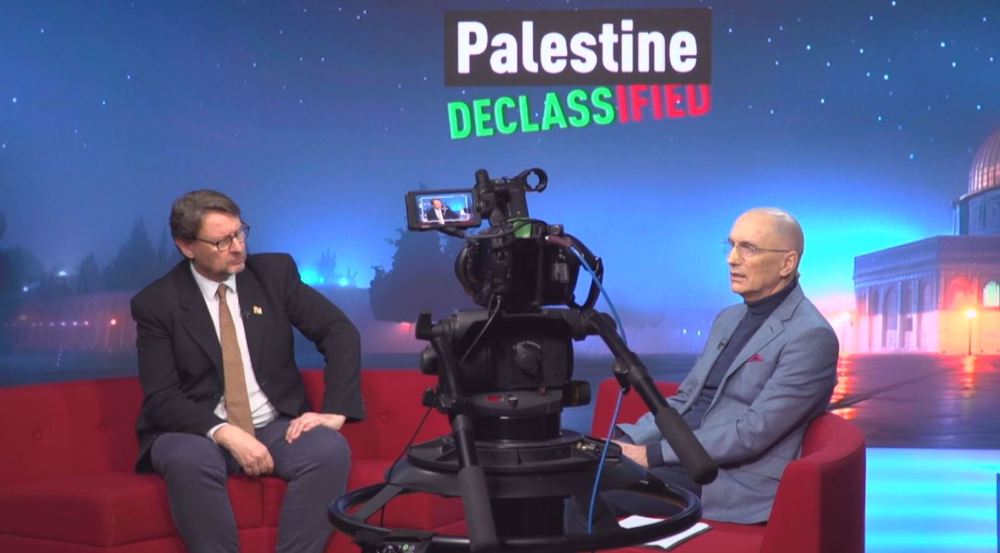
I produce a TV show called Palestine Declassified for Press TV, and write for a variety of other publications such as Electronic Intifada, Mintpress, TRT World and Mayadeen English. I mentioned this as well as mentioning that I used to work at the university of Bristol until I was sacked.

They asked about that. I summarised the story including the four occasions on which I was exonerated of ‘antisemitism’ at Bristol (internal enquiry, two external QC reports and the internal appeal), followed by the ‘landmark’ victory at the Employment Tribunal in February 2024.

We went on to discuss my trip to Lebanon.  What did I do there?  I recounted that I had visited the southern village of Maroun El Ras which is within a mile of the border of occupied Palestine, high on a hill overlooking the colonial settlements of Avivim and Yir’on.

I went with a number of other foreign guests including from Ireland, Yemen, Brazil and various other countries. What was there I was asked? I replied (truthfully) that there was nothing in the village since almost all 600 houses had been destroyed. 

The officer seemed confused: why would I want to visit then? Precisely because it had been destroyed by the Zionists, obviously.

We got fairly quickly to the question of whether I supported Hezollah as a proscribed organisation.  I referred back to my Employment Tribunal at which similar questions had been asked somewhat ineffectually by the University of Bristol’s counsel Chris Milsom.

There I had said the same thing as I now stated: I ‘support’ the right as given in international law for the Palestinians (and indeed others under occupation) to resist including by armed force. 

In case officers in SO15 or other actors need reminding of this, the relevant text is from the UN General Assembly resolution 38/17 of 1983, which states that it

"Reaffirms the legitimacy of the struggle of peoples for their independence, territorial integrity, national unity and liberation from colonial domination, apartheid and foreign occupation by all available means, including armed struggle".

They went on to see if they could entice me into saying I specifically supported proscribed organisations like Hamas and Hezbollah.  So, I obviously went on to say that it was not only a question of Hezbollah and Hamas, but also Palestinian Islamic Jihad and the PFLP-GC, which is of course not the same as the PFLP itself, which is not proscribed. It was instructive that my interrogator appeared not to know about PIJ and the PFLP-GC, asking me to repeat each name.

We also visited the topic of deproscription.  The officer wanted to know why I thought that all of the four, groups should be de-proscribed. 

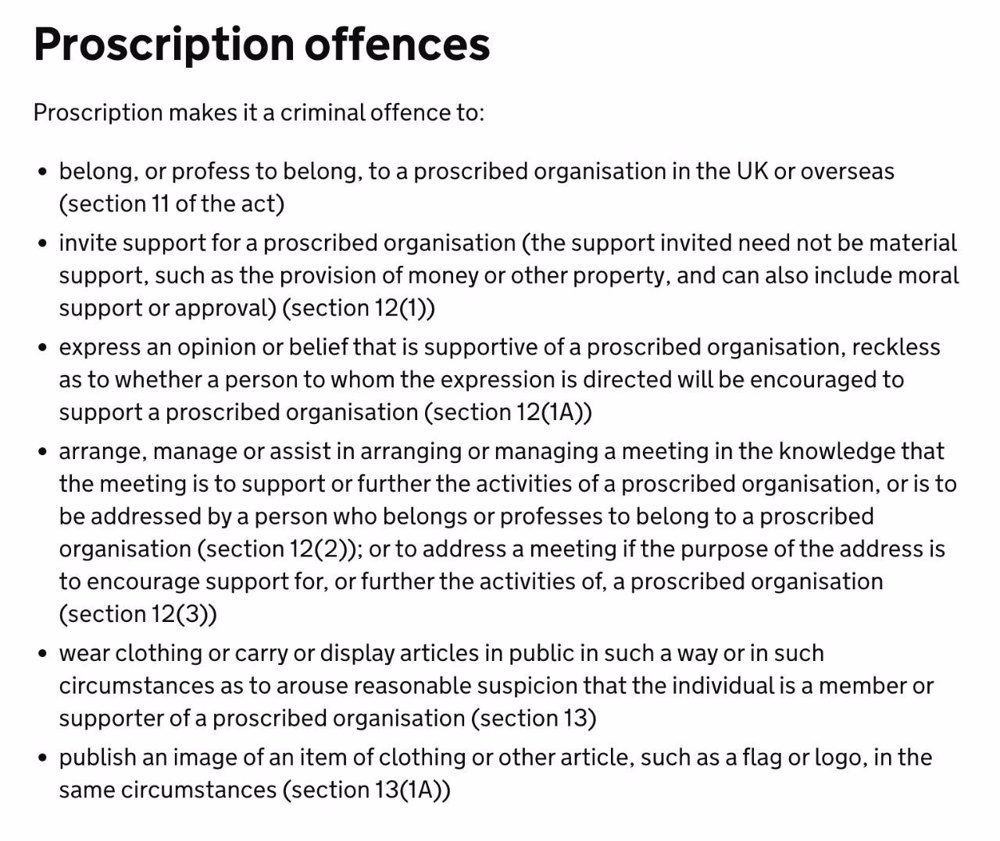
It seemed like he thought this was a valuable concession from me. But, as he is, presumably, aware, the Terrorism Act (year) specifically notes that it is not illegal to call for de-proscription.

I include a table from the Home Office website which gives a list of the charges that can relate to proscribed organisations.


And then we were on to the question of terrorism.  Did that mean that I thought they were not terrorist. At which point I am afraid I referred back to my decades long record of research on the question of terrorism and its role in propaganda including my early work on the struggle to decolonise the north of Ireland.

As if the sentiments encoded in the proscribed list or the Western use of the term ‘terrorism’ itself are necessarily subscribed to even by most British citizens, never mind the rest of the world. Let’s not forget that the way in which we use the term ‘terrorism’ in the west  - in particular ‘Islamic terrorism’, has it origin in Zionist propaganda operations as has been shown by, for example, Remi Brulin.

At one point, apparently out of the blue I was asked: Are you a practising Muslim? I expressed some surprise at this question. In his defence my interrogator said that I had earlier noticed and asked about whether the small pile of folded prayer mats in the cupboard was in fact a small pile of folded prayer mats. 

I had noted them earlier and wanted to check that’s what they were. Only the best for the predominantly Muslim ‘guests’ of the room! As the Guardian reports only 20% of Schedule 7 detentions are of white people (that’s including ‘white Irish’, and others stopped, like me for their solidarity activities, so it’s likely that the proportion of white ‘far right’ suspects stopped is lower than 20%)

The officer seemed mystified about my attendance at an event in which everyone must have been a supporter of Hezbollah. As if reporting on events and supporting those events is the same thing.  He asked if everyone there supported Hezbollah.

I replied that I didn’t feel able to report any great knowledge on the consciousness of perhaps the million people there. But it is certainly the case that there were very many Hezbollah flags. 

I did also note that there was a largish contingent from the Syrian Social Nationalist Party and made the point that the sheer numbers present suggested that Nasrallah has something of a larger reputation than just among party members and core supporters.

As we talked the officer started asking about Press TV, for which I work on a freelance basis.  He evidently had not known what Press TV was as it took a long time for him to understand  - after I told him that it was the English Language TV channel of the Iranian government  - the equivalent of the BBC world Service. 

Then he wanted to know about whether the people I work with at Press TV are extremists or have extreme opinions.  Obviously I had to press him to explain what he meant by extremism. Given the British government abandoned its efforts to define the term in any legally robust way, he fared no better. 

So he asked something about how many were opposed to western society. I was not impressed by this, since, as I said, most people in the world are opposed to the West, and many of them are British citizens.

And then; does Press TV support the recent ‘terrorism’ in this country?!  Which terrorism, I enquired.  And do you know what he said?  He only said the Southport attack. That was not terrorism I said.  Even his colleague butted in and agreed with me! 

So we were back to finding specific examples and - put on the spot - he came up with the stabbing and car at Parliament in 2017.  That, of course, was carried out by an individual who had made multiple trips to Saudi Arabia and appeared to have been inspired by an ISIS related ideology.

Before we got any further I was asked if Press TV covered incidents like this. The implication, of course, being that covering such activities might be tantamount to ‘supporting’ them.

Obviously, being a news service Press TV does cover political violence of many types, as does every other news organisation in the world.

But moving on I replied that in fact Press TV is opposed to those kind of attacks. I was on the verge of going on to say that this of course was different to the position of their colleagues in MI6 and in the government and indeed the BBC who are only too happy to collaborate in supporting ISIS/Al Qaeda in Syria if it suits their perception of British foreign interests.  But I let that lie.

By now we were winding down and it was pretty clear they were about to release me, even if I had taken their claim that it would be over soon with the requisite heap of salt. At the end they asked if I had anything to ask, like we were coming to the end of a job interview.

I made one statement which was that it was abundantly clear to everyone in the room that I was not a person who was concerned in the ‘commission, preparation or instigation’ of acts of terrorism. 

By way of defence of the detention the officer attempted to justify it in term of a British citizens attendance at the funeral of a terrorism leader, a defence which of course worked to deny that they had effectively been instructed by others to stop me. With that we were done and I was released at 1am too late to get home except via a prohibitively expensive taxi.

It appeared abundantly clear that SO15 did not have any real idea of who I was and had not prepared any case against me.  It was just a normal Schedule 7 stop. 

Except of course, it wasn’t. I had openly announced on X that I was in Lebanon for the funeral and had reported from my visit to Maroun El Ras and the Iran garden, on its outskirts both of which had been totally destroyed by Zionist bombardment.

I also posted a clip of my visit to Kfar Kila showing mass destruction of civilian infrastructure wreaked by the Zionists and my discovery of a US arms firm manufactured detonation wire used in blowing up civilian houses.

I also posted on the funeral itself, including while I was stuck in traffic on the way, as I arrived in the ‘nick of time’ and as the ceremony started.

Of course all of this was very triggering for the genocidal Zionists who track any deviation for the authorised position of pretending that the genocide is not happening and that those that resist are simply ‘terrorists’.

wide range of anonymous trolls and Zionist regime assets started mass reporting the Met Police calling for me to be arrested and jailed.  I know they say that the Zionists don’t have much power, but bouncing the Met into detaining a journalist on assignment seems like power of some sort.

Here is a select list of Zionist agents and assets who called for me to be arrested:

All of the above were involved in one way or another in the campaign to have me sacked at Bristol, a decision that the Employment Tribunal found was flawed and unjustified, in its ‘landmark’ decision.

This was all topped off by reports on Monday in the Mail (published at 5 to one in the morning just as Monday 24th began) and later (at 5.25 pm) in the Telegraph. This latter report cited the fanatical Zionist Robert Jenrick, the shadow justice secretary, who was reported as saying: “David Miller isn’t even bothering to hide his anti-Semitism any more.

He’s now openly boasting of his support for a proscribed terrorist group. It’s shocking that for so long he held a senior position at Bristol University.” Of course no actual ‘antisemitism’ was on display, and I said no words capable of being construed as ‘openly boasting’ of ‘support’ for Hezbollah.

Jenrick has form a far as I am concerned in that he has in the past spent a not inconsequential amount of time trying to have me sacked from my post at Bristol. For example, when he was Housing minister he directly bullied the University of Bristol over my case.

The report ended by saying that the paper had (like the Mail claimed too) contacted me for comment.  The facts are that I have had no such query from the Telegraph or from the Mail.

I must say that I did enjoy the column the next day by Stephen Pollard who presided over a significant number of libel defeats in his role as editor of the Jewish Chronicle.  ‘Opening a communication from’ from me back then he says was like ‘ingesting poison’. My parents would be proud.

What, self-evidently, happened in this instance was that the Zionist pressure worked its way through and an order to detain was issued.  As to whether it came from the top of the counter Terrorism Command, the Home Office or elsewhere, we don’t know as yet.

But it is very much of a piece with the general picture post October 7 2023, which is that there is intense Zionist pressure on the counter terrorism and policing apparatus to weaponise both hate crime laws and terrorism legislation.

 It is perfectly plain, as I have shown elsewhere that this pressure from Zionist lobby and intimidation groups and pressure from Zionist aligned politicians like Michael Gove, Suella Braverman, Stuart Polak, Robert Halton and the aforementioned Robert Jenrick, more than adequately explains all of the alleged rise in ‘antisemitism’ as well as almost all of the uses of the many Terrorism Acts on the statute books to oppress and repress those who will stand with the Palestinians in virtually any way.

And in recent months the attacks have widened to journalists, who’s historically recognised craft implies that they can report on all events without being attacked directly by the state. 

But now, after Richard Medhurst, Sarah Wilkinson, Asa Winstanley and most recently Ali Abunimah, it is clear that journalists too are direct targets of the Zionists operating as they do via the allegedly sovereign justice apparatus of Western states.

David Miller is the producer and co-host of Press TV’s weekly Palestine Declassified show. He was sacked from Bristol University in October 2021 over his Palestine advocacy.