
TEHRAN – For almost 500 years, the Parthian Empire controlled one of the world’s most important cultural and trade routes, stretching from Central Asia to the Mediterranean.
Also known as the Arsacid Empire, it was a major Iranian political and cultural power centered in ancient Iran from 247 BC to 224 CE. Its latter name comes from its founder, Arsaces I, who led the Parni tribe in conquering the region of Parthia in Iran's northeast, then a satrapy (province) under Andragoras, who was rebelling against the Seleucid Empire. At its height, the Parthian Empire stretched from the northern reaches of the Euphrates, in what is now central-eastern Turkey, to present-day Afghanistan and western Pakistan. The empire, located on the Silk Road trade route between the Roman Empire in the Mediterranean Basin and the Han dynasty of China, became a center of trade and commerce.
According to sources, Parthian art and architecture developed as a unique mix of eastern and western traditions. Geography, trade, and the needs of empire all shaped this style. It began east of the Caspian Sea and later took over the Seleucid Empire, which had followed the conquests of Alexander the Great.
As the empire expanded, it brought together many peoples, from India and China to Mesopotamia and the eastern Mediterranean. Artistic ideas moved freely across this large area. Over time, however, the Parthians created a style that was clearly their own rather than a copy of Greek or Roman models.
Parthian art showed clear differences from classical traditions. In architecture, domes and vaulted halls became common. In sculpture, human figures were often shown facing directly toward the viewer. Decoration relied heavily on geometric and floral designs. These features later influenced art and architecture across the Middle East.
Sources say the Parthian cultural impact lasted long after the empire fell. The Sasanian dynasty kept Parthian clothing styles, especially the tunic and trousers. Centuries later, Ottoman Turks adopted similar loose trousers, which are still worn in some regions today. In art, the Parthian style of front-facing figures influenced Byzantine traditions and can still be seen in modern art. In architecture, the iwan – a vaulted hall open on one side – became a key feature of Middle Eastern buildings.
Cultural roots from nomads to cities
The Parthians came from nomadic groups in Central Asia and shared early links with the Scythians. These roots likely shaped their early music and material culture.
Contact with Greek Seleucid rulers introduced Hellenistic styles, including Greek clothing, which the Parthians first adopted. Over time, they returned to their traditional tunic and trousers, adapting them into an elegant and symbolic style worn by elites throughout the empire.
According to the World History Encyclopedia, historians debate why Parthian culture moved away from Greek models. Some suggest rivalry with Rome encouraged a rejection of Greek artistic dominance. Whatever the reason, Parthian art developed independently, combining influences from Central Asia, Iran, Mesopotamia, and the Mediterranean into a single, recognizable style.
Wealth, trade, and luxury
Parthian art was supported by great wealth. Roman historian Cassius Dio wrote that Marcus Licinius Crassus attacked Parthia because it was “extremely wealthy.” Much of this wealth came from control of Mesopotamia and the Silk Road trade routes.
Silk, spices, perfumes, and medicinal plants passed through Parthian lands via the Euphrates and Tigris rivers. This trade created strong demand for luxury goods and skilled artisans. Gold, which had little practical use, became a key symbol of status. Parthian nobles wore gold jewelry and used gold-decorated fabrics in clothing, curtains, and tapestries. Even horses sometimes wore gold-studded equipment.

This c. 1st- or 2nd-century CE gold ornament shows an eagle with its prey and is one of a pair, with the other on display in the British Museum, London. Archaeologist Ernst Herzfeld proposed that it was part of a treasure found in 1910–11 CE in a chamber tomb near Nahavand, Iran, possibly belonging to an aristocratic Parthian family.
Crystals from India and Iran were made into cups, jewelry, and cosmetic containers. Everyday objects were also carefully designed. Coins show Parthian kings sitting on low chairs with decorative legs and backs, suggesting that furniture was both practical and artistic.
Luxury was not limited to the royal court. As rulers invested in cities, a growing merchant class also sought fine goods. Greek geographer Strabo wrote that Parthian investment in cities such as Ctesiphon encouraged crafts and trade that were profitable for their rulers and spread artistic production throughout society.
Architecture
Architecture became a strong symbol of Parthian identity. In Iran and Mesopotamia, Parthian rulers restored old cities and built new complexes with large-scale designs and distinctive features.
At Ecbatana, the former Median capital, a huge palace impressed Greek historian Polybius. He described buildings once covered in gold and silver. Although much of this decoration was later removed, Ecbatana served as a Parthian summer capital, and improvements were likely meant to restore its former importance.
In cities such as Assur, Uruk, and Nimrud, Parthians built houses and temples using barrel vaults and the iwan. The iwan, a vaulted space open on one side, was used for entrances and ceremonies. It differed greatly from Greek columned buildings and later became a major feature of Islamic architecture.
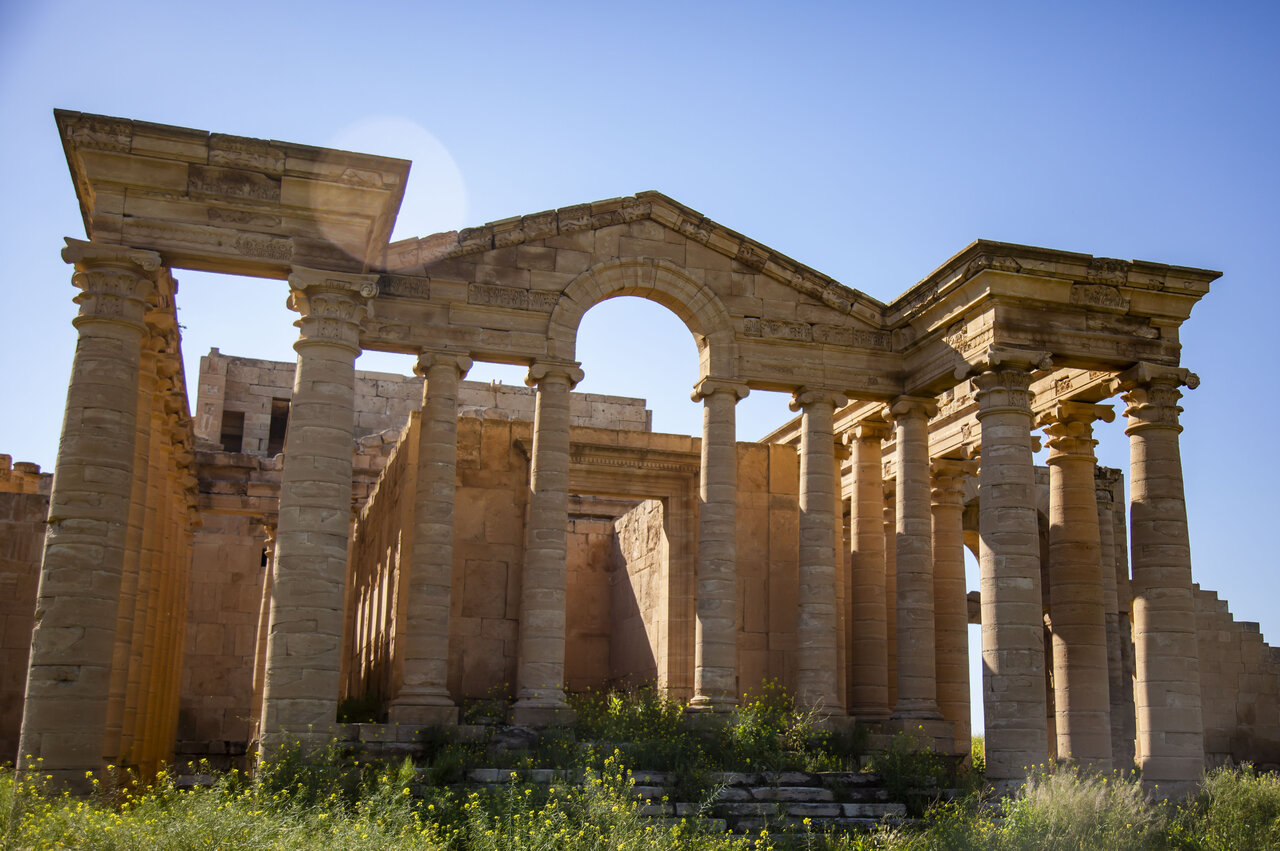
Parthian architects also preferred circular forms, unlike the rectangular shapes common in Greek design. At Hatra, Greek columns were combined with Parthian arches, creating a mixed style. At Assur, Parthian arches dominated entrances and building fronts.
Art and decoration
In sculpture and reliefs, Parthian artists favored front-facing figures. Unlike Greek and Roman art, where figures often look away, Parthian figures face the viewer directly. This style later influenced Byzantine art and created a more direct connection with the audience.
Parthian faces often appear friendly rather than severe. Some figures raise their hands in greeting or welcome. This may reflect a political culture that valued diplomacy as well as military strength.

Parthian long-necked lute
Interior decoration also shows Parthian creativity. At Assur, walls were decorated with detailed stucco designs featuring geometric and floral patterns, often painted in different colors. These styles later influenced Islamic decorative art and helped brighten interior spaces.
Despite their image as warriors and traders, the Parthians valued leisure and celebration. Music and dance were important in both public and private life. During a victory procession led by the general Surena, singers, dancers, and musicians took part.
At feasts, people played flutes, pipes, drums, and a stringed instrument called the sambuca. Group dances often followed. While written sources are limited, archaeological evidence from related nomadic cultures suggests a rich musical tradition.
Clothing as identity and power
Clothing was one of the clearest signs of Parthian identity. By the late first century BCE, elites commonly wore belted tunics and trousers. Loose garments with many horizontal pleats were worn by both men and women. Some trousers were made very wide, sometimes padded to increase their shape.
These pleats required large amounts of fabric, often silk, making clothing a clear display of wealth. Embroidery with floral designs, metal buttons, and coin-shaped ornaments added decoration. Hairstyles were also distinctive, with puffed hair, headbands, and full moustaches and beards for men.
Shared styles of dress helped identify Parthian elites across a large and diverse empire. At the same time, the rich use of fabric and ornament showed wealth supported by military power.

No comments:
Post a Comment