
By Jeremy Salt
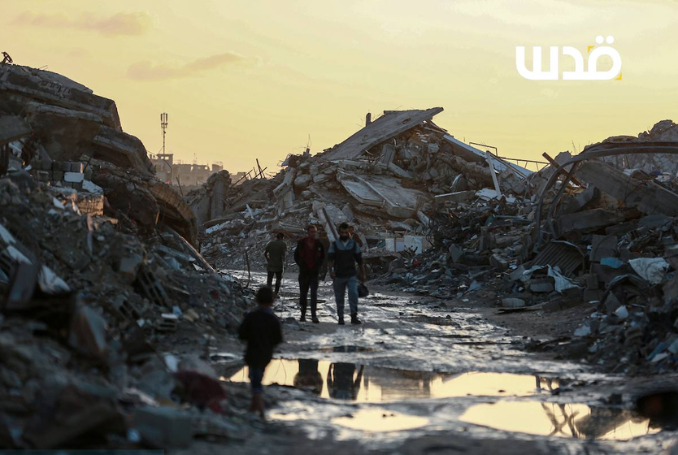 Massive destruction in Gaza. (Photo: via QNN)
These figures indicate the end goal of Israel, which is the total physical, cultural and historic eradication of Palestine and the killing, or removal by other means, of all of its people.
Behind the immediate horrors of massacres and destruction in Gaza and the West Bank, the effects of the dry economics of the genocide often take a back seat. In fact, they are analogous to the python’s slow suffocation of its victim and are just as deadly, over time, in their intent.
For those who do not have the time to plough through lengthy documents, here is a summary of some of the main points in the report by UNCTAD (UN Trade and Development) Secretariat (Geneva, November 24-28, 2025) on the economy of the Occupied Palestinian Territory (OPT), excluding East Jerusalem:
- By 2024, GDP of OPT had fallen to 70 percent of 2022 level; by end of 2024, the economy had regressed to 2010 level, “thereby erasing 22 years of economic progress in only 15 months.”
- In the West Bank, in 2024, GDP shrank by 17 percent and GDP per capita by 18.8 percent, erasing 17 years of economic progress. By the end of 2024, total GDP had fallen to 2014 level and GDP per capita to 2008 level.
- By 2024, Gaza’s economy had shrunk to 16.7 percent of 2023 levels and 13.3 percent of 2022 levels, with rising desperation leading to increase in child labor. The economic crisis in Gaza and the West Bank ranks as the tenth most severe (globally) since 1960. The crisis in Gaza alone is the most severe ever recorded, based on the Uppsala (Sweden) Conflict Data Programme data set.
- The Palestinian Human Development Index is projected to fall from 0.716 in 2022 to 0.643 in 2024, “erasing a quarter of a century of hard-won progress. The impact is worst in Gaza, where over 69 years of human development are estimated to have been lost.” Multi-dimensional poverty now engulfs the entire population.
- In the West Bank, violence, accelerated settlement expansion and restrictions on worker mobility have decimated the economy, “resulting in the worst economic decline since UNCTAD began to maintain records in 1972.”
- In Jenin, about 8,000 businesses have been forced to close and 74 percent of farmers have reported a 50 percent decline in revenue.
- The cost of living across the OPT rose by 54 percent in 2024. In Gaza, restrictions on the entry of humanitarian and commercial goods triggered a surge in inflation of 238 percent. Prices of food and beverages rose by 225 percent.
- In the West Bank, the private sector had lost $13 billion by the end of 2024 while, by October 2024, unemployment had soared to 80 percent.
- In 2024, the Israeli ban on Palestinian workers entering workplaces in Israel and settlements on the West Bank had eradicated 84 percent of income earned in these settings since 2022.
- By 2024, declining income led to a drop in imports and services by 34 percent and exports by 16 percent. The trade deficit narrowed to $4.13 billion compared to $6.98 billion in 2022, as the overall trade volume in the OPT dropped by 30 percent in 2024 compared to 2022.
- Trade with Israel constitutes 73 percent of the Palestinian total. Palestine is a “captive market.” Unilateral deductions by Israel and the withholding of revenue, coupled with lower revenue as GDP contracted, turned 2024 into the worst fiscal year yet for the Palestinian “government” (the Palestine Authority (PA)).
- “Deductions” by Israel from payments to the families of Palestinian martyrs amounted to $977 million between January 2019 and April 2025. Since October 2023, Israel has withheld additional amounts of $75 million per month. Between January 2019 and April 2025, cumulative deductions and withheld amounts surpassed $1.76 billion, equivalent to 12.8 percent of GDP in 2024 and 44 percent of total Palestinian net revenues.
- In 2024, the total (PA) deficit “on a commitment basis” rose to $1.3 billion, an increase of 147 percent from $528 million in 2023.
- In 2024, foreign aid doubled to more than $810.7 million, while remaining well below the $1.98 billion of 2008. The PA has reacted to revenue shortfalls since 2021 by paying partial salaries to civil servants and delaying payments to private suppliers and NGOs.
- The report praises the PA’s “significant progress” in fiscal reform: at the same time, the long-standing accusations of corruption and financial mismanagement within and by the PA need to be mentioned as part of the overall picture.
- In Gaza, the converging crises have been worsened by Israel’s suspension of cash transfers. Since October 2023, this has been accompanied by the “near total” destruction of the banking sector. In 2024 only two of 94 ATMs in Gaza were partly functional. By April 2025, 98 percent of banks in Gaza had “ceased operations,” many having been physically destroyed, triggering off a liquidity crisis that was devastating for consumers and businesses.
- In the West Bank, as of February 2025, 849 movement “restrictions,” including checkpoints, road barriers, earth mounds and trenches limited the movement of 3.3 million Palestinians. The most significant barrier remains the 712-km long wall, which is twice the length of the internationally recognized ‘green line’ of 1967. These obstructions force Palestinians to take detours and block access to towns and isolated villages.
- Since October 2023, attacks by settlers have reached record levels. Between October 7, 2023 and July 31, 2025, 2,802 settler attacks were recorded, causing Palestinian casualties and property damage. 9,594 Palestinians were injured and 979 killed, compared to 35 Israelis killed.
- Between January 2024 and July 2025, the occupying power demolished or destroyed 2,844 Palestinian homes and “structures”, thereby forcibly displacing 39,847 Palestinians.
- By October 2024, 147 settlements and 224 ‘outposts’, almost all soon to be confirmed as settlements, existed on the West Bank, housing 503,732 settlers, in addition to 233,600 in occupied east Jerusalem. A record 119 new ‘outposts’ were built in 2024-5.
- As of August 2025, famine on the basis of “reasonable evidence” had been confirmed in Gaza, reaching phase 5 in the Integrated Food Security Phase Classification. More than 0.5 million people faced “catastrophic” conditions and another 1.07 million (54 percent) an “emergency” (phase 4). 396,000 people (phase 3 and 20 percent of the population) were in crisis.
- As of September 3, 2025, more than 161,245 Palestinians in Gaza had been “injured” and 63,746 “killed”, including more than 18,400 children. (These estimates are substantially lower than Palestinian or other figures).
- At least 531 aid workers and 1,590 health workers had been killed, along with 247 journalists (again lower than other figures). More than one million children were in need of mental health and psychological support (apart from the thousands in need of advanced medical care that is not available).
- Approximately 92 percent of housing units had been destroyed. Only 50 percent of hospitals and 40 percent of primary health centers are (partly) functional. There are gender-specific threats to women and girls. The situation continues to deteriorate, “with no foreseeable end to the suffering.”
- More than 658,000 children and 87,000 university students have no access to schools, 88 percent of which require full reconstruction.
- In the agricultural sector, 83 percent of water wells, 80 percent of cropland and 71 percent of greenhouses have been “damaged”. Only 1.5 percent of farmland is usable and 72 percent of the fishing fleet has been destroyed. 89 percent of water, sanitation and “hygiene” assets have been damaged or destroyed.
- Under occupation, between 2007-2022, the GDP in Gaza grew by 1.1 percent, while the population grew by 61 percent. The per capita GDP “shrank” (i.e., was shrunk by Israel) 37 percent, from $1,994 in 2006 to $1,253 in 2022. The share of Gaza in the Palestinian economy contracted from 31 percent to 17.4 percent.
- Without the occupation and the blockade, by the end of 2023 the GDP, on average, would have been 77.6 percent higher than it was, implying a conservatively estimated loss of $35.8 billion of unrealized GDP potential in 2007-23.
- The post-October “military operations” have destroyed the economic foundations of Gaza “and propelled it from de-development to utter ruin.”
- In 2024, GDP contracted 83 percent compared to 2023. Over 2023-4, GDP “shrank” by 87 percent, dropping to $362 million. GDP per capita fell to $161, “among the lowest in the world.” The share of Gaza in Palestinian GDP fell from 17.4 percent in 2022 to 3.3 percent in 2024, although the population is 40 percent of the total.
- Data from the UN Satellite Centre shows that, by April 2025, 174,513 “structures” in Gaza (70 percent of the total) had been “damaged”, 94 percent by September, 2024. 70 percent had been totally destroyed.
- By the end of 2024, the private sector in Gaza had suffered an estimated $5.9 billion in physical damage. 2/3 of businesses had been eradicated and 22 percent partially damaged. “The military operations have significantly undermined every pillar of survival.”
- A joint assessment by the EU/UN/World Bank estimates that $53.2 billion would be needed for the reconstruction and recovery of Gaza.
Analysis by the Max Planck Institute of Demographic Research indicates that 78,318 people were killed in Gaza between October 2023 and December 31 2024. An update indicates that the “death toll” by October 6, 2025, mostly likely exceeds 100,000. Life expectancy fell by 44 percent in 2023 and 47 percent in 2024, compared to what it would have been without the “war” (i.e., genocide). The figures are the equivalent of the loss of 34.4 years of life and 36.4 years respectively.
UNCTAD is careful and conservative in the figures it presents, but they are still more than sufficient to indicate the end goal of the occupying power, which is the total physical, cultural and historic eradication of Palestine and, as far as possible, the killing or removal by other means of all of its people.
The questions must begin with why the State responsible for these world historical crimes is allowed to remain a member of the UN. Israel has shown by its behavior, since the very beginning, that it respects no law or covenant (including the UN Charter) that does not suit it and will go to any length to get what it wants which, in the future, is likely to include the use of nuclear weapons. Yet, the alarm bells that should be ringing loudly in the global corridors of power remain totally silent.
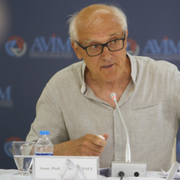
– Jeremy Salt taught at the University of Melbourne, at Bosporus University in Istanbul and Bilkent University in Ankara for many years, specializing in the modern history of the Middle East. Among his recent publications is his 2008 book, The Unmaking of the Middle East. A History of Western Disorder in Arab Lands (University of California Press) and The Last Ottoman Wars. The Human Cost 1877-1923 (University of Utah Press, 2019). He contributed this article to The Palestine Chronicle.

No comments:
Post a Comment