
By Somaye Morovati
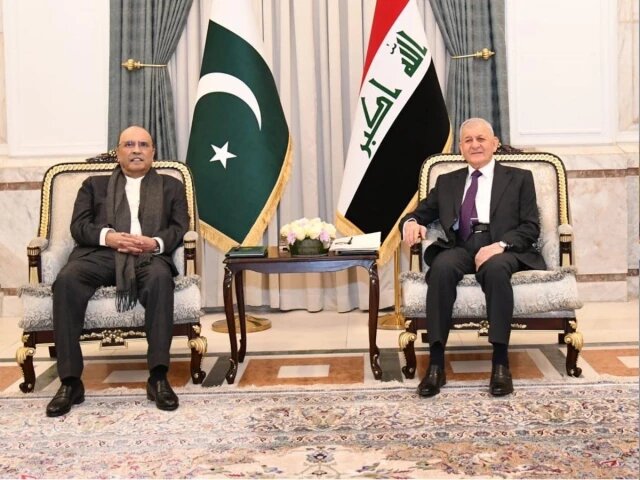
The official visit of Pakistan’s President, Asif Ali Zardari, to the Republic of Iraq in December 2025 is far more than a bilateral or ceremonial engagement; it represents a clear manifestation of Islamabad’s strategic recalibration in West Asia.
This visit forms part of Pakistan’s calculated foreign policy aimed at consolidating the country’s position within the complex and evolving regional equations while simultaneously managing emerging opportunities and geopolitical risks. Iraq today stands at the intersection of Iranian, Arab, and extra-regional interests, navigating both internal reconstruction and the consolidation of its political sovereignty. For Islamabad, active engagement with Baghdad represents a strategic presence in one of the most sensitive geopolitical arenas in the region—an arena whose decisions have direct implications for security, energy, trade routes, and economic flows across South and West Asia.
Choosing Iraq as a destination for a presidential visit not only highlights the country’s geopolitical significance but also underscores Islamabad’s effort to diversify its foreign and security relations and to maintain strategic equilibrium in regional politics. The core focus of this visit is economic cooperation and active participation in Iraq’s reconstruction. Iraq’s extensive needs in infrastructure, energy, skilled human resources, and technical-engineering services present Pakistan with a unique opportunity to engage not merely as an exporter of goods but as a strategic development partner. Investments in education, technology, knowledge transfer, and people-to-people exchanges can elevate bilateral relations to a sustainable, long-term level—ties that remain resilient against short-term political fluctuations and enhance Pakistan’s soft power projection. Emphasis on religious tourism and cultural exchanges further reflects Islamabad’s strategic use of soft power, demonstrating its intent to consolidate its presence through sustainable social, cultural, and economic relationships.
This visit is also part of Pakistan’s balanced diplomacy, which emphasizes constructive engagement with all key regional actors and aims to establish equilibrium and stability across West Asia. Islamabad’s goodwill message to Tehran en route signals Pakistan’s efforts to avoid regional polarization and to create a strategic balance between Tehran, Baghdad, and the Arab world. Such balance enables Islamabad to engage effectively with its neighbors and other key regional actors, manage potential crises, and open new avenues for cooperation and diplomatic breakthroughs.
Within this framework, Pakistan’s security and defense agreements with Saudi Arabia have reinforced Islamabad’s position in the Islamic world’s security architecture and generated new capacities for a stabilizing role in the region. However, the cooperation model with Iraq should be understood as a foundation for developing a new pattern of engagement with Arab states, one that is not solely predicated on security guarantees but also based on economic partnerships, infrastructure development, and long-term strategic programs. This approach allows Pakistan to leverage Iraq’s geopolitical position to deepen and diversify its engagement with the Persian Gulf states, achieving a balanced mix of economic and security interests.
From Tehran’s perspective, President Zardari’s visit carries strategic significance. Pakistan’s engagement with Iraq reflects a balanced, multilateral, and results-oriented approach, broadly aligned with Iran’s interest in regional stability, conflict de-escalation, and economic development. The potential emergence of a land-based corridor linking South and West Asia represents a strategic axis that, if effectively integrated into Pakistan-Iraq cooperation, could offer opportunities for Iran in regional security, stability, and collaborative development.
Iran is carefully assessing ongoing and potential developments, including energy agreements, security pacts, and Iraq’s possible role in a Pakistan–Saudi-led security framework, evaluating their strategic implications for regional stability, security, and cooperation. This approach reflects Tehran’s commitment to informed and forward-looking engagement in West Asia.
The visit also reflects Islamabad’s effort to emerge from regional crises and open new avenues of engagement with its neighbors. By leveraging a combination of economic, diplomatic, and security cooperation, Pakistan seeks to solidify its position as a balanced and responsible regional actor, capitalizing on Iraq’s development opportunities while mitigating potential tensions. Pakistan’s active role in Iraq’s reconstruction, investment in infrastructure, human capital development, and cultural-religious engagement all contribute to strengthening Islamabad’s strategic standing and expanding its soft power influence.
In sum, President Zardari’s visit to Iraq is not merely a bilateral encounter but a strategic step to enhance Pakistan’s diplomatic, economic, and cultural footprint in West Asia. It demonstrates Islamabad’s pursuit of a role as a balanced, responsible, and forward-looking actor capable of enhancing regional security, economic development, and stability, diversifying military and economic relations, and creating new capacities for collaboration with neighbors and regional states. For Iran, this visit represents both a strategic opportunity and a geopolitical signal—an opportunity to foster regional cooperation and economic-security convergence, and a prompt to closely monitor evolving security dynamics and strategic agreements in the region.

No comments:
Post a Comment