
By Romana Rubeo
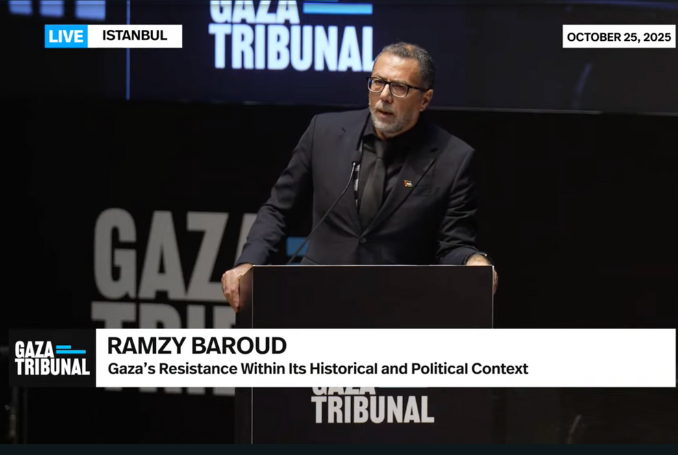
At the closing session of the Gaza Tribunal in Istanbul, Palestinian journalist and author Ramzy Baroud called Gaza a test of global morality and urged the world to sustain solidarity with Palestinians until their freedom is achieved.
The final session of the Gaza Tribunal, an international initiative investigating crimes committed against Palestinians in the Gaza Strip, continued on Saturday at Istanbul University, with closing remarks by law experts, intellectuals, and journalists, including Palestinian author and editor of the Palestine Chronicle Ramzy Baroud.
The tribunal, launched in London in November 2024 by academics, human rights advocates, and civil society organizations, seeks to expose the failure of the international community to uphold international law and protect Palestinians in Gaza.
Over three days, the sessions examined issues such as the targeting of journalists, the complicity of Western states in maintaining the blockade, and the silence of international institutions in the face of mass atrocities. The tribunal also heard video testimonies from journalists who were later killed in Gaza, and from activists involved in the Global Sumud Flotilla that attempted to break the siege by sea.
In his address to the closing session, Baroud described Gaza as a defining test of global morality and political integrity. “Gaza has proved to be the litmus test of humanity, of morality, of civil society, of international law,” he said, adding that civil society’s response had created “another line of defense” for Palestinians when governments failed to act.
He urged that the international solidarity movement not be treated as temporary. “The movement that was created against the genocide in Gaza must not be dismantled with the assumption that the genocide is over,” he said. “It manifests itself in many different ways, and the historical context that led to it remains until Palestine and its people are free.”
Baroud emphasized that Palestinian resistance cannot be reduced to its armed form or criminalized as terrorism. “Every Palestinian who stands up against colonialism and occupation is a freedom fighter,” he said. “The question about the legitimacy of Palestinian resistance is a diversion from the main issue: what pushes Palestinians to resist in the first place?”
He described resistance as a moral and existential act rooted in decades of abandonment. “We resist because nobody came to our rescue,” he said. “This generation of Gaza’s is different. My generation, during the First Intifada, learned the lesson of self-assertion. But this generation knows that nobody is coming for their liberation. People liberate themselves.”
Baroud rejected expectations that Palestinians remain passive victims. “Do not blame the Resistance for our own failure, and don’t put Palestinians once again in the corner to self-justify and apologize for not behaving as the good victims,” he said. “And if you do expect Gazans to be good victims, you know nothing about Gaza.”
Tracing the continuity of Palestinian resistance since 1948, Baroud recalled that within days of the Nakba, Palestinians had already formed fedayeen groups, peasants who attempted to return to their villages. “There has been no time in history in which Gaza did not resist,” he said. “Gaza is the center of Palestinian history, not because of its land or resources, but because of its people.”
He argued that Israel’s goal has never been solely to eliminate the armed resistance, but to ethnically cleanse the Palestinian population. “The fact that people are still there, even if they are sitting on the ruins of Gaza, means that the heart of Palestinian resistance is still beating,” he said. “And as long as it is beating, resistance in Palestine will remain alive.”
Baroud concluded by urging continued global engagement. “Feel bad for the victims, for the innocent children pulverized with their families, but don’t think for a minute that resistance in Palestine will stop, under any circumstance,” he said. “Gaza is on the frontline of this struggle—not only for the sake of Gaza, but for the sake of humanity.”
(The Palestine Chronicle)
– Romana Rubeo is an Italian writer and the managing editor of The Palestine Chronicle. Her articles appeared in many online newspapers and academic journals. She holds a Master’s Degree in Foreign Languages and Literature and specializes in audio-visual and journalism translation.

No comments:
Post a Comment